
With this new My Favorite Wargame Cards Series, I hope to take a look at a specific card from the various wargames that I have played and share how it is used in the game. I am not a strategist and frankly I am not that good at games but I do understand how things should work and be used in games. With that being said, here is the next entry in this series.
#38: The Civil War from Votes for Women from Fort Circle Games
Votes for Women is a very interesting card-driven game that covers the American Women’s Suffrage Movement from 1848-1920, culminating in the ratification of the Nineteenth Amendment which granted women the right to vote. The game is a 2-player game, that has a fully developed solitaire mode with an “Oppobot” and offers a cooperative mode for those who don’t wish to play as they Opposition. The Suffragist player will have to push Congress to propose the Nineteenth Amendment, and then focus on campaigning to have a minimum of 36 states to ratify the Amendment. The Opposition side will try to prevent Congress from proposing the amendment and failing that to have 13 states reject the amendment.
The game uses cards in a fairly traditional CDG way as there are events that can be be taken or the cards can be played to do things like Campaign, Organize or Lobby Congress. Each card has a specific Card Era that is used to create of the each players’ Draw Decks. Late cards will be on the bottom of the deck, Middle cards will be in the middle of the deck and Early cards will be on the top of the deck. The Suffragist and Opposition decks each have one Start card that will be placed in the player’s hand at the start of the game. Some Event Cards have a prerequisite and some of the cards require a player to roll a 6-sided die and only take the the action on a roll of 3-6. Otherwise, the Event Card is discarded with no effect. The cards in this game are also steeped in historical details, from the name of the events that tie back to specific individuals or happenings, to major moments in the struggle. This game is about the history of the struggle for the right to vote and it is very good!
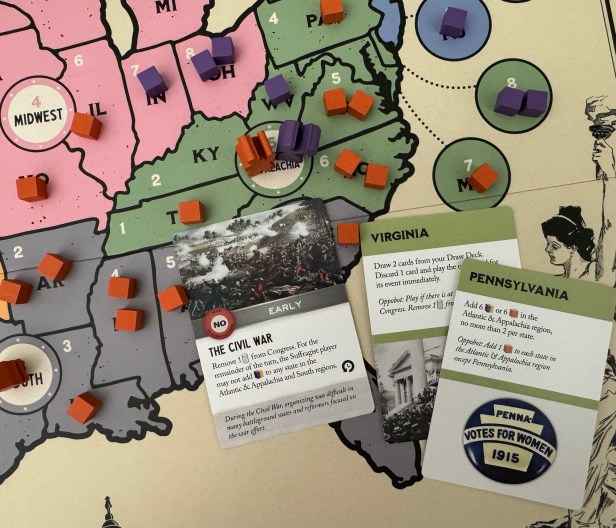
In this post, I want to take a look at a very important Early card in the game for the Opposition called The Civil War. This card is key for the Opposition player as it does several things that both assist them in getting some early States cards to use and also prevent the Suffragist player from obtaining them instead and also to remove any early progress made in Congress toward ratifying the 19th Amendment.
First off, removing a cylinder from Congress, which represents support for bringing the 19th Amendment to the floor, is vital for the Opposition player. Forcing the Suffragist player to have to spend their cards attempting to fill up Congress by the end of the game is a continual battle and is important because if the Suffragist doesn’t get support to have the bill introduced they will lose the game. What is the old saying in any Card Driven Game? I want to force the other player to do what they don’t want to do and prevent them from focusing on what they need to get done. There are a total of 6 spaces on the Congress Track and if the Suffragist doesn’t make progress throughout the game they are going to have to make a mad dash at the end to get to reach their goal and this will mean not being able to take key actions at the end of the game to capture states by taking Campaigning Actions or collecting Buttons. Ultimately, the Opposition player is not going to stop them from getting Congress on their side but they must take advantage of The Civil War and take away one of their cylinders. There are other cards in the Opposition deck that do this same thing but taking advantage of this early option will set the tone.
The most important aspect of The Civil War card is the fact that you deny the Suffragist player from being able to place influence cubes into the Atlantic & Appalachian and the South Regions. This means that the Opposition player has the real chance of locking these 2 Regions up in the early game by placing out influence cubes and focusing on capturing the 2 States cards in each of these Regions. These States cards are important because they are like a free action and give the player controlling them the chance to add cubes to the board, remove cubes from the board or take special actions like drawing and playing a card are random from their deck. The more cards that a player can play, the better their results will be. In the Atlantic & Appalachian Region, there are 2 States cards including Virginia and Pennsylvania and 1 States card in the South which is Georgia. By placing 4 Influence cubes in each of these States, the player will gain control of the States card and be able to play one of those per turn. This is a key battle within the battle, particularly during the Early game.
The American Civil War had a profound impact on the suffragist movement in the United States as the focus of the movement moved more toward the concept of the abolition of slavery. Even though the Civil War momentarily disrupted the suffrage movement, women’s efforts during the war and the organizations they created laid the groundwork for a stronger movement after the war. During the Civil War, reformers focused on the war effort rather than organizing women’s rights meetings. Many activists supported abolition, so they rallied to ensure that the war would end this inhumane practice.
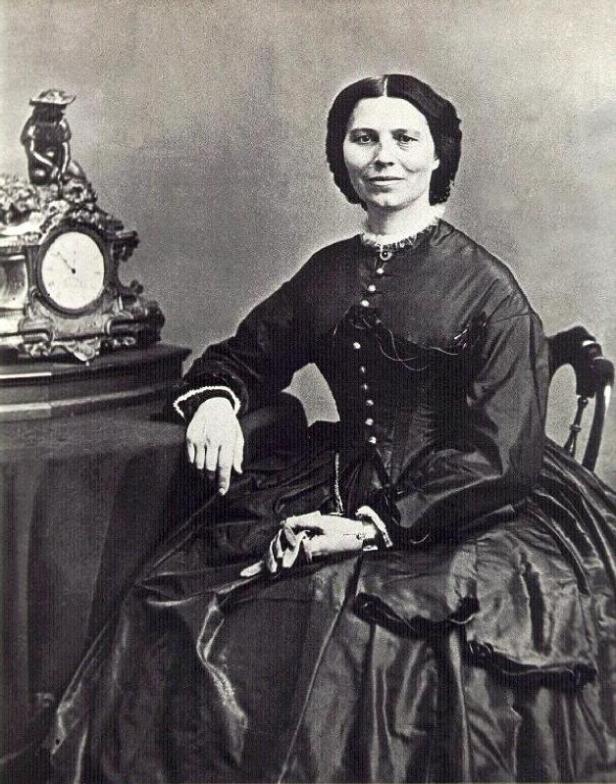
Some women’s rights activists, like Clara Barton, served as nurses. In the North, Elizabeth Cady Stanton and Susan B. Anthony established the Women’s Loyal National League. The group called for the immediate end of slavery and full citizenship rights for newly freed blacks. Women’s rights activists also were part of the United States Sanitary Commission, a large national volunteer association that raised money and sent supplies to Union soldiers.
Black women played a crucial part in the war effort. Harriet Tubman had been helping slaves escape to freedom since 1851. Because of her network of friends and familiarity with the landscape, she also became a spy for the United States during the war. The Women’s Loyal National League raised money to support Tubman’s work. Sojourner Truth, the prominent reformer and lecturer, envisioned what life would be like for newly freed men and women and led efforts to settle freed people in Kansas.
Here is a link to our full video review of the game:
We also published an interview on the blog with the designer Tory Brown and you can read that at the following link: https://theplayersaid.com/2020/09/07/interview-with-tory-brown-designer-of-votes-for-women-from-fort-circle-games-currently-on-kickstarter/
In the next entry in this series, we will take a look at The Victorious Leader from Twilight Struggle: Red Sea – Conflict in the Horn of Africa from GMT Games.
-Grant
 The Players' Aid