With this new My Favorite Wargame Cards Series, I hope to take a look at a specific card from the various wargames that I have played and share how it is used in the game. I am not a strategist and frankly I am not that good at games but I do understand how things should work and be used in games. With that being said, here is the next entry in this series.
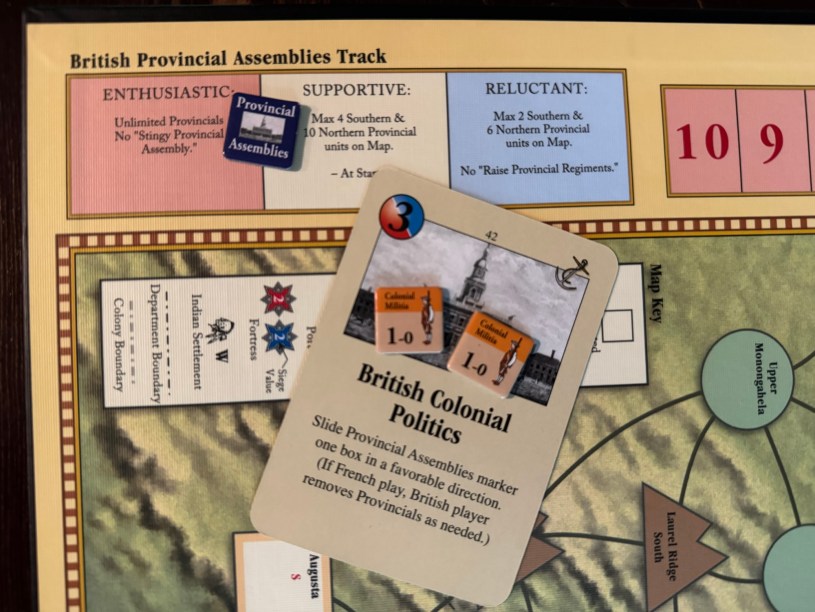
Card #34: British Colonial Politics from Wilderness War: The French & Indian War, 1755-1760 from GMT Games
One of my fondest memories of our wargaming journey was our initial experience with the full campaign game of Wilderness War from GMT Games. We were 2 very inexperienced wargamers and we slogged through a 9-hour marathon play over a few days that ended in a 0-0 tie of all things. That’s right, the game ended in a tie, even though we both had a card in hand, but I was unable to use mine to activate Levis, which was my only potential Victory Point scoring force, and Alexander’s forces were in too tenuous a position or too wounded to risk an open battle for VP’s. You would think that this would have turned us off to the game but on the contrary it made me fall in love with asymmetric wargames and the Card Driven Game mechanic with its use of Action Points and events to wage war on the North American continent. The end score of our game really followed the tension of the game, and the blunders on the side of the British that counter balanced their various successes.
All in all, this game was excellent to play and we both highly recommend it. The two factions play extremely differently which leads to many intricate and reactive strategic decisions. The British have many powerful forces with their Highlanders and cannon while the French have access to better leaders and mobile troops and Indian allies who can run around the frontier raiding and burning settlements for VP’s. Laying siege and assaulting really feels like it should, and avoiding battle until you are ready is something that is integral to maintaining a strong presence on the board. You cannot always get into every possible fight as you will not survive the attrition of these battles. The deck plays really well, and as you don’t have to worry about the opponents events in your hand going off, the management aspect is much simpler yet very engaging as there are always reaction cards you can play or cards that you want to hold onto for that perfect moment.

One of the side elements to this game is the continual battle for control of the British Provincial Assemblies Track. In the card deck, there are a few of these British Colonial Politics cards that will appear and they can be played by either the French or British player. This event is a simple card that will move the position of the Provincial Assemblies Marker on the Provincial Assemblies Track but that will have a fairly impactful result on the British and their ability to defend the frontier as there major armies are out in the wilderness fighting the French. The Provincial Assemblies Track will restrict the number of British Provincial units that can be in play by Department. The Provincial Assemblies Track only has a total of 3 boxes and each has a different effect on the game. The 3 boxes are titled Enthusiastic (on the very far left), Supportive (in the center) and Reluctant (on the very far right). You will also notice that there are notes located inside the boxes that prevent certain other cards in the deck, namely “Stingy Provincial Assembly” and “Raise Provincial Regiments”, from being played and either protect or hinder the ability of the British to levy additional colonial troops. Keep in mind that the Provincial Regiments are not main fighting forces but are best utilized by the British to protect key settlements on the frontier that can be raided by Indians.
The other real kicker about this event is that if played by the French player and it would reduce the track, meaning moving toward Reluctant, the British player is then forced to select and remove Provincial units on the board that are in excess of the number allowed by the position of the track.
While this is only a minor part of the game, I really very much enjoy the battle of raiding by both sides. These raids will create Victory Points and can be instrumental in the outcome of a game. The French and their Indian allies are very much more focused on raiding as they will have a bit more trouble in the field against the mighty British regular army so the lack of Provincial units and Militia by the British to defend these locations will allow the French to run rough shod over the frontier towns and villages gaining points toward their ultimate victory. I also really like this concept of the raiding and the levies as it is an offshoot of the War of Ideas that was being fought. This War of Ideas was the concept of the British ability to protect or not protect their subjects the Americans from the ravages of the Indian tribes and their French overlords. The French wanted the colonials to begin to doubt that England could or would protect them in an effort to lessen the inflow of British colonials and the pressure they were feeling on the frontier over the pursuit of furs, lumber and other rich resources that were being sent back to Europe to drive the economies of both France and England.
During the French and Indian War, British colonial politics were marked by tensions and conflicts between the British government and the American colonies. The British sought to exert greater control over the colonies, while the colonists resisted, leading to issues of representation, taxation, and westward expansion. The war itself, while initially seen as a shared struggle, ultimately exacerbated these tensions, contributing to the lead-up to the American Revolution. Following the very expensive war, the British government sought to impose taxes on the colonies to help offset the war debt. This was met with resistance from the colonists, who argued that they should not be taxed without representation in the British Parliament. The British also tightened trade regulations and navigation laws, aiming to control colonial trade and increase revenue. This further angered colonists, who often evaded these regulations and traded with the French. And one of the final straws was the Proclamation of 1763, which restricted westward expansion by colonists. The British aimed to prevent further conflict with Native American tribes, but this was viewed as an infringement on colonial interests.
In the next entry in this series, we will take a look at Domino Theory from Fire in the Lake: Insurgency in Vietnam from GMT Games.
-Grant
 The Players' Aid