
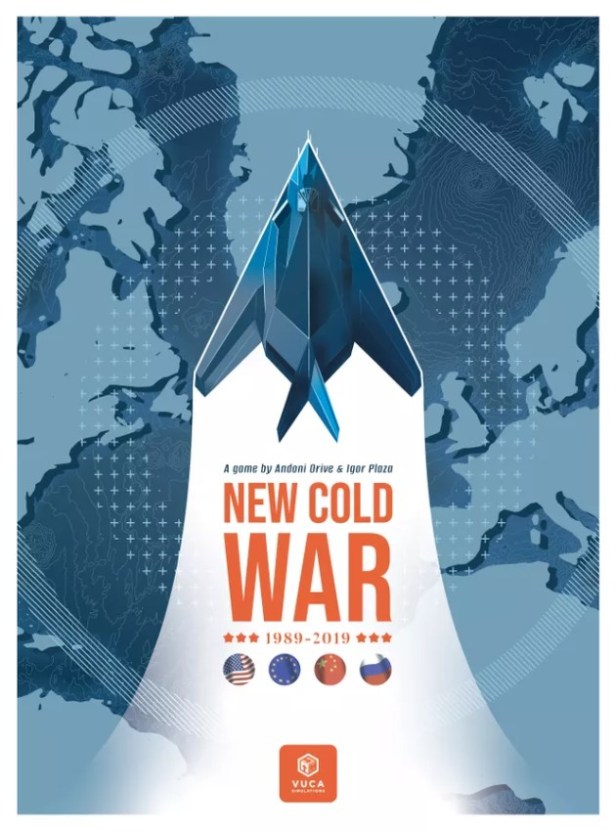
New Cold War is a game about geopolitics that takes place from 1989 to 2019. It begins with the disintegration of the Soviet Union and ends with the arrival of the COVID-19 pandemic. Players (from 1 to 4) take the role of the great powers fighting for the new world order: Russia, China (forming the Red Bloc), the United States and the European Union (Blue Bloc). The allied powers will have to cooperate with each other (exchange of cards, media marker…), but victory will be individual. There are two victory conditions: a power must declare two of the hidden objectives on its agenda during the game or lead the victory point score at the end of the last turn of the game. The game consists of nine turns divided into three decades with a game duration of 150-180 minutes.
While attending the World Boardgaming Championships last summer, I had the opportunity to play the game and very much enjoyed it. I have been hosting a series of Event Card Spoilers on the blog and reached out to the design duo of Andoni Orive and Igor Plaza to get some information on the game and they were more than willing to respond.
Grant: Andoni and Igor welcome to our blog. First off please tell us a little about yourselves. What are your hobbies? What’s your day job?
Andoni and Igor: Igor is a technology teacher and loves the mountains and playing paddle tennis. Andovi is in the logistics business and I loves reading, cooking and board games, of course!
Grant: What motivated you both to break into game design? What have you enjoyed most about the experience thus far?
Andoni and Igor: The main reason was that we were interested in being able to experiment with post-Cold War games, but since we couldn’t find any, we decided to create our own. We enjoyed very much the choice and the shaping of the historical events, which are the essence of the game, as well as the process of developing and balancing all the mechanics.
Grant: What lessons have you learned from designing your first game?
Andoni and Igor: I think the most important one is to persevere and never give up. It has been many years of work and the journey often goes through ups and downs, there was even a period of almost a year in which the game was abandoned and this made us feel bad on many occasions, as if we were missing a part of our life. The other lesson is that this would not have been possible without the help of a lot of people, so we believe that you always have to be open to listen and take advice.
Grant: What is your new upcoming game New Cold War about?
Andoni and Igor: It is a recent geopolitical game covering the period from 1989 to 2019. Players will manage the four great powers (US, EU, Russia, China) fighting for dominance of the new world order through a series of real events that most people of a certain age (we are 40 and 41) are familiar with.
Grant: Why was this a subject you wanted to focus on?
Andoni and Igor: There was really nothing premeditated about New Cold War, neither the subject matter nor the interest in creating the game itself. It was something that came out of a series of coincidences as you will see later in the interview. You could say that the starting point was our interest in games with a historical approach, but 6-7 years ago when we started we didn’t even know it was a wargame and we didn’t know it until much later.
Grant: What is your design goal with the game?
Andoni and Igor: As we just mentioned, there was no intention in making this game, it was something that grew by itself, over time. Once we saw that it had some potential, we did set certain guidelines, such as historical rigor or a dynamic game experience.
Grant: What type of research did you do to get the details correct? What one must read source would you recommend?
Andoni and Igor: We had to dip into a diverse bibliography to be able to investigate the most relevant events of the 30 years covered by the game. Especially complicated was the topic of China, since as Westerners it was more distant to us than the events about the EU, US and Russia. If I had to recommend a source it would be the geopolitical atlases of Le Monde Diplomatique, they helped us a lot!
Grant: How much did other CDG’s like Twilight Struggle influence your design?
Andoni and Igor: The influence of Twilight Struggle was paramount, without it there would be no New Cold War. In fact, Igor and I started to spend more time together thanks to this game and it was the will to create a sequel with the most recent events that set this whole project in motion. That’s why I commented that it was something that came up on the spur of the moment.
Grant: What challenges did you have to overcome with the designer?
Andoni and Igor: During this time, we have created two games: a kind of TS part two and New Cold War. At the beginning it was something more amateur and for personal enjoyment, so we made a copy of the mechanics with the only changes being the temporal context and going from 2 to 4 players. But over time, we saw that we could make our own game, giving it its own distinct character, but never hiding our inspiration. In fact, Jason Matthews knows something of the game and for us, his congratulations was something that made us very excited and that alone made all the effort worthwhile.
Grant: Why did you choose to cover the years 1989-2019?
Andoni and Igor: It was clear to us that the beginning of the game had to be after the end of the Cold War. Regarding when the game would end, we had more doubts, but I think that the arrival of COVID and those 30 exact years since the fall of the Berlin Wall made us choose this option. In addition, it was during the pandemic when the game developed more and extending the time space with everything that has been happening geopolitically was a problem to balance and finish the game. At some point we had to stop.
Grant: What was your process of picking out the key events and happenings from this period to include as cards in the game?
Andoni and Igor: First we started with the typical brainstorming to bring out the most obvious events. Then we started researching in various sources to deepen our knowledge of recent geopolitics, of which we are far from being experts. At the end, there were also events that had to be discarded, specially US Negative Events (attacks in Kenia and Tanzania, Katrina, Assange / Snowden…).
Grant: What are the different playable national powers?
Andoni and Igor: In the game we have four powers: US, EU (blue block), Russia and China (red block). Each power has its particularities and the way of playing is different, especially with China.
Grant: How do each of these powers differ in the game? What are their relative strengths?
Andoni and Igor: US starts the game very strong, due to its initial position on the Prestige Track and the deck composition of the 1st decade. There is even a mention in the manual about the preponderance of the US, which is a true reflection of the historical reality of these 30 years. Moreover, its orbited countries are very stable and three of them (Japan, Mexico and South Africa) are regional powers. Russia, on the other hand, started badly and got even worse when the USSR collapsed in 1991. From then on it can grow as it has strong events (Mandela, Chávez, BRICS, Ahmadinejad, Annexation of Crimea…) that make it very competitive in all regions, except in Asia and Southeast Asia where it normally does not want to confront its ally, the Chinese player. EU can only influence at the beginning of the game in Europe and Africa, although it can also quickly enter Central and South America if the vetoes of the US and Russia do not prevent it. Therein lies a strategic decision between concentrating its influence in the two initial regions or expanding further across the board but with weaker positions. The process of community building (Maastricht, Euro, enlargements…) makes it particularly strong in the old continent, without forgetting the threats that appear in the 2nd half of the game (terrorism, migration crisis, Brexit). China has similar restriction to the EU at the beginning, as it can only play in Asia and Southeast Asia. Moreover, its possibilities for expansion to other regions are later, so it tends to concentrate on the initial ones. US interests in Asia, which depend on its objectives, will also shape China’s departure to some degree. Once China expands into Africa and South America it is an especially dangerous player as it is able to achieve its objectives and end the game with an automatic victory.
Grant: What different type of cards are included in the game?
Andoni and Igor: Each power has a custom deck of 8 Objective Cards. The 135 events are divided into five blocks: one per power and the neutrals. Regarding their typology, in addition to the normal events, we have Crisis, Negative and War Cards.
Grant: How are they used to drive the action?
Andoni and Igor: This is a classic CDG, so we will decide whether to play the event or the operations. If we decide for this option, we can use the points in six actions: country control, coup d’état, stabilize/destabilize, increase the prestige and media track and keep a point in the reserve.
Grant: Can you share a few examples of cards and explain how they work?

Andoni and Igor: A relevant card type in the game are Negative Cards. They are always played as OPs and the event is executed against the power to which the card belongs. In the case of neutrals, the negative event is not always suffered by the power that played the card (e.g., Boko Haram or Corralito affect the power controlling Nigeria or Argentina). In addition, Negative Cards of 3 and 2 OPs have a double value of operations. If an opponent’s event is played, the lower value have to be used to compensate the damage we are already doing to the opponent.
Within the Negative Cards, there are the Crisis Cards (Tiananmen Massacre, Dissolution of the Warsaw Pact, 9/11, Terrorism in Europe, 2008 Financial Crisis). The peculiarity of these cards is that they do not allow OPs to be played as they have a value of 0, but in return a very detrimental event is executed for the power owning the card. These cards are played in a forced way when we have them in our hand and cannot be exchanged, vetoed, or discarded.

Another special type of card are the War Cards, of which there are five: Gulf, Balkans, Chechnya, Kosovo and Afghanistan/Iraq. To be able to play the event, the country where the war is taking place must be uncontrolled or controlled by a rival. In case the power to which the card belongs already controls that country, the war is not executed and the card must be played by its OPs. As in the case of the Negative Cards, these cards have a double operation value. The lower one is used when the war does not occur and thus compensates for playing an event of the opponent that is ineffective and does not benefit him.
Grant: What is the layout of the board?
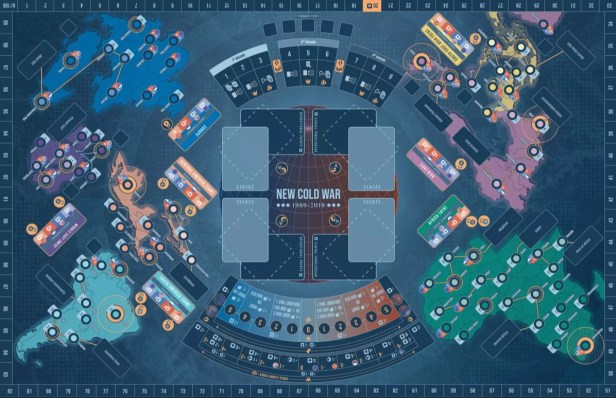
Andoni and Igor: In the center is the negotiation table, where the cards are played, which we are told is quite new in a CDG. At the top, bottom and around the board are the different tracks: turn, prestige, media and victory points. The rest of the board is formed by a kind of broken world map containing the seven regions in dispute. The homeland territories of each power are not represented on the map.
Grant: What are the different types of spaces and regions included?
Andoni and Igor: Each region is made up of a series of countries that can be of three types depending on their geopolitical importance: regional powers, geostrategic countries and non-geostrategic countries. In all regions there are one or more sub-regions, which are made up of a number of countries linked by orange lines, such as the Sahel or the South China Sea.
Grant: How do players fight for control of these regions and how do they create victory points?
Andoni and Igor: The control of the countries can be achieved through certain events or by playing operation points. In order to control a region you must have the minimum number of countries indicated for each of them and have more VPs than the other players. Most VPs are obtained in the global scoring phases that take place at the end of each of the three decades. You receive points for each country and rewards if you gain control of a region. Other ways to obtain points are: declaration of subregions and objectives, prestige checks, specific events…
Grant: How important is the concept of stability?
Andoni and Igor: This is a key concept in the game. All countries have a stability level ranging from 1 (less stable) to 4 (more stable). Orbited countries have a double level of stability, which is different for each block. This level indicates the OPs needed to establish own control or eliminate the opponent’s control in that country. Many players’ strategies depend on stability, with some players preferring to achieve quick control with low-cost unstable countries and others preferring to gradually build up lasting control that will be more difficult to eliminate. In addition, the stability tokens add a lot of life to the game by allowing you to momentarily increase or decrease the level of stability.
Grant: What purpose does the Prestige Track and Media Track serve?
Andoni and Igor: The Prestige Track is played individually and at the start of the game indicates the position of each power according to the historical situation in 1989. At the end of turns 2, 5 and 8 the advantages/disadvantages of the track are applied, which can be of various types: VP’s, reserve OPs and media, playing OPs on the map… On the other hand, the Media Marker is played by blocks. It is a very relevant game factor, since mastering it translates into advantages in all the checks of the game, both prestige and score.
Grant: How do players manipulate these tracks?
Andoni and Igor: Two of the six actions we can perform with the OPs of a card are to play on these tracks. Advancing prestige costs 2 OPs in the central part and 3 OPs at the ends. Regarding the media, each power can advance the track by itself with 2 OPs or by cooperating with its ally with 1 OP. This cooperation between allies, whether it occurs or not, is one of the mechanics that we like the most in the game, as it generates a lot of interaction between players. Another way these markers can go up or down is through events. US will suffer the bad press of cards like the Rwandan Genocide or Guantanamo, but will compensate with Obama or the neutral Fake News card. And something similar happens with the rest of the powers.

Grant: How do players win the game?
Andoni and Igor: The victory conditions are very simple. If a player manages to declare two objectives (maximum one per turn) before reaching turn 9, he will win the game automatically. If the final turn is reached, victory goes to the player with the most VP’s regardless of the number of objectives declared.
Grant: What type of an experience does the game create?
Andoni and Igor: It is a game with simple mechanics that you can learn to play in less than 30 minutes. This makes it a very accessible game, a fact that is favored by a recent theme that most of us are familiar with. In addition, the fact that it is a semi-cooperative game in the first half and much more competitive in the second half, guarantees a very interesting game given the high degree of interaction that is generated between players. We could say that there is a high degree of diplomatic skills to be used in order to achieve the dominance of the new world order and we believe that this ties in very well with the geopolitical theme, which is the backbone of the game.
Grant: What are you most pleased about with the design?
Andoni and Igor: As a general rule, we are very happy with the overall result. There are always slight aspects that could be changed for the better, but at a certain point we had to stop and focus on the publication. If we look at specific parts, we love the board and especially its central part with the mechanics of playing all at once and never knowing the order of play. Also the issue of vetoes, the media track, the asymmetry between powers, and how strategies vary from one to another… Not to mention the whole issue of bots that allow for 3-player, 2-player, and solo play.
Grant: What has been the response from playtesters?
Andoni and Igor: At the beginning of 2025, we completed the second series of conventions in Spain, where we attended Vassal Forever, Batalladores, and Bellota (and sadly not being able to attend Mesa de Guerra). We can say that the response from the public has been unbeatable, and that most people have always given us great feedback on the game. Additionally, we’ve found people with more critical analysis who have greatly helped us improve the final result. Logically, this couldn’t have come to fruition without the core of the development testers (thanks Javi, Patru, Migue, and Germán!!!).
Grant: What other designs are you working on?
Andoni and Igor: Right now, we’re focused on getting New Cold War out there in both Europe and the US. We joke among ourselves that we’re in an after-sales department: BGG forums, Living Rules, an extended solo play example, comments on YouTube reviews… So we haven’t fully immersed in the next step yet. It seems that the intense geopolitical situation of recent years is clearly showing us the path, which could involve an expansion that could cover the period from 2020 to 2027, to name a few… What we are clear about is that we want to continue with the New Cold War system, either with a sequel or by applying it to other different geographical and temporal areas. Although we must take it step by step and first see if the game’s reception can be as good as we think and, of course, hope for.

I wanted to give a thank you to both of the designers of the game, Andoni Orive and Igor Plaza, for their effort in providing these answers to my many questions.
I recently wrote a full First Impression style post on the game and you can read that at the following link: https://theplayersaid.com/2025/05/09/first-impressions-new-cold-war-1989-2019-from-vuca-simulations/
You can also read the Event Card Spoilers series that we have hosted over the past 6 months or so by following these links:
Card #7: 1st Decade Deck – The Tibetan Conflict
Card #105: 3rd Decade Deck – Annexation of Crimea
Card #82: 1st Decade Deck – Warsaw Pact Dissolved
Card #134: 3rd Decade Deck – Rise of the Far Right
Card #41: 2nd Decade Deck – Afghanistan and Iraq Wars
Card #25: 3rd Decade Deck – Xi Jinping
Card #61: 1st Decade Deck – UNSC Presidency
Card #30: 1st Decade Deck – Gulf Monarchies
Card #63: 1st Decade Deck – Counter-Insurgency
Card #64: 1st Decade Deck – War Lords
Card #132: 3rd Decade Deck – Trading of Mineral Oil Products
Card #76: 3rd Decade Deck – Erdogan
Card #77: 3rd Decade Deck – Fake News
Card #19: Objective Card – Russia Objective
Card #135: 3rd Decade Deck – Brexit
Card #90: 2nd Decade Deck – Chávez
Card #38: 1st Decade Deck – Battle of Mogadishu
If you are interested in New Cold War: 1989-2019, you can order a copy for $85.00 from the VUCA Simulations website at the following link: https://vucasims.com/products/new-cold-war
 The Players' Aid