Drop Zone: Southern France is a company-level wargame covering the Allied airborne assault that spearheaded Operation Dragoon, which was the invasion of Southern France or the Second D-Day on August 15, 1944. The history behind this operation is really very interesting as early on the morning of D-Day, the allied First Airborne Task Force (1st ABTF) parachuted a dozen miles behind the Riviera landing beaches to seize key towns and road junctions, to prevent the German occupation forces from counter-attacking the amphibious landing, and to facilitate the advance of Allied forces. The 4:00 AM parachute drop was badly scattered due to an unexpected dense fog bank that blanketed the battlefield. Drop Zone: Southern France covers the first two days of this airborne operation in six game turns, when the American and British paratroopers and glider-men fought surrounded and alone, supported only by French resistance bands. This game is very good and is just a solid wargame.
In Action Point 1, we looked at the Game Board paying attention to the airdrop zones, the terrain and the objective spaces highlighted in yellow and red. In this Action Point, we will take a look at the airdrop procedure and cover an example of both the airborne and glider landings.
Airdrop Procedure
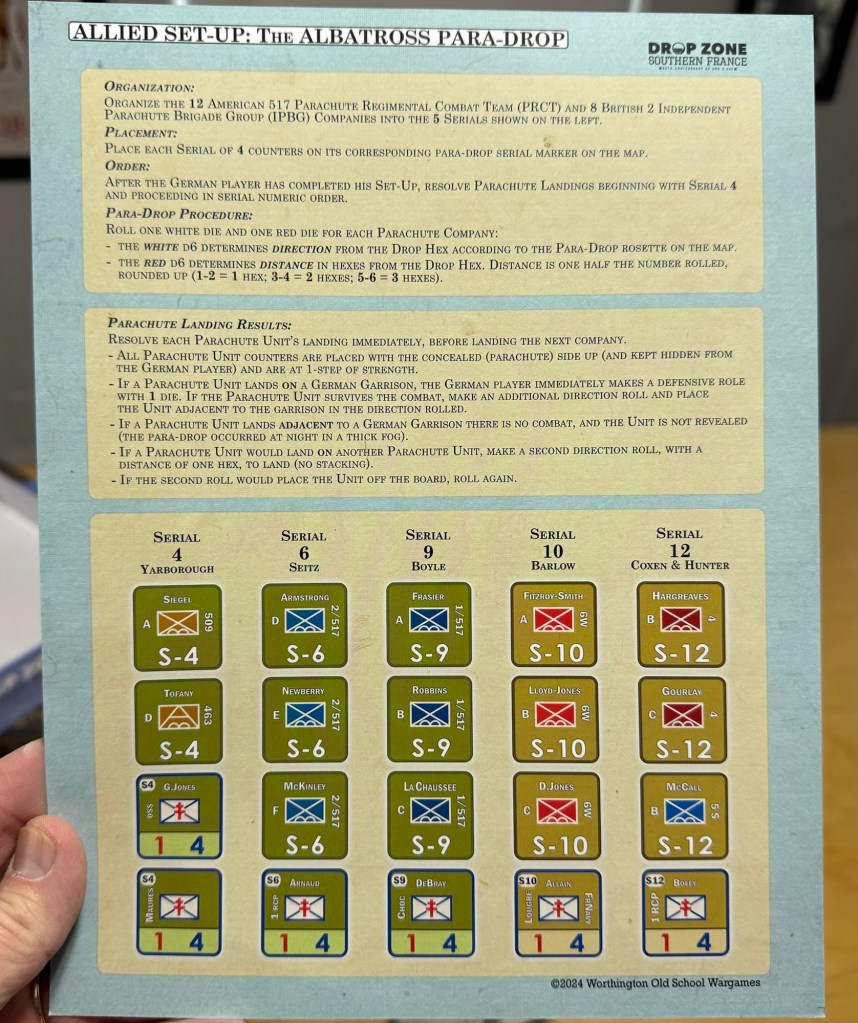
Before we got into the Airdrop Procedure, I wanted to share with you the makeup of the Allied forces who are jumping into Southern France during the Albatross Para-Drop mission on August 15, 1944. Below you will see a picture of the 5 Serials of paratroopers from the American 517 Parachute Regimental Combat Team (PRCT) (12 total) and the British 2 Independent Parachute Brigade Group (IPBG) (8 total) who are jumping into the fray on the first day of the invasion. These counters are double sided, with the exception of the French counters which are only single sided, and are easily identified with the Serial number printed on the bottom of the counters; e.g. S-4, S-6, S-9, S-10 and S-12 respectively.

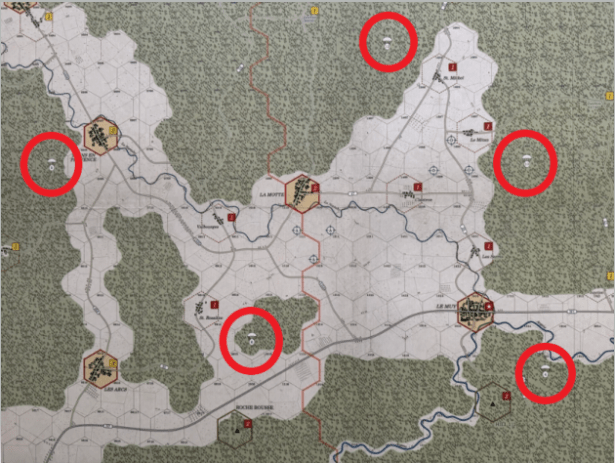
These Serials are broken into groups of 4 counters, which include some French units as well, and will drop as a group onto their identified Para-Drop Serial Marker on the Game Board. There is a specific procedure for these airdrops that is really pretty simple and easy to carry out. But, all good paratrooper wargames must have this process included in their games, although there are various ways to carry it out, because it represents the scattering and breaking up of the units as they land in different areas than intended. Each of the Serials has their specific drop area marked on the board with a small parachute icon and the Serial number listed in the circle on the image. Below is a look at all 5 of these drop zones.
The process involves rolling dice and then checking the scatter diagram that provides the players with the direction that their landings will drift when occurring. As you can see, the diagram is attuned to a 6-sided die and and the player will actually roll 2d6 with the white die determining the scatter direction and the red die determining how many hexes the landings will drift. This is such an interesting and always chaotic first step of most airborne games and is so important as having a cohesive landing where units are together will aid in their initial attacks and making headway on their objectives. But, the dice can be unkind and some of the landings will not go as planned and the Allied player will have to adjust and get them back on track to get moving.

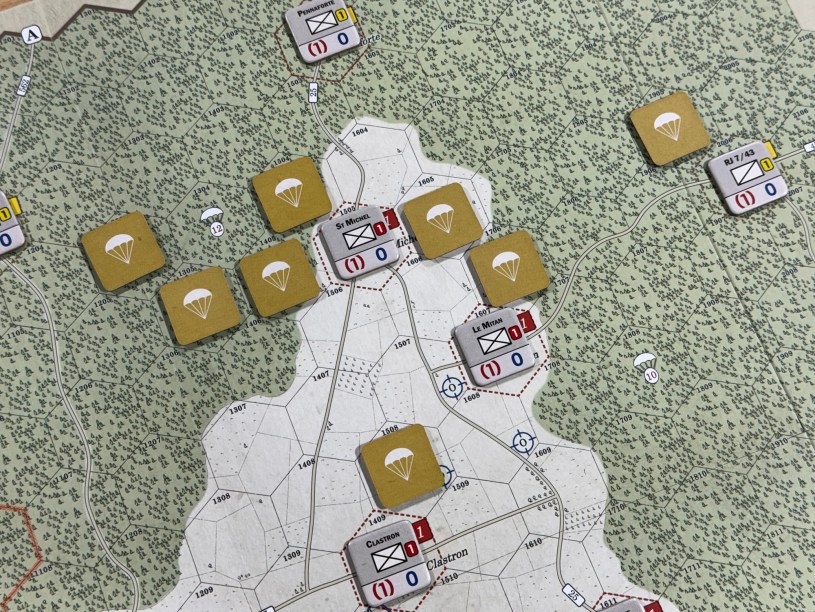
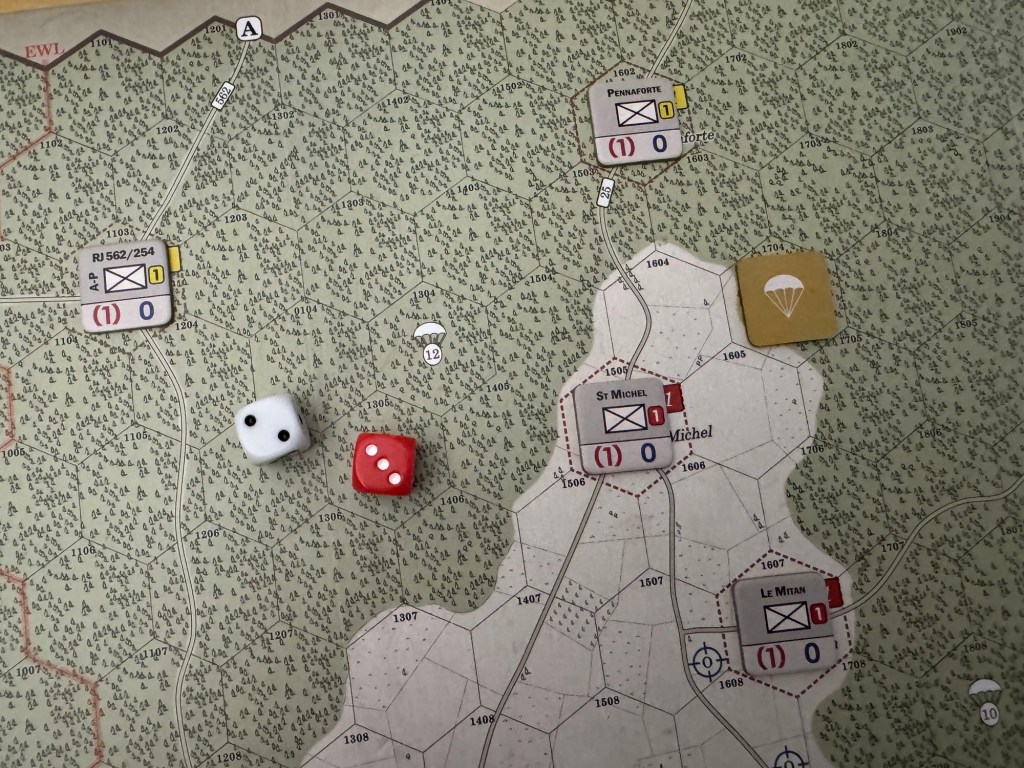
So let’s take a quick look at how this works with British Serial 12 (Hargraves). First, we find their Para-Drop Serial Marker on the Game Board, which is located to the west of St. Michel in the middle of the board identified as 12. We roll the 2d6 and use the white die result of 2 to identify what direction the drop will drift. The 2 means it will drift to the right and the red die result of 3 means that it will drift a total of 3 hexes.

This means that the Hargraves counter will be placed in hex #1704, which is in a good position as it it is just 1 hex away from 2 of the objectives in St. Michel to the southwest and Pennaforte to the north. It was also good that the paratrooper didn’t land on the hex with the German counter as it would have had to do an attack right away.

The final step is placing the Serial counter in the space hidden by turning it over to its parachute side. In this game, the units that are landing are hidden so that the German player is unsure about the strength of the different Serials. In this example, I showed you the counter but in the game you would keep that hidden.
For a look at the entire process, please see the below player aid with the procedure laid out in easy to follow steps.
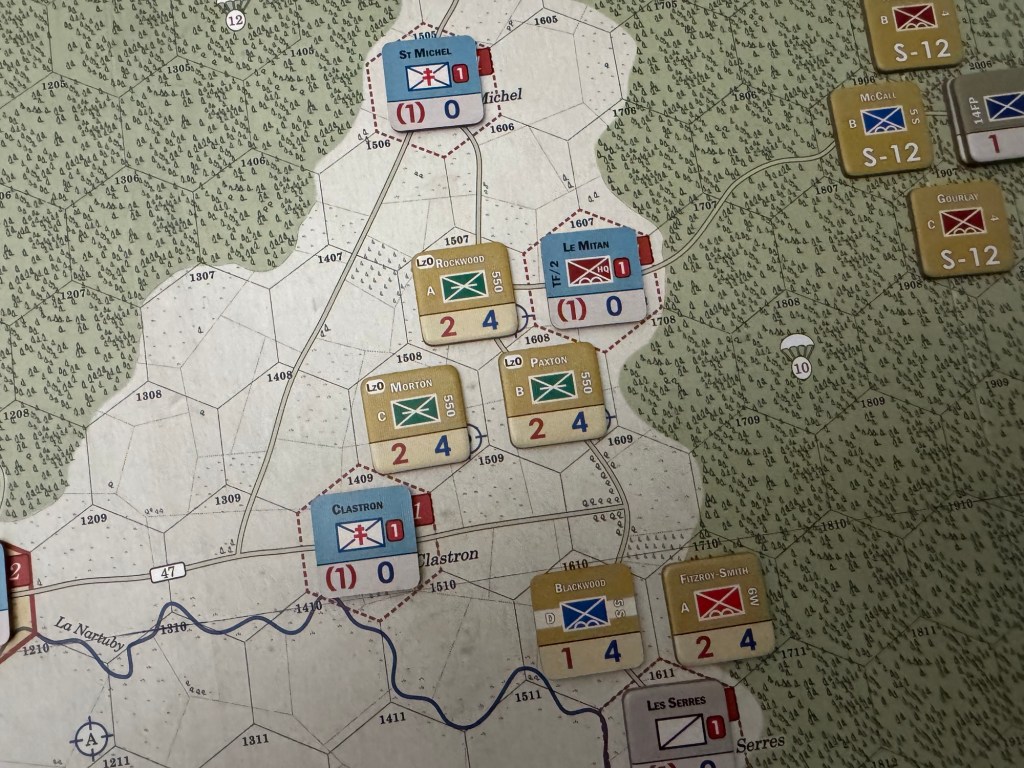
The final part of this post will be to look at the Glider landings which come later in the game after the initial drops and hopefully for the Allies after securing the towns around the glider Landing Zones. The gliders will land on Turn 3 and will come into a white circle with a target on it and a black letter. There are 3 different Landing Zones for these gliders and they are marked as A, C and O. There are a possible 3 landing hexes at A, 2 at C and 3 at O.
In this example, we will take a look at Landing Zone O, which is located adjacent to Le Mitan.
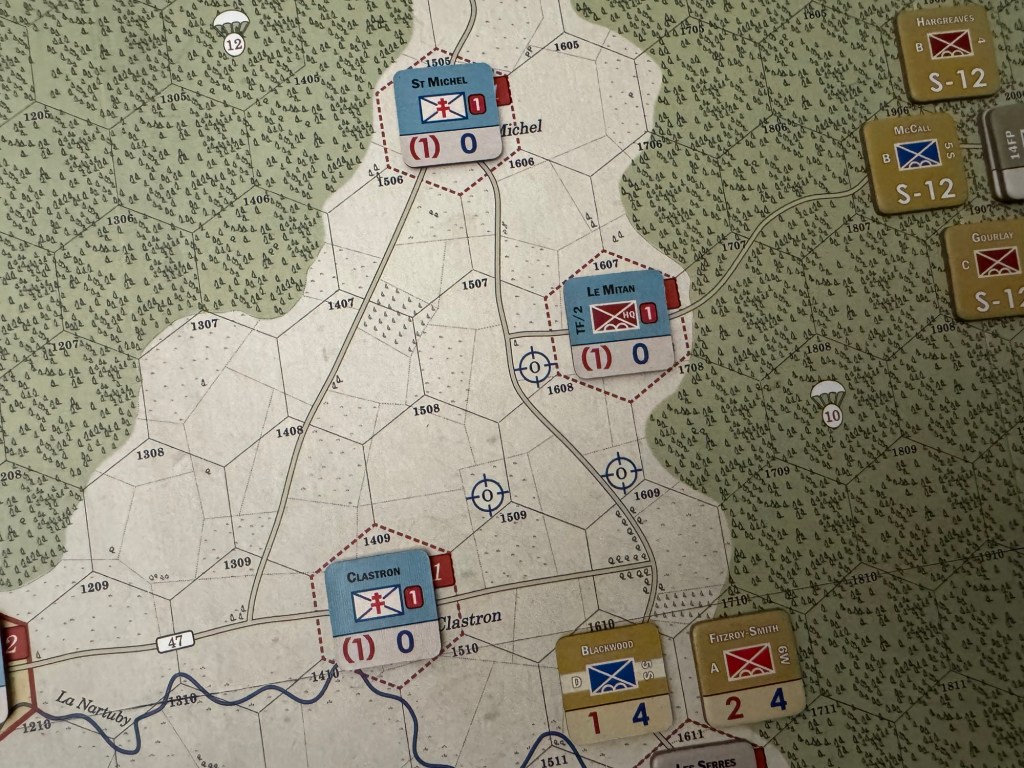
Daylight para-drop/glider units arrive just before the Movement Phase on the indicated Drop Zone/Landing Zone (DZ/LZ) hexes at a maximum SP strength of 2 each. If the DZ/LZ hex is enemy occupied, the glider unit will automatically loses 1 step and then must immediately attack using normal combat rules, which means there will be no use of Assets that provide bonus dice. If after the mandatory combat both units survive, the player will have to make a direction role to land.
If the DZ/LZ hex is friendly occupied, the glider unit on the ground must displace to an adjacent vacant hex, not located in an EZoC. If no such hex is available, the unit must displace two hexes, and so on. After the daylight glider units have landed, the regular movement phase begins. The newly arrived glider units may move and attack as usual.
I really liked the simplicity of the system used for the Airdrop Procedure. It just worked well and we found that the variety of the landing units was a very interesting opportunity as sometimes you want your units to drift to get closer to certain objectives in order to better attack from all angles.
In Action Point 3, we will take a look at the hidden units for the Allies and why this is such an interesting aspect of the game.
-Grant
 The Players' Aid
Very interesting. Already ordered my copy! This game caught my attention since I used to be a WWII reenactor that did an impression of the 509th PIB. Their history fascinated me a lot!
LikeLiked by 1 person