
I love playing these large geopolitical tug of war style Cold War card driven games like Twilight Struggle, 1989: Dawn of Freedom, 2 Minutes to Midnight and others. The scope of these games is huge, as they typically deal with the entire globe and all of the different theaters of the Cold War, they deal with coups, and insurrections, major political upheavals and wars. It is always just so very interesting to see how the events that cover that 40 year period unfold and how they are all intertwined. Well the Cold War was finished in 1989 with the toppling of the Berlin Wall and things like Glasnost and the United States of America came out on top of the struggle.
But, there has been a new Cold War raging since then with some of the old players but with other rising powers as well such as China. That New Cold War is a very different animal and I am was very excited when I heard about a new game called (you guessed it!) New Cold War: 1989-2019 from VUCA Simulations. I was very excited about the game because it was going to cover a 30-year period that I have grown up in and have a remembrance of many of the major events that are covered in the game. Things like the first Iraq War (which happened when I was a senior in High School), 911 (which happened when I was a new young father), and more recent events such as Brexit, the rise of the far right and others. I am just very much excited about a game that covers this period and I really am interested in whether this game lives up to the hype that I have built up in my own mind. I have played New Cold War twice now, once last summer at WBC on a prototype board and the 2nd recently while attending Buckeye Game Fest, and I am going to tell you that the game is very interesting and very good but I do have some concerns about a few things. I want to share my thoughts with you on the game in this First Impressions style post.

We played the game this past weekend while attending Buckeye Game Fest in Columbus, Ohio. We did a full 4-player game with me and Alexander, Russ (green shirt) and Ed (dark green shirt) and our friend Cullen acted as GM as he had prepared the rules and set up the game. I played as the United States, Russ as Russia, Alexander as China and Ed as the European Union. As I have mentioned, this was my 2nd play and I was very much looking forward to it as I had only really played about half a game last summer as I had to slink away to do a few interviews.
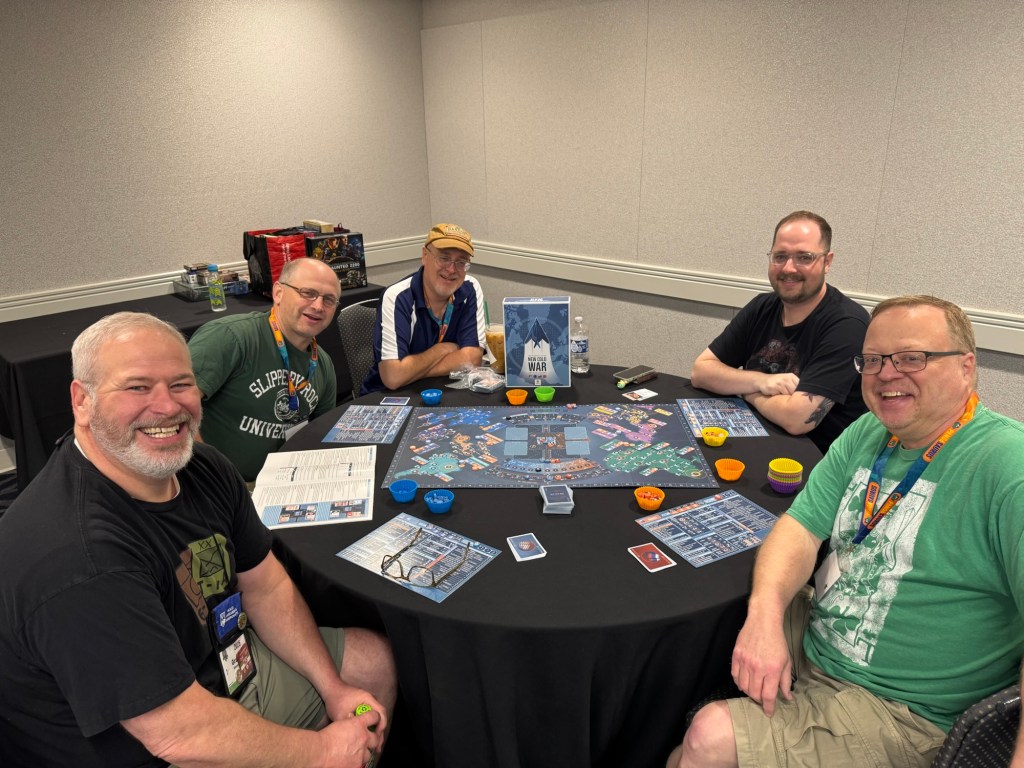
But first, let’s talk a bit about what the game is. New Cold War is a game about geopolitics that takes place from 1989 to 2019. It begins with the disintegration of the Soviet Union and ends with the arrival of the COVID-19 pandemic. Players take the role of the great powers fighting for the new world order during this 30-year period including Russia, China, the United States and the European Union. China and Russia are referred to as the Red Bloc and the United States and EU as the Blue Bloc. The allied powers will each have to loosely work together by doing such things as exchanging cards, both working to move the Media Marker on the Social Media Track and discussing their strategy for control of each of the regions. But remember that there is only one nation that can win the game and this loose alliance will begin to deteriorate as the game wears on. The game lasts over a period of 9 turns and one of the things that I really liked about this structure was that the various parts of the game didn’t score at the end of each turn but when they do score is identified on the Turn Track. This causes players to have to plan for these upcoming scoring opportunities and can be a really great part of the game as you prioritize your limited cards and actions to achieve the goals that will help advance your individual score. There are two victory conditions in the game; when a power must declare two of the hidden Objectives on its agenda during the game or lead the victory point score at the end of the last turn of the game. The game is advertised as a 3 hour game and our game took about 4 hours as we were all still learning. Once you get it down, I can see the game taking 2 1/2 hours to play to completion.

New Cold War is a Card Driven Game and includes cards that focus around the 135 most important events of the 30-year period covered from 1989-2019. Each of the power’s cards can be played as an event or for the printed operations points but when you play an opponent’s aligned card for the operations points, the event will automatically go off for them. There are also Negative Cards that are aligned with each power and these cards also must be played and cannot be traded, vetoed or discarded but must be played. These Negative Cards represent the worst events for each of the nations and include things like the Tiananmen Square Massacre that reduces China’s Prestige, influence on the Social Media Track and forces the loss of a couple of VP’s, September 11 Attacks that reduces the US’s Prestige and Victory Points but also destabilizes Saudi Arabia, making it easier to be taken over by the Red Bloc. The printed Operations Points can be used in 6 different ways. Placing or removing influence on countries on the map (based on their stability, geopolitical value and initial alignment), staging a Coup d’état, Stabilizing or destabilizing countries to protect or favor access to them, advancing on the Prestige Marker, advancing the Media Marker, either alone or in cooperation with your ally or creating a reserve of Operations Points to play in later rounds or game turns. The game really is a pretty standard CDG model and it works really well. I will say that the game heavily relies on iconography and we had a bit of trouble throughout the game sometimes mixing up the symbols but there is nothing here that is too difficult.
The production of this game is simply amazing and is the standard that VUCA Simulations has set for themselves and to which we have all become accustomed with their games. The board is big and beautiful, with clear and concise regions being grouped together. The central portion of the board is where players lay out their cards that are being played so that all can see them and have ready access to them as they get to take their Operations Points or the events. The wooden influence markers are fantastic and have embossed national symbols on them. My only complaint is the use of color. The Red Bloc, being China and Russia, and their wooden bits look very similar and the same with the Blue Bloc, USA and EU. I had a bit of trouble sometimes recognizing what was mine. The writing on the board is also a bit smallish and could have been larger. Maybe that is just a 52 year old me problem but I think that this could be an issue for many.
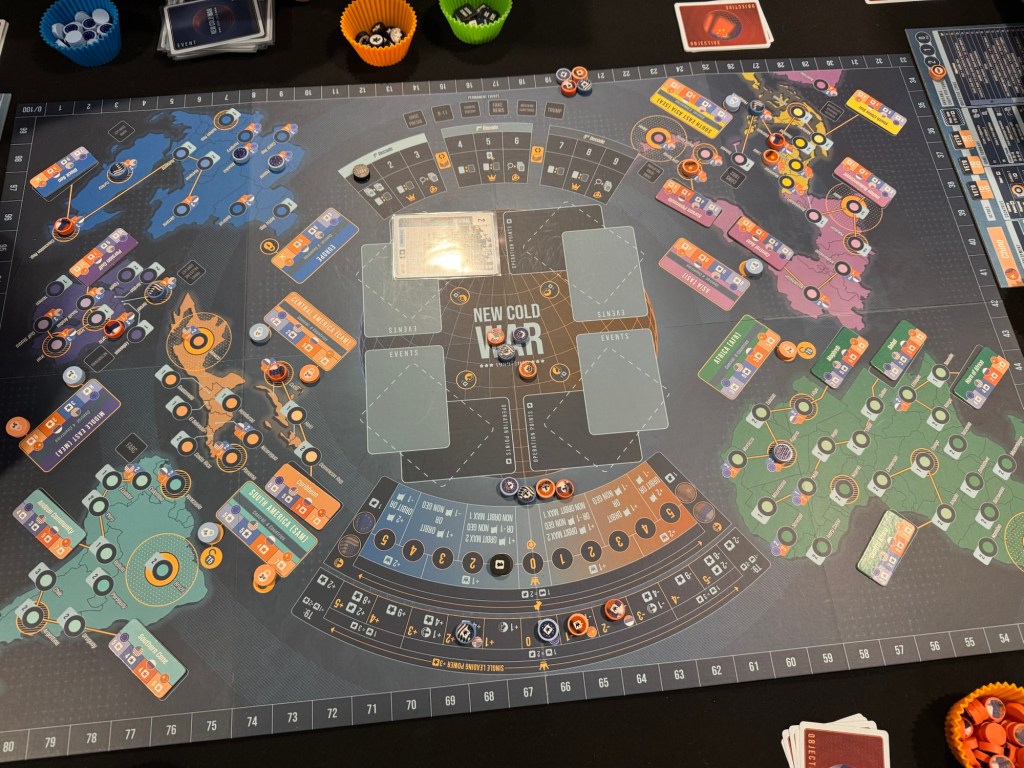
New Cold War is a very interesting and well put together game. It feels a bit similar to the other games I mentioned in the introduction, but definitely has its own feel and flow. It feels like a bit more complex than Twilight Struggle, but in a good way, as there are a few more tricks that players have access to. Rather than a Space Race Track, where players can get rid of an opponent’s nasty event card, this game has a discard pile where you can hold a card till the end of the turn (as you draw 4 cards and only play 3) and then during specified turns the players who are behind can rifle through these cards and draw one out to play in the next round. There are also coups but they operate very differently and are the mechanism by which you can play enough Operations Points to remove all of the influence there and then place down enough of yours to control the space. This doesn’t include any dice roles and was very seamless. You can also get VP from a successful coup based on the value.
The big new addition to the system is the concept of Crisis Cards, which include both Negative Cards and War Cards. I mentioned a few of these above but these are really naasty and you have to expect that they will happen. But when they do, it is like a punch to the gut as you will typically spend the rest of that turn trying to recover what was lost. The game also includes the option to Veto the play of Events and each player has 5 of these one time vetoes but there is a penalty for using these Vetoes as there will be a loss of VP in an amount equal to the Operations Value of the Event Card that is being cancelled. I also liked the variable player turn order as it is decided with the play of each turns cards. Cards played as Events will go off first, then as Operations Points in the order of highest to lowest Ops Value. This variable order is really well done and really makes you have to decide how and when you are going to play your cards as some have conditions to play and if they change then you might lose the opportunity to use them.

The game has quite a bit of asymmetry built in which is in the form of the types of countries there are and who they are aligned with. Some of the countries are referred to as Orbit countries, being friendly to one of the Blocs and this results in a lessened cost for that aligned Bloc to place influence into. Also, different nations gain different VP rewards for control of the same area as some are easier and more established for your Bloc to control while others are a definite process that you must commit resources to over the course of the game to break and get control of. This asymmetry is taken even further as a few of the nations are effectively locked out of influencing certain regions such as with China who is locked out of certain regions at the start of the game including permanently in Europe. China must work to expand their influence over the globe but it will not be possible until Turn 5 and then China has to work to get anywhere with Central America, the Middle East and Africa.

Our only real concern with the game was this aspect. China just seems to be so handicapped, as is Russia, with their setup and limitations. In 2 games, I have seen the United States run away with the game and the EU is also very competitive in this respect. There was lots of discussion after our most recent game about the trouble of playing as the Chinese and the Russians as they have a lot to overcome and we wondered if they are possibly underpowered. China really has a tough time I think. More plays will reveal the strategies needed to overcome this aspect of the game but I do have some slight concerns about the balance.
With that being said, we really enjoyed the game and in the end everyone really liked what it was that we were doing and how it was being done. The game is very good and will be worth the effort that you have to put into it to learn it and to play it multiple times to get the strategy down. I will play it again and would recommend the game to anyone that loves Twilight Struggle.
-Grant
 The Players' Aid
Good article. The concern Grant conveys about the balance of the game comes across in the early games. It is easy to play the US at first and it makes you think you dominate the board with superiority. Playing China requires more depth and knowledge of the game and more specific strategies. Little by little you will discover them. I hope those of you who have played it will enjoy it.
LikeLiked by 1 person
I figured as much and hope that we are able to discover those strategies. Great game though.
LikeLike