With this new My Favorite Wargame Cards Series, I hope to take a look at a specific card from the various wargames that I have played and share how it is used in the game. I am not a strategist and frankly I am not that good at games but I do understand how things should work and be used in games. With that being said, here is the next entry in this series.
#29: Seneca Falls Convention from Votes for Women from Fort Circle Games
Votes for Women is a very interesting card-driven game that covers the American Women’s Suffrage Movement from 1848-1920, culminating in the ratification of the Nineteenth Amendment which granted women the right to vote. The game is a 2-player game, that has a fully developed solitaire mode with an “Oppobot” and offers a cooperative mode for those who don’t wish to play as they Opposition. The Suffragist player will have to push Congress to propose the Nineteenth Amendment, and then focus on campaigning to have a minimum of 36 states to ratify the Amendment. The Opposition side will try to prevent Congress from proposing the amendment and failing that to have 13 states reject the amendment.
The game uses cards in a fairly traditional CDG way as there are events that can be be taken or the cards can be played to do things like Campaign, Organize or Lobby Congress. Each card has a specific Card Era that is used to create of the each players’ Draw Decks. Late cards will be on the bottom of the deck, Middle cards will be in the middle of the deck and Early cards will be on the top of the deck. The Suffragist and Opposition decks each have one Start card that will be placed in the player’s hand at the start of the game. Some Event Cards have a prerequisite and some of the cards require a player to roll a 6-sided die and only take the the action on a roll of 3-6. Otherwise, the Event Card is discarded with no effect. The cards in this game are also steeped in historical details, from the name of the events that tie back to specific individuals or happenings, to major moments in the struggle. This game is about the history of the struggle for the right to vote and it is very good!
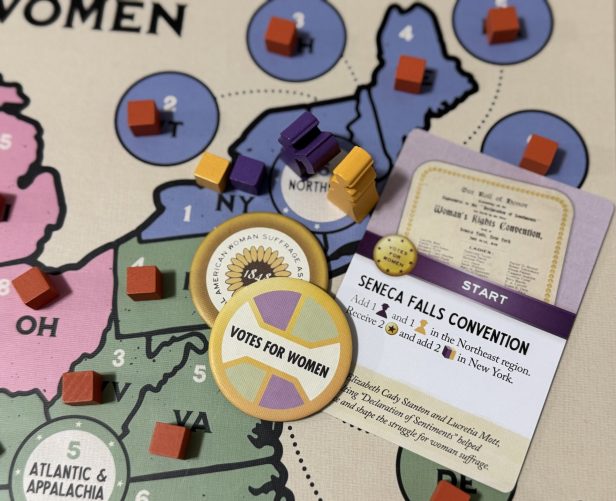
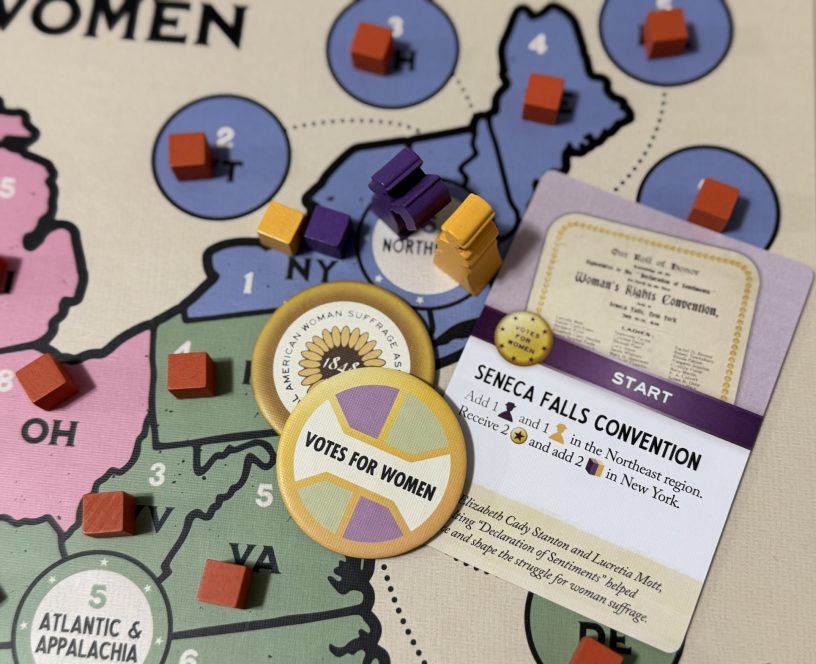
In this post, I want to take a look at one of my favorite Early cards in the game called The Seneca Falls Convention. This card is key for the Suffragist player as it allows them to do several things early in the game to get a good start on their fight. First, it allows the Suffragist player to place 2 Campaigners on the board, which are represented by beautiful wooden meeples of women decked out in the finest apparel of the time. The event specifically instructs the Suffragist player to place 1 purple Campaigner and 1 yellow Campaigner into the Northeast Region. The benefit of having these Campaigners here is that they can be used to take the Campaigning Action where they will roll dice and place out influence cubes into the various States attempting to get the most in the State to control it. The card also grants the Suffragist player 2 Buttons that are like a currency and can be used to bid for Strategy Cards at the beginning of each turn or be used to move Campaigner pieces from one region to another. Finally, the card allows the Suffragist player to place 2 influence cubes into New York of either color (purple or yellow) and this gives them a leg up on the quest to capture the New York Strategy Card that will require them to place a total of 4 influence cubes here. The New York Strategy Card grants the owning player the free option to place a total of 6 influence cubes into Sates in the Northeast Region. This is a very flexible and beneficial card to be played in the Early game and can get the Suffragist player off to a great start.
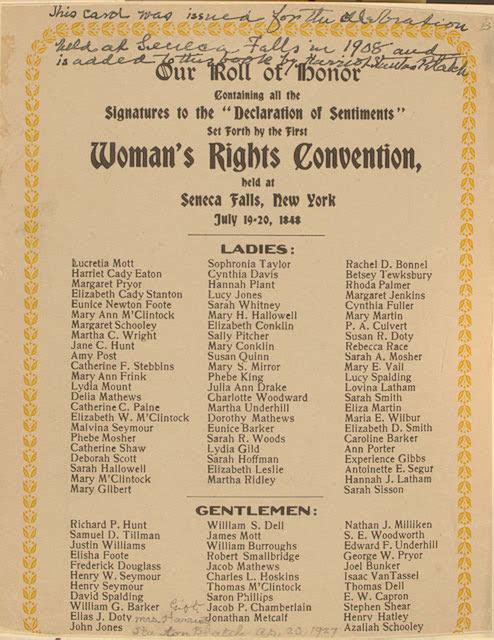
The Seneca Falls Convention was the first women’s rights convention held as a part of the Women’s Suffrage Movement. Its organizers advertised it as “a convention to discuss the social, civil, and religious condition and rights of woman”. A pretty bold step at the time and really a catalyst for the movement. The Convention was held in the Wesleyan Chapel of the town of Seneca Falls, New York, and it spanned two full days over July 19–20, 1848. Attracting widespread attention, it was soon followed by other women’s rights conventions, including the Rochester Women’s Rights Convention in Rochester, New York, two weeks later. In 1850, the first in a series of annual National Women’s Rights Conventions met in Worcester, Massachusetts. The convention was attended by about 300 people and was organized by Elizabeth Cady Stanton, Lucretia Mott and others.

The meeting was comprised of six sessions including a lecture on law, a humorous presentation, and multiple discussions about the role of women in society. Stanton and the other women presented two prepared documents, the Declaration of Sentiments and an accompanying list of resolutions, to be debated and modified before being put forward for signatures. A heated debate sprang up regarding women’s right to vote, with many – including Mott – urging the removal of this concept, but Frederick Douglass, who was the convention’s sole African American attendee, argued eloquently for its inclusion, and the suffrage resolution was retained. Exactly 100 of approximately 300 attendees signed the document, mostly women.
The convention was seen by some of its contemporaries, including featured speaker Mott, as the first important step among many others in the effort by women to gain for themselves a greater proportion of social, civil and moral rights, while it was viewed by others as a revolutionary beginning to the struggle by women for complete equality with men. Stanton considered the Seneca Falls Convention to be the beginning of the women’s rights movement, an opinion that was echoed in the History of Woman Suffrage, which Stanton co-wrote.
The convention’s Declaration of Sentiments became “the single most important factor in spreading news of the women’s rights movement around the country in 1848 and into the future”, according to Judith Wellman, a historian of the convention. By the time of the National Women’s Rights Convention of 1851, the issue of women’s right to vote had become a central tenet of the United States women’s rights movement. These conventions became annual events until the outbreak of the American Civil War in 1861.
Here also is a link to our full video review of the game:
We also published an interview on the blog with the designer Tory Brown and you can read that at the following link: https://theplayersaid.com/2020/09/07/interview-with-tory-brown-designer-of-votes-for-women-from-fort-circle-games-currently-on-kickstarter/
In the next entry in this series, we will take a look at Mile by Mile from from The Hunt from Salt & Pepper Games.
-Grant
 The Players' Aid
Great article on an outstanding game! Thanks for all you guys do for the hobby!
Ric
LikeLiked by 1 person
Thanks and you are most welcome! Love sharing about all the games.
LikeLike