With this new My Favorite Wargame Cards Series, I hope to take a look at a specific card from the various wargames that I have played and share how it is used in the game. I am not a strategist and frankly I am not that good at games but I do understand how things should work and be used in games. With that being said, here is the next entry in this series.
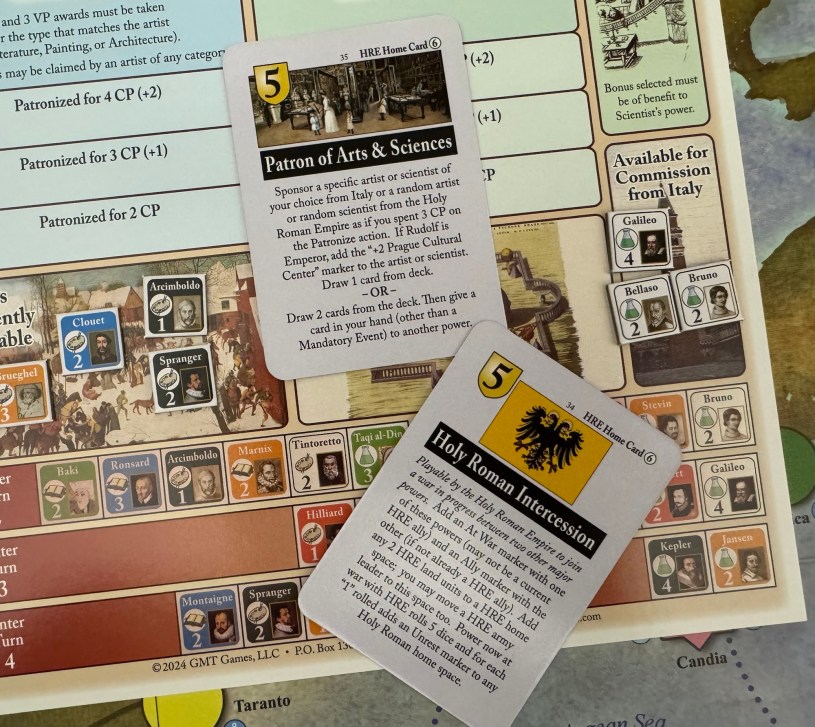
#28: Holy Roman Empire Home Cards Holy Roman Intercession and Patron of Arts & Sciences from Virgin Queen: Wars of Religion, 1559-1598 from GMT Games
Virgin Queen is a follow-up to Here I Stand and is a card driven wargame that looks at the Wars of Religion from after the Reformation to the end of the century and deals with the military, political and religious conflicts within Europe during the reigns of Elizabeth I of England and Philip II of Spain. As the game is card driven each of the various cards serves multiple purposes. Each card has a command point (CP) value in the top left corner which can be spent to take a variety of tasks available to your power, and an event which can be used in lieu of the CP. Cards labelled combat can be used in a fight, and cards labelled response can generally be used at any time with certain conditions that must exist in order to play.
The other cool thing about each power is that they have what is referred to as 2 Home Cards and players will have to decide each turn which one they want to keep depending on their strategy for that round. This game is somewhat different than its predecessor in the series, but overall has the same method of how cards are used, generally the same type of victory conditions and the same mechanics in regard to movement, combat and siege. In fact, well over half of the rulebook is identical and really made picking this game up fairly easy as all were familiar with the concepts and mechanics. Where it feels different is that there is a larger focus on outside opportunities for VP, including arranged marriages between nations, the expansion of the New World exploration and colonization concept and the new ability for patronage of the Arts and Sciences for abilities and victory points. There is some sentiment out there that these additional opportunities create complexity and somewhat distract from the focus of the game.
In this post, I want to focus on the Holy Roman Empire and their Home Cards called Holy Roman Intercession and Patron of Arts & Sciences, which both serve a very different purpose while assisting the HRE player in establishing their strategy and building up their victory points.
First up, let’s take a look at Patron of the Arts & Sciences. This card is focused on the additional VP opportunities that I mentioned in the introduction as it gives the HRE player the ability to sponsor a specific Artist from Italy or to draw randomly from their own Artists or Scientists. The first question that we should ask ourselves is can I just use the 5CP value of the card to do the same thing?; and the answer is yes but you will miss out on 2 key opportunities if you do this. One will be the addition of the +2 Prague Cultural Center marker that will add +2 to your total outcome when the chosen Artist or Scientist outcome is determined at the end of the round. This +2 can make a huge difference in what benefits you gain from the sponsorship of the Artists or Scientist and is not to be taken lightly. But you will have to ensure that the current Emperor is Rudolf and this something that you cannot directly control and will be more of a late game thing. The patronizing of Artists and Scientists is a way to gain Victory Points and should be a major part of an HRE strategy. The players can spend 2-4CP to sponsor an Artist or a Scientist. 2CP gets them sponsored, 3CP confers a +1 DRM, and 4CP a +2 DRM. Artists and Scientists range in value from 1-4, and during the winter phase this process is resolved by rolling 2d6 and adding the value of the Artist/Scientist and any bonuses from the spending of CP, and then you earn VP based on the result. You need at least a 10 to get anything. Artists confer 1-3VP, and scientists confer 1-2VP and possibly a special achievement. As an example, the player could gain the Observatory science achievement which will give a +2 DRM on all future science rolls. There are other beneficial achievements such as Cryptography (which grants a 1 extra die on Espionage attack or defense), Telescope (+1 to intercept or avoid battle die rolls) and Ravelin (+1 defense die in an Assault).
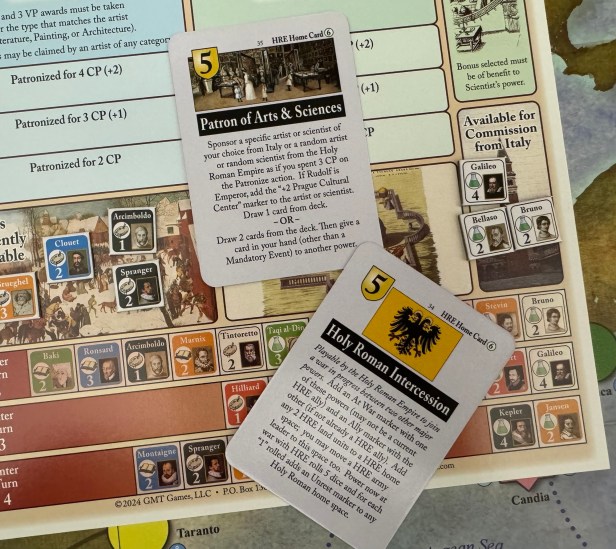
The second benefit of the card gives the player the choice of either drawing a single card from the deck or drawing 2 cards and keeping one and giving the other away. This can be a bargaining chip that you can use in the game during negotiation phase and state that you are going to play this card and will give them one of the 2 cards for something that you want. Remember that card advantage in this game is king and the more cards you have equates to more actions that can be taken putting you in a position to do better.
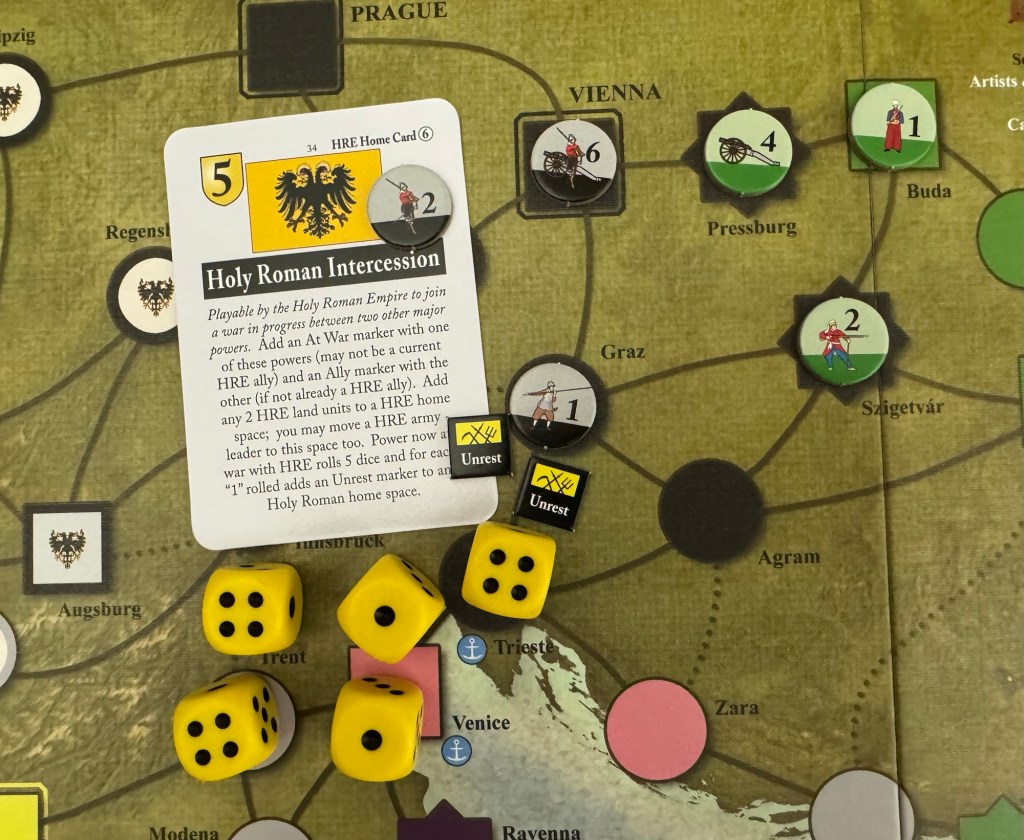
The second Home Card for the Holy Roman Empire is called Holy Roman Intercession. And this card is a doozy because it gives the HRE the ability to go to war with another power. Remember, that typically to declare war on another power you will have to do that before the turn begins by spending a card and the appropriate amount of CP according to the chart and this then telegraphs your intentions for the round and allows the other players to get ready and begin spending their cards and CP on building up forces and maneuvering to intercept the HRE armies as they move into position. I consider this card invaluable as it is somewhat of a sneak attack and can really give the HRE player the advantage during that turn.
It does have some drawbacks as the player that you declare war against will get to roll 5 dice and for each 1 rolled will place an Unrest marker to any Holy Roman Empire space. This can be devastating as it will take up your time to remove the unrest by the end of the round as it can spread during the Winter Phase but also could affect your movement and supply to your forward strike forces if they are placed shrewdly by the opposition. The other benefit which is nice is the addition of 2 HRE land units that normally would cost you 2CP each or a total of 4CP. This is a very good and versatile card and you should be choosy about which of the 2 your choose for the turn based on what your intentions and strategy are.
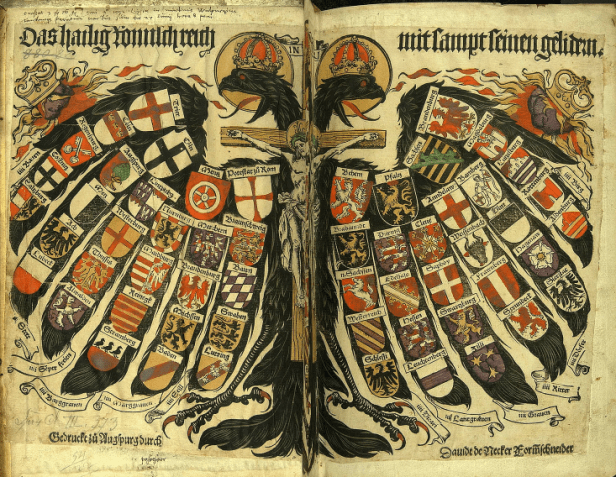
The Holy Roman Empire, also known as the Holy Roman Empire of the German Nation after 1512, was a polity in Central and Western Europe, usually headed by the Holy Roman Emperor. It developed in the Early Middle Ages, and lasted for a millennium until its dissolution in 1806 during the Napoleonic Wars. Since Charlemagne, the realm was merely referred to as the “Roman Empire”. The term sacrum (holy, in the sense of being consecrated) in connection with the medieval Roman Empire was used beginning in 1157 under Frederick I Barbarossa: the term was added to reflect Frederick’s ambition to dominate Italy and the Papacy. But, the exact term “Holy Roman Empire” was not used until the 13th century, before which the empire was referred to variously as universum regnum (“the whole kingdom”), imperium christianum (Christian empire) or Romanum imperium (Roman empire), but the Emperor’s legitimacy always rested on the concept of translatio imperii, that he held supreme power inherited from the ancient emperors of Rome. While often viewed as a patchwork of power dynamics, the Empire also played a major role in shaping European history, influencing politics, religion and culture.
In the next entry in this series, we will take a look at Seneca Falls Convention from Votes for Women from Fort Circle Games.
-Grant
 The Players' Aid