
While attending Buckeye Game Fest in the spring of 2022, we met two new designers who had a very cool looking prototype copy of their new game setup in the War Room called Song for War: Mediterranean Theater. Chris Helm and Seth Stigliano were really nice guys who obviously had put a ton of time into their game and it was immediately evident that this was going to be a different experience. Unfortunately, because of our crazy schedule of events and already committed to games, we were unable to sit down and play the game but got a crash course into the design as well as a good look at the awesome components.
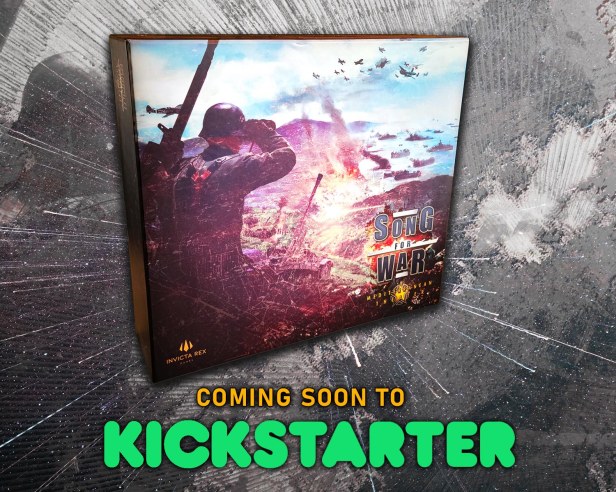
The game is coming back to Kickstarter on April 23rd after a first non-successful attempt in spring 2023 and I look forward to seeing the campaign fund and getting the chance to play this game by the end of 2026 (hopefully). They have made some changes to the game and I hope that this helps broaden its appeal to improve its chances of funding.
You can follow the campaign on the Kickstarter preview page at the following link: https://www.kickstarter.com/projects/invictarexgames/song-for-war-mediterranean-theater-0
Grant: What is going on with Song for War?
Seth and Chris: We’ve been working since the last Kickstart in 2023 to build on the feedback received, do a postmortem of what worked and what didn’t, conduct new play testing, and drive improvements into the game and the marketing strategy for the upcoming re-launch. While we didn’t get the outcome we wanted the first time around, it was an incredibly valuable learning experience. We are in the process of working with reviewers now. If you get a chance, check out the review / impression Youtube videos from Shelfside, Zilla Blitz, and Game Brigade – which have all been released recently.
Grant: What do you believe were the reasons the first campaign wasn’t as successful as it needed to be?
Seth and Chris: There were a handful of reasons why our first attempt fell short. On the product side, we did not have scenarios for a 1.5-4 hour game, which limited our initial reach. Sometimes folks want to play for a few hours and our initial offering only had the two longer scenarios – which we addressed by adding 2 new scenarios (Italy and North Africa). A second factor was marketing. After play testing, it became increasingly clear that folks who like Song for War the best are gamers who play games such as Twilight Imperium, War of the Ring, Terraforming Mars, or (not surprisingly) Axis & Allies players looking for a different take on the WWII tabletop experience. Meeting the preferences of this target group and reaching them will be a critical success factor in the re-launch. A last point was the mix of manufacturing cost, piece count and type, price point and the KS funding goal. These have to work together and can be a strategic challenge to strategically calibrate. While we ended up last time with nearly 300 backers (thank you all!), we fell short – but took a lot of insights away to build on for the second attempt.
Grant: What feedback did you get from interested gamers?
Seth and Chris: I touched on this a bit in the question above. The alternate scenarios that allow for shorter games of anywhere from 1.5-4 hours was one key area of feedback. A sub-theme to these shorter scenarios was also offering different purchase options for the second Kickstart. The feedback asked us to maintain a bigger board and high-quality components as key value-adds but also give some buyers the option to purchase a less expensive version of the game. The addition of the 2 new scenarios will provide this path. We’re in the process of scoping the manufacturing and distribution costs to determine a final plan.
Grant: What have you changed in this iteration of the game?
Seth and Chris: A few of the more notable changes include:
- Two new scenarios that run from 1.5-4 hours: 1) Battle for North Africa (starting point of February 1941). This scenario is 2-4 players, with the Germans and the Italians for the Axis against the British players representing the XXX and XXIII Corps of the 8th Army. And scenario 2) the Allied Invasion of Italy (starting point of September 1943). The two sides in this scenario are the US and Britain (just prior to the landings and they start off with hidden fleets) battling against Germany North and Germany South players.
- Several new mechanics, most of them designed specifically for the new scenarios. See response to question #10 below.
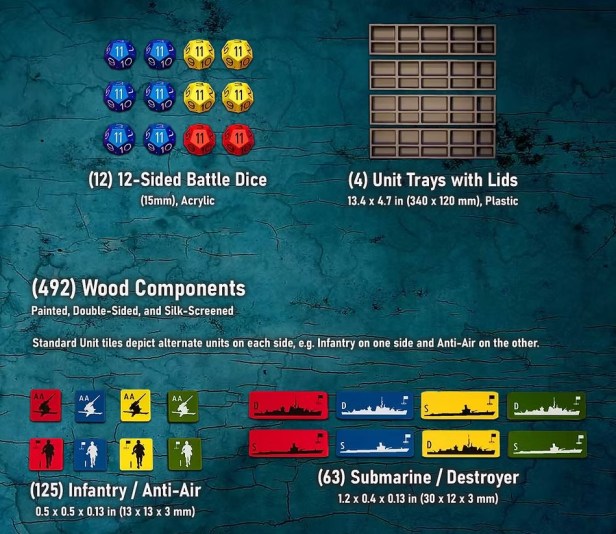
- Several upgrades to units. First, we made infantry more valuable. In some games, infantry units are a cheap way to put units on the board – usually when defending. We wanted to change that. We gave standard infantry an engineering ability, allowing them to lay mines, build defensive lines, and blow bridges. We also gave destroyers a mine laying ability. We also enhanced the land transport unit for the Germans by adding a National Support Card that upgrades standard transports to Panzergrenadier units with the ability to attack, defend, and retreat (and can still transport units, of course).
- Added a retreat ability for infantry, tanks, and Panzergrenadiers. This can be done at a strategic time during battle and gives the players more options and mobility, but only for these units.
- Added a tournament time mechanic for each scenario. We tested this at Origins in 2024 and have been working on refining it. By placing time limits on the sides when going through the phases, it creates pressure to act, but it’s fun.
- Lastly, we took an end-to-end look at all National Support Cards and refreshed many of the unit upgrades, unique units, events, and strategy cards.
Grant: Why did you feel going away from miniatures was the right call?
Seth and Chris: We received a fair amount of feedback that the miniatures were not a major value add for play testers or backers from the first Kickstarter. If it doesn’t have a big add to the game experience, it isn’t worth the production cost.
Grant: Will backers be able to get the miniatures if they so desire?
Seth and Chris: Currently, no. We are likely going to scope them out entirely, but you never know.
Grant: Why have you included 2 different versions of the game? Who is your target audience for each of the games?
Seth and Chris: There were two reasons: Adding two shorter scenarios to offer backers a shorter game, and offering a second, less expensive price point for a smaller version of the game. The target audience in both cases is the same. After a few years of play testing and the first Kickstarter, we learned the target is a gamer interested in spending a night in WWII with a deep but not overly complex strategy game. They typically are not hex and counter folks, and nor do we need to recreate history step for step – a sandbox approach with different potential outcomes is even preferred.
Grant: What are the main differences in these 2 versions?
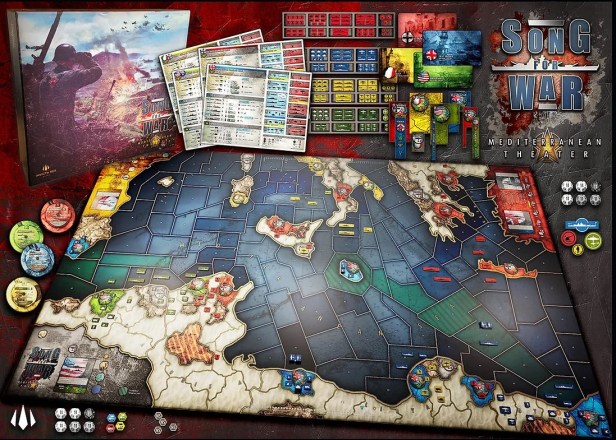
Seth and Chris: Currently, the all-in Mediterranean Theater version will have the 54 x 31 inch dual-sided map, all 4 scenarios, 64 National Support Cards (16 cards for each nation, including unit upgrades, unique units, strategy, and events), and a higher number of the wooden components. The smaller, less expensive game, Mediterranean Operations, will have the smaller map (half the size of the big map) with the two scenarios (Italy on one side, North Africa on the other) along with fewer wooden components. The National Support Cards will not be included in the smaller Operations game offering.
Grant: What advantage do you feel the smaller zoomed in version gives the design?
Seth and Chris: It allows terrain to play more of a factor – mountains and rivers in Italy, desert in North Africa, etc. This opened the door for new mechanics that give each scenario more unique flavor, such as the use of defensive lines in Italy and mobile supply hubs and supply chains in North Africa. We also were able to break up some key objectives and paths to victory points differently. For example, Tobruk is the crown jewel of the North Africa scenario and its full victory points cover several spaces on the board vs. just one – which allows for fighting on various fronts. It also recreates a key part of WWII history as Tobruk was hotly contested.
Grant: What new added specific mechanics have you injected into the zoomed in version?
Seth and Chris: For North Africa, we developed a supply chain mechanic that requires both sides to string supply lines using controlled objective spaces and land transports that can be used as mobile supply hubs. We also wanted to recreate the challenge of the further the Axis or Allies got from their core supply hubs/bases of Tripoli and Alexandria, the tougher it got to keep their forces supplied. This created a see-saw effect as each side was able to push ahead but then stalled and got pushed back again, until eventually the Axis fell at El Alamein. For the Italy scenario, the Germans laid in wait away from the coasts and kept units in reserve and used them to counter punch. We allowed Germany North and South to place units in hidden reserve boxes. So, while the Germans don’t know where the hidden Allied fleets will land, the Allies don’t know where the German reserve units are hidden, either. Another key mechanic for Italy is the use of defensive lines by the Germans. They used staged retreats and defensive lines along Italian rivers to make the Allied advance difficult, so we wanted to give players that option. And lastly, due to the German use of rivers, we added bridges to the map and gave the players the option to blow the bridges, creating logistical and movement challenges for the enemy.
Grant: How does this change the gaming experience?
Seth and Chris: Most importantly, it makes each scenario unique. North Africa and Italy, for example, were very different scenarios during the war, of course, so we wanted them to reflect that history and give players a different experience as well. Different mechanics, terrain, etc. all help with that. The same is true for the full Mediterranean Theater scenarios. If you are playing the November 1942 start at the outset of Torch, if has to be feel and play differently than the alternate April 1943 start. The trick is to provide unique experiences in each scenario while keeping the core mechanics intact and solid across all scenarios.
Grant: How does Battle work?
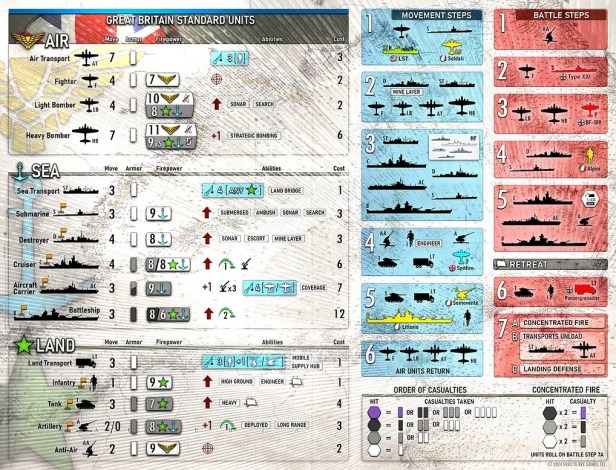
Seth and Chris: Everything is unit based with a focus on combined forces. In addition, nations move and fight together (Allied players vs. Axis players), not nation by nation. To enable better battles, first we use movement steps. In each step, only a handful of units can move and declare battles. Faster, lighter units (e.g., fighters and submarines) move sooner than the bigger, heavier units (e.g. tanks and battleships). In addition, lighter units may also get to move and declare battles several times while heavier units only get to move and declare once. This approach allows for combined forces to provide big advantages – fighters providing escorts and clearing air space, destroyers escorting transports and clearing key shipping lanes, ships and artillery bombarding, etc. For each battle declared, we then use battle steps that allow the abilities of units to come forward, and award using combined forces. For example, on battle step 1, only Anti-Air can fire / roll, and casualties (incoming enemy air units) are removed immediately, before they get to fire / roll. Then, on battle step 2, fighters get to shoot and clear air space, taking out bombers. Then, step 3 bombers, followed by ships and then land units. So planning ahead with your teammate and using combined forces really pays off.
Grant: How did you land on the decision to use 12-sided dice for Battle?
Seth and Chris: We found the use of 6-sided dice, or even 8- or 10-sided, to be too limiting. They did not allow for different units to shine through, with variation on the ability to hit or miss. Each unit also has its own abilities, including a special outcome on the roll of a 12 (which is an 8% chance to actually have that special outcome happen, which worked out well in play testing). For example, on a 12, a fighter or anti-air unit can choose which enemy air unit will be taken as a casualty. This can be huge when the enemy is bringing in a heavy bomber that is escorted by friendly fighters, for example – the 12 allows you to force the enemy to choose the heavy bomber as the casualty before that bomber gets to fire/roll because of how the battle steps work. And every unit has something cool like this that happens on a 12 – and then there are upgraded and unique units to consider as well. This creates a lot of hoots and hollers, and fun around the table, and using 12-sided dice is key.
Grant: How can units Level Up? How does this change their statistics and effectiveness on the battlefield?
Seth and Chris: There are a couple of ways. The first is related to rolling a 12, which applies when acting as the attacker or defender. In most cases, an infantry unit has little to no chance to destroy a tank, or a destroyer taking on a cruiser alone, much less a battleship – which makes sense. The game uses different armor levels and firepower levels to emulate this. However, it is conceivable that a unit with a weaker firepower (e.g., an infantry) will occasionally take out an enemy with stronger armor (e.g., a tank). To allow for this some units can “level up” the firepower of their hit on a 12, thus allowing an infantry to destroy a tank. But it requires rolling a 12, which means ~92% of the time this does not occur. In play testing, and in many of the reviewer videos that are coming out for the game, this mechanic did not imbalance game play – it injects a lot of fun that players enjoy. And no strategy is infallible…things can always go awry.
Grant: How do players earn victory?
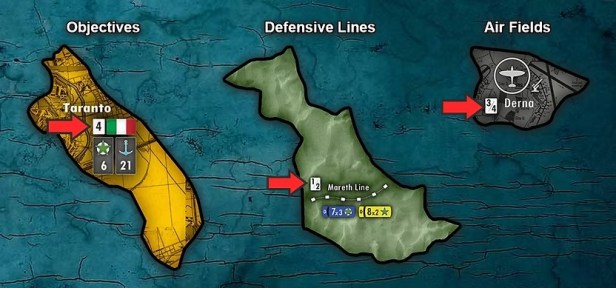
Seth and Chris: Across the board are various objectives and airfields, each with a different victory point value. The bigger prizes, such as Algiers, Rome, Malta, Tripoli, Tunis, Alexandria, Tobruk or Messina bring more victory points to the side that controls them – whereas the smaller ones such as Bizerte, Reggio, Mersa Brega, Derna, Benghazi, etc. all have lower point value. During the victory phase, each side adds up the victory points it has based on the objectives and airfields it controls. It is typical for control of these to change hands several times throughout the game, or even in one tactical phase. For the larger Mediterranean Theater scenarios, the Allies are the invaders, and they start with significantly fewer victory points than the Axis. To win, the Allies must take back a combination of objectives and airfields to reach a threshold of victory points. If they don’t reach it, the Axis side wins. For the smaller North Africa and Italy scenarios, the thresholds and conditions are similar but also with some key differences to reflect the historical conditions.
Grant: What are you most pleased about with the design?
Seth and Chris: Good question. The heart of the game revolves around the unit-based movement steps and battle steps. By taking away nation-by-nation taking turns to move and fight, this changed the entire gaming experience. It cuts out down time, keeps people standing around the table, and enables collaborative strategy – and it’s much more realistic and fun in that the Allied and Axis nations can plan, move and fight together. A close second is we often hear that once people turn the corner on the rules, it’s easy to play – and the player aid answers just about every question. No rule diving.
Grant: What has been the response of play testers?
Seth and Chris: Very positive. They’ve been honest and direct, which is what we need. And the play testing has confirmed our target audience for the game – board gamers who enjoy WWII and are all in to spend a game night in the Mediterranean Theater. Our best feedback comes from folks who also play Twilight Imperium, Axis & Allies, War Room, War of the Ring, Fortress America, etc.
Grant: What other designs are you working on?
Seth and Chris: Right now, it’s nights and weekends to ensure Song for War: Mediterranean Theater funds. That said, should we get there, we’ve already started looking into other WWII theaters – including the Pacific and Eastern Front. Battle of Britain and Normandy are also on the radar as potentials.
Grant: When can we expect the game to fulfill?
Seth and Chris: About 1 year after it funds.
We posted a designer interview with Chris Helm and Seth Stigliano during the first campaign and you can check that out at the following link: https://theplayersaid.com/2023/02/27/interview-with-chris-helm-and-seth-stigliano-designers-of-song-for-war-mediterranean-theater-from-invicta-rex-games-coming-to-kickstarter-february-28th/
*Keep in mind that some things have changed since that first interview but it still gives a good overview of some of the game concepts that we didn’t cover in this interview.
If you are interested in Song for War: Mediterranean Theater, you can follow the campaign on the Kickstarter preview page at the following link: https://www.kickstarter.com/projects/invictarexgames/song-for-war-mediterranean-theater-0
-Grant
 The Players' Aid
palatial! 106 2025 Interview with Chris Helm and Seth Stigliano Designers of Song for War: Mediterranean Theater from Invicta Rex Games Coming to Kickstarter April 23rd graceful
LikeLiked by 1 person