
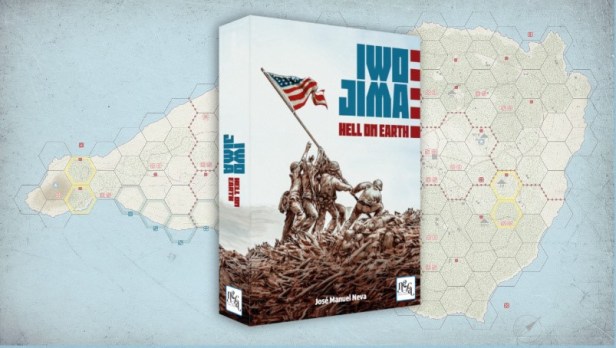
Neva Wargames is a new publisher who appeared on the scene last year. When I started seeing their posts on Twitter and Facebook, I was immediately impressed with their interesting topic choices for their upcoming games as well as the fact that they are trying to make small footprint wargames that pack a punch. And the art is also very appealing and brings an aesthetically pleasing and attractive look to their games! Recently, they placed their first 2 games up for pre-order through their Incoming! Pre-Order System including Sea & Steel: Columbus’ Voyages and Iwo Jima: Hell on Earth and both look really good! I reached out to José to see if he could share some information about his Iwo Jima design and he was more than willing to discuss.
If you are interested in Iwo Jima: Hell on Earth, you can back the project through the Incoming! Pre-Order System for 35.50€ (~$38.65 in US Dollars) from the Neva Wargames website at the following link: https://nevawargames.com/product/iwo-jima-hell-on-earth/
Grant: José welcome to our blog. First off please tell us a little about yourself. What are your hobbies? What’s your day job?
José: Hello Grant, I appreciate the opportunity to participate in your blog. I work as a Building Engineer. In my free time, I engage in sports (mainly calisthenics in the park), read history books, listen to various types of music, and play board games.
Grant: What motivated you to break into game design? What have you enjoyed most about the experience thus far?
José: I rediscovered board games a few years ago, having played them often during childhood. A friend introduced me to modern Eurogames, but I soon found an interest in wargames due to my interest in history. As a result, I focused exclusively on playing wargames. One day, while reading a book, I thought about designing a game and decided to challenge myself. Since then, I have continuously worked on designing games. I take pleasure in summarizing historical events and identifying mechanics that accurately reflect the specific period I am focusing on, while ensuring the development of an engaging and playable game.
Grant: How has the adventure of becoming a wargame publisher and starting Neva Wargames come about? What is your overall objective?
José: The idea began with the concept of auto-publishing games in small, book-sized boxes. Over time, the concept evolved, and now three different product lines are offered to accommodate various types of wargames. More designers have also joined the team. Neva Wargames serves as an extension of the hobby rather than a primary business, operating as a small independent company focused on delivering high-quality products at fair prices. Future success may lead to increased investment in projects to enhance customer friendliness, such as requesting payments before shipping or creating Vassal modules and board game arena versions for broader accessibility. The emphasis is on detail-oriented production, standardizing product lines, and releasing quality games for the wargaming community.
Grant: What lessons have you learned from designing and developing your first few games?
José: I have learned through trial and error, making mistakes and correcting them by receiving constructive feedback and implementing other people’s ideas that improved my games. I have always been open-minded about accepting help from experienced wargamers. Thanks to this experience, I can now design games more efficiently.
Grant: What is your new upcoming game Iwo Jima: Hell on Earth about?
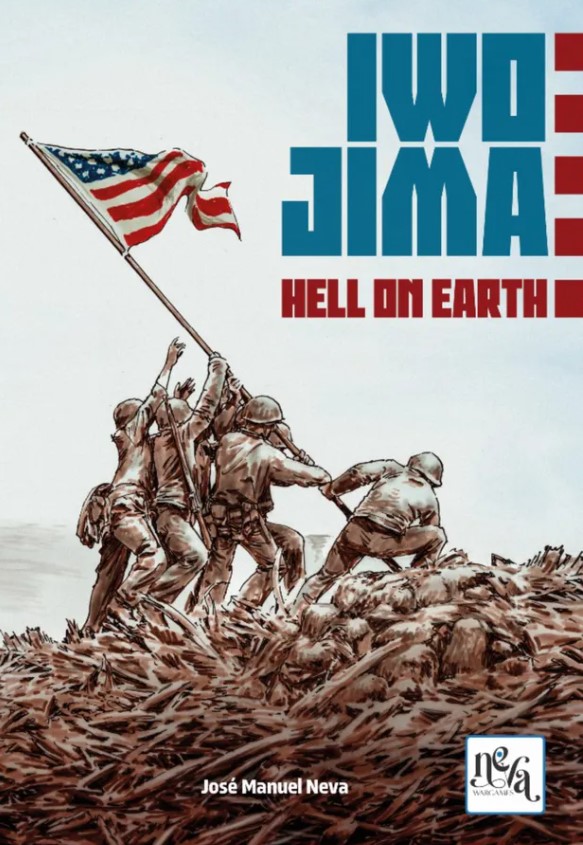
José: Iwo Jima: Hell on Earth is the first game in our Neva Skirmish Line. It’s a hex and counter wargame with some mechanics of my own for the combat and a combination of secondary mechanics to keep the game fresh and replayable. This solitaire game lets you play as the U.S. Marines during Operation Detachment. It offers a challenge for both intermediate and experienced wargamers.
Grant: Why was this a subject you wanted to focus on?
José: I have had the concept for a game like this in mind for quite some time. However, it was while reading a book about the Battle of Iwo Jima and seeing the iconic picture of the raising of the flag on Mount Suribachi, which everyone recognizes, that everything clicked into place. The more I read about the battle, the more ideas emerged for the game, ultimately leading me to design it.
Grant: What is your design goal with the game?
José: I am very happy with the results, and I am considering to keep working on a small series of small WWII battles following this title if the community is interested. After the release, we might conduct some surveys about potential possibilities for the next title that will follow Iwo Jima. [Editor’s Note: My vote would be for Saipan!]
Grant: What type of research did you do to get the details correct? What one must read source would you recommend?
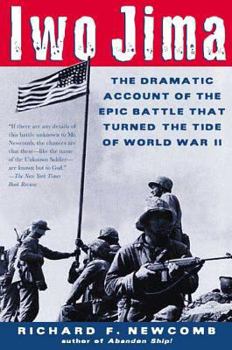
José: I have read several books, watched many documentaries, and read web articles. I recommend the following two books:
– Newcomb, Richard F. Iwo Jima. Holt Paperback. 1965.
– Khan, Mark. The Battle of Iwo Jima. Frontline Books. 2018
The second book has an excellent collection of pictures that make it very engaging. Both books are good, but neither one is a great choice on its own.
Grant: What from the island hopping campaigns of WWII and the Battle of Iwo Jima were most important to model?
José: Kuribayashi initiated the attacks after a significant number of US units landed on the island, creating confusion among the forces. In the game, remaining in a beach landing hex is risky, so moving away from the beach promptly is crucial.
The terrain on the island was challenging. The positions of the Imperial Japanese Army were heavily fortified with extensive bunkers, concealed artillery, and 18 kilometers (11 miles) of tunnels. In the game, there is a chit-pull system that might cause a Japanese unit to be redeployed just before a battle, taking advantage of the extensive tunnel network. This situation requires the U.S. player to adapt to the evolving circumstances.
Grant: What is the scale of the game? How did you design the game around that scale?
José: Given the Neva Skirmish Line mounted map size of 17.32 x 11.81 inches, I needed small battles to fit those dimensions. The Iwo Jima Island spans about 5 miles. Each hex represents roughly 400 yards. The optimal approach to ensuring a controlled game duration and accommodating limited space involves utilizing unit sizes equivalent to those of a U.S. regiment and a Japanese battalion.
Grant: What different unit types does each side have access to?
José: You have at your disposal the 3rd, 4th, and 5th Marine Corps divisions. The operational units are as follows:
• 9th Regiment (3rd Div)
• 21st Regiment (3rd Div)
• 23rd Regiment (4th Div)
• 24th Regiment (4th Div)
• 25th Regiment (4th Div)
• 26th Regiment (5th Div)
• 27th Regiment (5th Div)
• 28th Regiment (5th Div)
• 147th Ranger Regiment (Ohio National Guard)
From the Japanese side you will find the 109th Infantry Division plus elements of the Japanese Navy under the command of Lieutenant General Kuribayashi.
Grant: What is the anatomy of the counters?
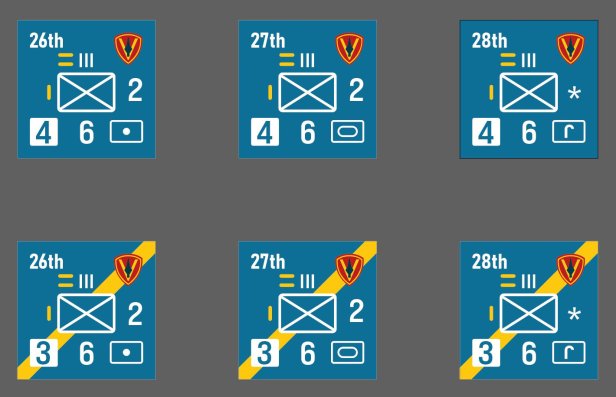
José: U.S. units have 4 steps, two steps on each side. You will find the following information on a U.S. counter:
▶ (A1) Marine Regiment No. ▶ (A2) Division Insignia ▶ (B) Unit Size and Type ▶ (C) Number of Steps ▶ (D) Combat Factor (CF) ▶ (E) Movement Allowance (MA) ▶ (F) Combat Support Type ▶ (G) Combat Support Value ▶ (H) Band indicating the reverse of the unit.
There are three types of combat support for U.S. units: Flamethrowers, Armored and Artillery.
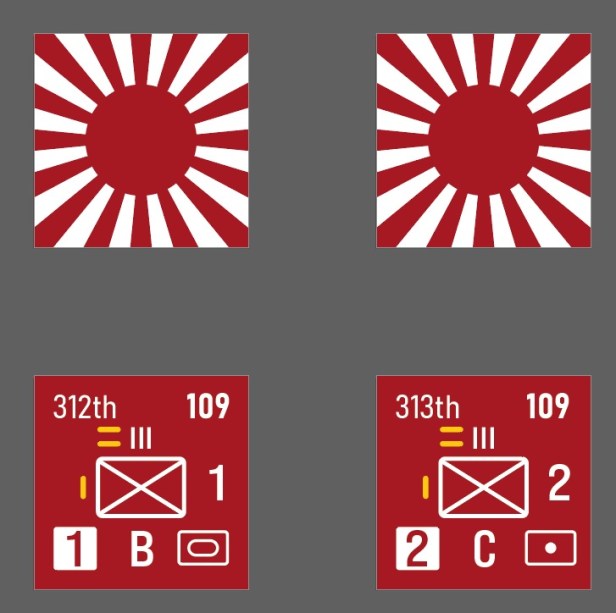
A Japanese unit has only 3 steps and they start on the reverse side indicating the unit is hidden.
▶ (A) Battalion and Division ▶ (B) Unit Size and Type ▶ (C) Number of Steps ▶ (D) Combat Factor (CF) ▶ (E) Defense Type ▶ (F) Combat Support Type ▶ (G) Combat Support Value ▶ (H) Japanese Fla
The letters of the Japanese defense type are used to indicate a Cave (A), a Bunker (B) or a Trench (C).
There are four types of combat support for Japanese units: Headquarters (HQ), Anti-Tank, Armored and Artillery.
Grant: What role does hidden units play in the game?
José: Hidden units play a significant role in the game. Collecting intelligence for the U.S. ensures more strategic planning of attacks. Additionally, hidden units, combined with a randomized initial Japanese unit setup, enhance the game’s fog of war and replayability.
Grant: How does the game model intelligence?
José: U.S. intelligence has some information about potential Japanese defenses, but it is important to verify on the map that there are actual units at those locations. Additionally, more information about those units should be gathered by revealing them to see their actual composition and plan a better attack. Units can be revealed through successful bombardment, combat or reconnaissance.
If you attack a hidden unit or if a hidden unit is supporting the attacked Japanese unit, you will draw Intelligence Chits that provide information about the unit and their combat support value. While attacking hidden units can be risky in certain situations, it is essential to continue advancing to achieve timely victory. Understanding when to attack hidden units or gather intelligence through reconnaissance actions is crucial for success.
Grant: What are Reaction Markers and how do they work?
José: Reaction Markers are special chits drawn during the Intelligence Chit drawing process. This marker has two sides: one representing redeployment and the other a Banzai attack. Historically, it was more likely for Japanese units to proceed with redeployment rather than a Banzai attack due to strategic decisions aimed at maintaining positions for as long as possible. For the U.S. player, redeployment could offer tactical advantages in combat or facilitate faster advancement. However, since redeployment is randomized by sectors, it may also result in reinforcing Japanese defenses, thereby complicating future operations for the U.S. player. Additionally, this mechanic enhances replayability and simulates the hidden movement of Japanese units through tunnels.
Grant: What are Command Markers and how do they work?
José: Command Markers were the last feature implemented in this game. The game can be challenging to achieve victory, so an opportunity was provided for the U.S. player to use special tactics during gameplay. However, players need to manage them carefully, as excessive usage can result in a reduction of Victory Points at the end of the game. Additionally, players can receive Bad Intelligence Chits during the game, which limit the opportunity to use these tactics because they must keep Bad Intelligence Chits that occupy space on the Command Display, which is limited. The special tactics include additional combat support, bombardment, movement, additional attacks, command points, re-rolls…etc.
Grant: What is the general Sequence of Play? What type of experience did you want the Sequence of Play to invoke?
José: The Game Sequence is comprised of 9 phases, ensuring a dynamic gameplay experience while addressing all critical aspects of the game:
- Weather Phase: This phase may impact the movement allowance of U.S. units and affect bombardment for both sides in case of adverse weather conditions.
- Bombardment Phase: Bombardments are carried out by both U.S. and Japanese forces. Each side has different Bombardment Points, with the U.S. player needing to allocate these points strategically for optimal planning in subsequent phases.
- Movement Phase: Only U.S. units are allowed to move during this phase. Before initiating movement, players have one free attempt to reorganize units through a Disorganized Retreat or an Organized Retreat.
- Attack Phase: During this phase, U.S. units adjacent to Japanese units may engage in Reconnaissance Actions (attempting to reveal hidden units by impacting a hit and flipping them to their revealed side) or Combat. Up to two U.S. units can be assigned for a Direct Attack, while up to three units can be utilized for an Indirect Attack, allowing combat support from up to three units.
- Raid Phase: This phase represents the defensive rolls of Japanese forces during night raids against U.S. units.
- Surge Phase: Essentially a repetition of the Movement Phase (Phase 3).
- Exploitation Phase: Essentially a repetition of the Attack Phase (Phase 4).
- Command Phase: Players roll to determine the number of Command Points allocated. These points can be used for reinforcement, deployment of reserve units, drawing additional Command Chits, among other strategic actions.
- Organization Phase: A brief phase designed to facilitate the transition to the next game turn or the end of the game.
This sequence provides a comprehensive structure that enhances the strategic and tactical depth of the gameplay.
Grant: What area does the map cover?
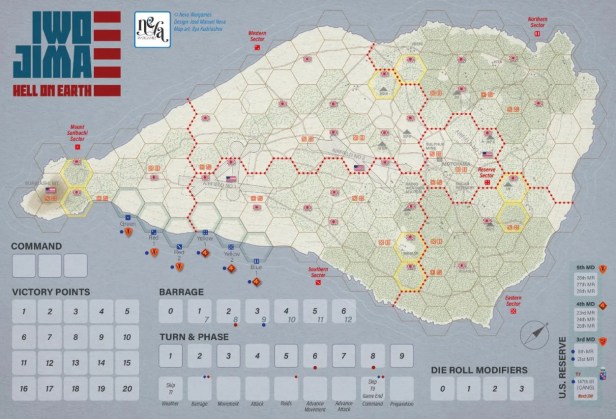
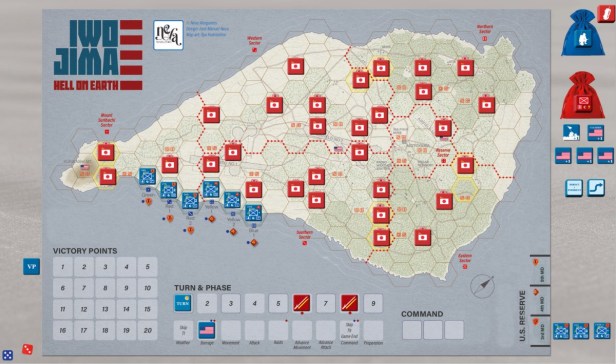
José: Iwo Jima Island covers 5 miles, with each hex representing 400 yards. The map includes five terrain types: Beach Landing, Clear, Rough, Difficult, and Mount Suribachi. It is divided into six Japanese defensive sectors for redeployment purposes.
Grant: What strategic pinch points does the terrain create?
José: For the game, it is essential to consider the following hexes:
- Hexes indicating fixed artillery locations for Japanese forces
- Hexes containing hills
- Hexes containing key objectives for the U.S. player
Other iconography such as towns and roads are decorative, as they are not used during gameplay. Most buildings were utilized to construct fortifications, and the U.S. bombardment prior to and during the battle altered the island’s terrain. Consequently, roads are not considered to be in sufficient condition to be included as an option in the movement chart for this game.
Grant: How does bombardment work? How did you go about building the Bombardment Table?
José: The idea was to use a single table for both sides, but different approaches were required due to significant differences. The U.S. bombardment includes naval and aerial barrage. The U.S. player begins with 9 Bombardment Points and can gain additional points by controlling airfields during the game. In contrast, Japanese artillery is limited, receiving 1 Bombardment Point for each Fixed Artillery Hex under Japanese control. Loss of control over these hexes reduces their bombardment capability.
The U.S. player determines how many points to allocate to an objective, with higher points increasing the likelihood of better outcomes. Additionally, placing certain US units on the map could provide extra roll modifiers. The US player must carefully consider the assignment of Bombardment Points.
Grant: How does combat work in the design?
José: This design involves two critical aspects. A unit can engage in combat through Direct Attack, Indirect Attack, or a combination of both. In a Direct Attack (with a maximum of 2 U.S. units adjacent to the target), the combat factor value of these units is utilized. For an Indirect Attack (with a maximum of 3 U.S. units if conditions are met), the units’ combat support type and value are used to participate in the combat. Units involved in a Direct Attack may also be used for Indirect Attacks as needed.
The next step involves comparing the combat ratio to determine the appropriate table column for checking the die result. Die Roll Modifiers must then be examined, based on factors such as the type of Japanese defense units (which could include Trenches, Pillboxes, or Caves), the comparison between the combat support from the U.S. player and the Japanese side, and terrain effects.
Individuals who have previously played “Iwo Jima: Lite Edition” will find the combat system familiar; however, this version offers a more intricate system that requires a thorough understanding of how to effectively use combat support to optimize probabilities against resilient defenders.
Grant: What is the makeup of the Combat Table? What about the fighting are you trying to model?
José: The Combat Table is a traditional one, slightly adjusted in favor of the Japanese side to reflect the intense nature of the Pacific battle. However, it is designed so that the U.S. forces can progress at a reasonable pace with strategic decisions, mirroring the historical advances of U.S. units during the battle. There is a small chance for a unit to undergo a Disorganized Retreat, or an Organized Retreat can be chosen to minimize casualties.
Grant: How do Banzai Charges work?
José: A Banzai Charge occurs when drawing a Reaction Marker, especially if the U.S. player has many VP or the game is near its end. These situations modify the Reaction Marker Roll. Japanese units performing a Banzai Charge are likely to lose a step but can inflict 1 or 2 hits on U.S. units, making these charges very dangerous for the U.S. player.
Grant: What are Raids and how do they work?
José: The role of Japanese forces is primarily defensive. After researching nighttime raids conducted by the Japanese, I decided to incorporate this element into the game. This phase is straightforward. Players must identify U.S. targets within the range of Japanese units and make a roll. If the Japanese raid is successful, U.S. units may sustain a hit. Any units that end up too close to Japanese units are subject to selection for a Raid roll.
Grant: How do players win the game?
José: Your objective in Iwo Jima: Hell on Earth is to clear the island and secure victory by capturing Mount Suribachi and the three strategic airfields.
To achieve this, you must eliminate all Japanese units, who will fight to the death for their homeland.
You have 9 Turns (36 days) to achieve the objectives. You can get or lose Victory Points as follows:
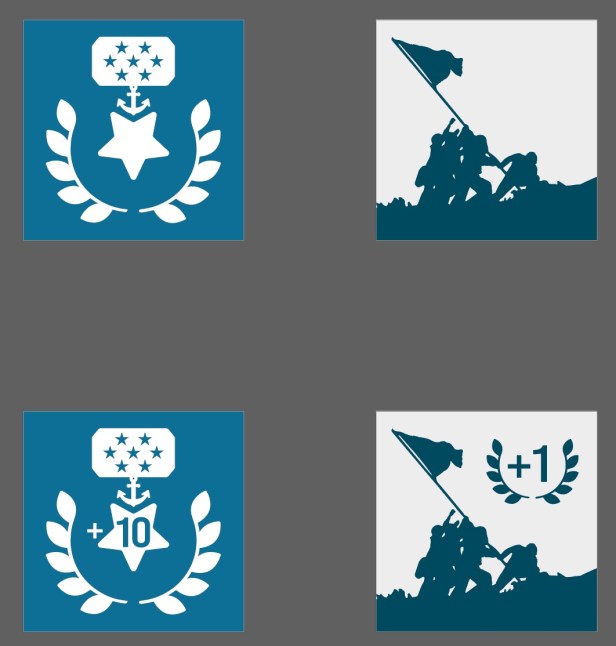
• For every 2 Japanese units eliminated, you will obtain 1 Victory Point (VP).
• Capturing Mount Suribachi in the first 3 turns will grant you 1 VP.
• Capturing the First airfield in the first 4 turns will grant you 1 VP.
• Capturing the Second airfield in the first 5 turns will grant you 1 VP.
• Capturing the Third airfield in the first 6 turns will grant you 1 VP.
• Clearing the island of Japanese before the 9th turn will mean the end of the Operation with 1 VP in your favor.
• Each 3 Command Markers used (off the map) subtracts -1 VP at the end of the game.
• 5 or more U.S. units with 1 or 2 steps at the end of the game = -1 VP
• Japanese surrender: if in the 9th turn, you have managed to control the 4 Key Objectives and there are no more than 5 Japanese units on the island. Roll a die:
Result > number of Japanese units on the map = +1 VP
Grant: What type of an experience does the game create?
José: The objective as a designer was to create a challenging solitaire game that focuses on strategy, player decision-making, and introduces a fresh approach to a combat system based on a classical hex and counter system style.
Grant: What are you most pleased about with the design?
José: A player can complete a full game in less than 90 minutes, using a manageable number of components and requiring less display area on the table. Neva Wargames aims to provide high-quality wargames that balance depth in decision-making and strategy with compactness and playability. This approach accommodates those who do not have extensive shelving space, large tables for game display, or the ability to leave games set up for extended periods. I consider this mission successfully completed. I am very pleased with the outcome and the feedback received from the community so far.
Grant: What has been the response of playtesters?
José: I am fortunate to have very dedicated playtesters on our team who pay attention to even the smallest details. Attention to detail is crucial, and they are a key part of our team. They are currently conducting a final round of playtesting to ensure everything is perfect before printing the final version. I extend my sincere gratitude to all of them.
Grant: What other designs are you working on?
José: I am developing three games: Spartacus: Rome Under Threat, a 1-2 player game about the Third Servile War, which is nearing completion and should be ready for printing next year. Peking: 55 Days of Fury, a 1-2 player game about the Peking siege in 1900, and Cid Campeador: Warlord, a strategic game for 1-4 players set in the Spanish Moorish ages, are both 50% complete. I have many game design ideas in my notebook but need to finish these ongoing projects first.
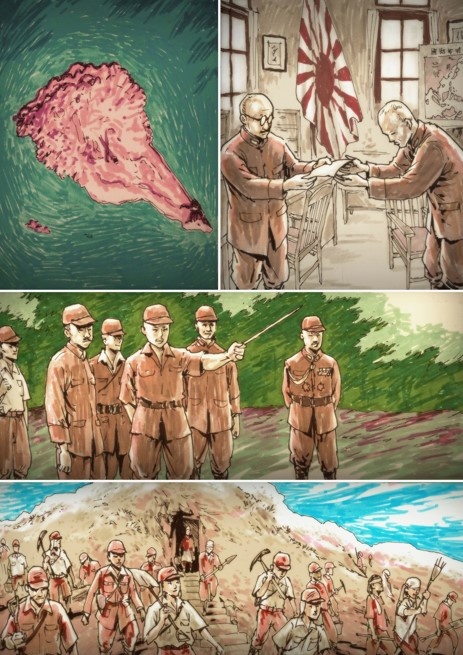
José, thank you so much for your time and effort in responding to our request for this interview and for the great detail that you have given us about this game. I am very much interested in Iwo Jima: Hell on Earth and cannot wait for it to be available to play!
If you are interested in Iwo Jima: Hell on Earth, you can back the project through the Incoming! Pre-Order System for 35.50€ (~$38.65 in US Dollars) from the Neva Wargames website at the following link: https://nevawargames.com/product/iwo-jima-hell-on-earth/
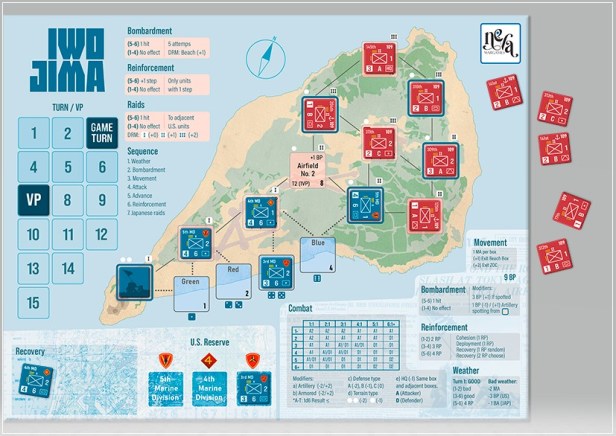
One final note, if you are interested in learning more about this game and what it might become, Neva Wargames dropped a free Print and Play wargame on December 24, 2024 called Iwo Jima that covers the seminal battle by the same name during World War II. It’s a simplified demo of this larger Iwo Jima: Hell on Earth game. In order to get it, you will have to subscribe on the Neva Wargames website for their newsletter, you’ll then receive an email that you will have to confirm and then will get another email containing a download link.
-Grant
 The Players' Aid