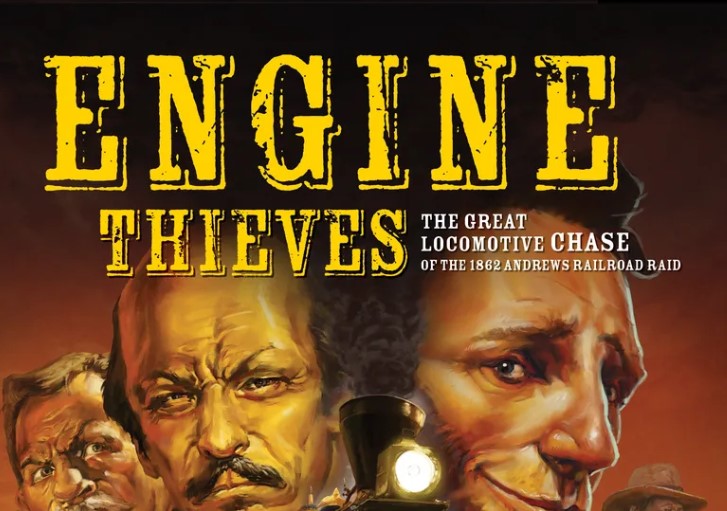
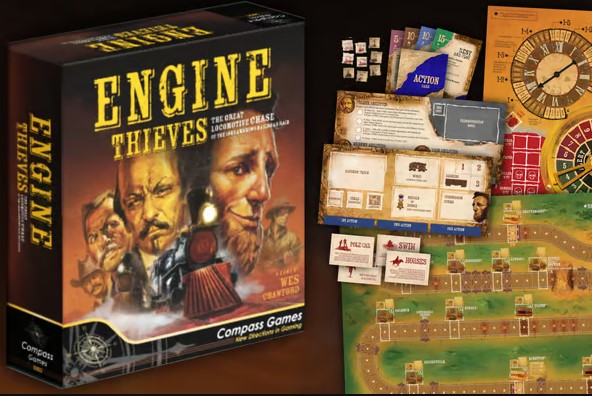
A few years ago, while attending the WBC, I had the chance to meet Wes Crawford who was demoing his upcoming game Engine Thieves: The Andrews Railroad Raid of 1862 from Compass Games. He was a very nice guy and his game was pretty interesting as well. Now that the game has finally made it to Kickstarter, I reached back out to Wes to ask him some questions about the game and he was more than interested to answer.
If you are interested in Engine Thieves: The Andrews Railroad Raid of 1862, you can learn more about the project and back it at the following Kickstarter link: https://www.kickstarter.com/projects/compassgames/engine-thieves/
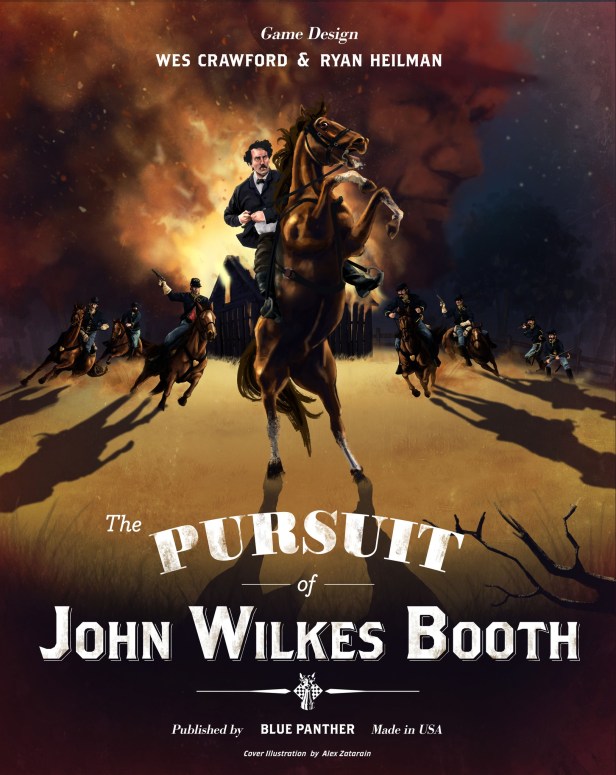
Grant: Wes welcome back to the blog. How have you felt about the release of your latest game The Hunt for John Wilkes Booth from Blue Panther?
Wes: Thank you for reaching out to me, Grant! I have been very excited about the release of The Pursuit of John Wilkes Booth over the last several weeks. Ryan Heilman and I are co-designers of this game and we both feel it came out as we envisioned it. The artwork by Alex Zatarain is eliciting a lot of attention. Steve Jones at Blue Panther supported the project heavily and basically let us determine how the game components were going to be produced. It has a 22” X 34” canvas mat which feels thematic as the player detectives unfold it on a table to begin their search for Booth. All the small components are wooden and there are six sets of cards with historical art. I’m very pleased about gameplay and the narratives that each game produces, which are quite different across games.
Grant: What lessons did you learn from that process that you can use with your new project?
Wes: “Learning” is the key in this field. NOBODY knows everything about designing games and, if they act like they do, I believe they have really hit a rut and don’t realize it or are content with making the same game over and over. I know this from my day job of working as a professional musician, too. So, I have learned a lot with this project about planning and design but remain willing to engage in some trial and error. It’s crucial to play test over and over and test out strategies that are not typical to make sure they don’t break the game. With historical gaming it’s easy to find yourself testing slight variants of historical approaches to make sure it feels historical, but extreme strategies must be tested, too! I also continue to learn much about the impact and integration of art and icons into games. However, if you are referring to how I might use what I have learned from the Booth game to bring to the Engine Thieves game, that would be the other way around! Engine Thieves was first conceived over 4 ½ years ago and was signed with Compass not quite three years ago and is presently Kickstarting (March, 2025). The Booth game was signed only a year ago and it is already out! Blue Panther can move quickly because they are a printer and because they don’t have a large backlog of signed games in a queue like so many other companies.
Grant: How is your and Ryan Heilman’s new publishing company Wharf Rat Games going?
Wes: Thanks for asking! Ryan is a pleasure to partner with. He is very even keeled and knows much more about business than me. Our skills seem to complement each other’s well and we talk and write just about every day. I’m not going to downplay how incredibly fortunate we are to sign Hermann Luttmann as designer for our first game release, A Forlorn Hope. It’s like participating in an ongoing Masterclass just observing how Hermann works and thinks about design! His push-your-luck system with this WW1 trench warfare game is quite marvelous and fun, and rather addicting! Ryan and I also have our Rat Chat Show which we produce monthly for You Tube. Our main goal with the show at this point, besides increasing our name recognition, is to promote the board game industry, so we have interviews with designers, publishers, developers, and artists which are all very fun and insightful. And you are on our interview list, Grant!! We give away a second-hand game in each show, too, with those signed up on our email list eligible to win. We plan to attend Circle DC, Origins, WBC, Connections, and some local DC/Baltimore/PA cons this year, and I’ll be at Compass Expo in May and November. We’ll be playtesting A Forlorn Hope, so I hope to see your readers there!
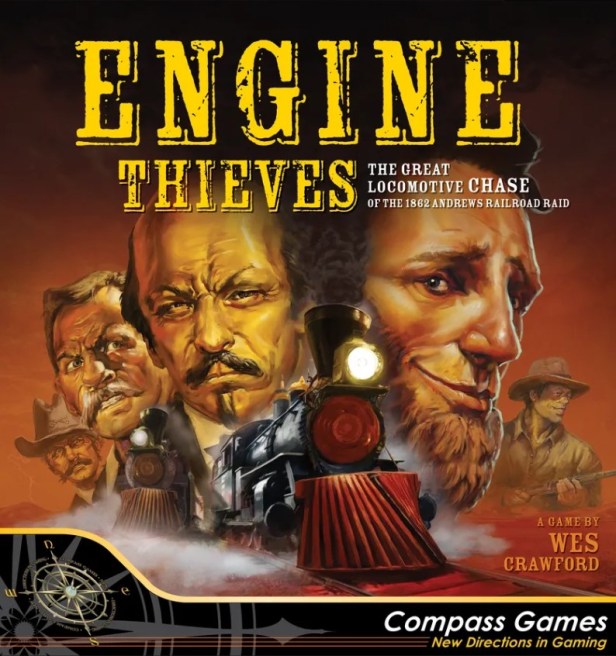
Grant: What is your upcoming game Engine Thieves about?
Wes: Engine Thieves is what the Southern newspapers called Andrews’ raiders in 1862 when reporting on what is commonly called “The Great Locomotive Chase”, named after the 1880’s book by raider/author William Pittenger. Disney turned this into a 1956 film with the same name. In April of 1862, Union General Mitchel believed he had a good chance of advancing on and capturing Chattanooga and possibly ending the Civil War quickly by splitting the Confederacy in half, and by subsequently advancing on Lee on a second front via the railway at Lynchburg, VA. Mitchel was worried about the rail line connecting Chattanooga with Atlanta and all of the supplies and fresh troops there. James Andrews, a double spy getting rich from smuggling for the CSA but mostly working for the Union, proposed taking 24 volunteer soldiers, dressed as civilians and armed only with pistols, south to Marietta, GA where they would board a train heading north acting like they didn’t know each other, then steal the train, next to 3,500 Confederate troops, when everyone else got off for breakfast at Big Shanty (now Kennesaw)! They were then determined to burn bridges, tear up track, and cut telegraph wires and meet General Mitchel past Chattanooga in Bridgeport! Andrews was extremely charismatic and good at bluffing his way through stations. However, Andrews did not count on the train’s conductor, foreman, and engineer (Fuller, Murphy, and Cain) chasing them first on foot, then with a pole car, then on several trains! Eventually, under pressure from pursuers and with time consuming station encounters and six other trains heading south on this single railroad track, Andrews and the raiders ran out of wood for the train two miles past Ringgold and they abandoned the train. All of this and much more can happen in the game!
Grant: Why was this a subject that drew your interest?
Wes: First, I strongly believe that small unit raids during the ACW are one of the most under-gamed segments in historical gaming, yet the narratives are fascinating! I grew up watching this movie on TV and it resonated with me. However, this is actually the second small unit ACW game I designed. About a dozen years ago I was in a Washington, DC bookstore, Politics & Prose, and flipped open to a page in a coffee table book on the ACW. The page described a Confederate raid on St. Albans, VT!! I had never heard of this! A few years later when I started getting back into gaming and game design after being out of it for about 35 years, I decided to make a game on this event, or rather series of events covering The Raid, The Escape to Canada, The Trial, and The Covert Mission. This game is going to artwork now with Compass. After this, though, I thought that I would also like to make a Union raid game that also included about 20 raiders dressed as civilians traveling behind enemy lines to steal something of value, to burn structures, and were chased by railroad workers. And then I remembered watching Disney’s The Great Locomotive Chase on our black and white TV as a child, and now it’s a boardgame! The raiders called their raid a “Yankee Scare Party,” so that will probably be in the title of the game.
Grant: What is your design goal with the game?
Wes: As with most historical games, I want to present circumstances as factually as possible yet give players agency over the relevant participants and make alternate decisions. Consequently, as a small raid, each Union raider has their own counter with their picture on it, and they “ride” on the train represented on the Raider Dashboard. Fuller, Murphy, and Cain (F/M/C) have their own dashboard while their presence on the board is represented by a counter of their mode of transportation. Andrews’ ability to coerce and bluff station workers is represented by his finite number of Persuasion Cubes which the player may wager to augment a Challenge dice roll and to convince south-bound trains to get out of his way. Andrews told station workers his train was full of gunpowder and he was on a special mission to get it to Beauregard. Shiloh had just occurred, and the Southern newspapers declared it a great Confederate victory. Station workers did not want to get near a train carrying gunpowder, either! So, my goal was to create a historically accurate setting but where players could try alternate options for completing the mission and attempt to augment their luck and push on, not knowing for sure what awaits them on the track ahead. There is a fun two-player version which incorporates secret Action Card play, Event Cards containing narrative historical events and lots of “Gotcha” moments, and Medals of Honor counters that help raiders in combat and are earned by causing chaos in Northern Georgia. The Union soldiers attempting this mission were the first to receive the Medal of Honor and I wanted to incorporate that into the game.

Grant: What sources did you consult about the details of the history? What one must read source would you recommend?
Wes: The Great Locomotive Chase by raider/author William Pittenger is a must-read primary source. Stealing the General written by Russell Bonds is the best book I found that combines information from many other books into a single work, although I think he’s a bit harsh on Pittenger.
Grant: How have you included the family of those in the game development?
Wes: Yes!! Through a set of circumstances and contacts on Facebook, I contacted William Pittenger’s great-great nephew, Gregg Pittenger. Gregg is a lifelong historian on this event, has been a Civil War reenactor (including in the Gettysburg film), and has been an avid wargamer most of his life. He lives in Ohio but met me in Indianapolis when I was at a drumming convention there with 7,000 drummers. We played my first prototype in the hotel lobby with drummers giving us strange looks until about 3:00am and really hit it off. I asked him to be the developer for the game and he has done a great job! During the raid’s anniversary around April 12th, we plan to meet in Georgia and tour the sites and museums of the raid and play the game with people along the way. He has done this trip many times, but this is my first time.
Grant: What other games did you draw inspiration from?
Wes: At first I was going to design the game along the lines of the St. Albans Raid game, but even though the raids are essentially two sides of the same coin, there were enough differences that I started from scratch in trying to model this very unique historical event. It’s essentially a straight-line point-to-point system where I had to model the personalities involved as well as the extensive fog of war for what lay ahead of the raiders. Each turn is 15 minutes of game time, and each space is one mile. So, there really isn’t another game like this. Mosby’s Raiders has facedown enemy counters, too, but that’s where similarities end, and I did not play that game until after I finished mine. This is a covert raid with mission goals. Like any such game, the only violence the raiders need to do are those acts associated with their mission, and they need to stay discreet by cutting telegraph wires and by bluffing their way through stations in order to survive. I’m not sure if there are many games like that, maybe Ranger, Raid on St. Nazaire, or the like, but none are on a train where you must worry about your wood fuel consumption. With that said, David Thompson’s Valiant Defense Series showed me that you could design exciting games at the man-to-man level without being overly complex, and I love Hermann Luttmann’s immersive and evocative language in his games.
Grant: What has been your most challenging design obstacle to overcome with the game? How did you solve the problem?
Wes: Originally, Engine Thieves was going to be a two-player game, but it quickly morphed to a solo system from the raiders’ perspective. Brittani at Compass wanted a two-player mode, though, so I approached this from scratch again. In the solo system the raiders player plays 15 minutes of Action Cards each turn. I kept this and added Action Cards for the CSA player with direct agency over the actions of Fuller, Murphy, and Cain. The CSA player also has some control over the Train Schedule Stacks (TSS’s) heading South towards the Raiders. This part of the game can be much deeper and strategic than can be gleaned at first glance, so I recommend that players think through their decisions with the TSS’s carefully. Much will be learned from the experience. The two-player mode allowed me to add Event Cards that contributed a number of interesting anecdotes to the narrative as well as hope for the CSA player if things seemed hopeless. The Medals of Honor mechanics balance the Event Cards and provide incentive for the raiders player to act aggressively to earn MOH tokens that provide a chance to mitigate casualties in rough spots.
Grant: What are the hallmarks of Compass Games’ Golden Age Collection?
Wes: You should ask Compass this question for the most exact answer, but I see this series defined as conflict-driven games that feel cinematic in scope and that bridge the perceived gap between wargames and Euro games. My game has the added bonus of being a special kind of “train game.” At its heart, I feel this is predominantly a historical Civil War game, though.
Grant: What is the layout and function of the game board?
Wes: The game board is a representation of the rail line from Big Shanty to Bridgeport. I want the players to feel this distance, so each space equals one mile and it is 126 miles from Big Shanty to Bridgeport. Although the actual rail line runs roughly southeast to northwest, the artist designed a serpentine track that allowed for a 22” X 22” board. If the track ran historically roughly straight on a long board that board would have been about 100” X 8”, which is obviously not very practical for players or publishers! One funny story was that the artist, from Finland, designed the first iteration of the board completely tan and with cactus…I guess he was thinking of cowboys in the Wild West when he was first tasked with designing a board from 1862 with trains chasing each other. He fixed it when he understood that this was not Arizona or Nevada, but rather Georgia in the springtime! And, to be honest, if I was asked to design a board for a wargame in Finland, I would have probably made it all white with snow.
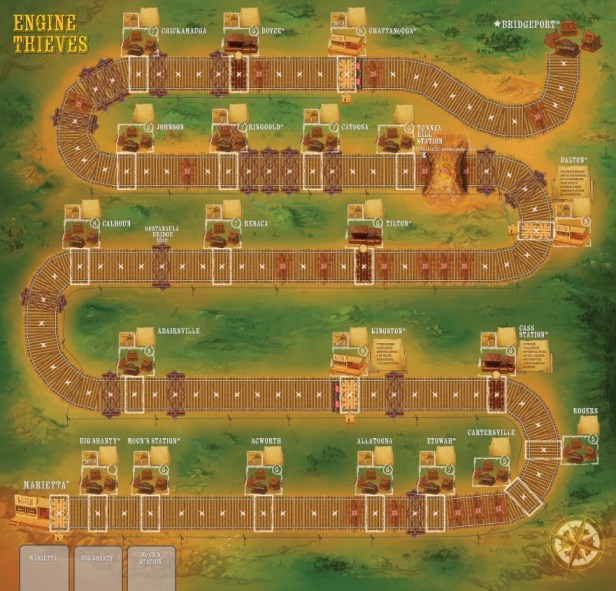
Along the rail line are stations with specific rules and Challenge values, dangerous track, and the all-important bridges that need to be burned. The telegraph line runs parallel to the track, with Marietta, Kingston, Dalton, and Chattanooga serving as telegraph stations. Three wood stations – Cass Station, Tilton, and Boyce are very important for keeping the raiders’ train running. CSA units with hidden strengths reside in most stations.
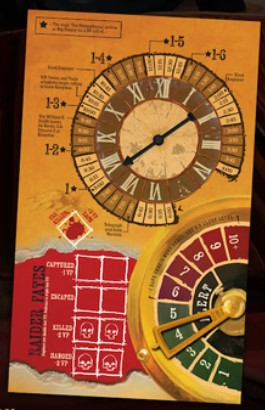
Grant: What is the function of the Tracking Board?
Wes: The Tracking Board was mostly Brittani’s design and is very cool! One circular track looks like a clock and utilizes a plastic clock hand to track 15-minute turns, along with pertinent information for specific turns. The other semi-circular track has a plastic arm that looks like a train control, and this tracks the Alert Level.
Grant: What different type of cards are included in the game? How are they used to carryout the process of the escape and the pursuit?
Wes: The engine of the game is the set of reusable Action Cards for each side. These cards take 0, 5, 10, or 15 minutes each and may total to no more than 15 minutes per turn. The order that they are played is crucial. Any current card may be replayed but the last card in the sequence is then discarded for the turn. The raiders’ 5-minute “Combat Attack” card may be inserted into a card sequence at any time to give them some necessary flexibility.
Marietta and Big Shanty Cards may be played by the raiders player before game play begins and may change the initial deployment of the raiders. Particularly important is the “Henry Greene Cole Union Spy” Card which allows the player to inspect and potentially discard six counters from Train Schedule Stacks. Moon’s Station Cards allow the raiders to stop there and gain some tools for tearing up track if they so choose. Pursuit Cards depict each of the eleven trains that somehow participated on the day of the raid along with cards labeled “Run,” “Pole Car,” “Swim,” and riding “Horses” for the pursuers. As previously mentioned, Event Cards add interesting capabilities in the two-player version.
Grant: How are the Pursuit Cards and the Train Cards used?
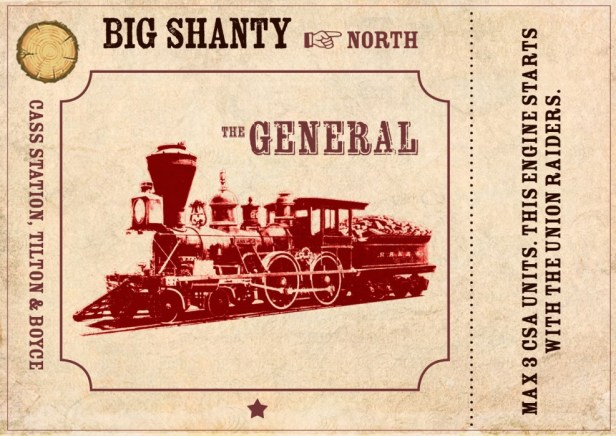
Wes: Pursuit Cards are placed in their designated box on the CSA player’s dashboard. The top card always shows the transportation mode for Fuller, Murphy, and Cain. This includes the Train Cards, except that “The General” is placed on the raider player’s dashboard since that is the train the raiders originally stole. Some trains will come under the CSA player’s (or bot’s) control, such as “The Chattanooga Military Train” that is only activated if a telegraph warning message ever reaches Chattanooga. Historically, “The Pennsylvania” didn’t reach Big Shanty from Marietta until noon. However, if those in Marietta had taken the “Engine Thieves” seriously it could have given chase and reached Big Shanty as early as 8:00am, so that is possible in the game. Most thought Confederate deserters had likely stolen the train at first, and that they would be easily caught or would soon abandon the train. Did I mention that 3,500 Confederate troops were camped next to the track at Big Shanty when the train was stolen?!
Grant: Can you show us a few examples of these cards and explain their game effects?
Wes: Here are some of these cards and their effects:
-Here is the Pursuit Card for “The General” with relevant information. Since it can be abandoned by the raiders for another train and then F/M/C can commandeer it, notice it, too, shows how many CSA units can ride the train.

-This is the “Suspicious Railroad Workers” Event Card. It is very helpful to the Confederate player when they spring this card on the raiders player getting ready to undergo a Station Challenge! It is used to slow them down by requiring them to have to undergo and additional challenge that must be completed allowing the pursuit to catch up.
Here are several Action Cards:
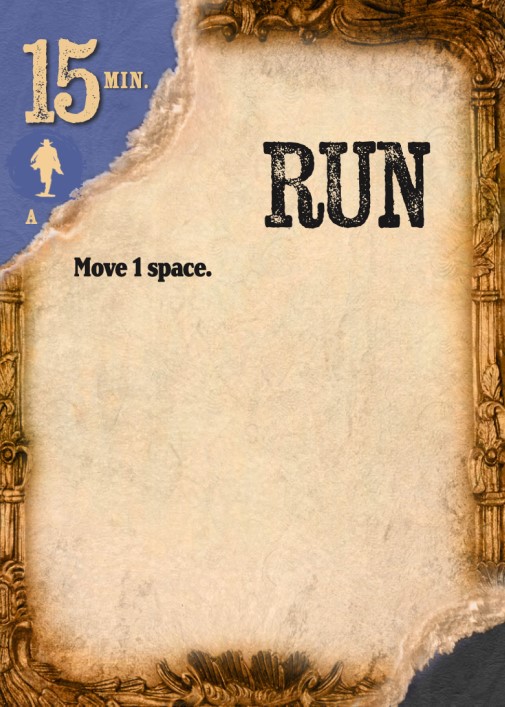
-This raiders card takes 15 minutes for them to move on their stolen train. Notice that the player may choose to either go slow, medium, or fast which determines how many spaces they move and how many wood cubes are expended during the movement. A key point for the raiders is the management of their fuel resources and this can be a very key decision point. The raiders are penalized for going into or through stations at fast speed since that raises the Alert Level.
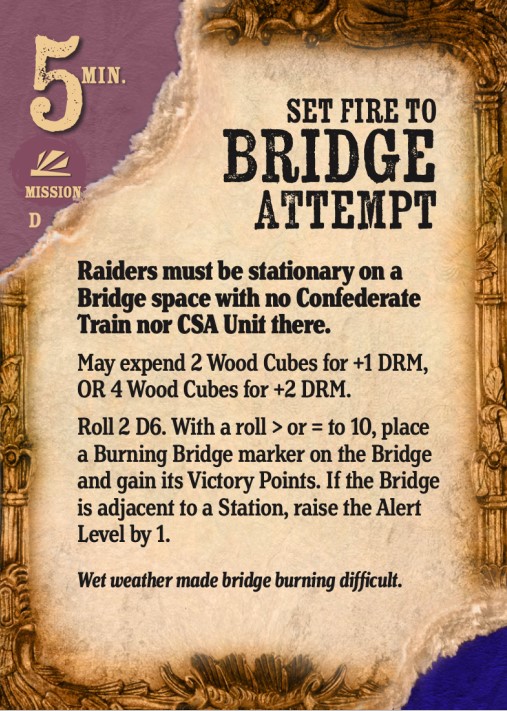
-This raiders card takes 5 minutes to attempt to burn a bridge. The act of burning the bridge is intended to slow the pursuit of the CSA allowing more time to get away. As you can see though, there is a choice to burn up some of your needed wood resources in order to do this which will ultimately slow them down later. This is a key risk/reward strategy decision that must be made and creates some really interesting decision spaces.
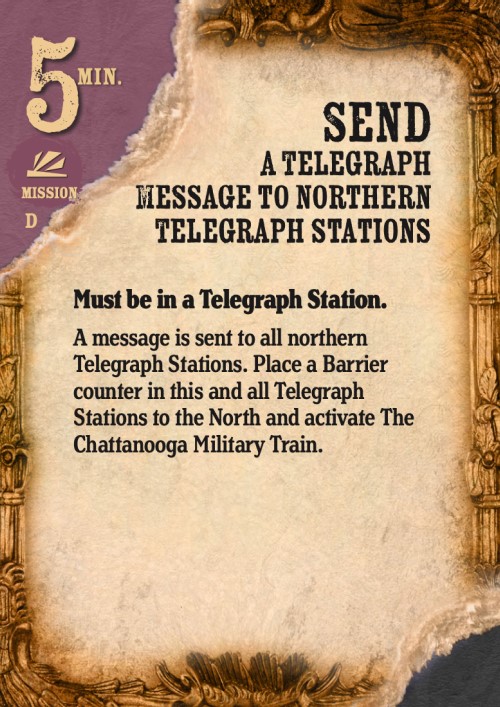
– The Send a Telegraph card shown above is a 5-minute CSA Card that allows F/M/C to send a telegraph message to be sent north to alert other telegraph stations that a train has been stolen and is heading their way. This is cataclysmic for the raiders!
Grant: What is the layout of the Player Dashboards?
Wes: The Raiders’ Dashboard has a box for the train card they are currently riding on, always starting with “The General.” Next to this is a box for the train’s tender where the wood cubes are kept. Then there is a box for the individual counters for the raiders. Notice there is also a track for the number of boxcars left on the train since the raiders player may choose to cannibalize boxcars for wood. Historically, this was done! Below all of this, there are spots to place the Andrews counter, counters for the engineers, and tired engineers. Then there is a box for earned Medals of Honor counters, and finally a box for Andrews’ Persuasion Cubes.
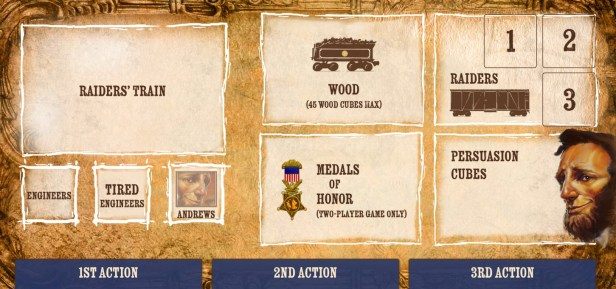
At the bottom are slots for Action cards.
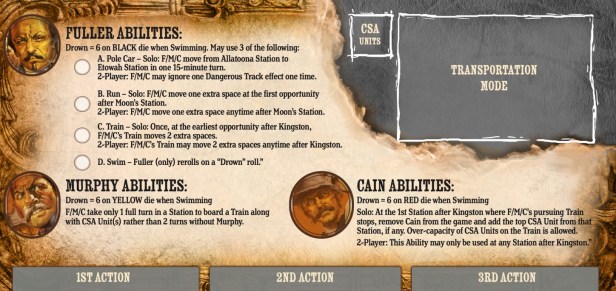
The Confederate Player’s Dashboard (or the bot’s) shows Fuller, Murphy, and Cain and lists their special abilities. In the top right corner is a box for their current transportation mode as well as any CSA units travelling with them.
At the bottom are slots for Action cards (two-player mode only).
Grant: What different actions do the players have?
Wes: This game allows for lots of actions by each player as long as they never exceed 15 minutes each turn. It might be easiest to list them without explanation:
RAIDERS (numbers represent minutes; variable minutes are due to various circumstances) – Move 5, Move 10, Move 15, Cut Telegraph Wire 5/0, Set Fire to Bridge Attempt 5, Damage Track 15/10, Challenges & Encounters 5, Load Tender at Wood Station 5, Emergency Wood 10, Break Up Boxcar for Wood 15/0, Combat Attack 5, Attack and Capture Southbound Train 10, Destroy the Yonah at Etowah 10, Decouple Boxcar 5, Throw Rails and Ties on to Track 5/0, Remove Barrier 5, Rest and Plot 15, Abandon Train 5.
Additional cards for two-player mode – Send Un-Manned Train Southbound 0, two Dummy 0 cards.
CONFEDERATES (numbers represent minutes; variable minutes are due to various circumstances) – Run 15, Pole Car 5, Pole Car 10, Pole Car 15, Swim 15, Horses 15, Train 5, Train 10, Train 15, Send Telegraph Message to Northern Telegraph Stations 5, Pursuers’ Train Loads Wood 15, Pursuers Commandeer a Confederate Train 15/0, Cain Leaves the Chase 5, Load CSA Units 5, Alert CSA Units in Station 5.
Additional cards for two-player mode- two Dummy 0 cards.
Grant: How is victory achieved?
Wes: Raider VP totals determine victory. The raiders player needs 25 VP’s in solo mode and 16 in two-player mode to win. There is a fairly wide margin that encompasses a Draw in this game. Technically, the raiders should only win if they wreak havoc AND reach General Mitchel in Bridgeport to report their accomplishments so he could advance on Chattanooga, but that’s a high bar to attain. There was some victory in simply stealing the train on such a daring mission since the mostly negative perception of Union soldiers to that point changed after the raid and Confederates were forced to guard bridges afterwards.
Basic VP’s are earned by:
-Burning a bridge = 6 VP’s (the Oostanaula Bridge = 15 VP’s)
– Cutting a telegraph wire = 2 VP’s
– Damaging Track = 1 VP
– Eliminating a CSA unit of any strength = 3 VP’s
– Reaching Bridgeport with the stolen train = 15 VP’s
– The raiders player loses (-1) VP for each captured raider (Engineers X 2 and Andrews X 3)
– The raiders player loses (-2) VP for each killed or hanged raider (Engineers X 2 and Andrews X 3).
Grant: What different modes does the game offer?
Wes: This game may be played solo or with two players. I highly recommend that new players start with the solo mode and learn the basic mechanics. Then the additional two-player mechanics will not be so difficult to understand. Mastering them is another story, though!
There are two other scenarios that players might enjoy:
- Historical Scenario. This basically locks down the initial conditions regarding available raiders, what happens in Marietta, Big Shanty, and Moon’s Station, and what happens as the raiders reach Etowah and see “The Yonah,” to match the raid’s history.
- April 11 Scenario. The raid was originally planned for April 11th, not April 12th. Due to heavy rains further north in Tennessee, Andrews saw that his raiders were not going to all make it to Marietta to begin the raid by the 11th. He made the decision to wait a day to begin the raid since he reasoned that the rains would have held up Mitchel’s forces by a day or two, but they hadn’t. The April 11 scenario imagines the raid occurring a day earlier with fewer raiders, without Murphy since he just happened to be riding “The General” on the 12th and with bridge burning much easier since it was sunny along most of the train’s route this day.
Grant: What type of experience does the game create for the players?
Wes: In solo mode, I believe the game provides a fresh experience since I don’t believe there is another game like Engine Thieves in the marketplace. This is mainly due to the unique situation that the game models. I have asked play testers if they can think of a similar game and so far, they have said they cannot. Out of over 175 play tests, Gregg and I have only had three people dislike it. One said it was a chase game and chase games made them feel nervous. One said they only play pick-up-and-deliver train games, and one person left the game early for another reason I shouldn’t reveal but I understand.
The two-player game can get very tense as things don’t go their way for the raiders and they realize that many trains and TSS’s lay ahead of them with F/M/C closing in from behind. Then there are times when it seems the raiders are coasting to victory and Event Cards get played that put them in unexpected jeopardy. Honestly, with F/M/C running at first and then switching only to a pole car at Moon’s Station, it’s easy for the Confederate player to feel like their play is a bit programmed for a while until they commandeer a train. However, there is some very strategic game play with the TSS’s and trains heading south. Just to give advice to your wargamer readers, treat the beginning play as if you are holding a line that a mobile force punched through. While you try to stabilize that line with your frontline forces (F/M/C), you have reinforcements and reserves that may reach strategic choke points to slow down and challenge the breakthrough units. It takes a while for most Confederate players to realize they have a lot more control over the beginning part of the game than they first think.
Grant: What are you most pleased about with the design?
Wes: For me, it’s always the history. Gregg and I seriously researched (he already knew so much!) this raid and, if anything, we have erred too much on including historical elements. I won’t say it negatively affects gameplay, but there are a fair amount of unique rules referencing various stations and specific trains. We could have simplified even more than we did in a few places, but uppermost in my mind was the thought that I don’t want some historian or family member of a raider telling me I got something wrong! One example is that “The Pennsylvania” has never caught the raiders in 200 plays. It would have been easy to just get rid of that train and its rules for activation. Still, it’s mentioned in the history books and I’ll just wait for that one time where it picks up F/M/C and catches the raiders before they can burn a bridge behind them. Similarly, there is a special ambush rule at Tunnel Hill (a long railroad tunnel that F/M/C were worried could be a prime ambush). Probably my greatest boardgame moment ever was when Gregg was the Confederates, hot on my heals, and I just stopped at Tunnel Hill and waited for him to move up to my train and I committed a vicious ambush on him and eliminated all his CSA units! I had cut all the telegraph wires so it was smooth sailing bluffing my way through Chattanooga and meeting General Mitchel in Bridgeport! I hope Gregg doesn’t read this…
Grant: What other designs are you currently working on?
Wes: For Compass Games, the St. Albans Raid is next, followed by a historical fantasy game called Flat Earth. If The Pursuit of John Wilkes Booth game sells well, I have a related game idea in mind that would bookend the Civil War. I’m excited about a new wargame system I have coming up which is called the Urgent Commands System. I first applied it to the Battle of the Bulge since it’s probably the most published battle in gaming. My thought are that if I can present players with an enjoyable game with a new system that gives them a novel and fun system for a tried and true battle, then I might have something to offer. I played it with a noted Bulge designer at Compass Expo and he said he liked it, so I’m excited about getting this ready to release and trying the system out with other battles.
I have done research for games on the last day of WW2, a glorious Union unit from the ACW, and a famous WWII film mixed with historical fact and mystery. This sounds like a GMT newsletter section for upcoming games, I guess!
I also have a Cold War card game called Cold Warrior I’d like to publish, as well as my Terror Cell- Washington, DC game. Both are up on The Game Crafter. Wharf Rats could publish some of these but we keep running into possible opportunities to publish games by noted designers, so we keep pushing our personal projects off.
Thank you for interviewing me again! Please believe me when I say that you, Alexander, and The Players’ Aid are greatly loved in the historical gaming community. You provide an invaluable service to gamers, designers, and publishers alike.
Thanks so much for your time in answering our questions Wes about the game. I am very much interested in this little peace of American Civil War history and I cannot wait to give it a go.
Here is a link to a video interview with Wes and special guest Gregg Pittenger while attending WBC in 2022:
If you are interested in Engine Thieves: The Andrews Railroad Raid of 1862, you can learn more about the project and back it at the following Kickstarter link: https://www.kickstarter.com/projects/compassgames/engine-thieves/
-Grant
 The Players' Aid
I’ve played war games with my cousin Gregg since the 1960s and have seen his luck with dice turn and bite him! I’m glad you contacted me so I could introduce you two. Looking forward to getting a copy of the game myself!
LikeLiked by 1 person