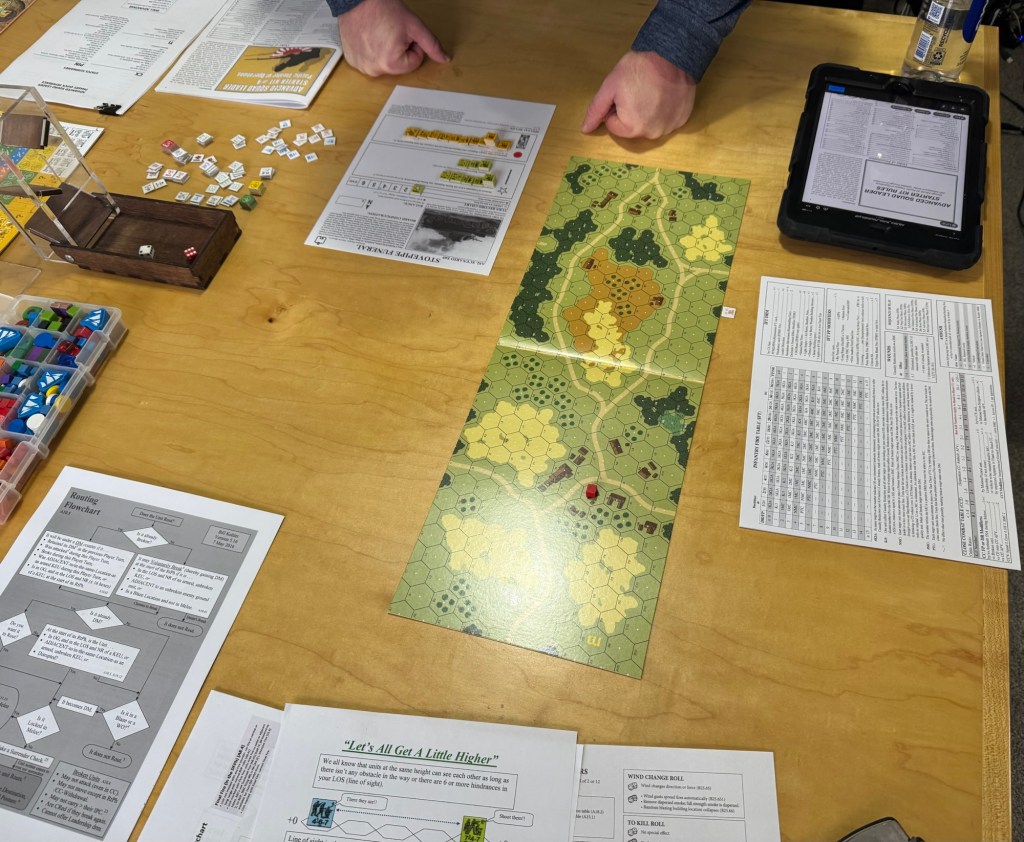
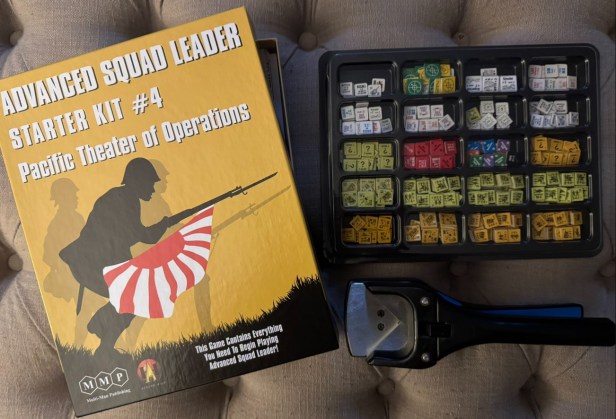
This one has been a long time coming! But I was recently fortunate enough to have a friend from St. Louis visit and teach me the basics of the Advanced Squad Leader Series. I say basics as we played my recently purchased copy of the Advanced Squad Leader Starter Kit #4: Pacific Theater of Operations that I had picked up at WBC last summer. We played for about 4 hours and tackled ASL Scenario S69 called Stovepipe Funeral from the Starter Kit. I am very much overwhelmed with my thoughts on this interesting and detailed game. I am not going to do the game justice in this piece as this is just my initial thoughts and impressions after playing a single scenario but I want to give you those thoughts in this first impressions post.
I fully expect that many of you will vehemently disagree with my opinions on the system and the game, and that is totally fine. I am not really sure that my opinions are totally formed at this point and are definitely a far cry from a final verdict. I will say that I have a desire to try this one again and in my opinion that is a good thing.
First off, let’s take a look at what Advanced Squad Leader is and then by comparison what the Starter Kits are about. Advanced Squad Leader or ASL is a tactical level boardwargame that is set on the battlefields of World War II. The game is a very in-depth and detailed look at tactical operations and involves lots of elements that you would expect from this type of game. It is commonly known for its large voluminous and dense rulebook as well as its immersive gameplay. I know that some would say that ASL is one of the greatest wargames ever made. However, some would say it is very complex and doesn’t accurately model certain aspects of World War II combat. I have also heard that some think that the rules are difficult to grok and get and it is very easy to forget little things or steps as you move through the process of the Sequence of Play. Therefore, many feel that it is helpful to have someone who knows the system to teach you the game. I would definitely agree with this and was very appreciative to my friend Mike and his efforts to assist me in this endeavor.
The Starter Kits are designed as a ramp up to the full Advanced Squad Leader experience. The Starter Kits have provided a means for new players to soften the learning curve involved with the game and partially game aspects of the rules that will expand and grow upon each other as you progress through the scenarios in each pack but also as you move from ASL Starter Kit #1 to Starter Kit #4. I will say though that the process of learning these rules, while a bit dry at times and very involved and tedious, had a certain aspect of charm or magic to them. What I mean by this is that you can see things progress as you get into the game and link concepts and rules together to create a cohesive experience with the rules. It doesn’t mean that they are easy though as the process is involved and will take some time and practice. I will say that as you get into it, and you are going through the steps, you kind of begin to not think about the rules that much and just get into the play. What I mean by this is that the rules become a bit ingrained in your thoughts as you go through the steps and you stop worrying so much about getting things right!
Complexity
This is the big thing with Advanced Squad Leader. There are simply a lot of steps and a lot of rules. It is very complex. And those that play the game are proud of that complexity and feel that it is absolutely needed in these type of tactical level wargames. And those steps and rules all have a specific acronym. AF (Armor Factor), AFPh (Advancing Fire Phase), CCPh (Close Combat Phase), CAFP (Cover Arc Focal Point), DFPh (Defense Fire Phase), DM (Desperation Morale), FF (First Fire), FFE (Fire for Effect), FFNAM (First Fire Non-Assault Movement), FRD (Fractions Rounded Down), FRU (Fractions Rounded Up), LLMC (Leader Loss Morale Check), LOS (Line of Sight), LOF (Line of Fire), MMC (Multi-Man Counter), NT (Non-Turreted), PBF (Point Blank Fire), PFPh (Prep Fire Phase) and on, and on, and on, and on….
I think that at first this part of the game absolutely blew me away. We are used to acronyms as every wargame really has them. But, I was not prepared for the sheer volume of acronyms. But the thing with acronyms is that once you experience them, and understand what they are and what they are trying to do, you only refer to them by the acronym and their true benefit becomes evident. That is why they are used and why they work. And ASL is better for its use and reliance on these acronyms.
But the complexity is another thing. The game is very deep and has a process and a modifier for each and every aspect of the game. When you first move, you have to check for Opportunity Fire from your enemy’s counters which are in range and sight of your units, which is not uncommon in wargames at this scale, but there is a prescribed way to have this done. You move the counter and before moving to the next hex you look at your opponent with those worried and fearful eyes. No words are needed. Only a look. And then you do it again until upon looking at your opponent at that inopportune time (or at the opportune time for them), they grab their dice and start calculating their attack and begin to roll and at that time you know you are in trouble.
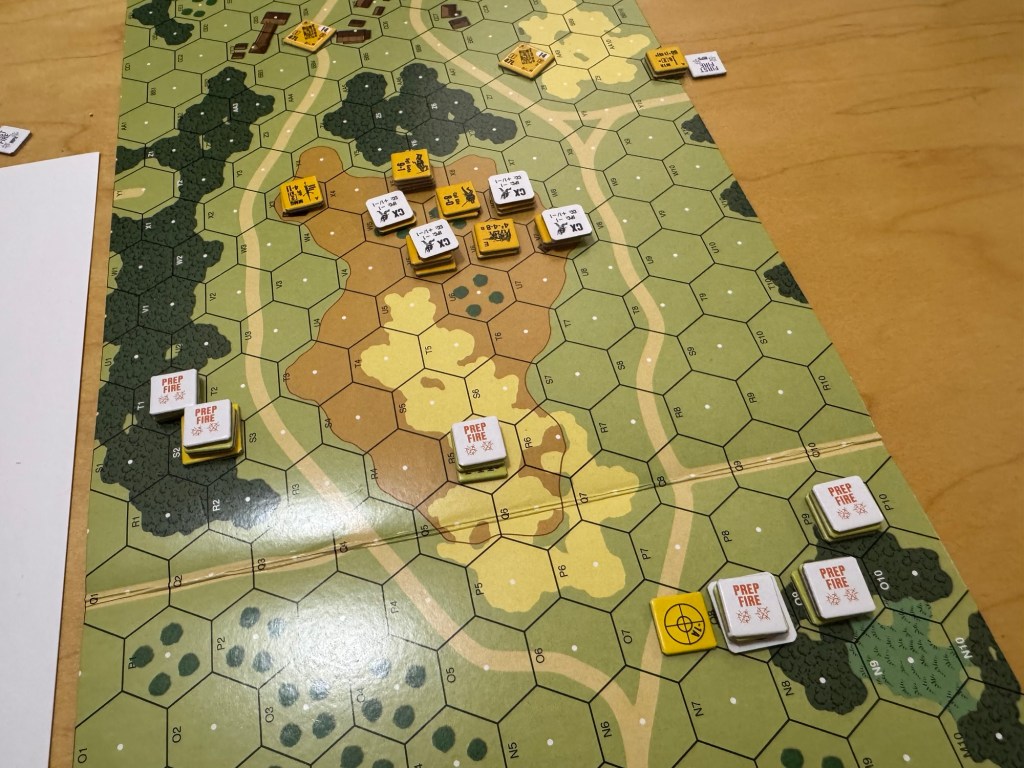
But, I found that the most complex portion of the rules were those with the Defensive Fire Phase, Advancing Fire Phase, and the intricate system of morale checks and unit breakdowns. The Defensive Fire Phase involves a complex sequence of actions, including things such as calculating the number of shots a unit can take that usually depends on the unit’s firepower, the terrain they are shooting into and whether or not there are leaders present. There are also opportunities to combine this fire with multiple units in the same hex and that once again have a leader present. Also, the fact that each of those shots will require its own calculation and then multiple dice rolls to determine a hit and then another die roll to determine the damage. Morale Checks and Unit Breakdowns are also fairly involved and will take a few steps to calculate and then reference to determine outcomes. There is this thing call Desperation Morale that also makes things really difficult to do if a unit is broken and is not necessarily complex but will break your heart as you see your units fail their Morale Check turn after turn due to that +4 DRM knowing that they are lying on death’s door and just awaiting that follow-up attack from their enemy to finish them off.
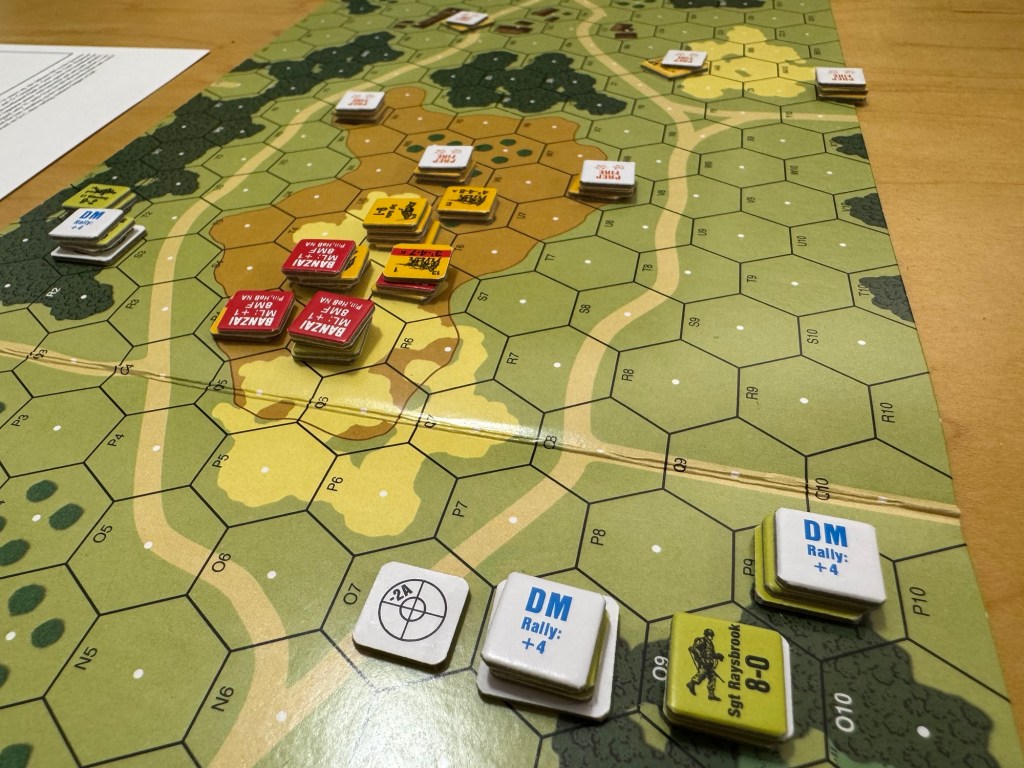
People find Advanced Squad Leader to be very complex and I think that this is a major barrier to entry for new or newer wargamers. For those that grew up on the system, they don’t find it that much of a problem because they have been playing it for decades. But for those that are new, it can be really daunting and frankly many start and put it away after not getting very far in their understanding. But, after having now played, I tend to see this as a raw deal for ASL as I didn’t think that the rules were all that bad. It made sense to me and while it took a few hours (literally we played 5 rounds in about 4 hours with a teaching overview and setup), I actually picked it up much more quickly than I thought I would. And that frankly gives me hope that I can play it again in the future. But, I bring this up because I feel that the reputation of the game is daunting and probably keeps more people back than the actual play experience. Does that make sense? I hope it does because I want people to know that it is not undoable!
Appeal is the Granularity and Realism
I have asked many people what the appeal is for them with Advanced Squad Leader. They typically all refer to many aspects of the game, including things like its depth, rules complexity (not I am just joking with this one!), granularity and realism as well as the thought that anything worth playing should be hard to learn. But, I would agree that the granularity of the game and its focus on realism are two of its greatest advantage. Now before you blow me out of the water, my use of realism here isn’t to say that the game is a simulation. I actually think that is not the case. Because ASL gives you this God’s eye view of the whole battlefield and the omnipotent understanding of the situation and of what can and will happen, it allows you to somewhat plan around it. And I think that any battlefield commander will tell you that this is not the case as you never know exactly who you are fighting, their makeup, their numbers and capabilities nor their support.
But I think that the systems used and the rules that prop them up are really quite realistic and provide you the player with a good understanding of the factors involved in these small tactical engagements and their pitfalls. I do really think that the system mimics the process and actions of soldiers in many ways. Does it do this perfectly? Probably not but I am unsure that I can’t definitively say at this time in my journey but I want to learn more and understand the answers to those questions. And hopefully I can play it again to get a better feel and understanding. I also think that people really enjoy the bits and pieces of chrome that are injected into the system. I bring this up as I experienced the chrome of banzai charges as we played ASLSK#4 The Pacific Theater of Operations.
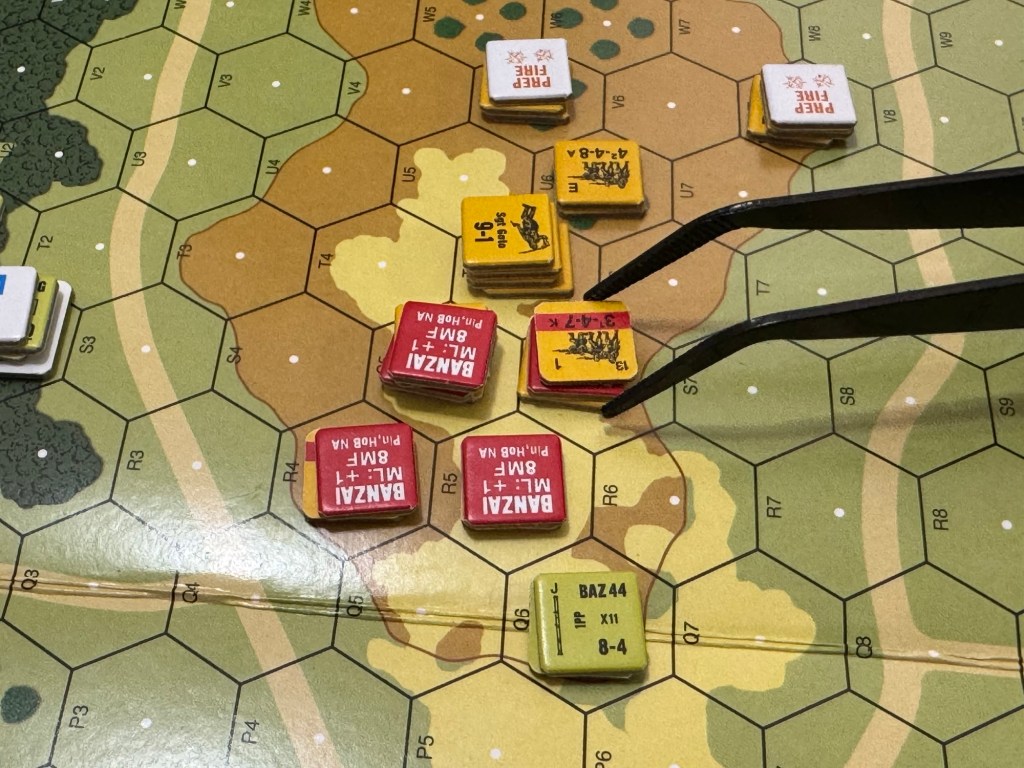
In my experience with ASLSK#4, I was very interested to see the chrome of banzai charges and how it would be handled. I was not disappointed as it was very fearsome and provided the Japanese troops with the chance to cover a great deal of distance in a short time and get right in on my defending American units who were not prepared nor capable of standing up the wave of bodies coming at them. In fact, I learned a great lesson with this play about how not to deploy my units and to not break them up as much but keep several units together as a group so they can offer more Defensive Fire as the charge approaches. This was really my only hope and I did a pretty decent job of hitting a few units and stopping them in their tracks but I didn’t hit enough to stop the inevitable outcome of an overrun.
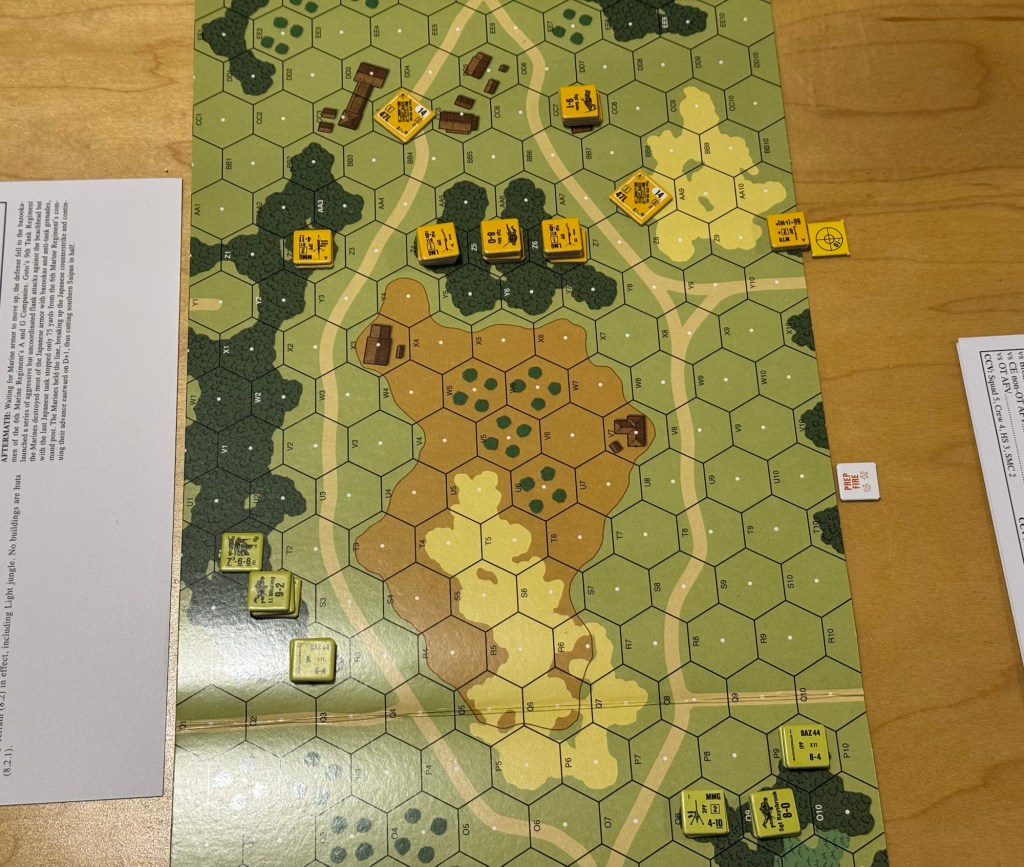
Narrative Created is Fantastic
One of my favorite type of wargaming is at a tactical level! I just love tactical squad level combat. I will say that I am partial to World War II tactical games but am always open and willing to play other time periods. There is just something about the strategy, the tension and fear inherent in the game that really draws me in. What is going to happen when I run my squad out from their comfortable and relatively safe building to cross a field, offering little to no cover, in order to get into position to eliminate the enemy? I don’t know but whatever it is it will be fun!
Tactical wargames excel at several things. Their modeling focuses on individual units, which can range from vehicles and squads all the way up to platoons or companies. These units are assigned rating factors based on what types of individual weaponry the units carry, reflected in firepower, range and usually movement. Tactical games are usually designed so that a rudimentary knowledge of military tactics will facilitate good gameplay. I have played many versions of tactical goodness and it is most definitely my favorite brand of wargame. The reason it is my favorite genre is that the rules are generally simple and straight forward (not necessarily the case here with ASL), the action is always hot and heavy, the games are generally scenario based and play fast and it is always fun as literally anything can happen. And Advanced Squad Leader excels at creating an interesting and compelling narrative around these battles. The level of detail and the processes that support the game actually greatly enhance that narrative as you are forced to look at the overall action and tactics of the game through the set of rules and the many acronyms used in the game. I very much enjoyed the process of thinking about what each action and counter action meant in the overall process of a battle. I am not sure that I have any final opinions about that but would say that it is very interesting to look at the game in this light.
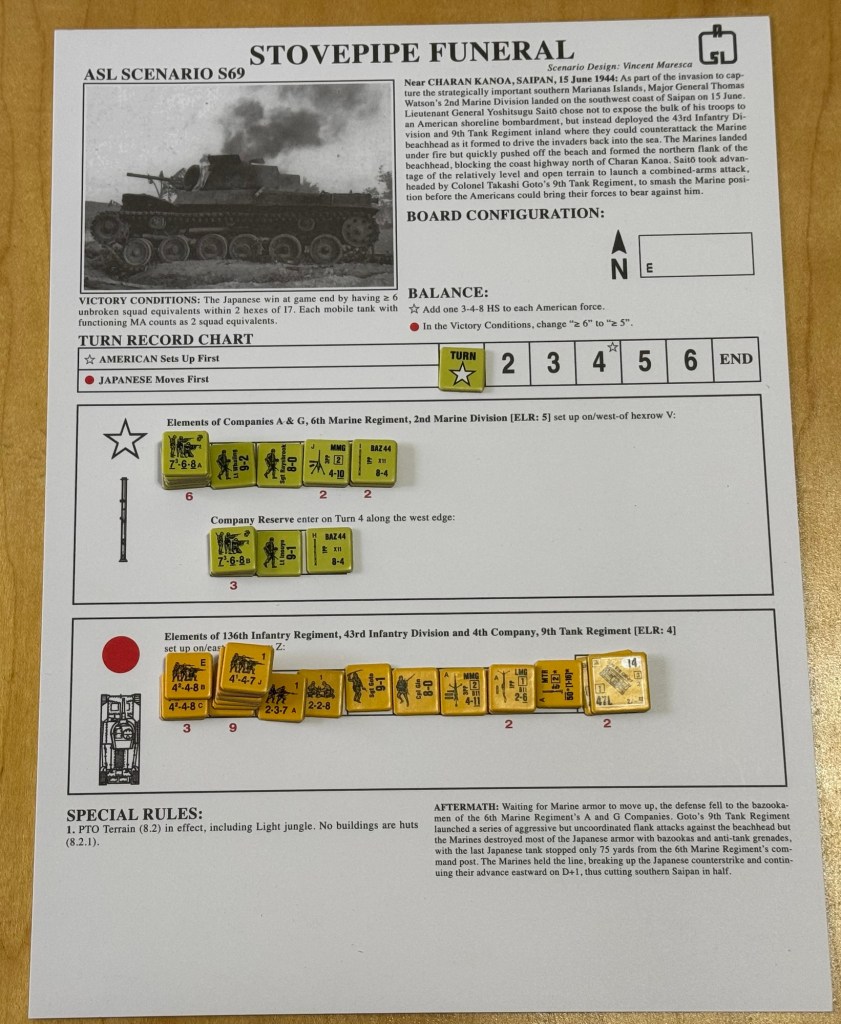
Plus, similar to many other tactical scenario based systems I have played, ASL does a great job of providing a historical background to each of the scenarios and injects elements of the campaigns into the game to provide the players with insight into the happenings and outcomes of that overall historical campaign.
I had a very interesting and engaged experience with the ASLSK#4. I enjoyed much about the experience and am looking forward to future excursions into the system where I can grow and expand my experience level along with my understanding and comfort level with the system. I do think that I am asking myself a question though that many have probably asked after playing. Is the juice worth the squeeze here? Meaning, is the time and barrier that are required and created by the depth and complexity of the rules worth it? I think that only time and some more plays will answer that question but at this point I am leaning towards maybe not. I don’t know that this is my final answer but I think that my desire to play more and learn more is a good sign and hopefully will result in a more firm understanding of what it was that I experienced here and whether or not I want to experience more.
My final comment is that I want to thank my friend Mike Heckman from St. Louis, Missouri. For coming all the way over to my house a few Friday night’s ago, for printing out tons of player aids, flowcharts, tables and abbreviated sequence of play that eased me into the experience. I also want to thank him for his open mind about my thoughts as I shared them throughout our play and the complaints that I would make from time to time. I know that he holds ASL as a sacred thing and I want to make sure that I give it the respect that it deserves.
Thank you for reading my thoughts and for encouraging both Alexander and I over the years to try ASL! I think that we were interested in trying it because of many of you and your love of the system and I wanted to make sure to give it a try. Please give me your thoughts on my thoughts and I will continue to make this journey!
-Grant
 The Players' Aid
Well done Grant – thanks!
LikeLiked by 1 person
Well thanks. A bit nervous penning my thoughts on this game as I am new to the system and it is so very revered and respected. I hope that I did it justice in my initial thoughts.
LikeLike
The emergent narrative of ASL is one of the reasons I enjoy the game. In the full rules you have snipers, heat of battle results, which add to the narrative generated by the nationality differences, wounds, leader creation, RoF on machine guns all of which have a great impact on the story generated by the game.
LikeLiked by 1 person
I would hope one day to build up to the regular ASL. Looking forward to my continued journey!
LikeLike
Great post! I had the rulebook and first three modules back when I lived in Chicago, but I had to sell them when I moved because I knew I would never get them played and I needed to divest myself of stuff for the move.
I now have Starter Kit #1 and we’ll see if anything happens with it.
I loved the Squad Leader system back when it was just Squad Leader, and loved playing it with a buddy of mine, but I haven’t seen him in years. It was back in college.
LikeLiked by 1 person
I would just stick with the SKs for the time being starting with SK #1. There are a ton of scenarios by now in this sub-system and it really does a great job of capturing the feel and excitement of the full game. The main thing I would say you’ll will miss out on is playing the HASLs (Historical ASLs) which are fascinating because they are usually played out on a game map created from actual battlefield aerial photography. There is one though, Decision at Est, which is ASLSK. Frankly I doubt you will make the transition into full ASL, but you can get 75% of enjoyment of the system with the SKs.
LikeLiked by 1 person
I definitely think that there is plenty there for me to explore.
LikeLike
Thanks Ken. We will take a look at that scenario and try to get it played.
LikeLike
Grant, can you expound on why you started with ASLSK#4 and not #1? My guess would be that you don’t have #1. What are your thoughts of starting with #4 versus #1, pros and cons? Thanks for the write-up!
LikeLiked by 1 person
Alexander has #1 but I bought #4 because I wanted the PTO. I think you can start with any of them. #1 is designed as the starting point though.
LikeLike
Do you know if the rulebooks are all inclusive? Basically a single rulebook, in either #1 and/or #4, that have all the rules for the entire SK series? I’m thinking something similar to the rulebook for Band of Brothers.
LikeLiked by 1 person
I think that each has the basics but then adds the specific stuff for the starter kit on top of that.
LikeLike