Our friend Gregory M. Smith is a solitaire genius and has done many of these solo, narrative driven wargames that we have all enjoyed for hours on end while we have been unable to find an opponent or just because we want to play a game on our timeline. We have interviewed him many times for his games such as Zeppelin Raider, Interceptor Ace, The Hunted, Western Front Ace, Amerika Bomber, Defending America, American Tank Ace, British Tank Ace, Rebel Tide: The American Civil War, 1861-1865 and most recently Yamato: The Final Cruise of the Super-Battleship: April 7, 1945. But Greg also does a bang up job with 2-player games and he has a very interesting upcoming 1-2 player game called Gladiators: Blood & Glory from Compass Games. I was fortunate enough to get a good look at this game in its early stages at WBC 2023 and we played a 2-player duel and had a great time. I reached out to Greg and he was more than willing to talk with me about this new game.
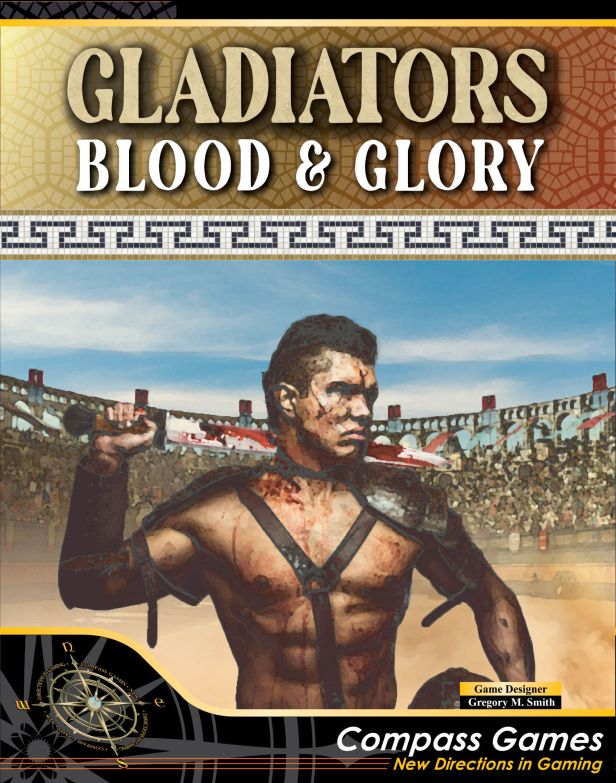
Grant: What is your new upcoming game Gladiators: Blood & Glory about?
Greg: Gladiators: Blood & Glory is a game where the player is a Lanista, the owner of a gladiator training school called a Ludus. As such, he can have up to five gladiators, training them and equipping them to fight in the monthly games. During the matches he will earn denarii (money) by fighting his gladiators in matches, and can earn more by winning and even more (possibly) by wagering.
Grant: What inspired you to make this game?
Greg: I’ve watched my share of gladiator movies over the years, I suppose, and thought it would be a nice change of pace from my usual tank, aircraft, and submarine games. And it was!
Grant: What sources did you consult to get the details correct?
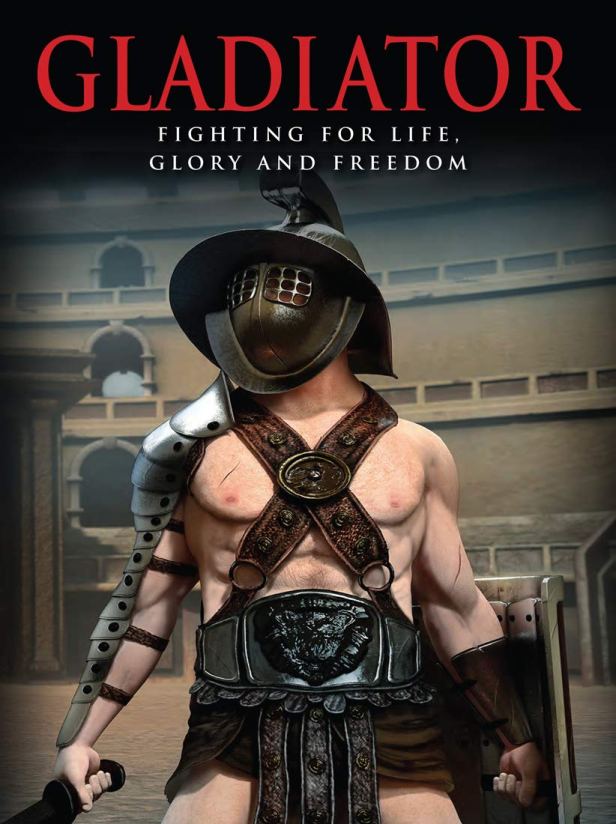
Greg: There is no shortage of gladiator books out there available for research, and I have read several. I backed up the book reading with the internet, but the surprising source for me was a “coffee table” book on the subject simply called Gladiator by Ben Hubbard published by Metro Books in 2015. Normally I don’t have high hopes for such books, but this one was an excellent reference and the source of details on all things gladiatorial. I highly recommended it if you have any interest in the topic. There was plenty of information about the different types of gladiators, their chosen weapons and tactics and then also much about the gladiator schools and the life of a gladiator as they trained, fought, healed and readied themselves to fight again.
Grant: In the game, each player is running a Ludus. What does this look like in the game?
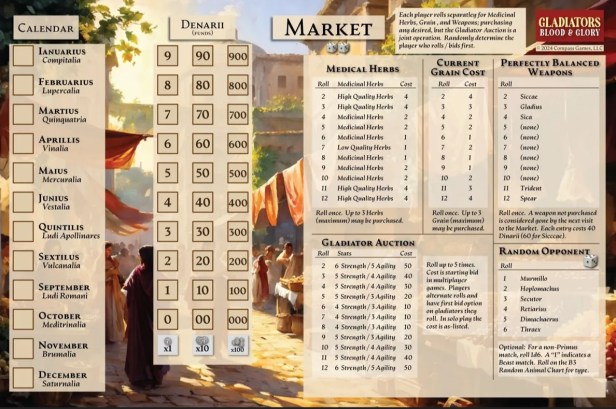
Greg: The gladiator matches happen monthly, but your Ludus is the operational framework for the game and will take up much of your time in making decisions. As fun as the tactical fighting of your gladiators is, the Ludus is where they are fed, trained, healed (if needed) and sometimes furnished better weapons. Part of the Ludus portion of the game involves going to market and getting more gladiators and supplies as needed.
Grant: What training, equipping, and logistical decisions do players make?
Greg: One of the key decisions the Lanista makes is deciding which of his gladiators will receive focused training. Logistically, you have to go to market and get grain, new gladiators, and possibly “perfectly balanced” weapons. The really good weapons are a bit pricey, however, and you probably won’t be able to afford them for a while.
Grant: What different type of skills can each gladiator gain through training?
Greg: There are five skills that can be “purchased” by spending experience points. They have different costs as some have a stronger game impact than others. These include things such as reflexes, expert, sixth sense, adrenaline rush and cunning. Each is different and serves a very important part in the overall tactical experience.
Grant: What are the benefits of these skills?
Greg: The benefits of each skill are listed below as well as the number of each card that are found in the shared Combat Deck.
1. REFLEXES (3) – This skill gives the player an option: Draw a card, or temporarily (for the next block attempt) increase his Agility by one, or a net throw cannot be dodged.
2. EXPERT (2) – You may flip this skill to the used side to attack from a Neutral position with a card that normally requires Advantaged position. (Does not apply to “Killing Blow.”)
3. SIXTH SENSE (3) – The gladiator has developed an uncanny sense of impending danger. Once per match, he automatically dodges an attack (that can be dodged.) No die roll is required, but a card must still be discarded.
4. ADRENALINE RUSH (5) – All attacks for the rest of this player turn have +1 damage.
5. CUNNING (4) – (Retiarius only) You may flip this skill to prevent a player from becoming untangled from a Net until the end of your Combat Turn. (He cannot discard a card.)
Grant: What different types of gladiators are included and how do they compare?
Greg: There were actually many types of gladiators across the centuries of the Roman Empire, but I chose six gladiator classes I felt were the most iconic. They are the Murmillo, armed with a short sword and a large shield; the Secutor (very similar); the Retiarius, armed with a net and trident; the Dimachaerus, armed with two swords; the Hoplomachus, armed with a spear and small shield; and the Thraex, armed with a hooked sword and a small shield.
Grant: As a 2-player game, what type of system is used for the combat mechanic? What other inspirations did you use?
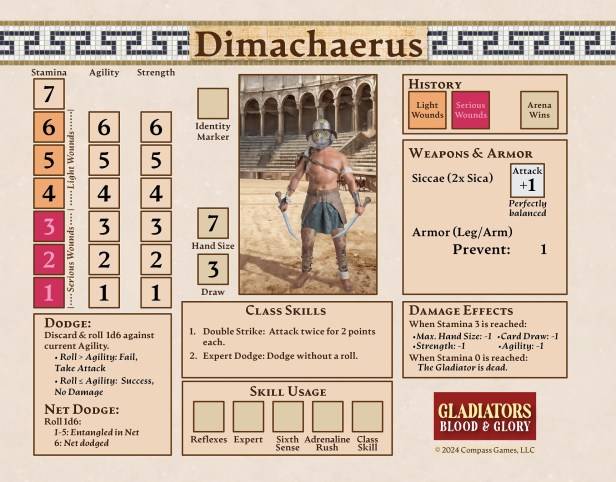
Greg: The combat is very simple (with nuances) and is somewhat patterned off an air combat game called Down in Flames. Basically, you are face to face in the arena, and alternate turns. During your turns you attack, and perhaps play cards that will give you positional advantage. Having positional advantage allows you to play the stronger attack cards in the deck, such as “Killing Blow.” The combat system is very fast and easy to pick up but it all hinges on how the player manages their hand and utilizes their cards.
Grant: What are the different type of cards used and their benefits?
Greg: There is a shared combat deck both players use to refill their hands at the end of their turn. About 40% are attack cards, about 40% are defense cards, and the remaining cards are special purpose and/or movement cards.
Grant: What is each player’s ultimate goal in the game?
Greg: The temporary goal is to survive the current match in the arena, but the ultimate goal is for the player to be the best and most highly respected Lanista in the Empire, as measured by the number of “Rudis” swords his gladiators have won.
Grant: How do players wager in the games? What type of strategy should be kept in mind with this aspect?
Greg: Wagering is somewhat dangerous, as money is not that easy to come by in the game. I’d say if you were either desperate and confident, or reasonably well-off, it would be worth doing. Players may wager up to five denarii on each match. There are odds based on how many skills each gladiator possesses, so beating a more skilled opponent, while (in theory) harder to do, will garner you more coin in return.
Grant: What is the general Sequence of Play?
Greg: The game sequence starts with the player going to market, then training their gladiators. Then, you fight up to three of your (maximum) five gladiators in the current month’s games. You return from games, have the Medicus attend to your wounded, and repeat the cycle. Pretty simple, really.
Grant: What is the layout of the Arena?
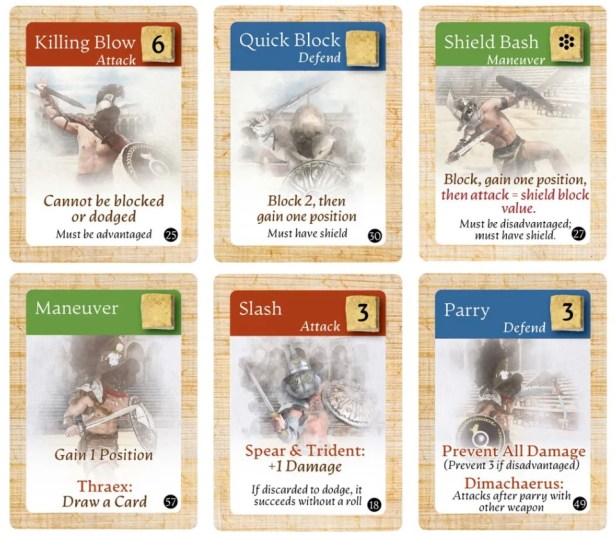
Greg: To be honest it’s very abstracted, as you have a central area where the two gladiators face off, and small boxes to the left and right represent positional advantage when gained. There are tracks for crowd favor and betting among other things.
Grant: What information is contained on the Gladiator Mats? Can we see a few examples?
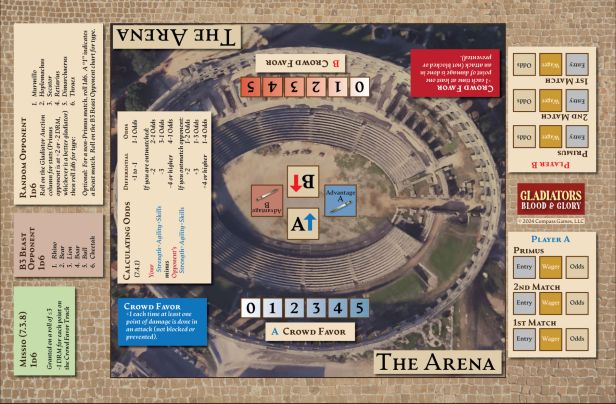
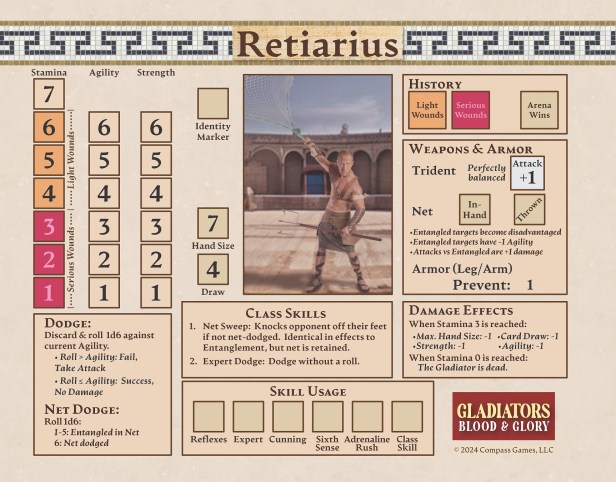
Greg: The Gladiator Mat contains all the information needed to conduct an arena match, such as his physical status (strength, agility, and stamina) and how many cards he can hold and draw at the end of the turn. It really can be considered the center piece of play. It also has boxes to place any skill markers he may have, and shows his armor and weapon status. Here are a few examples; the Dimachaerus (shown above) and the Retiarius (below).
Grant: What optional rules are available?
Greg: There are rules for fighting animals, multi-player arena rules, and solitaire play. Although most of my games have been solitaire in the past, this one is primarily designed for two players.
Grant: How does the solitaire option play out?
Greg: This game really shines for two-player, as the card play goes back and forth and can be quite tense at times. Having said that, the solitaire option works, but as you’re following a set of rules to play your opponent (a “bot” framework of sorts) it is probably easier than actually fighting another human.
Grant: How does the AI make a decision about what cards to play in combat?
Greg: There is a list of actions the AI will make when it comes to card play and what cards it will use. It is very aggressive and will attack until it runs out of cards (it won’t, for example, sandbag any cards) so from that perspective it’s not very sneaky. It plays a bit more like “smash mouth football” in that sense. When on the defense, it has a decrement list of what cards it will discard, for example, if required.
Grant: What type of experience does the game create for players?
Greg: I think it has appeal for different types of players, or at least, appeals to several different aspects of a player’s game preferences. For example, I think the Ludus operations (going to market, training, etc.) will appeal to the organizational nature in players, while the arena combat will appeal to their fighting side. It’s more than just stabbing gladiators, would be my point.
Grant: What are you most pleased about with the design?
Greg: I’m really happy with the arena combat. I spent many, many hours balancing the six different classes in the game. They are asymmetrical, yet have play balance assuming equal skill.
Grant: Who is the artist and how did their style support your vision for the game?
Greg: Nadir Elfarra was my artist for this game. As you might or might not know, he was on Western Front Ace as a backup artist and the primary artist for American Tank Ace. Since then, Compass has given me priority on his time and I’ve developed a bit of a bromance – I just love his work, we work together quite well (which doesn’t always happen, trust me) and I just respect the hell out of him. I love what he’s done for this game and am always looking for him to be on my projects. I love the Roman mosaic feel to some of the art and I think he just gave it a great period feeling.
Grant: What has been the feedback of your playtesters?
Greg: It’s been really positive, so I certainly can’t complain. I enjoy it myself, which, as I like to say, is a good sign. I think the best part of it is a single match can be played in 15 minutes or so, once you know what you’re doing, so you can use it to take a break from other things without losing too much time.
Grant: When can we expect to see the game released?
Greg: Well I know it’s off to the printers, so I’m pretty sure later this year, hopefully by summer, maybe fall depending on when Compass decides to fit it into the release schedule. But soon-ish.
Grant: What other designs are you currently working on?
Greg: I am almost embarrassed to list them all, but what the heck: Western Desert Ace (North Africa aircraft), Sinking Yamato (just finishing touches today), Sensuikan (Japanese submarines, pretty much done), Israeli Tank Ace (just started in earnest), Panzer Ace, British Tank Ace, Soviet Tank Ace, B-36 “Peacemaker”, B-52: Linebacker II, Gotha Raider (bombing London 1917-1918), Viking Dawn (like Conquistador! but with Vikings), Carrier Ace (Pacific War 42-45), Iberian Tide (Spanish Civil War, with Michael Vitale), Ground Attack Ace (Stukas AND Sturmoviks), Insurgent Tide (Iraq War 2003-2008) and Rebel Tide (US Civil War.) So that’s sixteen in various stages. I like to keep busy as you know by now! 😊
Thanks for interviewing me, always a pleasure. You do a great service for our hobby.

I think that there are certain topics that always generate interest and demand our focus as wargamers. Gladiators is one of those topics and a few years ago, we sat down with Gregory M. Smith while at WBC to play and discuss several of his games including this new one fresh out on pre-order called Gladiators: Blood & Glory from Compass Games.
While the name of the game has changed slightly from its original Blood & Sand name, here is a link to our video interview with Greg at WBC in 2022 (keep in mind that we discussed other items in this video):
If you are interested in Gladiators: Blood & Glory, you can pre-order a copy for $52.00 from the Compass Games website at the following link: https://www.compassgames.com/product/gladiators-blood-glory-pay-later/
-Grant
 The Players' Aid