We are familiar with some of Pascal Toupy’s work in a few games. We both have played, and really enjoyed, Saigon ’75 from Nuts! Publishing and Alexander has played a few of his solo games in Firebase Vietnam found in C3i Magazine #34 from RBM Studio and Roman Disaster at Teutoburg found in C3i Magazine #35. He is a good designer who has put out several good designs. When I heard that he was doing a game with Fellowship of Simulations, and that it was based on the Vendée Militaire and the French Revolution, I was immediately interested. After seeing a bit more info about the game I reached out to Pascal and his design mate Jean-Phlippe Barcus to see if they would share some background information on the design and they were more than willing to do so.
*Please keep in mind that the artwork and layout of the various components shown in this interview are not yet finalized and are only for playtest purposes at this point. Also, as this game is still in development, card and rules details may still change prior to publication.
Grant: What is your upcoming game Vendée 93 about?
Pascal: Vendée 93 is about one of the tragic episodes of the French Revolution. In February 1793, following the mass mobilization of 300,000 men ordered by the National Convention to defend the eastern frontiers against the armies of the coalition monarchies, revolts broke out in the Vendée region of western France. What began as a peasant uprising turned into a counter-revolutionary movement with the involvement of the local nobility, and eventually degenerated into civil war.
Grant: What was your inspiration for the design?
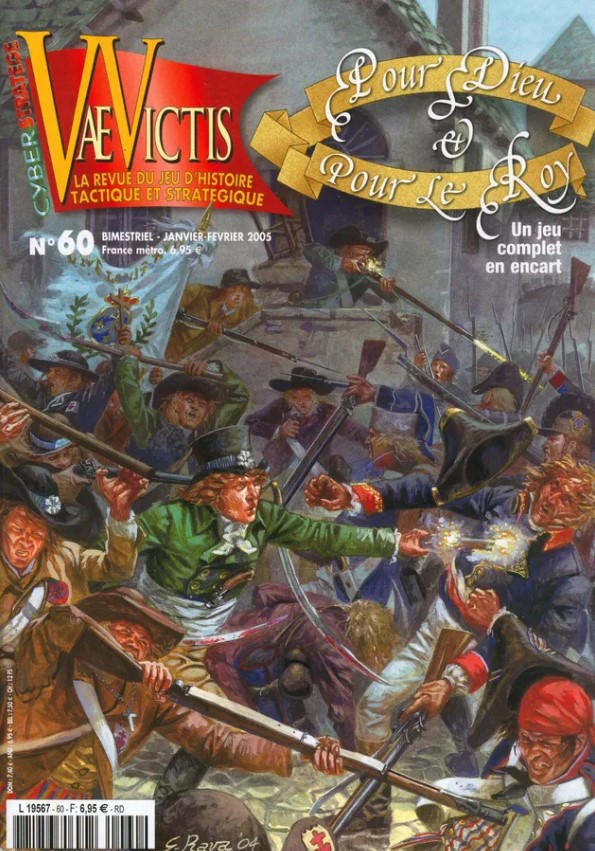
Jean-Philippe: I was born in the Vendée area and now live very close to the places where these events took place, which has encouraged me to deepen my knowledge of the subject through various historical readings and field visits. As far as wargaming influences are concerned, one of the rare simulations of the Vendée Wars is Pour Dieu et pour le Roy by Jean-Philippe Imbach and Nicolas Stratigos, authors well known to readers of Vae Victis magazine. We both played it and thought it had some good ideas. But we wanted to go deeper and make it accessible to as many players as possible.
Grant: What is the setting for the game? How much have you fleshed out the history?
Pascal: The Vendée War took place during the Terror, a bloody episode of the French Revolution. It was a period “full of noise and fury” in which passions on both sides were driven to paroxysms. We have chosen to depict the beginning of this fratricidal conflict, rich in heroic and sublime deeds, rather than trying to “model”, for example, the terrible and dramatic events generated by Turreau’s terrible infernal columns from 1794 onwards.
The mere names of Charette or Marceau are enough for the French to recall this crucial period of their history, just as for you Americans the names of Stonewall Jackson or William T. Sherman take you back to your Civil War. So it was easy for us to flesh out the game simply by making good use of onomastics and toponymy, but also, of course, by implementing some game mechanics that we felt were relevant to the simulation of these events.
Grant: What is your design goal with the game?
Jean-Phlippe: Vendée 93 is our second collaboration and follows Saigon 75, making it the second installment in our Under Pressure Series. We quickly agreed to visit our national history and the theme of the Vendée War was a natural choice. Our aim was to evoke this through a light wargame with high quality components, capable of immersing players in the issues of the time with a low time investment.
Grant: What sources did you consult to get the historical details correct? What one must read source would you recommend?
Pascal: Mostly French sources, simply because they are sufficiently numerous and reliable, and because the Vendée War (or, more precisely, the Wars of the Vendée) have been the subject of renewed interest among our historians in recent years. We also visited the sites of the conflict and learnt a great deal from our visits to museums, particularly that of the town of Cholet.
Among the books that guided our work, I would like to mention:
– Blancs et Bleus dans la Vendée déchirée” (Jean-Clément Martin)
– Military history of the Vendée wars” (Hervé Coutau-Bégarie and Charles Doré Graslin)
– Nouvelle histoire des guerres de Vendée” (Jean-Joël Brégeon and Gérard Guicheteau)
and, of course, the indispensable “Mémoires de la marquise de La Rochejaquelein”, who was both witness and protagonist of this period.
Unfortunately for the English-speaking public, I don’t think all these books have been translated.
Grant: What elements did you need to model from the Vendée Militaire and the French Republic against the Royalist insurgents?
Pascal: Two telling examples among many: the role of leaders and the return to the fields.
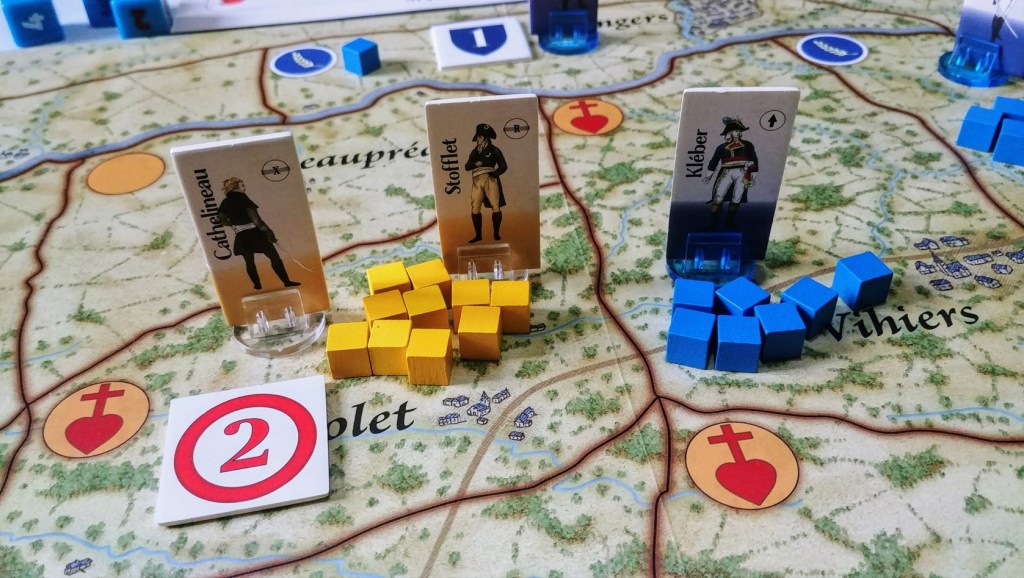
The nobles who led the rebels were the only ones with military knowledge. The example of bravery and skill they were able to set for those fighting for their cause proved decisive in the conduct of the battle. In the Republican camp, the value and experience of the commanders leading the blue units varied from mediocre (Leschelle) to excellent (Kléber). That’s why for Vendée 93, we have chosen to emphasize the role of the leaders, whether in the actual mechanic of troop management and leader test, or in the attribution of specific “traits” for use in combat.
Another peculiarity of this conflict is that most of the combatants in the Vendée were peasants who had to work in their fields, especially harvesting. As a result, they tended to return home to attend to their duties as soon as the fighting was over. This behavior didn’t make it any easier to capitalize on the eventual military successes of the whites. In order to reflect this “troop meltdown” in the game, we associated each Vendéan army with a “Back to the Fields” ratio, which was directly integrated into a dice roll, and which depended on the degree of mobilization (use or non-use of a “tocsin” marker) by the Vendéen player during his turn.
Grant: What are the hallmarks of the Under Pressure Series?
Pascal: The objective of the Under Pressure Series is to provide games based on asymmetrical conflicts that are not commonly represented in simulations. These games must be « simple » and relatively fast-paced, while underscoring the historical significance of the subject matter and offering players a distinctive gaming experience.
Grant: Why does this design fit that profile?
Pascal: It meets all the above requirements. Vendée 93 is an asymmetric game with a rare theme; it’s simple, not simplistic, fast and educational. In designing Vendée 93, we have avoided any element, factor or mechanic that would make the rules more complex, to the detriment of the game’s fluidity.
For example, we’ve done away with any need to consult charts; everything is managed by dice, with only victory points and turn tracks remaining.
Grant: I have read where Vendée 93 has a more “pronounced wargame feel” than its predecessor in the series Saigon 75. What does this mean?
Pascal: Vendée 93 takes a little longer to play than Saigon 75, it has more “historical chrome” (for example, players handle leaders with evocative names), there are more tactical options (a battle can last several rounds, terrain and fortresses have an effect on the battle…), and the introduction of Reaction Points adds an extra dimension of planning. We’ve also included a historical scenario that puts more constraints on the players by requiring them to adapt to the chronology of certain events.
Grant: What is innovative about the reaction system in the game? How does this element work?
Pascal: Traditionally, in Card Driven Games, you use action points on your turn. The idea was to be able to ‘store’ them in order to trigger ‘reaction’ actions on your opponent’s turn. The actions available to each side are different, of course. This allows more freedom of choice, control and bluffing than if you had used specific reaction cards.
Grant: What is the layout of the board?
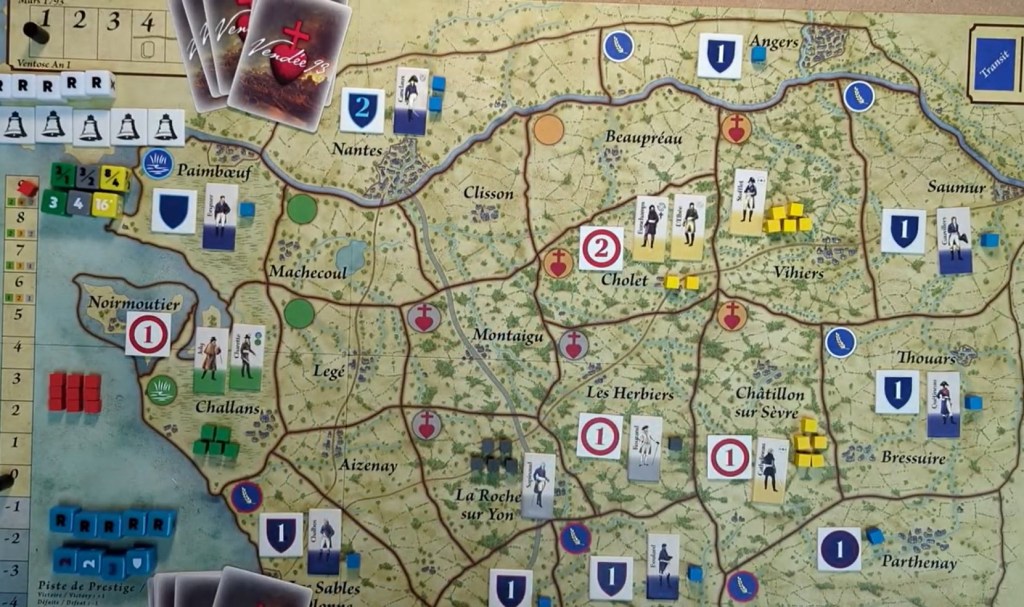
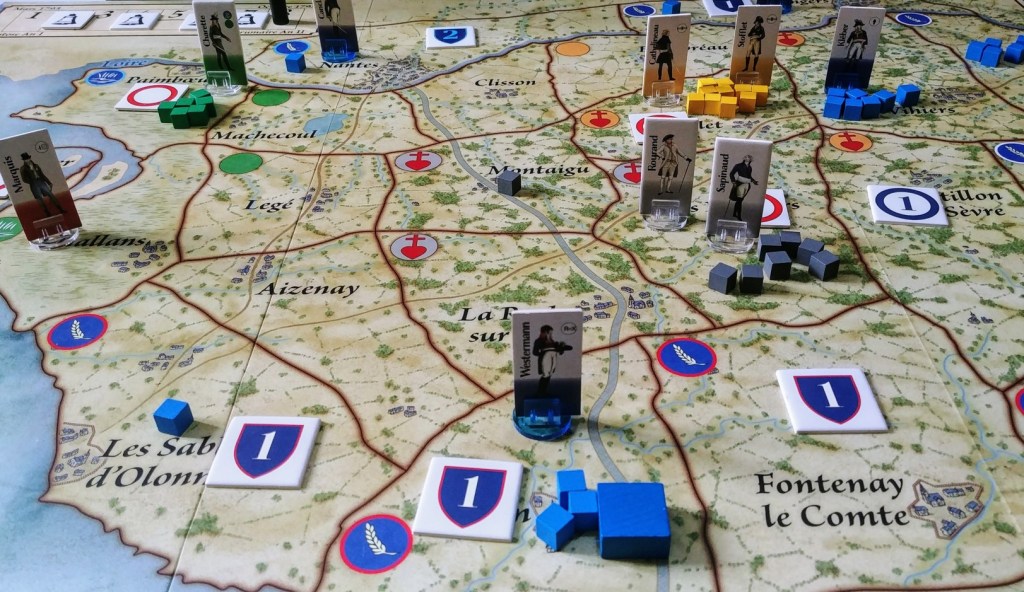
Pascal: The board represents the theatre of operation of these events, the so-called Vendée Militaire. It includes not only the département of the Vendée, but also southern Loire-Atlantique, the left bank of the Loire, south-west Maine-et-Loire (Anjou) and north-west Deux-Sèvres.
It also features an 8-turns track (from March to October 1793), a victory point track called the Prestige Track (the Royalist player alone gains or loses victory points), and a box for delayed Republican reinforcements.
Grant: What is the significance of the different symbols on the spaces?
Pascal: Zones with green, yellow and gray dots are Royalist zones. They are controled by the Armée du Marais, Armée d’Anjou and Armée du Centre sectors of operation, respectively. Zones with blue dots are Republican zones. They come under the sector of operations of the Armée de Nantes, Armée de Saumur and Armée de La Rochelle respectively. In addition, there are 4 types of terrain: plain (wheat symbol), bocage (Sacré- cœur symbol), marsh (marsh symbol) and mixed (no symbol).
Grant: What is the purpose of the numbered counters laid out in the spaces?
Pascal: These markers represent the objectives of each side. They are flipped when an area is captured by the enemy and count as victory points.
Grant: How does the design use cards?
Pascal: Vendée 93 is more card-driven than Saigon 75, as it is the cards that provide the Action Points to take actions on the field, rather than the result of an Activation Table as in its predecessor. When played, a card provides Action Points (AP), triggers an Event, and sometimes Reaction Points.
Grant: Can we see a few examples of cards and you discuss their significance?
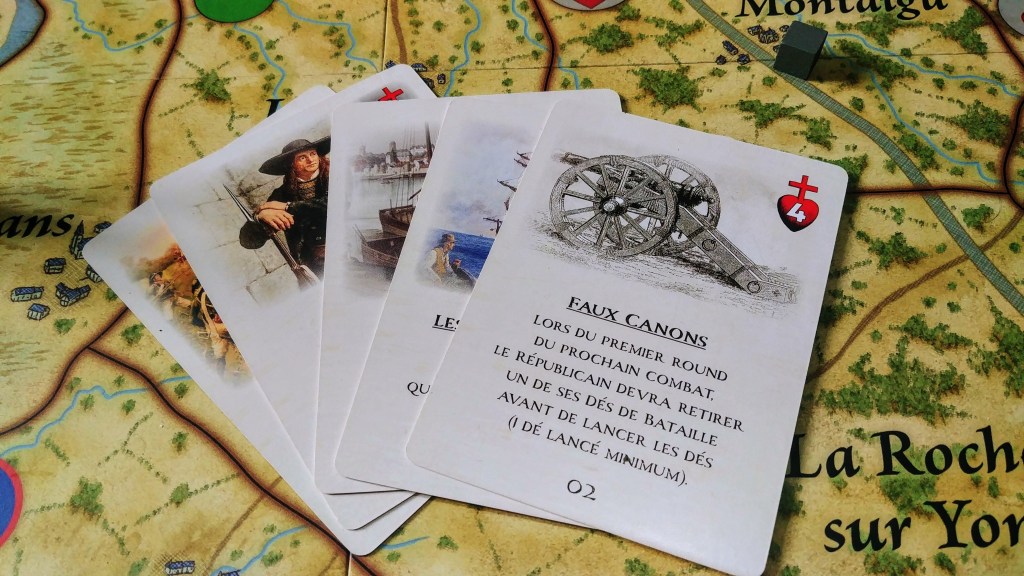
Pascal: Yes of course, and we’ll see the most important elements they display. Each card shows in particular an icon indicating the side applying the effect of the event, a number indicating the number of Action Points granted by the card, possibly a red cube (Reaction Point), and a description of the event’s gaming effect.
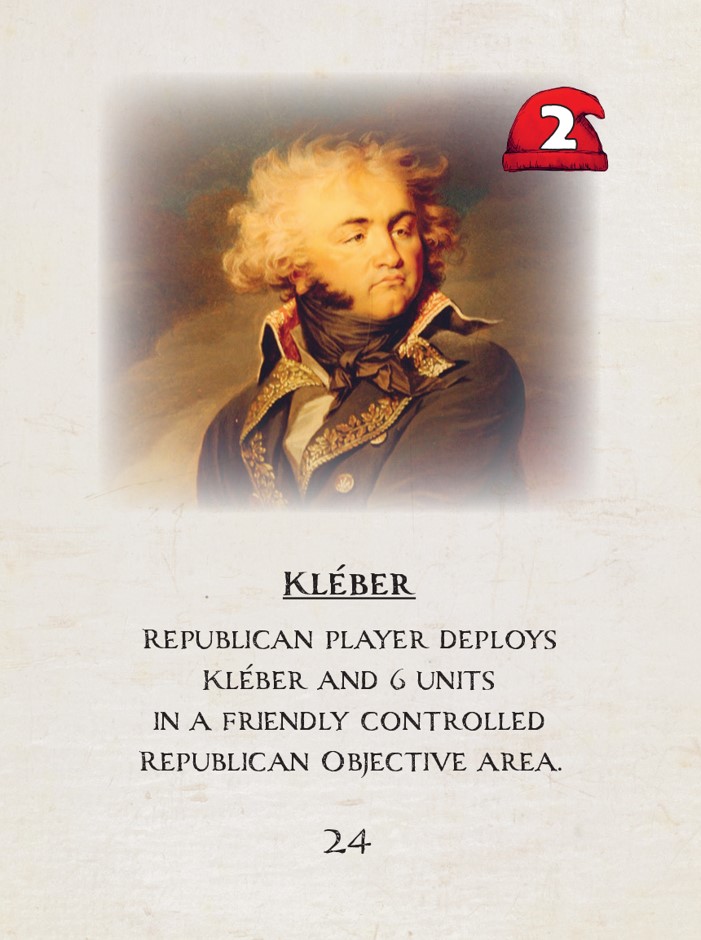
For example, the Kleber card has a favorable event for the Republican player (Phrygian cap symbol) and gives two Action Points to the player who plays it. This is a good card for the Republican because, although it only gives him two Action Points, it also gives him his best available leader with six reinforcements. Now he must have the card in his hand! There are 36 cards, and only 22 are drawn in the game. It is therefore unreasonable for the Republican to base his entire strategy on the arrival of Kleber…because Kleber is not certain to arrive if the card is not drawn. And if the Vendéen player has the card, he can either not play it (accepting that this dead weight will weigh down his hand throughout the game), or he can play it at the moment or in the way that is least advantageous to the Republican. That’s the art of card management in all CDG’s!
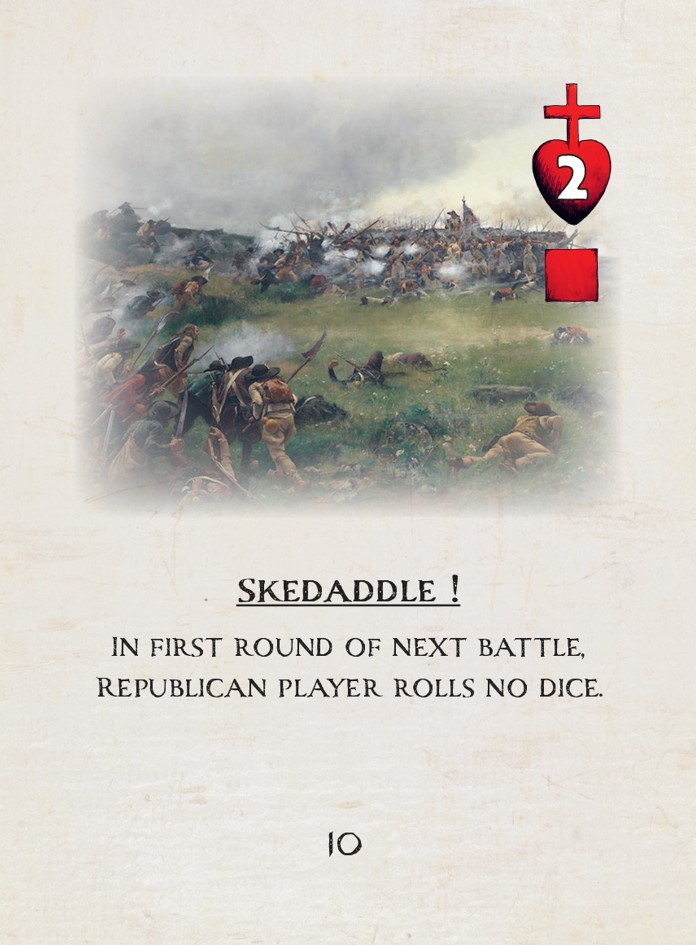
This card is a Royalist Event (Sacred Heart symbol) and gives two Action Points and one Reaction Point (red cube) to the player who plays it. Republican troops were often surprised by the guerrilla tactics of the Vendéens and suffered many casualties before they could react to the ambushes of an elusive enemy. The tactics of the Vendéens have become famous. While their vanguard attacked the enemy head-on, the whole corps enveloped it, scattering it to the right and left. This invisible circle was tightened by firing through the hedgerows, and if the Blues failed to break free, they all perished at some crossroads or in some sunken road. Madame de La Rochejaquelein, who was one of the protagonists of these events, puts it this way: “Their attack is a terrible, sudden irruption, almost always unforeseen. (…) They don’t wait for a command to fire. If you resist their violent attack, the rebels will rarely challenge you for victory, but you will reap few rewards because they retreat so quickly that it is very difficult to reach them, as the country almost never allows the use of cavalry. They scatter, escaping from you through fields, hedges, woods and bushes, knowing all the paths, the red herrings, the gorges, the gorges, knowing all the obstacles to their escape and the means of avoiding them.”
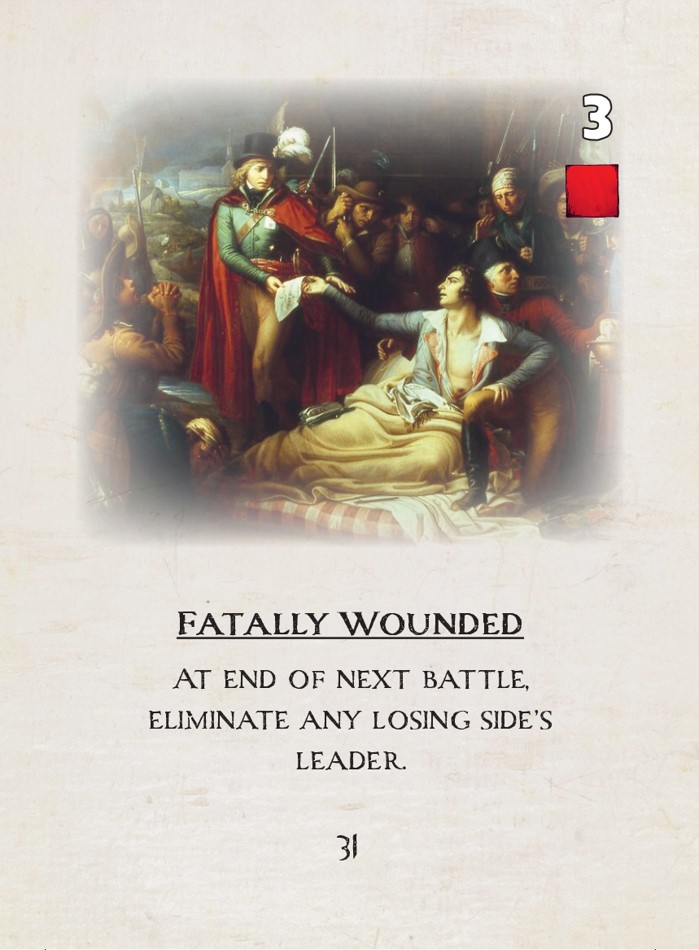
Here we have a neutral event (no symbol) which grants three Action Points and one Reaction Point. Leaders were essential to the conduct of operations on both sides. Whether they were Vendéen peasants or Republican recruits, these inexperienced soldiers needed guidance on the battlefield. The loss of a leader on the Vendéen side was a serious blow to the morale of the army (and also costs the Royalist player one Prestige Point in the game). On the Republican side, leaders were often recalled to Paris after defeat or for lack of results, and sentenced to prison or the scaffold for treason !
Grant: How does combat work?
Pascal: Combat is handled slightly differently than in Saigon 75, as it can go on for several rounds, but you always roll as many dice as the number of units present, up to a maximum of five, and the result is also read off the dice.
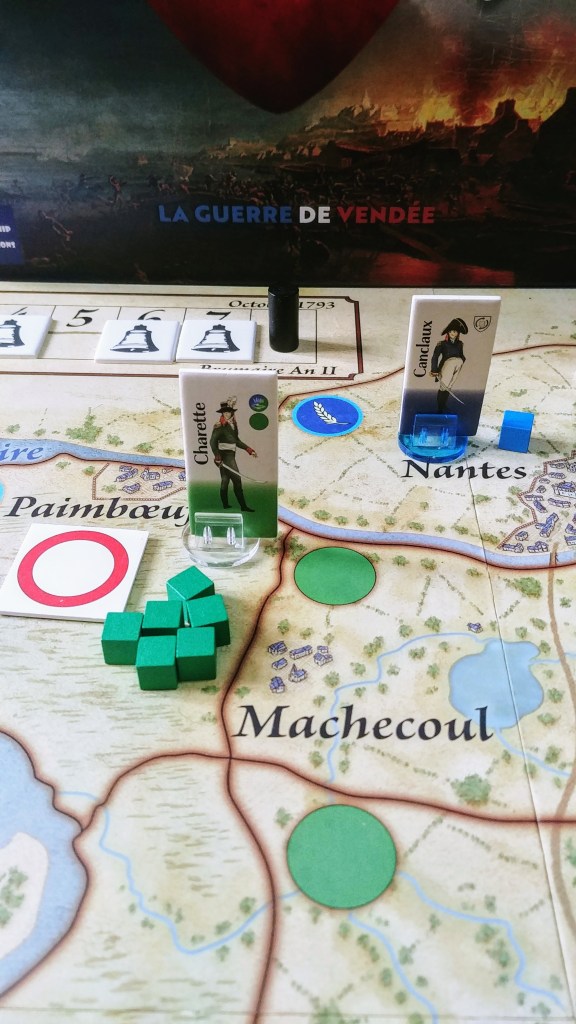
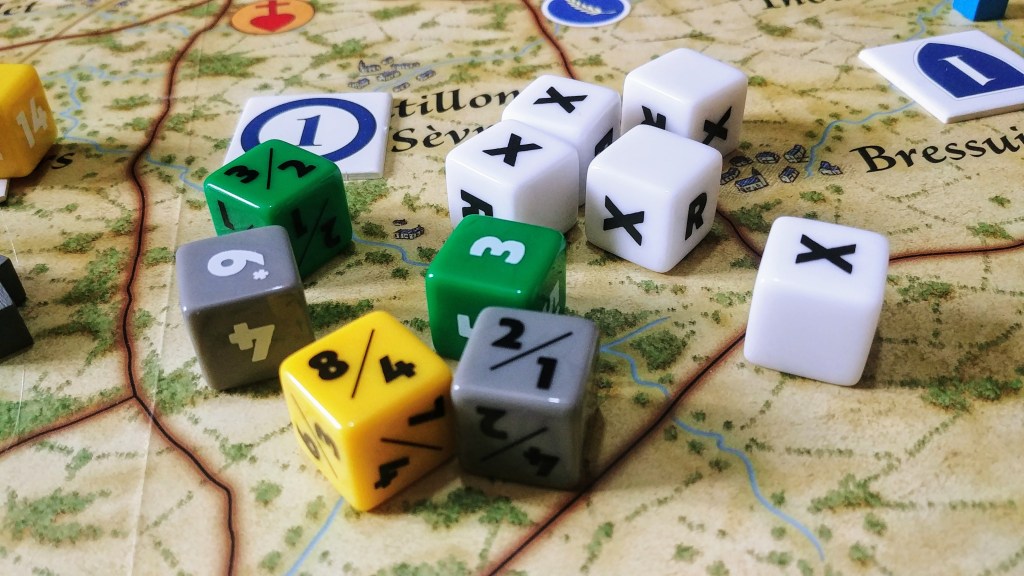
Grant: What is the makeup of the custom dice?
Pascal: Custom dice eliminate the need to consult charts and speed the game. They show the number of reinforcements, the number of Royalist units “Back to the Fields”, the availability of a leader, and the effectiveness of fortresses.
Grant: What different forces do players have access to?
Pascal: The Vendée insurgents (Royalists) are facing the young Revolutionary Republic (Republicans). The Republican player controls 3 armies/areas of operation: Nantes, Saumur and La Rochelle.
The Royalist player also has 3 armies/areas: Marais, Anjou and Centre.
Grant: What are some of the basic strategies for each side?
Pascal: The Vendéen player has an advantage at the start of the game. Historically, the insurrection took advantage of the surprise and unpreparedness of the Republican camp, whose troops, made up mainly of National Guards, were ill-equipped. As the months passed, the Convention sent thousands of men to the Vendée. These reinforcements tipped the balance irresistibly in favour of the “Bleus”. From then on, the player who takes the destiny of the Catholic and Royal Army into his own hands will have to win either an automatic victory in the first few rounds, or take enough objectives to be able to trade ground for time in the second half of the game.
Grant: Which side has the most difficult task ahead of them to win the game?
Pascal: The decisions made by both players in the first three rounds of the game are crucial.
The initial hand of cards also plays an important role in the initial tactical decisions, making each game different. The longer the game goes on, the harder it is for the Royalists to win.
Grant: How does the solitaire mode work?
Pascal: Vendée 93‘s solitaire system has been heavily inspired by GMT’s CDG Solo System. Thanks to this simple system, the player will be able to play each side alternately as best as he can while remaining faithful to the game and instilling a dose of fog of war necessary for the solo experience. The Solitaire mode uses two Solo boards to manage each side’s hand of cards. At the start of each side’s turn, the player rolls 1D6 to determine which of the cards in one or more of the slots are available for play. There are usually 2 or 3 cards available at any one time, but the final decision is up to the player.
Grant: How does the solitaire make decisions? What are its priorities?
Pascal: The player’s options are immediately limited by the die roll, allowing them to make a decision fast. The player is unaware of all the cards that will be accessible for each side because cards are only disclosed when their lettered slot is rolled. The player can concentrate on the options for the active side instead of the effort of trying to consider every card while feigning ignorance of what the other side is planning to do. This is made possible by the die, which also decides which slots are available each turn.
Grant: What type of experience does the solo mode create?
Pascal: Although playing solo, the system allows for a certain amount of surprise. Sometimes the die rolls and the ideal plan is hanging in the balance. Whether things look grim (until the die roll flips the perfect card) or everything feels like it’s falling perfectly in line (until the card slot you need isn’t rolled), the Solitaire mode reintroduces the fog of war to the solitaire play.
Grant: What are you most pleased with about the design?
Pascal and Jean-Philippe: We are both pleased with the Tocsin (Royalist reinforcements) and Back to the Fields mechanics, which are both fluid and offer a good historical rendering. We also like a lot the Reaction Points system, which has the incidental effect of simulating a certain fog of war.
Grant: What has been the experience of your playtesters?
Pascal: We are the designers, developers and primary playtesters of our games. So by the time we invite other players to test a game, it’s already at an advanced stage of development. Our first priority is to ensure that they come from a variety of backgrounds, not just wargaming. What we’re looking for from them is more feedback on their experience of the game, how they felt about it, did they enjoy playing it? The answer has to be yes, but if their answer is more qualified, we’ll try to find out what went wrong and get into the details of what bothered them.
Grant: What other designs are you mulling over?
Jean-Philippe: Our next collaboration, again for the Under Pressure Series, will be on the subject of the Mexican Revolution (another civil war!) and will feature Emiliano Zapatta and Pancho Villa. It will also feature a multiplayer option. I’m also currently working on a number of board game projects in the broadest sense, either on my own or in collaboration with other authors. The most advanced project, Tatoo Masters, should see the light of day in 2025. It’s a party game whose theme, as its name suggests, is the world of tattoos!
Pascal: There’s a lot of work on my desk! I’m overseeing the final playtests for the Eastern Front expansion to Great War Commander (Hexasim), and with developer Marco Poutré we’re fine-tuning Napoleon in Egypt, which is on GMT’s P500. Last September, my game Cowpens 1781 was published by VaeVictis and was a great success. I had already completed other battles from the American Revolution and the French and Indian War for the Black Powder Battles System. The players were very enthusiastic and asked me to adapt the system to the War of the Austrian Succession and the Seven Years War. So that’s what I’m doing now, starting with the Battle of Fontenoy (1745)!
Thanks Grant, thanks Alexander for having us on your excellent blog.
Thanks to both Pascal and Jean-Philippe for their time in answering our questions about the game and its design process. I am very much looking forward to this one. I have played several games from Fellowship of Simulations and have always very much enjoyed them and their overall aesthetic and production.
If you are interested in Vendée 93, you can learn a bit more from the game page on the Fellowship of Simulations website at the following link: https://www.fsimgames.com/en/vendee93/
-Grant
 The Players' Aid