As you know, we very much enjoy multi-player wargames and anytime there is a new multi-player game coming out we very much sit up and take notice. In early 2024, Columbia Games launched a Kickstarter for a game on the Napoleonic Wars called Alliance: Multiplayer Napoleonic Wargame. Alliance is billed as a 1-7 player strategic level game of diplomacy and warfare in the Napoleonic Era with a Columbia Block System twist. The game is huge and plays best with more players. The players take on the roles of different nations during the time and you can play as Austria, England, France, Prussia, Russia, Spain, or the Ottomans. We recently played a full 7-player game and had a grand old time. While the game is not perfect, and there are some quirks that you must get past, the game is really pretty fun and interesting and could be one of those main staples at gaming conventions where you need a lot of players. I want to share my First Impression thoughts on the design and give you a good idea about how the game plays.
First off, the game is best played with 7 players. This is a big game and the really great element here is the negotiation, treaty making and breaking and the alliances that will form. This requires a certain type of gamer to be done well. Someone that is willing to push the boundaries of negotiation, really dig in and come up with proposals that benefit all sides. Thinking outside the box. I don’t like it when players negotiate like they are the be-all-end-all and if you don’t do all that they want then they throw their hands up and then come at you. Everything is up for negotiation and deal making, including peace, cessation of hostilities, ceding territory, allowing other nations to enter your lands without conflict, giving gold, making loans, etc. with the exception of cards. You can’t give a card to someone, because the cards are what set the turn order each turn. I would have liked to see the ability to swap out cards. For example, there are leader cards for each of the nations and they do give the player a nice ability but leader cards also allow for a diplomacy check to be initiated with the various neutral minor powers called Non-Player Empires or NPE’s found around the board. These minor powers are key to anyone’s empire building goals as they are a source of Victory Points that come without direct conflict and the risk of the dice betraying you and losing your important units. Levying new units onto the board is not easy and the players only get 3 (or 4) Action Points to use to build up armies, add new armies or move those armies to initiate combat.
Since there are 7 playable factions in the game if you don’t have 7 players then the unused factions become NPE. Thru diplomacy they can become part of your empire and forces but you still only get 4 cards no matter how many NPE’s you control. Makes for some interesting decisions on how to use your AP’s and when to spend gold for additional moves or builds. This Diplomacy comes down to a dice roll (2d6) and you get a bonus to your roll by adding the VP value of friendly NPE cities and Gold that you spent.
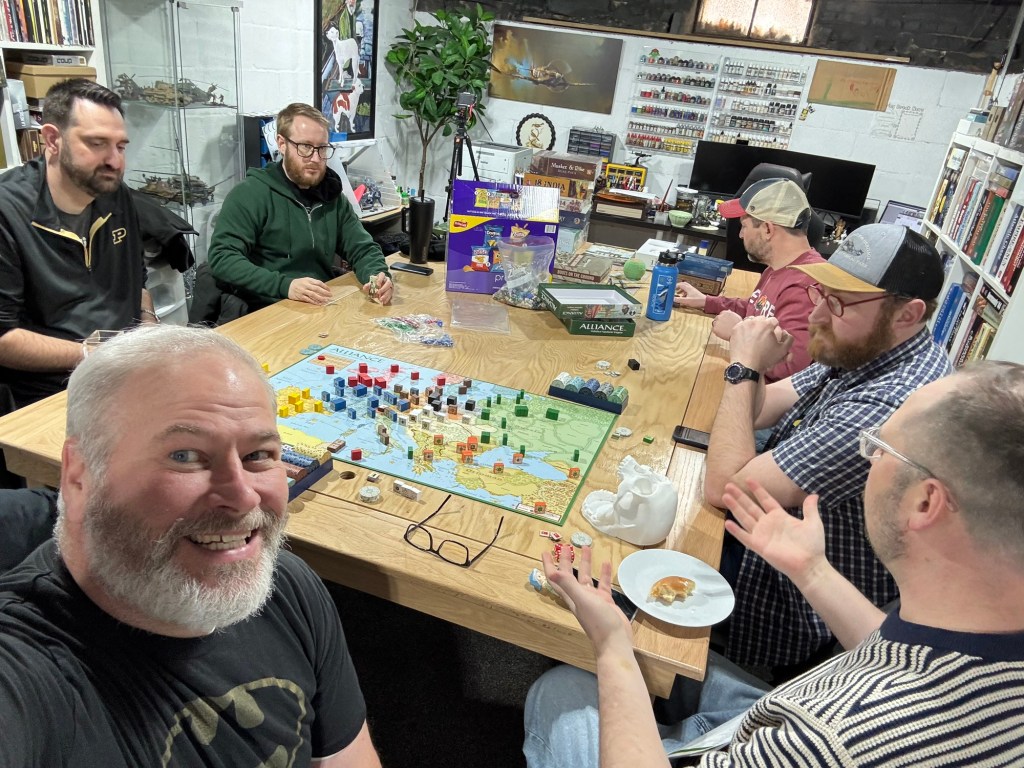
I really enjoyed our experience with Alliance this past weekend. We invited 5 friends over to play with Alexander and I including Mike Heckman (from St. Louis), Russ Wetli and Jacob Garis (from Lafayette, IN), David Thompson (yes the designer David Thompson of Valiant Defense and Undaunted fame!) and his friend Chris Blackford (Dayton, OH). 7 friends, sitting around a table, negotiating, making and breaking alliances, laughing, yelling, disagreeing, lots of dice rolling and trying desperately to keep our blocks hidden from prying eyes. The game took us 5 1/2 hours for a 4 turn scenario and all had a good time. There was a lot to like. But the game wasn’t perfect and I think that we all felt like the bones were good but it needed a bit more meat.
Maybe some event cards would have been a good idea. A bit more structure around the negotiating and alliance making and breaking. Maybe a penalty for backstabbing your friends. Maybe some benefit of some kind for sticking it out. Some player aids would have also been greatly appreciated and a few copies of the rules. We have since printed out some players aids and extras sets of rules to be used in future games but now that box is even more full.
If you are familiar with Columbia Games and their great block wargames, you will see a lot of familiar things in this game. One of the major hallmarks of their system is that there is terrain and that terrain in both regions and borders will limit the stacking or units and attacks, but also will limit the amount of units that can cross a border. There are also cards in the game that provide Action Points for the movement of armies, levying troops (pipping up the unit by rotating their block) and cadre builds which are new units that are placed on the board. But the most familiar system that is present is the combat system. But more on that later.
Back to the cards and how they work and how they determine the initiative system. This was hands down one of the best parts of the game. The are 42 cards included in the deck and these cards are individually numbered 1-42 with only 1 card of each number included. These cards are then divided amongst the 7 player nations in the game and are considered those nations cards but anyone can use them. If a player has a card that is their nation, they will then gain an extra Action Point to use going from 3 AP to 4 AP. This was very important in the game and you wouldn’t think that just 1 additional AP is a big deal but it is and if you get your own cards at the right time you can really make some hay while the sun in shining. But the cards also determine the turn order as each player will play 1 card facedown at the start of each round and then all simultaneously reveal them and then turn order will be set from the highest number played to the lowest.
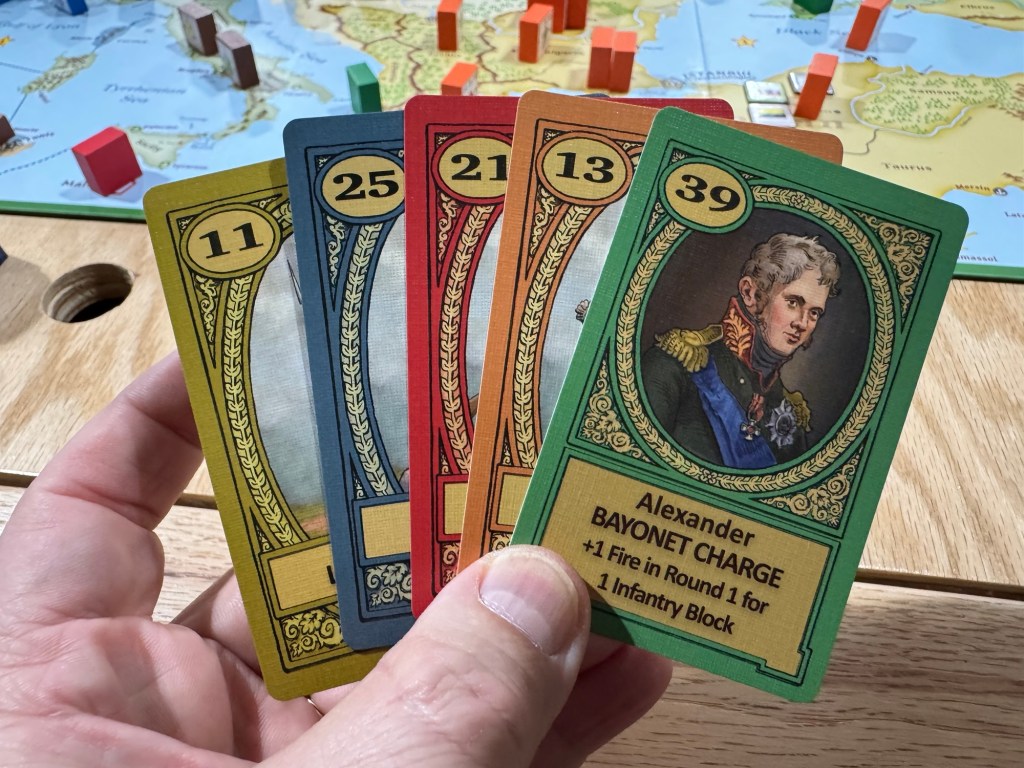
This card system is really well done and is simple yet very effective. It creates some really key decisions throughout each of the 4 rounds that players get each turn. Do I play my highest numbers to go first at this point? This could allow me to build up my units before I get attacked or even add new cadres to less defended areas. Or do I bide my time and play my low cards so that I can see what my opponents are doing with their actions before deciding how to spend my AP’s? These decisions are really important and timely each round and really create some great situational opportunities and decisions. I think that the real issue here is that once an enemy army have moved into your territory you can no longer pip up your units or add new cadres to that area so you are kind of stuck with what you have there. Although, you could use your AP’s to reinforce that area from adjacent armies and this is another key decision because I can only see their number of blocks and not the makeup of that army. How many pips does each block have? What is their firing priority and what number they will hit on? All things that are unknown when the decision to spend your AP’s is made. This really makes for a great game!
The cards also have events that provide limited one turn bonuses for movement, combat or levying. These events are not game breaking but when used at the appropriate time can be the difference between victory or defeat. I wish that these cards were more varied and or were replaced with event cards that could provide some additional benefits or harms to you or your opponents. I have always been a fan of hidden information and the unknown in wargames and this was a bit of a missed opportunity.
Let’s cover the combat system now in more depth. The Columbia block combat system is based on a few simple matters. Each unit is assigned a fire priority letter from A to D. A is the highest, meaning that these units will get to fire first in combat, while D are the worst units and they will fire last if they survive. The other important element is their to hit number which is identified right next to their fire priority letter. For example, an A2 unit means that they will fire first in combat and will hit on a 1-2 roll on a D6. These units typically represent things like artillery or fortresses. Typically B units are the HQ’s or leaders as they will then attack next and they are normally better so have designations like B3 or B4 (Napoleon). C units are typically your workhorses and represent infantry. They will fire 3rd in combat but almost always have the highest number of pips, translating to number of dice that are rolled for these units and have the best to hit numbers of 3 or 4. D units are last and represent ships (not England’s however) or militia. They will normally hit on a 1 or 2 and are not very good.
As dice are rolled in priority order, losses are taken immediately and will have to come from your largest units first meaning the largest amount of steps. This might mean that later firing units such as Infantry who are C priority, will be rolling less dice than they normally would have. This is one of the key elements of the game. Deciding what units to reduce when hits are needed to be taken. It is required that you take form the largest amount of steps but if you have several units that have the same steps regardless of priority letter you get to choose. You might lose a step on an A unit in order to preserve your dice for your infantry. These choices are fantastic and really set this system apart from other combat systems. It is really very simple but effective and strategic and we love the combat system as we have in many of their other games.
There was a new addition to the combat system in the form of the HQ units. Many of Columbia Games other games have leader or HQ block, so this is not a new thing, but the difference is in how they can be used in combat. A player can choose to can reduce their HQ block to extend the battle by 1 round so that the attacker does not get to retreat after 4 rounds of combat. It can also be used to initiate a second pursuit battle in the same battle phase. This was a very interesting choice and we liked it very much. There were times when we didn’t want to let those few remaining blocks to leave quite yet and wanted to finish then so we didn’t have to fight them again later when they have a chance to reinforce and add steps. Being given this choice really made battles feel different and a bit more strategic as you could use your leader as a type of currency to force the action. Fantastic addition to the system!
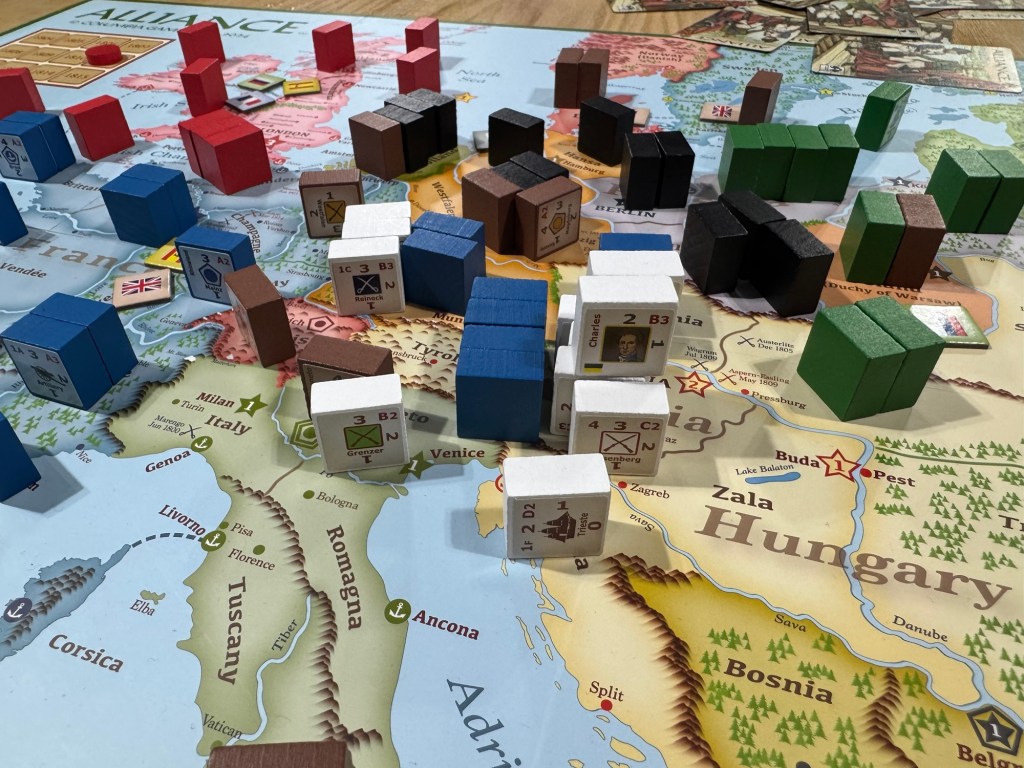
One other somewhat new concept was that of using your available Gold for additional movements or troops but also the ability to sell your AP’s for Gold. I thought at first this was strange but it made sense as we went along. There were just sometimes that you didn’t have an action you wanted to take or didn’t need any more troops at this time so you can sell the AP’s for Gold. Gold is really important when it comes down to the heart of the game the Diplomacy.
The game comes with 3 different 4 year scenarios. These are mainly used when you want to try to the game from a different stance or setup as each scenario changes the starting numbers of blocks and steps and locations. On the box, each of the scenarios is estimated at 4 hours and I think that this is correct with the exception of your first play. It will take longer. The 1st of the scenarios is France and Spain versus Britain with all other factions and minors starting neutral. The 2nd scenario is a free for all with everyone starting neutral and the 3rd scenario is France, Austria and Prussia going against Britain and Spain with all others neutral.
These scenarios all allow for a different experience and anyone of them would be good for you or your group. Just get this game and give it a try. I think that you will like it.
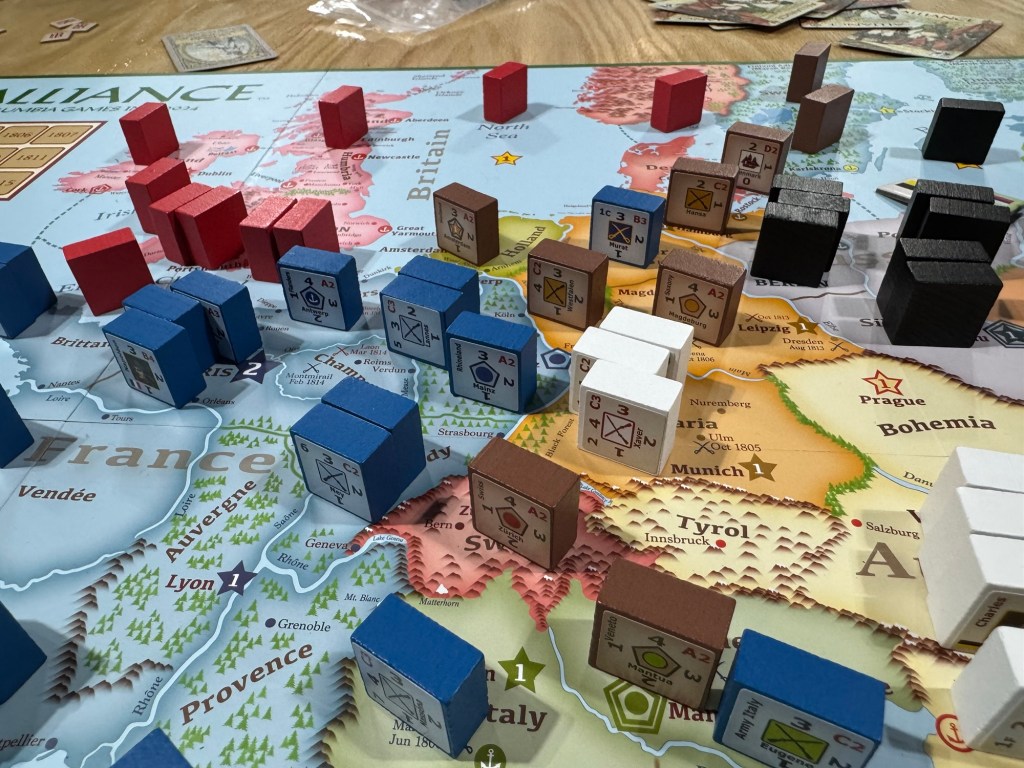
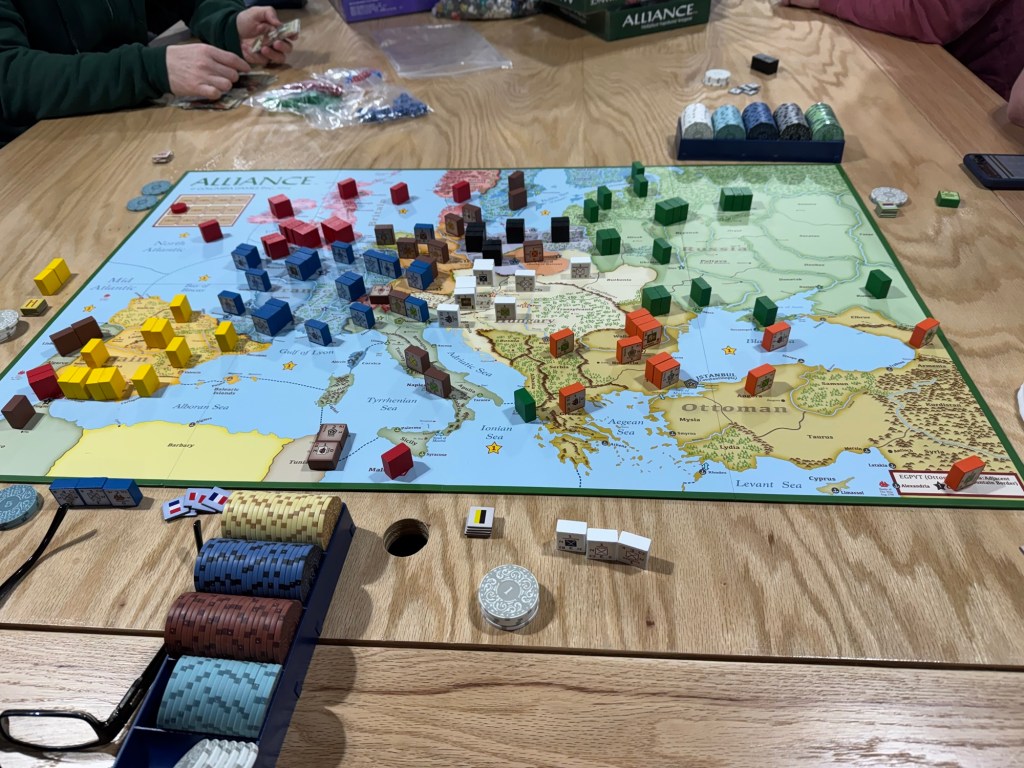
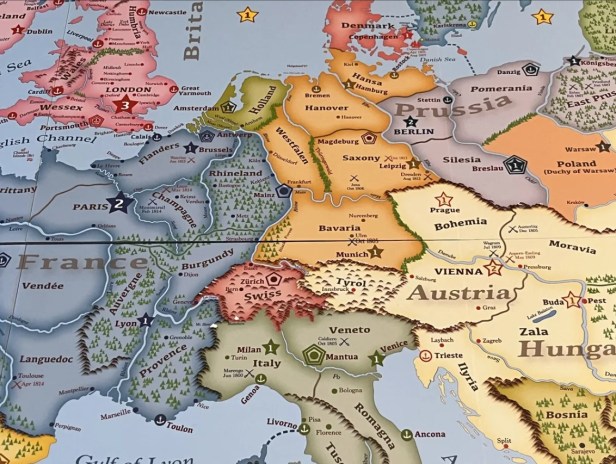
As for the production, this is a well produced and beautiful game. The game uses a standard wargame box and not the normal “sleeved” box used in other Columbia products. The game comes with a fully mounted mapboard measuring 22″ x 34″ instead of the folded cardboard that we are all used to and for which we hate as it just never seems to lie truly flat! set for seven players. You do have the option to purchase a larger and more functional neoprene mat for the game that measures a full 44″ x 68″. While it is costly at $149.98 it is highly recommended as they board it comes with is very crowded and keeping your units hidden from view is a challenge that would be made easier by a larger board. The board is absolutely gorgeous and really is a step up from some of their other games! There is terrain clearly shown including mountains, rivers, hills and forests and it just really looks great. The area boundaries are clear and it all just works well together. This board will probably find its way into my Beautiful Boards of Wargaming! Series.
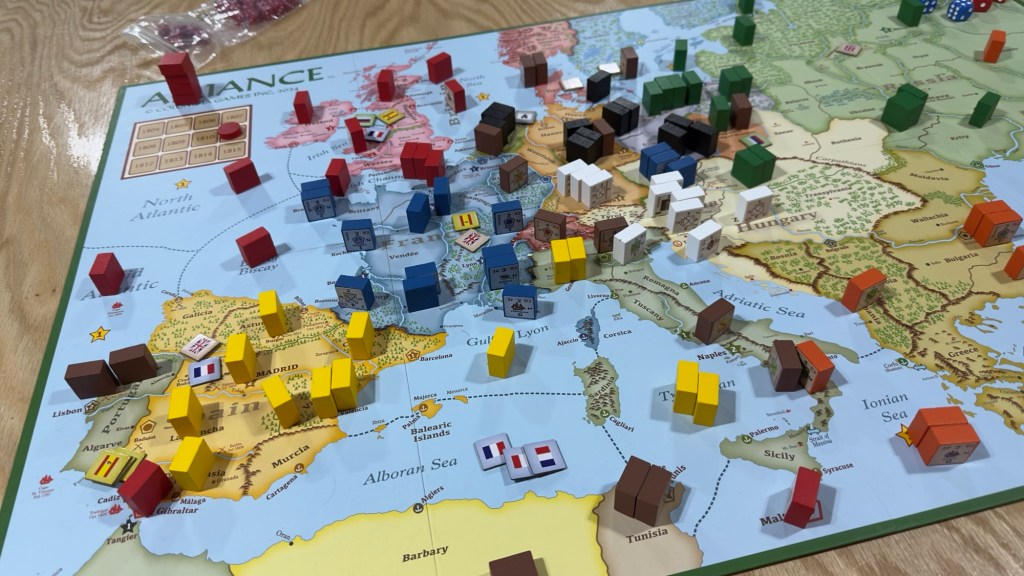
The game also comes with 8 sets of colored blocks including blue (France), red (England), yellow (Spain), white (Austria), black (Prussia), green (Russia), orange (Ottomans) and brown (Non-Player Empires). Once these are set up on the board it really is a sight to see! Tons of vibrant colors really create a feeling of excitement and interest and the game is very pretty to look at! There were no player aids…which in our humble opinion is a crying shame! As mentioned earlier a 2nd set of rules would have been helpful.
All in all, we had a great time with the game. I think that we all felt that the game was solid but was just missing some things. I would like to see what the community comes up with as far as variants and other changes over the next year. But the game delivers on its promise of a sandbox strategic level Napoleonic wargame with a focus on alliance building and maintenance. There is a lot to like and we plan to play this one again soon.
In the end of our game, the Austrians (me) defeated Napoleon in a huge battle in Vienna and kill the Emperor bringing an immediate end to the game. The Ottomans (Alexander) won with 12VP, Spain (Russ) is 2nd with 10VP, Austria (Grant) had 9VP, Russia (Chris) 7VP, Prussia (David) 6VP and England (Jacob) 6VP. France (Mike) doesn’t score because he lost his Emperor.
If you are interested, we posted an unboxing video on the You Tube channel:
We will have a first impression video coming up soon and if you are interested in the game, you can order a copy for $99.98 from the Columbia Games website at the following link: https://columbiagames.com/columbiablocksystem/alliance/
-Grant
 The Players' Aid
This one sounds like a fine game. Your own observations about this game strike me as being spot on.
The humorous quip about the donut was a nice touch.
A hundred and fifty bucks for the neoprene mat? OUCH! Yeah, nice but expensive. One could buy one or more additional board games for that price, Grant. Surely, there’s not to be lots of room for improvement on the manufacturing end of things, going forward. Costs can be real killers in the board game industry, after all.
I do like the map for this Alliance: Multiplayer Napoleonic Wargame. I also really like the blocks. I’ve never played a block wargame, before, but I have loved the sight of them, ever since I first encountered them a number of years back. While you routinely dip your toes in the gaming waters of many different wargames, Grant, some of us remain relegated to a state of relative banishment (self-imposed though it may be).
I really appreciate your pointing out some of the shortcomings and the positives associated with the games that your reviews cover. It’s helpful information to become privy to (privy is an odd choice of words, perhaps, since you post openly in your blog postings, here).
Personally speaking, what are my chances of fielding seven players for a game of Alliance: Multiplayer Napoleonic Wargame? Zero, if I had to take a stab at guessing. That’s one of the things that I liked the most about play by mail (PBM) gaming. It made it vastly easier to play in games with lots of other players, simultaneously (Hyborian War, for example, has 36 players vying for victory). The seven players that this game of Alliance: Multiplayer Napoleonic Wargame can be played with is basically 1/5th of that, but since it is played face-to-face, that’s got to be quite the experience, I’d imagine.
The trees depicting forests on this game’s map grab my eye. The mountains? Not as much. They simply don’t appear to my eyes as much as the forests do. Maybe it all boils down to individual taste.
Whenever you inject such quips as, “This really makes for a great game!” and “Fantastic addition to the system!”, my eyes stand up and take notice. You have a lot of experience playing board games, generally, and wargames, specifically, so you don’t toss such compliments out lightly.
You didn’t cover the emperors aspect of this game as much as I would have preferred, but one can’t win ’em all, I reckon.
LikeLiked by 1 person
Thanks for your comments. Getting 7-players together is always a challenge but I think this one is worth the effort.
LikeLike
With so many players sitting around the table, how can you keep from seeing the strength of your neighbor’s units? I thought that three or maybe four players was the practical maximum for a hidden information block game.
LikeLiked by 1 person
It’s nearly impossible so you have to do the honor system or turn the back block around. It really wasn’t a problem. We all had a good time.
LikeLike