
Stephen Rangazas has been active behind the scenes over the past several years with his development work on Fall of Saigon: A Fire in the Lake Expansion. He then used his background and research capabilities to great effect as he did the background work on the Event cards for that game. From that experience, he has now come forward with a few of his own designs in The British Way: Counterinsurgency at the End of Empire, which was released in 2023 as well as Sovereign of Discord released in 2022. Now, he is working on a new COIN Series Multi-Pack that deals with insurgencies in Latin America during the height of the Cold War called The Guerrilla Generation. We reached out to Stephen and he was willing to share about the design at this stage of the project.
*Keep in mind that the design is still undergoing playtesting and development and that any details or component pictures shared in this interview may change prior to final publication as they enter the art department.

Grant: Stephen, welcome back to the blog. What is your upcoming game The Guerrilla Generation about?
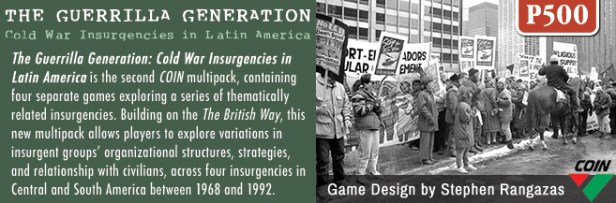
Stephen: The Guerrilla Generation covers civil wars in Central and South America during the Cold War. The conflicts include Uruguay (1968-1972), El Salvador (1979-1992), Nicaragua (1979-1990), and Peru (1980-1992). The goal of the multipack is to illustrate for players the great variation in how insurgencies operate. Although the COIN Series has shown large variation across non-state actors (insurgents, paramilitaries, criminals, terrorist cells, and non-violent activists), the multiplayer games in the series often abstractly depict politically motivated insurgents (FARC, M26, Taliban, VC, etc…) as following a similar pattern of seeking popular support (Opposition) and an expanding infrastructure (Bases) by using Rally, Agitate, and Terror. Despite changes in the labels and mechanical tweaks, these factions largely come off as the same abstract archetype with the same organizational practices.
Such a level of abstraction makes perfect sense in the complex multiplayer dynamics of the larger main volume games; however, 2-player multipack games do not have that problem! Players of The British Way might have already noticed that, despite having four “red” COIN insurgent factions, there is quite a bit of difference between the urban terrorist cells (Irgun, EOKA) and the rural insurgencies (MCP, Mau Mau). The Guerrilla Generation goes a step further by providing four insurgencies that all operate differently so players get an experience closer to the vast real world variation in insurgent organizations.
Grant: What was your inspiration for the design?
Stephen: The British Way was inspired by recent academic scholarship that concluded British counterinsurgency was “nasty not nice” and relied more on coercion than hearts and minds measures (e.g. Anderson 2005; French 2011; Hack 2021, etc…). Similarly, The Guerrilla Generation, which focuses on the insurgent side of civil wars, was inspired by several great comparative works on insurgency. First, Jeremy Weinstein’s Inside Rebellion (2006) played a major role in sparking off the explosion of political science research on variation in insurgent organization’s key practices: recruitment, control, governance, and violence. Weinstein’s main argument is that insurgencies’ initial endowments (external resources or internal support from the population) guides their future treatment of civilians. A good example of his argument in the game is the comparison of the highly violent Contras, largely backed externally by the United States, and the FMLN insurgency in El Salvador who relied more on the population and committed far less violence against civilians. Like Stathis Kalyvas’ The Logic of Violence in Civil Wars (2006), Weinstein’s book has become essential reading for anyone interested in civil wars. It’s taught in university courses all across the globe, including in my own class on civil wars!
Focusing more on insurgency in Latin America, The Guerrilla Generation is inspired by two books. Timothy Wickham-Crowley’s Guerrillas and Revolution in Latin America: A Comparative Study of Insurgents and Regimes since 1956 (1993) is a classic comparative work that was an early inspiration for the idea of creating a series of “multipacks” that allow players to make their own comparisons like they’d find in Wickham-Crowley’s book! Second is Dirk Kruijt’s Guerrillas: War and Peace in Central America (2008) which is a comparative history of civil wars in El Salvador, Nicaragua, and Guatemala (not included in the multipack) that provided the title of the game from his argument about “the guerrilla generation”, or the youth who made up the insurgencies across the region.
Grant: What is the setting for the game? How much have you fleshed out the backstory?
Stephen: The setting is Latin America (Central and South) between 1968 and 1992. In terms of backstory, if you mean the background leading up to each conflict, then the game provides Pre-War tables that change up the setup of each game (either randomly or by player choice) with accompanying background notes. The Guerrilla Generation also includes the “Personas” for each game that Joe and I retroactively added to The British Way: https://insidegmt.com/faction-personas-for-the-british-way/. If you mean supporting historical notes, players can expect the same level of treatment as The British Way: background notes for every card (base game, campaign, etc…) and comparative articles in the playbook to help players understand the broad themes of the multipack.
Grant: What is your design goal with the game?
Stephen: As I mentioned above, the goal of the multipack is to illustrate for players the major differences in how insurgencies operate. I picked the four insurgencies from the many in Latin America to pick ones that each represent a different “type” of insurgency: externally backed cross border (Contras in Nicaragua), urban cell based group (Tupamaros in Uruguay), a rural group with widespread popularity (FMLN in El Salvador), and finally a highly centralized violent rural group (Shining Path in Peru). Each of these different insurgent factions will require players to approach lowering Government Political Will differently. As with The British Way, two games focus on lowering high Government Political Will by the end of the game by exhausting their opponent’s will through violent acts (Tupamaros and Contras) and two focus on push and pull bargaining model where each side can win an automatic victory or a better negotiated settlement (FMLN and Shining Path).
Grant: What four conflicts are included in the design?
Stephen: As mentioned above, the multipack covers four distinct civil wars: three rural and one urban that focuses on Uruguay’s capital city of Montevideo. The earliest conflict is the Tupamaros urban insurgency from 1968 to 1972. Then, there are the two major wars in Central America, El Salvador and Nicaragua, that begin at the start of the 1980’s and end in the early 1990’s, which are used in the “Resisting Reagan” campaign game. The United States played a far greater role in those two conflicts than the two that occurred in South America. Finally, the game on the Peruvian civil wars covers from the declaration of the state of emergency in 1983 up to the historical capture of the Shining Path’s leader Guzmán in 1992. The Shining Path insurgency began at a lower level a few years before 1983 and continued after 1992, but again at a lower level that doesn’t quite fit the scale of the COIN Series.
Grant: What other considerations were there for inclusion?
Stephen: The other two major considerations were Guatemala in the mid-1970’s and 1980’s and Argentina in the 1970’s. However, those two topics involve very high levels of state terror against civilians (state repression in Argentina and mass violence as a part of the counterinsurgency campaign in Guatemala) and roughly cover the same types of insurgencies as other games in the multipack: UNRG insurgency in Guatemala is similar to the FMLN in El Salvador while the Montoneros in Argentina are similar to the Tupamaros in Uruguay. I increasingly think the COIN Series is quite limited in its mechanics and scale to deal with the dynamics of violence beyond simply summarizing conflicts (which is still useful for people who have never heard of them!).
For instance, although the conflicts in the El Salvador, Nicaragua, and Peru games include high levels of civilian victimization, I recently started designing and then scrapped a Soviet-Afghan War expansion for A Distant Plain, given my misgivings with the series handling of similar conflicts in the past and difficult transferring it well to others. Players may see these conflicts in my future games but at a lower, more carefully defined scale and incorporating more of the cutting edge social science research on the logic and effects of violence during civil war.
Grant: What new mechanics or rules have you introduced to this volume?
Stephen: Multipacks represent a classic problem with answering a question like this one. I always tailor the mechanics to each conflict to highlight the unique dynamics of each one. This leads to a fairly long list of new mechanics and rules unique to each of the four games included in the box. Players who want an overview of the changes for each game should check out the InsideGMT articles for The Guerrilla Generation so that I don’t extend this already long interview! (e.g. https://insidegmt.com/the-guerrilla-generation-uruguay/ ) All five articles can be found on the GMT page for the game.
Grant: I understand that the level of complexity is higher than in The British Way. How does this complexity manifest itself in the game?
Stephen: The “medium” complexity of this multipack comes through in several ways. First, all of the games are a bit larger in terms of map spaces, types of map spaces, and playing pieces for each side. This quickly leads to a more complex map state for players to read, just as Fire in the Lake is a bit more daunting than Cuba Libre despite a similar length of rules. In addition, the games include more rules than The British Way to handle additional mechanics beyond the core Faction player aid sheets. For instance, El Salvador includes special types of Event Cards (Pivotal Events and a small deck for each faction, the Atrocity and Reform Decks) while the Peru and Uruguay games include rules to represent key actors not represented entirely by one of the two factions (local self-defense forces known as rondas in Peru and the possibility of military intervention in Uruguay). Finally, the games all last longer than The British Way. Each “campaign” now lasts 8 cards with three campaigns making up a game. This increases the length from 16-18 turns in The British Way to 22-24 in The Guerrilla Generation. This change requires players to more carefully manage their resources and will present a nice change for those who found The British Way games too short.
In addition, just as the complexity of each individual game increases over those in The British Way, the campaign rules for the “Resisting Reagan” scenario are also more involved than the “End of Empire” campaign found in the first multipack.
Grant: Can we get a look at each of the different maps?
Stephen: Sure, although players should note that these are playtest art, and that the final art will look far better as with all of GMT’s games. There is a bit of a “chicken or the egg” problem with GMT’s approach to art. I sometimes see people online holding back their preorder for a game that they find interesting until they see the final art. However, this same approach will mean many games will take very long to reach (or never reach) the assignment of an artist! The nice thing about GMT’s P500 system is that you’re not charged until right before the game ships, giving potential buyers the chance to P500 a game and back out later if they don’t like the art style (though I suspect that is quite rare). In other words, the art style will be similar to the quality of The British Way, so I encourage potential buyers to not go off any of the playtest art for making their final decision.


Grant: Each of these conflicts covered present their own unique challenges and opportunities. What is each game’s new focus?
Stephen: I’ll go chronologically in the order that the conflicts occurred.
In Uruguay, one of the central dilemmas for the Tupamaros insurgent Faction is setting their organizational posture. At the beginning of the game, they start with a “Control” posture that provides less Cells and Arms Caches but represents a more tightly controlled organization allowing for more daring armed propaganda and the benefit of Capability Events. Once the Tupamaros switch to Expansion (or are forced to switch by event), they expand the membership of their organization gaining a larger pool of pieces and better ability to use violence, but at the cost of lower control over their organization (any in play Capability Events switch to their negative side) and a lowered ability to communicate a coherent message with their Propagandize Special Activity. The Government Faction has a similar dilemma over when, if ever, to bring the military into the conflict. At the start, the Government has only Police, but given the smaller scale urban map their Police are capable of moving around easier than in other COIN games. If the Government Political Will falls below a certain point, then the Government may bring in a large number of invulnerable Troop pieces and gain heightened repressive abilities. Such a strong force will generally overwhelm the Tupamaros as historically, but risk a military coup against the civilian government (if Political Will falls below Coup Threat), which counts as a Tupamaros moral victory!

In El Salvador, a major new challenge for each side is leveraging the Special Event cards in the game as much as possible. The FMLN insurgent Faction begins the game by playing their “FMLN Offensive” Pivotal Event (think Easter Offensive from Fire in the Lake) which then they get back for another attempt at toppling the Government. The FMLN also possesses a special “Radio Venceremos” Base piece that allows them to broadcast Government atrocities as long as it remains on the map. By drawing from the Atrocity Deck, the FMLN can punish particularly violent Government players by increasing FMLN resources or through endgame shifts in Political Will. The Government Faction has to choose over a game whether they will pursue a Reformist or Rightist government, either winning through US Aid and Reforms, or falling back on the use of state terror in the form of Reprisals. Their Pivotal Event, “Duarte Elected” will help them make the shift toward Reformist but only after at least two Cities are at Support. Once on the Reformist side of the Government Track, the player can draw from the Reform Deck. The Reform Deck is how the Government gains Capabilities that improve their Faction. However, within the deck are cards representing Rightist backlash to reforms. The more reforms implemented, the more likely there will be backlash.

In Nicaragua, the Contra insurgent player faces the challenge of keeping up US Aid. US Aid determines the number of Contra Operations each turn, the number of Bases available, and the degree that Contra pieces may stay in Nicaragua during the Propaganda Round. However, US Aid lowers once each Propaganda Round and events such as the Boland Amendment can also rapidly lower aid. The Contra player may increase US Aid by using the “Iran-Contra Pass”, but that also adds Iran-Contra markers, increasing the chances the affair will go public (see more below). The Sandinista Government Faction must decide how much to go after the Contras in Nicaragua versus attempting to destroy their Foreign Country bases in Honduras and Costa Rica. Air Lift and Assault will keep up pressure in Nicaragua but the Sandinistas must decide how many Troops to deploy. Expanding the draft to bring out more Troops only helps the Contras goal of economically exhausting the country. Another way to limit the Contras is for the Sandinista to use the Bombard Special Activity to eliminate Contra pieces hiding in Foreign Country spaces. It is a preemptive way of eliminating Contras but at the risk of losing Political Will over international backlash at violating their neighbors’ sovereignty.

Finally, in Peru, the Shining Path player must decide on how much they want to use Terror, which works differently than in other multipack games or COIN volumes. In rural Highland spaces that make up most of the map, Shining Path Terror is free (the organization’s ideology favored the use of violence) but places underground rondas self-defense militia that may later activate and help the Government Faction. In Lima and the other major urban areas along the coast, Shining Path Terror aims to directly lower Government Political Will by pressuring the democratic government through targeting their urban constituency. In addition, Lima, the country’s capital, can hold more than one Terror marker allowing the Shining Path to extensively use violence for a greater hit to Political Will. A major challenge for the Government Faction is encouraging the growth of rondas in the Highland spaces and activating those already placed by Shining Path Terror. Activated Rondas eliminate Shining Path Guerrillas during the Propaganda Round and also help the Government’s Assault in the Highlands.

Grant: I know that there is one of the games (Uruguay) that is an urban setting. What had to change in your approach to capture this type of situation?
Stephen: The Palestine and Cyprus games in The British Way already represented a step in the direction of flexible factions that use small clandestine cells which aim to drag down their opponent’s Political Will through acts of Sabotage and Terror. In Uruguay, the conflict was limited to the capital city of Montevideo rather than spread across urban areas of the country like in Palestine. This led to several mechanical changes to represent the change in scale. First, the map has five “strategic centers” such as the University or Prison around the City, which are key targets for Sabotage and that all produce a unique effect for the Tupamaros when sabotaged. Sabotaging the Prison space can even free Cells from the Prison Box! Second, a lot was going on in the city beyond the actions by the two actors such as student protests, visits by foreign dignitaries, and other random happenings. These events are represented by a “headline” Event on the top of each card that triggers at the end of the turn unless blocked by a Special Activity (see examples below). Finally, the map also includes a few abstract rural spaces representing the rest of Uruguay. Although commonly viewed as an entirely urban one, the Tupamaros viewed the urban front as important for setting up a rural one. Several attempts were made to establish rural base areas, but the poor terrain for rebellion makes such attempts risky in the game as much as real life.
Grant: I also see where another game focuses on a cross border war that focuses on inflicting economic pain (Nicaragua). How does this play out?
Stephen: The Contras do not work like a standard COIN Series Insurgent Faction. They cannot Rally their Commandos in Nicaragua! Instead, they can only Organize Commandos in Foreign Countries and place Bases in Nicaragua spaces to help keep their forces there. Instead, the Contras must Infiltrate or Raid their Commandos into Nicaragua or can use their Supply Special Activities to place Commandos directly there if there is a chain of Contra pieces back to a Foreign Country Base. At the end of each Propaganda Round, most Contra pieces will be forced to redeploy back to Bases in Honduras or Costa Rica. This results in waves of Contras descending on the country each campaign with the hope of lowering Political Will by exhausting the country’s economy. However, given the scale of the devastation needed to disrupt the economy, a few Sabotage markers will not cut it. Instead, the Contras’ aim is to place Unrest markers (Contra pieces + Sabotage) at the Propaganda Round markers to lower Political Will. Areas with Unrest markers last from one campaign to another lower Political Will even further. The Contras’ Sabotage Operation may place two Sabotage markers, increasing the chances of Unrest placement, per selected space if they also place a Terror marker. Terror markers help the Sandinista Government Faction by blocking Contras’ Organize Operation and making the placement of Sandinista Militia pieces free! Spaces marked as “Port Spaces” also lower Political Will further if there are any Sabotage markers there. Therefore, Contras share some similarities with both Irgun and EOKA from The British Way and more traditional rural insurgencies found across the COIN Series.
Grant: Events are still a major focus of the games. How many cards does each game have?
Stephen: There are a lot of Event Cards in The Guerrilla Generation! Each game comes with 36 normal events (4 more than included for each in The British Way game). In addition, El Salvador includes an additional 14 special events (2 Pivotal Events, 6 Reform Deck cards, and 6 Atrocity Deck cards). Finally, the “Resisting Reagan” campaign scenario includes 29 additional cards. This amounts to 187 Event Cards and each comes with a background note (not counting Propaganda Cards).

Grant: How long did it take to create these events? How similar are they across each game?
Stephen: While I do research for each game, I make a list of possible events. Since I do almost all the research for a game up front to ensure I understand the dynamics, I have a good list of events to choose from when I start designing the game itself. The events are fairly different across the games because I pick events that highlight the major mechanics unique to each game. For instance, there are Capability Events in each of the games, but there are several variations in how Capabilities work across the games to match the specific conflict. Government Capabilities in El Salvador only come from their Reform mini-deck, while the effect of Tupamaros Insurgent Capabilities “flip” depending on their organizational posture. In addition, Events in Uruguay also have a “headline” event on every card that represents chaotic minor events going on throughout the city that each side can block with one of their Special Activities (Propaganda for Tupamaros and Censor for Government).
Grant: Can you give us a few key examples of cards that deal with the theme of each game?
Stephen: Again, I’ll go in chronological order. In Uruguay, a major theme of the game is the democratic backsliding that occurred throughout the conflict and eventually led to a military coup against Uruguay’s democracy shortly after the defeat of the Tupamaros. Given the current wave of democratic backsliding around the world, it’s a timely event theme! Each of these Events give the Government Faction a powerful effect at the risk of increasing “Coup Threat” which increases the chances the game ends in a military coup, a loss for the civilian-led Government Faction.


Prototype cards, not final art. Headline Events are at the top of each card and trigger at the end of a turn unless blocked by Special Activity.
Second, in El Salvador, a major theme of the events is the displacement of the Salvadoran population caused by Government actions, particularly bombing and massacres. Over 20% of the total population of the country was ultimately displaced by the violence. The gray card represents one of those in the FMLN’s Atrocity Deck, which they can use to raise the cost of Government violence by broadcasting atrocities committed by Government forces to the world.


Prototype cards, not final art. A normal Event, an FMLN Capability, and one of the cards in the Atrocity Deck representing atrocities by the US backed Government Faction.
Third is Nicaragua. A major theme of the events relate to the mechanics representing the Iran-Contra Affair, the Reagan Administration’s attempts to circumvent Congressional limits on aid to the Contras. Once enough Iran-Contra markers accumulate, representing growing evidence of wrongdoing, there is a heightened risk that the illegal support for the Contras will be exposed.


Prototype cards, not final art. A Contra Capability and two normal Event Cards.
Finally, Peru includes events related to the “hunt” for Guzmán, the leader of the Shining Path insurgency. The “hunt” represents the Peruvian police closing on the location of Guzmán that historically led to his capture in 1992. Given the highly centralized nature of the insurgency, the capture of Guzmán dealt a serious blow to the organization.


Prototype cards, not final art. Three normal Events that affect the “Hunt Track” that tracks police progress at finding Guzmán.
Grant: What is the makeup of the Resisting Reagan Campaign? How does this work?
Stephen: Since there is a lot going on there, I’ve dedicated an entire InsideGMT article to describing the campaign scenario. The scenario is quite a bit more involved than The British Way’s End of Empire scenario: https://insidegmt.com/the-guerrilla-generation-resisting-reagan-campaign-scenario/. The campaign adds a more detailed layer of the effect of US domestic politics on the conflicts in Central America. In particular, the campaign covers the struggle between the Reagan administration and the Central American Peace Movement (CAPM) to expand or limit America’s role in the conflicts of the region. A couple of highlights is that, unlike End of Empire, players play two games side by side (El Salvador and Nicaragua) rather than four games back to back. In addition, the campaign comes with a four player variant that divides each side into two player roles (a player for the Government and Insurgent Factions on each side). Finally, since the British served as the side linking the conflicts together, the insurgent player in the End of Empire campaign did not get the same level of choices (this is now partially addressed in the Enemy of My Enemy Expansion). Both the Reagan Administration and CAPM players now play an equally active role in shaping the effect of US politics on the two conflicts.
Grant: What are you most pleased with about the design?
Stephen: I think this design allowed me to explore the limits of the COIN Series. Those limits forced me to come up with a number of mechanical changes across the games that I think make the games richer than The British Way and quite different from the now long list of COIN volumes. On the other hand, the process of designing the games led me to increasingly doubt the utility of the series as a whole. Those thoughts are largely summarized in a video interview I did with Fred Serval a little over a year ago: https://www.youtube.com/watch?v=keUR15gYwSM&t=8s. Over the last year since the interview, my doubts have continued to grow around the series’ use of scale and abstraction.
I’ve come to the conclusion that I could generate several additional interesting multipacks, since there are plenty of unique insurgencies still needing coverage! Yet, there are severe limits on how well the series can show specific conflict dynamics. Those limitations can provide fairly misleading implications for how players learn about civil wars that I’ve done the best to avoid in my own contributions to the series. To be clear, I’m very proud of the work that Joe and I have done together on all our contributions to the COIN Series. The multiplayer volume that I view as the best, The Pure Land, still remains unreleased! However, my personality and academic background pushes me to keep trying to design better researched games with clearer ties to conflict dynamics.
Grant: What has been the experience of your playtesters?
Stephen: I doubt any designer would self-report that playesters don’t like their game! Luckily, playtesters report enjoying the games, with many of The British Way former testers finding the games’ mechanics to be quite different from the first multipack. The reception of the Resisting Reagan campaign has also been positive, though it can be a little demanding when playing multi-hand solo. We’ve included a note recommending solo players break the campaign into several sessions based on playtester feedback.
Grant: What other designs are you mulling over?
Stephen: The design of the Enemy of My Enemy Expansion for The British Way is completed and we have already done quite a bit of testing. The expansion is already in a good place without much more to do before being ready for art. Despite my misgiving with the series, I’m happy with how the new games and variants turned out. They represent my ninth and tenth multipack style COIN games, which always raise the question of whether I can produce new distinct gameplay. However, given the unique features of the two conflicts (Arab Revolt 1936-1939 and Japanese Occupation of Malaya 1942-1945), I can happily report that the two games’ gameplay deviates from any of the eight games across the two multipacks! The new variants also change up the four original games’ strategies with only a small amount of new rules. I think it accomplishes my main goal for the expansion, which is to thank all those who helped support and enjoy my first game by further extending the game!
I’ve been pretty busy with moving this summer but have a number of ongoing projects at various stages. First, I am working on a co-design with my main design collaborator (excluding Joe Dewhurst): Non-Breaking Space, the designer of Cross Bronx Expressway and Solitaire TacOps: Ortona. The game explores the military side of counterinsurgency at a much lower scale than the COIN Series. I’ve greatly benefited from regularly interacting with a group of designers: Joe Dewhurst (best developer in the hobby), Peter Evans (developer and forthcoming designer), Non-Breaking Space (most mysterious designer in the hobby), and Cory Graham (Vijayanagara designer and connoisseur of weird games I’ve never heard of before). Discussion among our group, usually over a chaotic multiplayer game, has refined my understanding of how to communicate ideas through games.
Second, I’m continuing to work on my new insurgency and counterinsurgency system that is at the scale of sub-national regions (think of the “Corps” of South Vietnam or Regional Commands in Afghanistan). Finally, I’m converting the research I finished for an abandoned multipack on later British counterinsurgency campaigns into a new province-level insurgency system. These two new systems seek to focus on a specific scale of insurgency to better capture the decision-making of real world actors and incorporate social science research of the last two decades into the mechanics of the games.

As always Stephen, thank you so much for your time in answering our questions so thoroughly and with such context to help us all better understand the intricacies in this entry into the COIN Series Multi-Pack. We have also made an offer to Stephen to host a series of Event Card Spoiler posts on the blog for the game and I hope that he accepts. I really love taking a look at the Event Cards and how they shape the game before it arrives to give me and you insight into the direction the game is taking with its narrative. Always extremely interesting!
If you are interested in The Guerilla Generation: Cold War Insurgencies in Latin America, you can pre-order a copy for $69.00 from the GMT Games website at the following link: https://www.gmtgames.com/p-1032-the-guerrilla-generation.aspx
-Grant
 The Players' Aid
Thanks.
Like Stephen, and Volko too, I am also moving past the GMT COIN system.
China’s War 1937-41 will be my last formally published game using the system, and I intend to follow it this year by self-publishing O Canada, a game on modern Canadian politics that uses an adaptation of the system for one of the least violent and “kinetic” situations you could think of.
I always thought the COIN system would be good to use for a power-politics situation and this is my kick at it.
Stephen’s games on the Tupamaros and Shining Path movements will be the second ever published on these conflicts: the first ones were mine, designed in 1994 and 1995 respectively.
Stephen has had the benefit of 30 years of research and stuff being dumped on the Internet, so his analysis is more detailed but I think we both hit the high spots of the conflict quite well.
And these games are distributed on a GMT scale (not the “DTP in a comic book bag” presentation my games had, with Microgame Design Group) so I would not be surprised to see his games eclipse mine through recency and numbers.
Though I am happy with both of these games still, 30 years down the road, and also happy that they form the early members of a family of games that became a system that partially inspired the GMT COIN system, which kind of brings us full circle.
I also understand his misgivings about the ability of the COIN system to be all things to all people wishing all levels of detail… it was a semi-abstract, high level system to begin with, and he has stripped it down to its essentials with his two multi-packs.
It’s encouraging that he says he intends to work on operational level counterinsurgency next; this is the row in the COINfield I’ve been plowing for years, with the District Commander series of four games and some other one-offs (Binh Dinh ’69, BCT Command: Kandahar co-design, Green Beret). I’m interested to see what he comes up with.
Brian Train
LikeLiked by 1 person