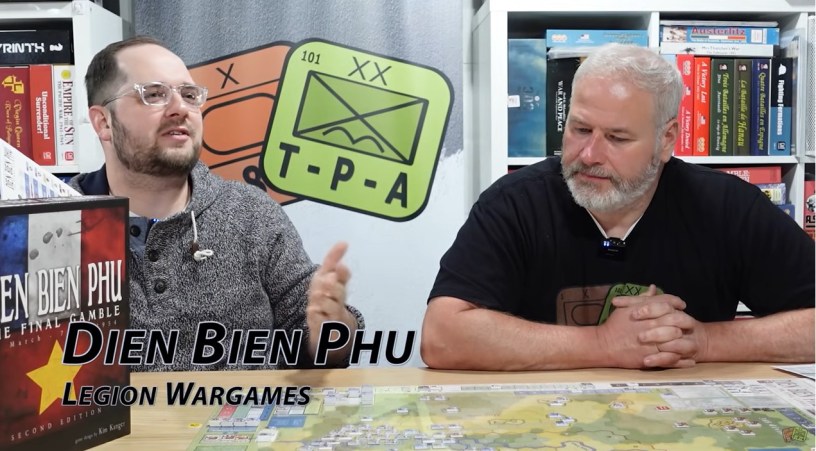
Dien Bien Phu – The Final Gamble from Legion Wargames is a 2-player wargame about the decisive battle of Dien Bien Phu in 1954 that not only ended the French Indochina War but also had political repercussions far outside the region itself. One player represents France and her colonial troops. The other player represents the armed force of Viet Minh, the communist/nationalist independence movement of Vietnam. This game is not a traditional wargame and has different victory conditions than normal and also some unique and interesting supply rules. The Viet Minh win by forcing the French troops to surrender and France wins by not surrendering.
The board covers the former village of Dien Bien Phu and surrounding areas. There is a small submap of the French strongpoint “Isabelle” further south in the valley. There are several groups of French strongpoints scattered around the map, each one with a female name (all named after the commander – de Castries’ – mistresses, according to lore). The map is divided into three divisional sectors (plus a fourth one facing the submap “Isabelle”). Each sector has several zones that represent Viet Minh trenches winding from the map edge towards the center of the map. Each hex represents 150 meters and each game turn covers three days. There are 21 turns in the game, but historically, it ended after 19 game turns with a Viet Minh victory. The scale allows stacking of three French units (usually infantry companies) in a hex, but there are no stacking limits for Viet Minh battalions, which creates a chess feel.
French supply is a bit of a mini-game within the game. As this battle took place far out in the wilderness of Vietnam and both sides had to adjust to the limited flow of supplies that could be brought forward, through the air to the French, and through vast forests to the Viet Minh. Supplies tend to be a lot less than wished for. There are several supply tracks on the map showing how much ammo, food & bullets, fuel & spares, medicine as well as the amount of truck transport available for the French. Each game turn air transports will bring in a mix of supplies together with replacements and reinforcements. This is done on a chart with a grid where a mix of supply markers are placed together with eventual reinforcements and replacements. Weather will then decide what will arrive and what will abort back to Hanoi. The French player will never know for sure what and how much will arrive and has to take that into account.
-Grant
 The Players' Aid
So, this one is still on my Shelf of Shame….which pains me.
Question: Is that just a regular ol’ piece of plexiglass you put over the map?
I generally dislike Paper Boards….or should I say, I highly prefer “Mounted Maps”….but, this plexiglass solution seems like a great idea.
Anyway….the idea of set up being “squinty” is a tough one for me.
Thanks for the great review and congrats on the “dust off”!
LikeLiked by 1 person
It is a run of the mill piece of plexigalss purchased at and cut by Lowes. We have several pieces each and use them often. The only real problem is that the glare from the lights makes taking pictures a bit of a challenge.
LikeLiked by 1 person