Recently, I noticed 2 new games from Trafalgar Editions that were being offered on various crowdfunding platforms (both Kickstarter and Gamefound). One of the games was focused on North Africa called Afrika Korps 1941 and the other on the invasion of Poland in 1939 called Poland ’39. I reached out to the designer Crisanto Lorente Gonzalez to get some more information about the games and in this interview I will share more about Afrika Korps 1941.
If you are interested in Afrika Korps 1941, you can back the project on the Kickstarter page at the following link: https://www.kickstarter.com/projects/1615432558/afrika-korps-1941
Grant: Right now Trafalgar Editions has 2 Crowdfunding campaigns (Poland ‘39 and Afrika Korps 1941) going on simultaneously. Why did you decide this was the best path forward for your designs?
Crisanto: I had these two projects already finished and we thought that if we released them at the same time in a single crowdfunding campaign the amount to ask for would be too high and neither of the two games would come out. Also, although many backers want both games, many others would not want them and this also limited our ability to successfully reach the end.
In the end we thought that releasing them in two different campaigns could be beneficial…
Grant: How did you make a decision to use Gamefound for Poland ‘39 and Kickstarter for Afrika Korps 1941?
Crisanto: Simply because we didn’t know that you couldn’t launch two projects on the same platform, so we were forced to refer Afrika to Kickstarter.
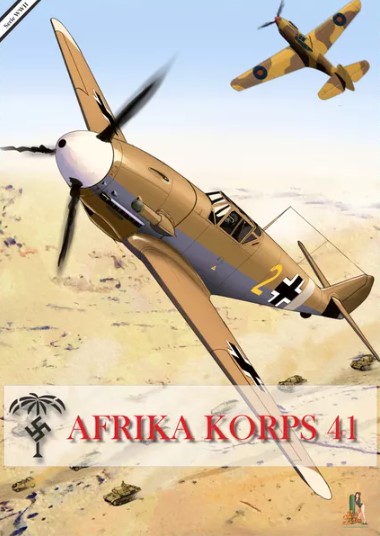
Grant: What is the focus of your Afrika Korps 1941 game?
Crisanto: It covers the North Africa campaign from Rommel’s arrival to Montgomery’s reorganization of the 8th Army…ending in December 1942.
Grant: Why was this a subject you wanted to design a game around?
Crisanto: I was looking for a different game system, and the African campaign has always fascinated me… plus, there aren’t an excessive number of units and this makes the game smaller and faster playing.
Grant: What design challenges did you have to overcome with the game?
Crisanto: I wanted to break away from the usual and develop an area-based game system. I created a unique combat system—very simple, without complicated tables—where every unit plays a crucial role.
Grant: What sources did you consult for the historical details? What one must read source would you recommend?
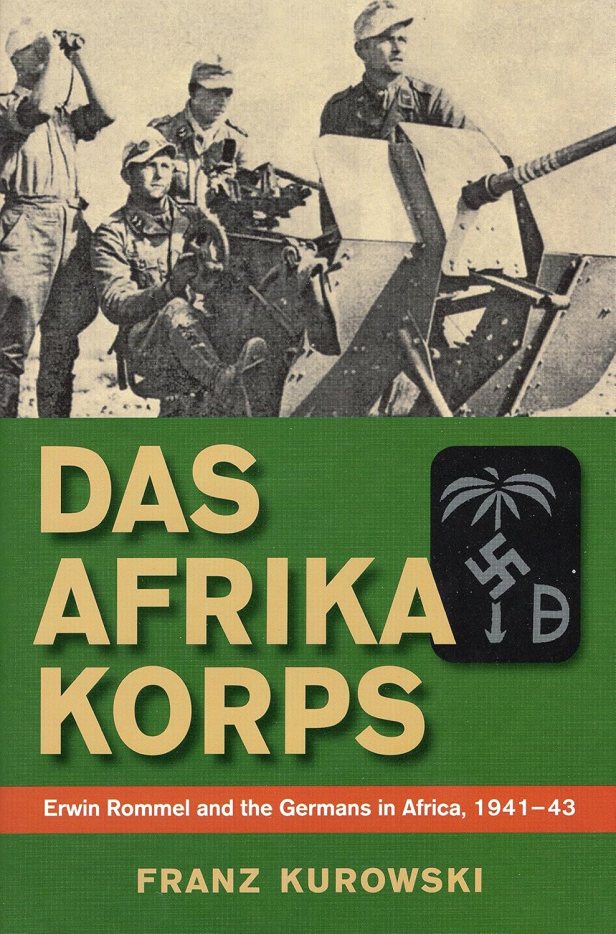
Crisanto: I researched numerous publications and articles, but perhaps the most influential source for developing the game was Das Afrika Korps – Erwin Rommel und die Deutschen 1941-1943 by Franz Kurowski.
Grant: What does the game model from the war in North Africa in 1941?
Crisanto: The first wargame I ever owned was Afrika Korps by Avalon Hill, released in 1978. That game introduced me to the world of wargames, and I’ve been immersed in it ever since. While I drew inspiration from it, my game is quite different as it features a unique combat system and an area-based map rather than the more traditional hex and counter based system.
Grant: What is the scale of the game and force structure of the units?
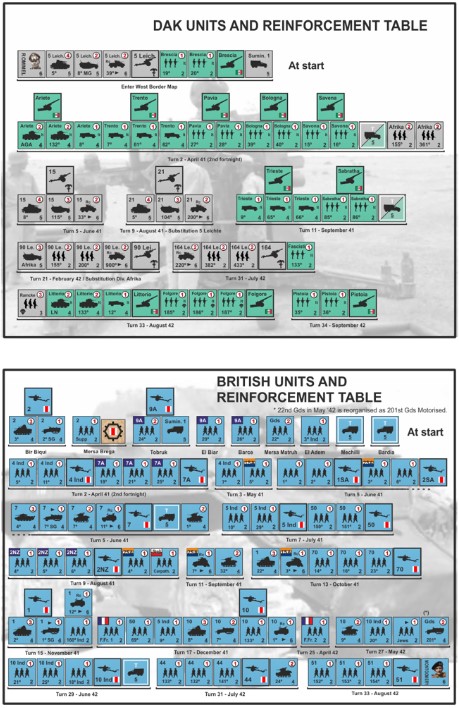
Crisanto: The areas vary in size, meaning some cover greater distances than others, and it is hard to state that for the board. Unit sizes are regiments for the Germans and Italians, while the Allies use brigades. An Allied brigade is roughly equivalent to a DAK regiment. Additionally, there are some reconnaissance units included at the battalion level.
Grant: What special units or unit types are included in the Order of Battle for both sides?
Crisanto: The most versatile units in the game are the reconnaissance units. They have great mobility and are not subject to the same restrictions as other units (at intermediate and advanced levels). They do not require supplies to attack and can never be isolated. There are only a few of them, but they are extremely valuable and both sides must use them wisely in order to win the game.
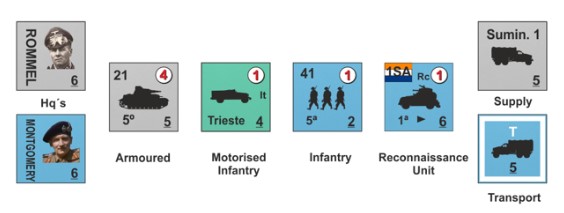
Grant: What is the layout and anatomy of the counters?
Crisanto: The unit counters contain minimal information: the unit type (indicated by its icon), its identification number, and its combat value. Some units start on the board at the beginning of the game, while others enter play during the turns specified for their arrival.
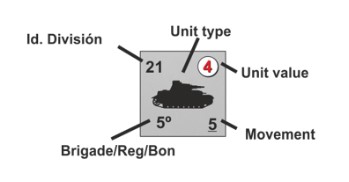
Grant: How does combat work in the design?
Crisanto: The combat system works very well in the design—there are no complicated tables, and battles are resolved quickly. When combat units enter an area occupied by enemy units they must stop and then combat ensues. Each side rolls as many dice as there are unit point values in that area to conduct the combat.
Grant: What is innovative about the combat system?
Crisanto: When one or more units enter an area occupied by enemy units, a battle must take place, and only one side can remain in that area after combat. The combat values of all involved units are added up, but each side can roll a maximum of 8 dice. The combat resolution is simple: A roll of “1” is a miss. Rolls of “2” and “4” are blocks. Rolls of “3” and “5” are hits. A roll of “6” counts as both a block and a hit. Any hits that are not blocked result in unit losses. This streamlined system ensures that every unit plays a vital role in combat. Additionally, for an attack to take place, the attacking unit must have a supply unit supporting the battle.
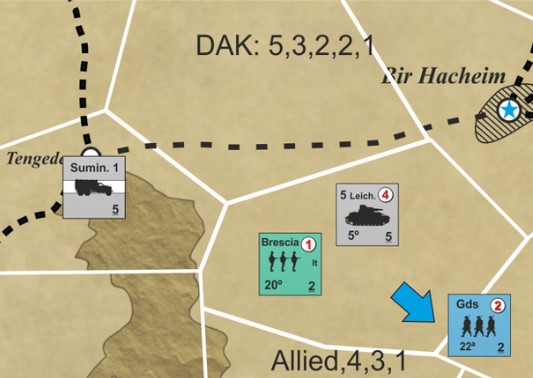
Grant: What is the general sequence of play?
Crisanto: Artillery and Aviation Reset (Intermediate and Advanced level), German Reorganization and Supply Phase, German Movement Phase (Intermediate and Advanced level), German Air Phase, German Artillery Phase (Intermediate level), German Combat Phase, German Combat Movement Phase, Allied Reorganization and Supply Phase, Allied Movement Phase, Allied Air Phase (Intermediate and Advanced level), Allied Artillery Phase (Intermediate level), Allied Combat Phase and Allied Combat Movement Phase.
Grant: What area of North Africa does the board cover?
Crisanto: The board covers from El Agheila to El Alamein (along the Western Desert).
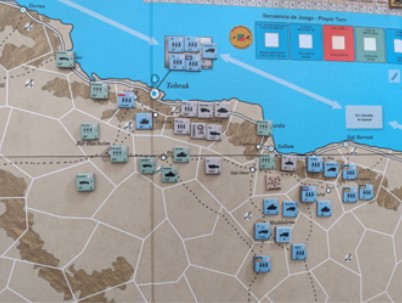
Grant: What challenging tactical situations does the geography create?
Crisanto: The terrain is a critical factor in establishing effective defensive positions that can halt an enemy advance. In Intermediate and Advanced gameplay, mechanized units, such as tanks and armored vehicles, experience significant movement penalties when operating off-road in desert environments.
Grant: How is victory obtained?
Crisanto: For the Basic game, the objective is to capture and hold both HQ’s, Tobruk and Benghazi simultaneously. In Intermediate and Advanced gameplay, a victory point system is introduced. Players earn victory points by controlling specific locations on the map, and the player with the most victory points at the end of the game is declared the winner.
Grant: How did you go about creating a challenging yet plausible course for victory?
Crisanto: This game is no different from other games…the important thing is to know how to move your units and avoid making mistakes. Normally, in any game, the one who makes the fewest mistakes is the one who wins the game, regardless of the side they play. That’s what I think.
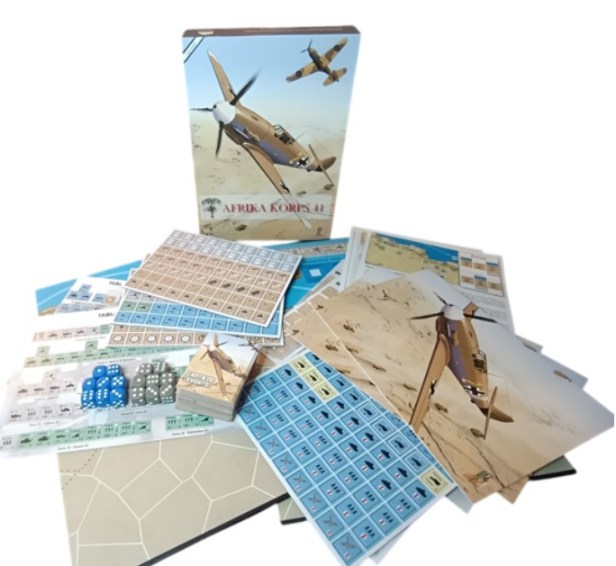
If you are interested in Afrika Korps 1941, you can back the project on the Kickstarter page at the following link: https://www.kickstarter.com/projects/1615432558/afrika-korps-1941
-Grant
 The Players' Aid