
With this new My Favorite Wargame Cards Series, I hope to take a look at a specific card from the various wargames that I have played and share how it is used in the game. I am not a strategist and frankly I am not that good at games but I do understand how things should work and be used in games. With that being said, here is the next entry in this series.
Card #22: The Gamecock Thomas Sumter from Liberty or Death: The American Insurrection from GMT Games
In case you didn’t know, I love Liberty or Death: The American Insurrection! This is my 2nd favorite volume in the COIN Series and is such a fantastic game filled with the history of my favorite historical period the American Revolutionary War. Liberty or Death was the COIN Series’ first foray into non-modern warfare and takes us to the 18th Century and the days of the Brown Bess musket, the 18 pound siege cannon and nice and tidy formations better suited for a gentleman’s war. The focus of the game is the struggle of the American Patriots against their mother British government as they have made their intentions clear to become independent with the Declaration of Independence. The game is a multi-faction treatment of the American Revolution, which includes the Patriots and their allies the French against the British and their reluctant allies the Indians.
Liberty or Death is a 1 to 4 player game focused on all aspects of the struggle including financing operations with Rabble Rousing, infiltrating British held cities to Skirmish, blockading major cities with the mighty French fleet, Raiding the frontiers with the Indian nations, the spread of propaganda to build support for the revolution, fort building and small scale battles. So, with this short description you can see that this game is not a “traditional” wargame but does contain some armed conflict. So a game about the American Revolution that isn’t focused on battle you say? How can that be? Well, I will tell you that this game is probably a perfect representation of the multifaceted struggle that wasn’t necessarily decided on the field of combat, but by the little actions of many behind the scenes characters. Yes battle will decide the control of major areas of the board and decide the fate of troops as they must be concerned about being in supply through a network of forts but the game is so much more than just rolling some dice and consulting a CRT!
My late mother is from Cordova, South Carolina, a small unincorporated area outside of Orangeburg, South Carolina and about 45 minutes from Columbia. I grew up going down to South Carolina to see my relatives several times per year and always had a great time with my cousins. My mother also was a proud southerner and would often share her thoughts with me about their history, focused on the Revolutionary War and the Civil War, and how the south would rise again. You might see the irony in her chosen name for me (Grant) so named by my siblings after US Grant. We also had a Dalmatian dog named Sherman. Go figure!
But the Southern Theater was a key theater during the American Revolutionary War. Such battles as Charleston, Cowpens, Kings Mountain, Camden and others figured into the outcome of the war. The fighting here was much more personal and vicious and there were many great leaders who rose up to lead their local militias against the tyrannical Red Coats. Thomas Sumter was such a man and he has his own card in Liberty or Death. This card comes in handy when you are trying to wage the war of hearts and minds and sway the local populace in favor of or against the British occupation. This changing of the Support or Opposition is a key struggle of the game and is not always easy as you have to move your units into a location then use their Commands or Special Activities to change the leaning of the people. This can take several action rounds and will cost the player several Resources. Anytime there is a card that changes these immediately or for free they are like gold.
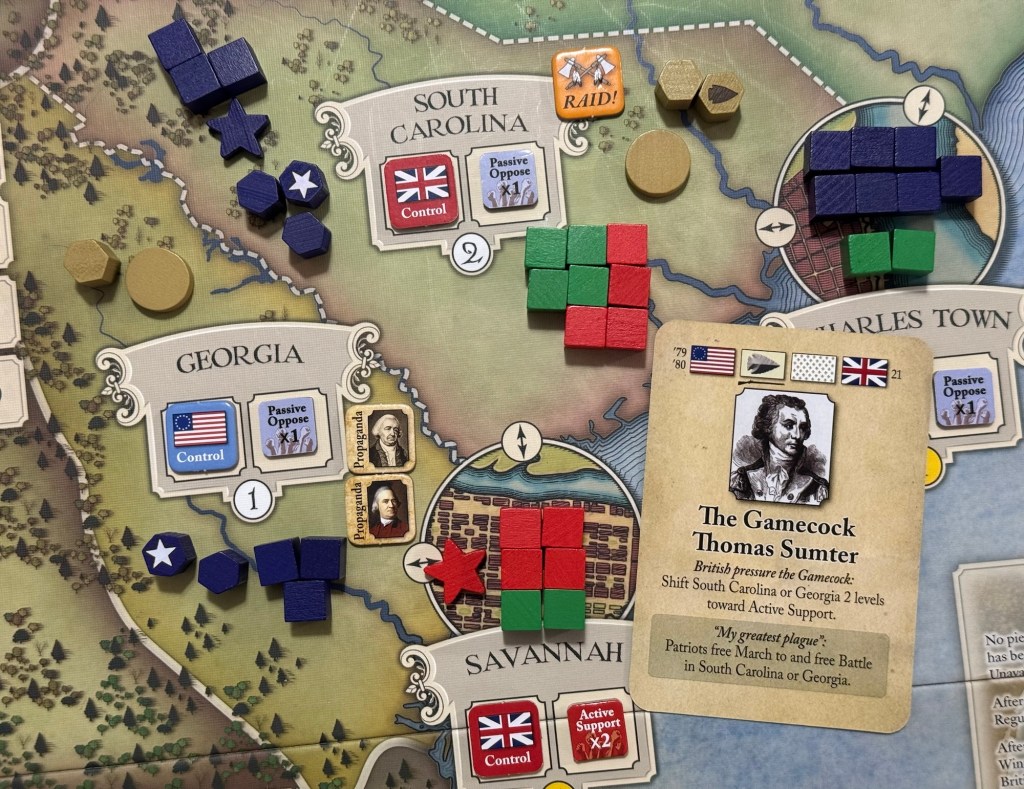
The Gamecock Thomas Sumter is such a card for the British, as when it is played for the Event, the British can shift South Carolina or Georgia two levels toward Active Support. This is a major tool to be used here and should be strongly considered by the British player when this event comes up.
The bottom part of the card is really my favorite. Historically, a British General commented that Sumter “fought like a gamecock” and Lord Cornwallis paid him the finest tribute when he described the Gamecock as “his greatest plague.” The bottom part of the event, allows the Patriots to free March to and free Battle in South Carolina or Georgia. This is a major benefit as normally you can March but then have to wait until your next activation to commence with a Battle. This card, similar to the effects of the top part of the event, allows for a 2 in 1 action and is very helpful at the right time. Those Continentals in Charles Town are just chomping at the bit to get to March into South Carolina and punish the British.

Cards like this make all of the difference in these COIN Series games. Allowing players to do actions that normally would take a few rounds to accomplish and for free is always a boon and players have to keep these cards in mind as they go through the process of attempting to achieve their victory conditions.

Thomas Sumter spent much of his life as a soldier. He served as an officer in the Virginia militia during the French and Indian War and in conflicts against the Cherokee on the frontier. In 1762, he accompanied the Cherokee leader Ostenaco to London, where the chief had an audience with King George III. In the years before the American Revolution, Sumter spent time in debtors’ prison, moved to South Carolina, and established a successful plantation. During the Revolutionary War, Sumter became a prominent commander in the South Carolina militia. In 1776, Sumter, at the head of the 2nd Regiment of Riflemen watched at Charleston during the Battle of Sullivan’s Island but did not participate in the action. A lack of activity eventually prompted him to resign his commission and return home. When Lt. Col. Banastre Tarleton’s raiders burned his home, however, he organized a band of partisans to harass the British and their Tory allies. Sumter’s greatest military achievement was his partisan campaigning, which contributed to Lord Cornwallis’ decision to leave the Carolinas for Virginia. Sumter was nicknamed the “Carolina Gamecock,” for his fierce fighting tactics. After the war, Sumter was elected to the United States Congress, first serving in the House of Representatives from 1791 to 1801. He then represented South Carolina in the Senate from 1801 to 1810. Fort Sumter, for which construction was begun in 1829, was named in his honor. Thomas Sumter died in 1832 at the age of 97.
In the next entry in this series, we will take a look at Peace Corps from Twilight Struggle: Red Sea – Conflict in the Horn of Africa from GMT Games.
-Grant
 The Players' Aid