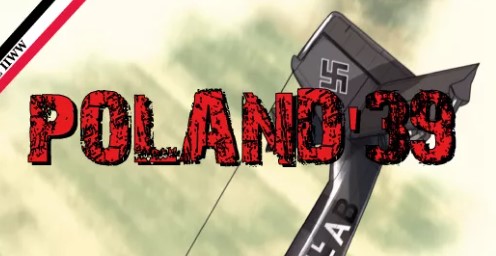
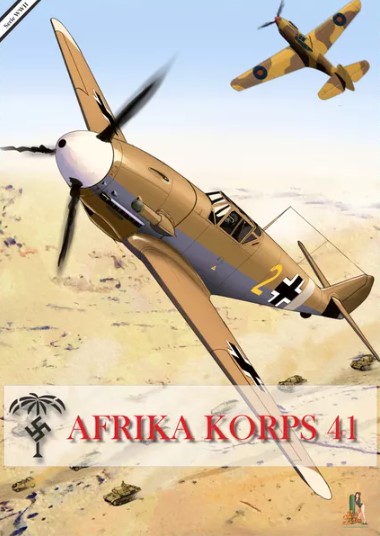
Recently, I noticed 2 new games from Trafalgar Editions that were being offered on various crowdfunding platforms (both Kickstarter and Gamefound). One of the games was focused on North Africa called Afrika Korps 1941 and the other on the invasion of Poland in 1939 called Poland ’39. I reached out to the designer Crisanto Lorente Gonzalez to get some more information about the games and in this interview I will share more about Poland ’39.
If you are interested in Poland ’39, you can back the project on the Gamefound page at the following link: https://gamefound.com/en/projects/trafalgar-editions/poland39
Grant: Crisanto welcome to our blog. First off please tell us a little about yourself. What are your hobbies? What’s your day job?
Crisanto: My main hobbies are designing strategy games (wargames), playing them, and reading history books when I can. Sometimes I paint miniatures, but I find it quite difficult to find the time and to do well.
I work as a manager in a nursing home, providing support services to the medical sector. In Spain, this position is typically called a “gobernante” or “encargado.
Grant: What motivated you to break into game design? What have you enjoyed most about the experience thus far?
Crisanto: It all began with a simple tweak to the rules of a game about the Battle of Trafalgar. I was hooked! The more history I read, the more I wanted to know. After spending three years deep-diving into the battle at Madrid’s Naval Museum, I published a comprehensive rulebook and a book about the campaign. It was a crazy journey, but the best years of my life. I’ll never forget those ancient texts I was lucky enough to read there.
What I love most is getting completely immersed in the battle or scenario I’m researching. It’s incredible to read about these amazing events and then bring them to life in a game. It’s like magic! I’ve always admired historical simulation game designers for their incredible imaginations and creativity.

Grant: What is your new upcoming game Poland ‘39 about?
Crisanto: Poland ’39 offers a deep dive into the German ‘Fall Weiss’ plan to invade Poland in 1939, which ignited WWII. The game also explores Poland’s ‘Plan Z’, a strategic maneuver to delay the German advance until France could intervene from the west. It faithfully recreates the entire campaign, from the initial invasion to the Polish government’s capitulation in October.
Grant: Why was this a subject you wanted to design a game around?
Crisanto: This journey began three decades ago when I partnered with a friend to launch a publishing house. My passion for wargaming led me to propose a series of books combining history and wargames. Unfortunately, the venture failed, and I lost both my investment and my friend. Yet, the idea of creating a historical narrative through wargames, starting in Poland and culminating in the fall of Berlin, remained. While the scope of this ambitious project has narrowed, I’ve managed to publish Norway 1940 and am currently crowdfunding Afrika Korps 1941.
Grant: What design challenges did you have to overcome with the game?
Crisanto: It’s been a long road, but I’m finally satisfied with the rules. Turning this complex campaign into a fun and engaging game has been no easy feat. People often oversimplify the German invasion of Poland, but the truth is far more nuanced.
The game incorporates the challenging terrain of Poland, with its rivers, swamps, and forests, which were key to the Polish defense. The outdated fortifications also played a role in slowing the German advance. The chaotic state of the Polish military is reflected in the game mechanics, limiting their maneuverability. However, the Polish cavalry, treated as elite units, can be a powerful force if used correctly. To balance the game, German air superiority is reduced, while the Russian and Polish air forces are weaker. The game also accounts for the Soviet invasion of Poland, adding another layer of complexity. It’s been a labor of love to create a game that captures the nuances of this campaign and provides hours of enjoyment for up to three players.
Grant: What sources did you consult for the historical details? What one must read source would you recommend?
Crisanto: Frankly, I’ve looked at quite a few, and in many cases, very concise and precise sections. But fundamentally, I recommend the following without hesitation:
• The Invasion of Poland: Blitzkrieg. Author: Steven J. Zaloga. Publisher: Osprey.
• 1939 Hitler Crushes Poland. Publisher: Biblioteca El Mundo.
• The Memoirs of Winston Churchill (in the sections on this campaign).
• Memories of a Soldier. Author: Heinz Guderian. Publisher: Altaya.
• Memoirs: The First and the Last. Author: Adolf Galland. Publisher: Altaya.
• Stuka Pilot. Author: Hans-Ulrich Rudel. Publisher: Altaya.
Grant: What is the scale of the game and force structure of the units?
Crisanto: The game uses a scale of approximately 40 km per hex, resulting in a very compact game map that fits on any table and looks great when assembled. I really like the large hexes and large counters – I’m getting older and I find the tiny counters in modern games difficult to see. In-game units are army corps for infantry, and brigades or divisions for armored, motorized, cavalry, and armored train units. So, you can stack divisions or brigades together, but never army corps, as they are enormous units.

Grant: What special units are included on both sides?
Crisanto: German forces are primarily equipped with armored units, reflecting their Blitzkrieg tactics and Stukas.
Polish forces rely heavily on cavalry and armored trains, which played a significant role in their defense.
Russian forces, while not as mechanized as the Germans, still field a significant number of cavalry units.
Grant: What is the layout and anatomy of the counters?
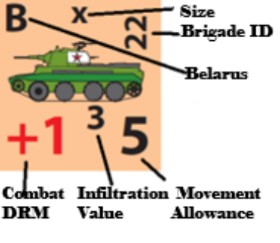
Crisanto: Each unit counter features an illustration representing the unit, whether it’s infantry, armored, motorized, or cavalry. To the left of the illustration is the combat value, to the right the movement factor, and between them, a superscript indicating the infiltration factor. This last factor is an original concept I’ve introduced to simulate a unit’s ability to move through enemy-controlled areas, varying depending on the unit type and the infiltration objective.
Grant: How does combat work in the design?
Crisanto: Because each hex represents a large area, combat is resolved between adjacent hexes. To keep things simple, I’ve designed a combat system where supporting hexes contribute to the combat roll. The player with the highest roll wins, and the difference between the two rolls determines the outcome, as indicated on a combat results table. It’s a straightforward mechanic that adds depth without overwhelming the player.
Grant: The game is designed for 2-3 players. How does this work and what players control what sides or commands?
Crisanto: Yes, the game is designed for 2 or 3 players. In a 2-player game, one player controls the Polish forces and the other controls both the German and Russian forces. If there are 3 players, each player controls one nation: Germany, Poland, or Russia.
Grant: What is the general sequence of play?
Crisanto: Sequence of Play:
1. Turn Start.
2. Supply and Replacement Phase.
3. Air Phase.
4. Railway Movement Phase.
5. Movement Phase.
6. Combat Phase.
7. Realignment Phase and railway control.
Grant: What area of Poland does the board cover?
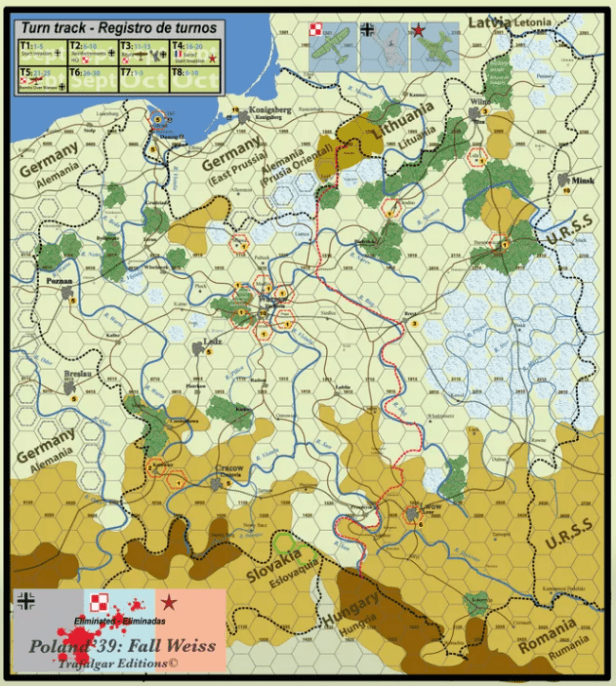
Crisanto: The map depicts all of Poland in 1939, including its borders with Lithuania, Latvia, Prussia, the USSR, Romania, Hungary, and Slovakia. Germany is also included, of course.
Grant: What challenging tactical situations does the geography create?
Crisanto: The strategic importance of Poland’s major rivers, such as the Vistula, is clearly depicted, highlighting their role as natural defensive lines for the Polish forces and significant obstacles for the German advance.
Grant: How is victory obtained?
Crisanto: To win the game, players must capture strategic locations, particularly Polish cities. These captured locations award victory points, and the player with the most points at the end of the game wins.
Grant: How did you go about creating a challenging yet plausible course for victory?
Crisanto: Victory points can be used to represent the various campaign objectives, allowing for nuanced outcomes. Even if Germany achieves a military victory, their overall success can be mitigated if they fail to capture specific objectives. For example, if the Germans fail to reach the Soviet border as outlined in the Molotov-Ribbentrop Pact, a Polish or Russian victory can be declared, depending on the circumstances.
Grant: What type of experience does the game create?
Crisanto: The game accurately reflects the German drive towards Warsaw and the challenges faced by the Polish defenders. A ticking clock mechanic adds tension to the game, forcing the German player to achieve their objectives quickly. If the German player fails to capture a major city within a specified timeframe, they lose the game, emphasizing the need for rapid advancement. Conversely, the Polish player must carefully manage their forces, seeking to delay the German advance until external factors, such as French intervention, can tip the balance in their favor.
Grant: What are you most pleased with about the design?
Crisanto: I really like how the game captures the campaign with a limited number of units, a retro aesthetic, and simple rules. It’s a great way to have fun and learn about what happened in 1939.
Grant: What has been the experience of your playtesters?
Crisanto: Players have praised the game’s simplicity, clean map design, and the enjoyable experience it offers, especially for the Polish player. However, the German player can also have a lot of fun, particularly if their strategies are successful.
Grant: What interesting special options or add-ons are there for the backers?
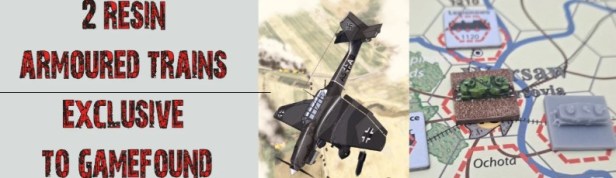
Crisanto: As a token of our appreciation, backers will receive 4 resin miniatures: Polish armored trains and two German Kubelwagens from Rundstedt and Von Bock’s headquarters. These exclusive miniatures are free for all backers. If we reach additional stretch goals, we will also provide a player’s guide, two additional scenarios (bringing the total to 6), and custom dice. We hope the community will help us reach these exciting goals!
Grant: What other designs are you mulling over?
Crisanto: I’m currently working on a card game focused on World War II submarines. The goal is to create a quick and simple gameplay experience. In addition, I’m planning to publish a book about the defense of Cartagena de Indias by Blas de Lezo in 1741, and consequently, a game based on this historical event. Finally, I’m considering a reprint of the game 2nd Volume: Ships of the Line; Aboukir 1798 and the Battle of Lake Erie 1812.

Here is a link to an introduction and how to play video in Spanish (so you will have to turn on subtitles):
If you are interested in Poland ’39, you can back the project on the Gamefound page at the following link: https://gamefound.com/en/projects/trafalgar-editions/poland39
-Grant
 The Players' Aid