
With this new My Favorite Wargame Cards Series, I hope to take a look at a specific card from the various wargames that I have played and share how it is used in the game. I am not a strategist and frankly I am not that good at games but I do understand how things should work and be used in games. With that being said, here is the next entry in this series.
Card #21: General Strike from 1989: Dawn of Freedom from GMT Games
1989: Dawn of Freedom is a fast paced game simulating the end of the Cold War in 1989 as the Berlin Wall fell under pressure from the people as during this year a series of democratic revolutions ended the 40 year Soviet empire in Eastern Europe. 1989 simulates the political, social and economic aspects of these revolutions using a card-driven system similar to Twilight Struggle. I have really very much enjoyed my plays of 1989 and those plays are increasing as the game has been placed on the very cool and user friendly online platform Rally the Troops!
Any game that has cards is focused somehow on attacking those cards or at least minimizing access to them or to taking a turn away from your opponent by causing them to have to discard one of their cards or to do something else with that card. In fact, conflict and wars are usually made up of these type of intelligence and counter intelligence “games” where one side tries to get the other side to believe something that isn’t true and spend their time and resources chasing that down while something else is going on. One of best cards that do this type of thing in 1989: Dawn of Freedom is General Strike. It ends up being somewhat of a trap that the player cannot get out of and it is delightfully cruel to play this on an unsuspecting Communist player.
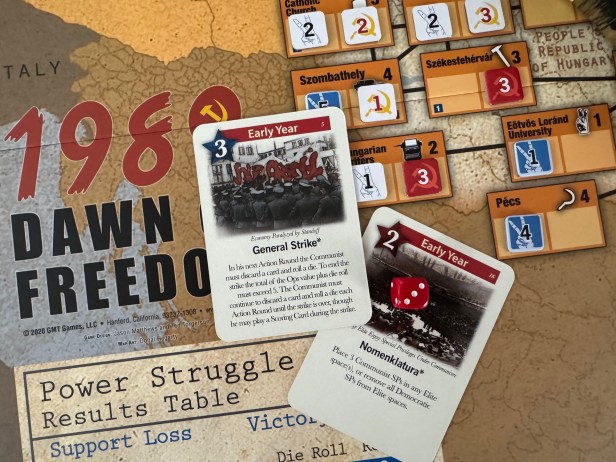
General Strike is a 3 Operations Point Democrat Strategy Card that will be removed from the game if the card is used for the event. The card text states that “In his next Action round the Communist must discard a card and roll a die. To end the strike the total of the Ops value plus die roll must exceed 5. The Communist must continue to discard a card and roll a die each Action Round until the strike is over, though he may play a Scoring Card during the strike”.
This card is a clone of the Quagmire/Bear Trap cards found in Twilight Struggle that attempts to force the Communist player to spend their time discarding cards and rolling a die hoping to gain a result greater than 5. But, where General Strike is a bit different is that it is quite a bit easier to extricate yourself from the situation as it allows the Communist a quicker way out if they choose to discard a larger Operations Point Strategy Card to go along with the die roll. I think that when I have tried to use it well is playing it for the Ops early so that it will be around for later in the game in Mid Year. It is always a good thing to have an extra 3 Ops Point Strategy Card in your deck rather than out of the game. It is also excellent when the Communist player has to play the card. This leads to the Democrat getting a boon with the Communist player not being able to anything that wrong, other than getting out of the strike, and then the Democrat can get back to back actions, although planning this out is impossible. Ultimately, forcing the Communist player to spend their cards for 2-3 rounds trying to get out of the card is very beneficial as it will give the Democrat several unopposed actions that can make the difference in changing the landscape of the board.
The strike in this era and time in the Communist bastion of Eastern Europe and East Germany was very risky for both the revolutionaries and the powers. Dangerous because the protestors could be arrested, beaten or disappeared and dangerous for the power that be because their actions could incite more unrest and generate local and international sympathy. A strike can be seen as a test, a gauge of worker support for the aims of the democratic revolution. But also to see how the Communist regimes would react. Often the opposition leadership was leery to call a strike. A poor showing of participation risked revealing that the revolution was limited to the intelligentsia and the students – that the workers still supported the regime. For the Communists, already facing economies in crisis, a strike broadly supported for an extended period was an existential threat and belied their claim to be the vanguard of the working class.
According to Historian Sascha Lange, who took part in the rally at age 17, “here was a consensus among protesters that nobody should use violence against the police because it was clear they were facing a state apparatus armed to its teeth just waiting for protesters to throw a stone or attack a police officer.” He says their commitment to non-violence left the state powerless because it had no pretext to take action. According to the historian, “the power of the spoken word and the sheer number of people effectively disarmed the GDR leadership and police forces.” Recently he and his father, satirist Bernd-Lutz Lange, jointly published a book in German, David against Goliath, on East Germany’s peaceful revolution.

We posted a full review video and you can watch that at the following link:
In the next entry in this series, we will take a look at The Gamecock Thomas Sumter from Liberty or Death: The American Insurrection from GMT Games.
-Grant
 The Players' Aid
Excellent historical contextualization… and, of course, a potentially very powerful card (which my opponent used to great effect against me in my last game of 1989)!
LikeLiked by 1 person