We have not played a ton of Napoleonic Era wargames. Really just a handful focused on the Nappy 100 Series from Victory Point Games, several of the games from Shakos (Napoléon 1806 and Napoléon 1807), the recent released Limits of Glory – Campaign I – Napoleon’s Eastern Empire from Form Square Games and some card games from Worthington Publishing (Napoleon Returns 1815). There are many of them out there and real wargamers usually play them a lot but we have just really only scratched the surface on getting into the genre. But, there is something with these games that does draw me in. Even though I am not into the history or feel a connection to the subject matter, they are somewhat magical in my humble opinion. Typically, these Napoleonic Era wargames are large hex and counter affairs with lots of units, large stacks, deep CRT’s, even sometimes using a base 6 math equation to divine combat results (I am looking at you La Bataille). They are REAL wargames and I am very glad that there are so many titles out there as there is a lot of fertile ground to expore! Recently, we played a very fine example of a Napoleonic Era wargame in a new offering called Battles of Napoleon: Eylau 1807 from Sound of Drums. This game is a fantastic example of a deep and interesting simulation of the period but with very approachable rules and mechanics designed to be able to appeal to any level of wargamer. While we didn’t experience the grand campaign game contained in this box, we did play a very approachable and relatively low counter density scenario that taught us the basics of the system and really gave us a taste for more! I want to share my thoughts on this game in this First Impressions style post, its very interesting and unique activation mechanics, its fun factor and its beautiful production.

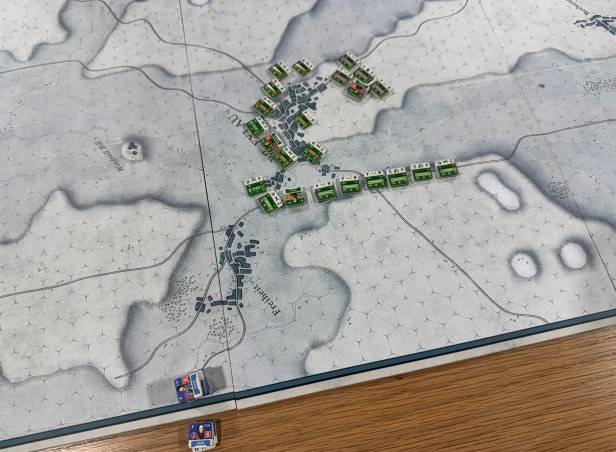
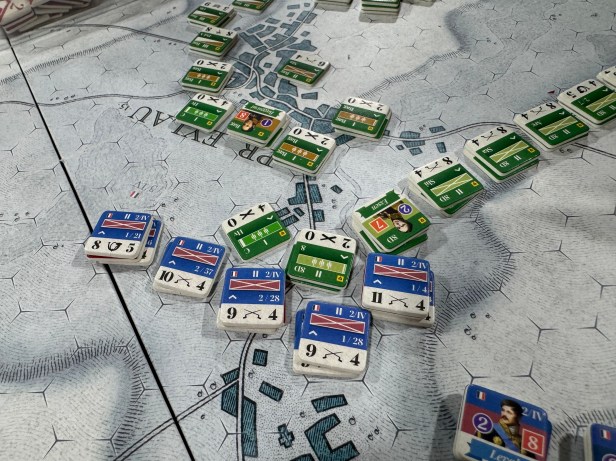
Before we get into the gameplay itself, and the system and mechanics used, I need to cover the beautiful components and production. Absolutely everything contained in this big and beautiful box is absolutely of the highest quality. The counter design is fantastic, albeit simple, and just works really well and the general aesthetics of the remaining components is superb. My favorite part of the game components is the beautiful board. As you know, the Battle of Eylau took place in heavy snow conditions, with the battlefield covered in a significant amount of snow, making it a key factor in the battle’s challenges and outcomes. I have read where the battle is most often described as taking place on “snow-covered terrain” or “snowy fields.” Well, the artist for this game, Marc von Martial, has captured that description perfectly in the board and its graphics. You might look at the board and initially think that it is a just a hodgepodge of white, gray and darker gray, and you wouldn’t be totally wrong in that assessment, but the way those colors are used and presented really create a fantastic backdrop for the battle. The board is totally devoid of any other colors but I found myself just staring at it as we were playing. Once the counters are placed on the board, the entire aesthetic changes to one of highlighting the garish colors of the French and Russian units against this background of white, gray and darker gray. This causes a very imposing look to the units in formation as they make their lines of battle and brace to accept the oncoming enemy. Just a really great presentation of the battle and a fine canvas upon which to play out this titanic struggle!
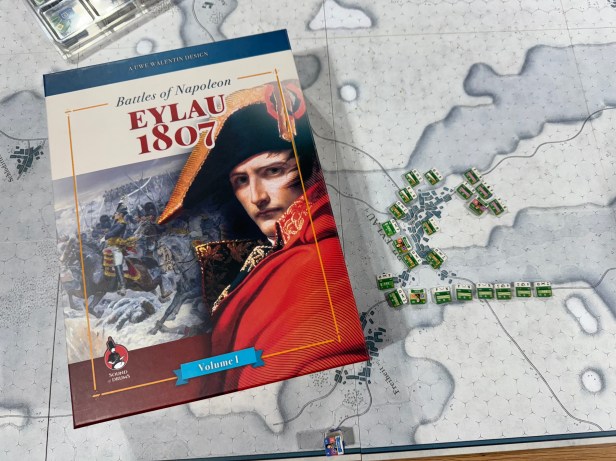
The board scale is 150 m per hex, and the units size is battalions for the infantry, representing between 400 and 1,000 men, regiments for the cavalry, representing 200 to 600 horse and individual batteries for the artillery of between 8 to 20 guns per unit. The counters are just gorgeous as well with beautiful colors and great little individual illustrations of their NATO symbols with portraits for the Leader counters. The counters are pre-rounded and come off the sprues very well with no issues and saved me a ton of time in clipping them. Thank you Sound of Drums!
The counters are double sided, but as is typical in war games they are not used to show reductions but one side are the units in line or column, limbered or unlimbered and with cavalry fresh or fatigued and show their differing movement capabilities. When infantry units are prepared to receive cavalry charges and form up in a square, there is a nice little marker that you place on top to denote this.
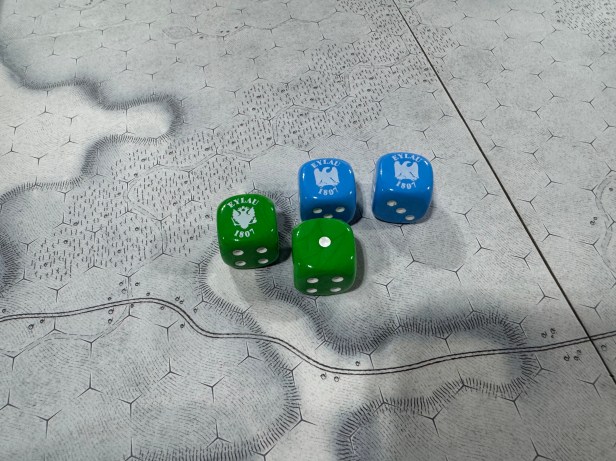
The game also has an option for custom dice for each of the combatants, with light blue for the French and green for the Russians and they are just great with the 6 space being the national symbol (and not the 1 as I have seen in some other products). These dice are chunky and very nice as they further enhance the experience and the thematic connection.
But, before you believe that the game’s production doesn’t have some imperfections we have to talk about the player aids. The player aids are very durable, made of a thick cardboard, and they can actually be used as a bludgeoning weapon if needed but there are mistakes. I am not sure what happened with our advance copy but the player aids were not correct and have now been changed. There were inconsistences in DRM’s on the player aid as compared to the rules and this made for a very interesting experience for our first few rounds. We were able to find and download the corrected versions on Board Game Geek though and this was really just a minor inconvenience. I did read where the designer and head bottle washer at Sound of Drums Uwe Walentin has said that “there will be free physical copies of the rules, charts and tables available. They will be included in Battles of Napoleon Vol.2 – Quatre Bras 1815 / Wartenburg 1813 and also available separately from the game as a free upgrade kit”.

There also were very helpful Order of Battle sheets for both sides that aided tremendously in setting the game up. They also are quite beautiful as well in and of their own right and probably deserve to be framed and hung on a wall somewhere. Just fantastic stuff!
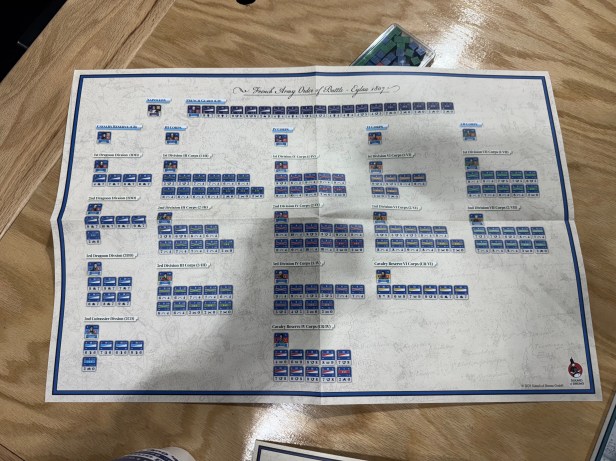
The suggested retail price of the game is somewhere around $85.00 but you can find a copy on most major board game outlets such as Miniature Market for as little as $75.00. I know that this price is a bit expensive but the quality of the components is such that this is a real bargain once you look at all that you get in that big box. You can’t demand quality and not have to pay for it!
Let’s now dive into a bit of the mechanics, which really are the focus of this game and are what make it very different and very good. The game does an exceptional job at balancing approachability with the simplicity and straightforwardness of the rules while causing a slew of difficult and very interesting and impactful choices for the player to take. This is a bit of a rare thing in this type of hex and counter wargame as contiguous lines of units limit your choices about when and where to attack and how to go about defeating your enemy. The way that these choices are forced on the players is through the fantastic orders system and the take on the tried and true chit pull activation.
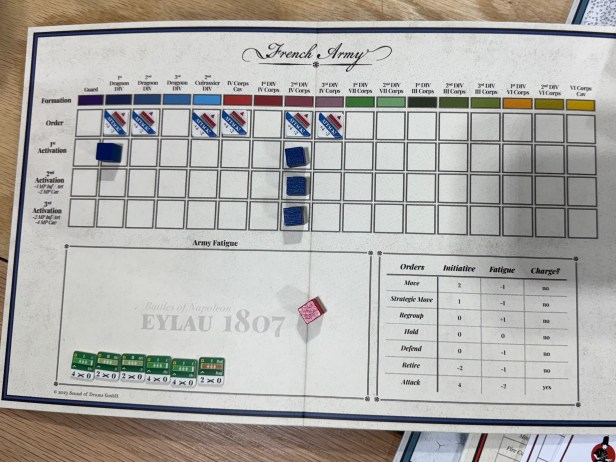
During the Order Phase of the sequence of play, each player will get to choose the specific orders that each Division will have for the entire turn. This process is done in secrete as each side want sot hide their intentions for as long as possible to really create the fog of war that many games need to keep them interesting and inject thinks such as bluffing that lead to various tactical surprises. Once each of the active Divisions received its orders, they cannot be changed until the beginning of the next turn. There are no restrictions to changing of any order as long as the Leader has enough command points and the Division leader is within range of the units they wish to activate. This range is typically 12 to 18 hexes and is a major part of what each player has to focus on to keep their formations in unison and to create good attacks and maneuver. If the Division’s commander is not in range it will have to roll a die against their command rating to check if they succeed in changing orders.
Just so you get a good understanding of the orders, there are a total of 7 different orders. Each of the orders gives the army that it is given to a specific number of Initiative Points and for some orders the players will lose Army Fatigue Points as they are doing less strenuous moves. The more Initiative Points an army has, the more likely it will be the Initiative side, which is sometimes very important but is a case by case decision and the more Army Fatigue Points it has it may lose the Initiative. The player then draws out a cube from the draw back and it will activate one of their armies of those of their opponent. Each of these activation cubes will be placed under the army shown on the chart above and then each order has a fatigue cost, which is then substracted from the player’s pool at the beginning of each turn. This concept of fatigue is really central to the game and the campaign game will be won and lost on this level of fatigue. Fatigue will lead to a number of victory points, which ultimately determine the winner.
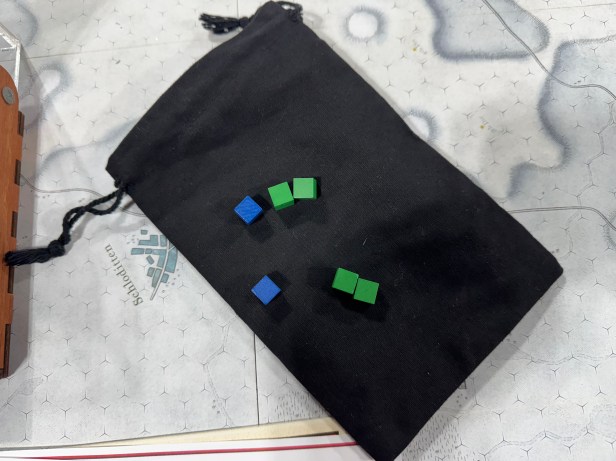
The number of cubes inserted into the draw bag is set out by the scenario played or by a die roll in the campaign game and will lead to some really interesting situations. The bag is populated by each side’s activation cubes which can be used when drawn to then activate a Division. Sometimes it is just the random draw of the cubes but you are hoping for activations when you need them and that will benefit you the most when drawn. Going first, followed by a few activations in a row is really great until you then give over that initiative and your opponent draws several of their activations in a row setting you back or gaining significant advantage. The luck of the draw was never more appropriate as here. There also are Fire Combat cubes that are included in the bag that can lead to units who can getting to fire at their opponents. These units have to be in range and cannot have an obstructed line of site to their targets. Infantry fire at adjacent infantry and artillery while artillery fires from several hexes away as they have range but cannot have their own units in between them and their targets. I love this part of the activation draws and really think that it works well. When there are just 2 cubes left in the bag, the turn will end. So you never really know what of your cubes will be left over or if you got all of your activations.

The game system really emphasizes the maneuvering and coordination of different units between different Divisions. Maneuver is always a great part of any wargame and Eylau 1807 does this very well. Moving your units into position, all the while planning on how best to to use them, is very important. As a commander, you will have to make your choices wisely about how you move and where with an understanding of the activations that you have remaining in the draw bag. Moving your units into range of your enemy with their artillery knowing that you have no activations is a recipe for disaster and you really have to understand your current state and situation. I really liked this as I feel like this is what commanders do on the battlefield. Make decisions about their unit’s capabilities, status and available assets to set their strategy and battlefield orders. Also of great importance is the concept of facing.
As the game moves along, infantry assaults and cavalry charges will lead to gains and losses in battlefield positioning as casualties are accumulated with markers but will also cause the defending units to have to fall back and change the look and order of the battlefield. The game is more than just about losses though and punching holes in lines and isolating units will lead to more favorable attacks and positioning to keep your units as safe as they can be. You have to keep this in mind.
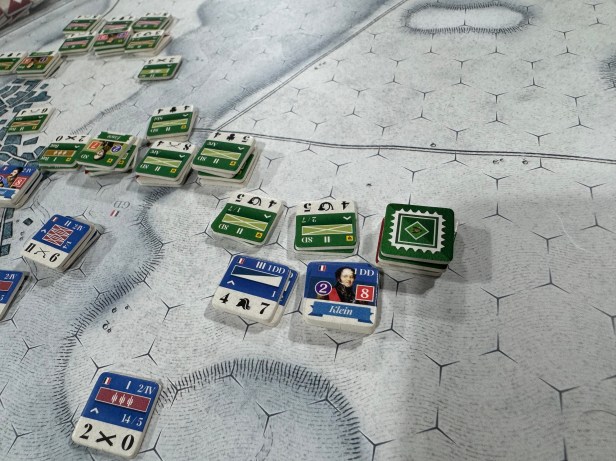
We just really had a great time with Eylau 1807. And even though we played a smaller scenario to break ourselves into the system and get an idea about how it works, this one is going to come back to the table as I believe that the intent of the game is best realized in the play of the campaign. Here is where fatigue will matter more and the attritional style of the combat losses will begin to add up. But this system is top notch and very fun. I was super impressed with the design and really feel like what we were doing and how we were trying to do it. Uwe did a good job with this one.
I do wish that the rules were a bit clearer but there are living rules that have been edited on the Board Game Geek page and I would recommend printing those out and using them rather than the rules that come in the box. I am very much looking forward to Volume II in the series and really think that this one has some legs to it and should be a system that we all can embrace and enjoy for years to come!
-Grant
 The Players' Aid