
Recently, while perusing the internet, I found mention of an upcoming block wargame on the battles in and around El Alamein in World War II from VentoNuovo Games. The game covers the Axis and Commonwealth Forces clash in the North African Theater in Egypt during 1942 and really looks to be pretty interesting. The game is called The Lions of El Alamein and will be coming to Kickstarter soon. We are doing this interview in a few parts with a small set of questions, probably in the range of 5 or 6 and will post these in a run up to the Kickstarter launch in the near future.
If you are interested in The Lions of El Alamein, you can visit the Kickstarter page at the following link: https://www.kickstarter.com/projects/m41/the-lions-of-el-alamein?lang=it
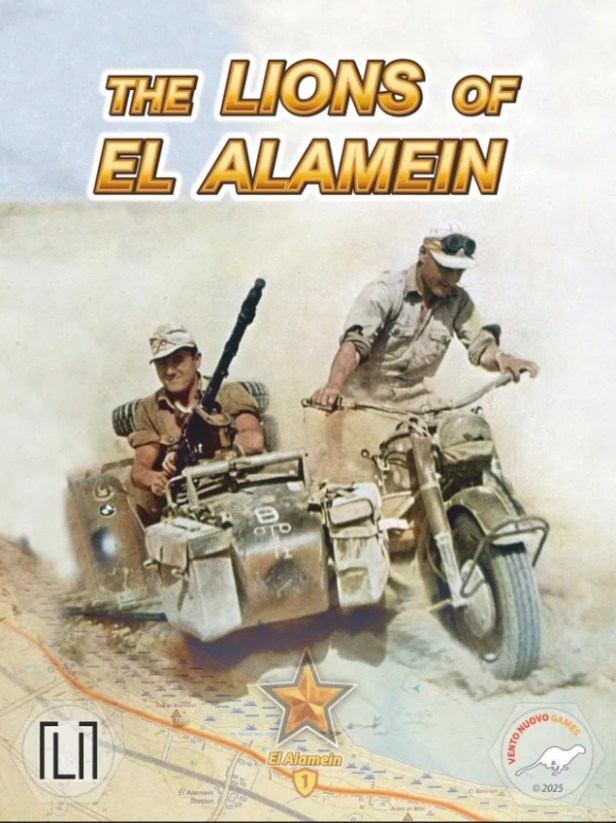
Grant: What is this new upcoming game called The Lions of El Alamein that you are working on?
Emanuele: It is an historical wargame covering the series of battles fought by Axis and Commonwealth forces in Egypt, from July 1 to November 4, 1942.
Grant: What does the name refer to?
Emanuele: As you know, the boys of the Folgore ParatrooperDivision of the Italian Army after the last battle of El Alamein were renamed “Lions” for the pride with which they faced the battle and the winners paid them this honor of arms.
You also know that my father was an officer of the Folgore and I can assure you that even now that he is 91 years old he has not lost that mystical pride that distinguishes all men of such story.
However, I believe that all those young men who fought on the line (that’s what they called it) from July 1 to November 4, 1942, must now be remembered as authentic Lions, without distinction of flag, language or nationality.
Because none of us now would have managed to survive that hell of sand, sun, steel, fire, and blood in 1942.
And because today we can sit comfortably on our sofa reading a book or watching television thanks to the spirit of sacrifice demonstrated by those 300,000 and more.
May the memory of the Lions of El Alamein live forever, and may new generations take them as an example.
Grant: What is important for you to focus on in this game set in the North African Theater of Operations?
Emanuele: There are very few simulation games that have covered all three battles of El Alamein so far. And I believe that the reason is similar to the limit – but inverse – that afflicts the battle of Cannae: the disparity of forces. And for El Alamein also of resources. Because it is difficult to make a stimulating simulation game on an unbalanced set-up, and it is even more difficult to simulate with good accuracy a series of battles that took place over such a long time span and that for over 100 days saw the contenders swing like pendulums on the brink of defeat and shortly after of triumph. So when a few years ago I was reading recently declassified secret documents, I began to understand that to simulate that series of battles it was necessary to resort to a new system, more ingenious, more refined and more elegant than the previous ones.
With Waterloo and the Barbarossa Trilogy we had introduced logistics and the chain of command. With Black Swan the combined forces and the retreat dictated by the tactical disadvantage on the battlefield. With Blitz in the East they had brought logistics back to light with the use of a dual production system, and to strategy with the possibility of disrupting the objectives of the Russian campaign with the removal or use of new generals and strategies, and to tactics with the addition of air superiority and that of armored vehicles. But…for El Alamein all this was not enough.

Because in the desert, far from road and rail networks, ports, inhabited centers, without fodder for pack and draft animals, the difficulties to be solved were many more.
And as you know, at VentoNuovo we are not satisfied with downloading the Orders of Battle from Wikipedia, making some colored drawings, adding first-choice components without using toxic dyes or lacquers. Or worse, resorting to those artificial intelligence modules that today draw maps with a click.
Our creativity was put to the test.
But we knew we could do it and that if we had gone to study the territory, the terrain, the communication routes, the mule tracks, the oases, the passes, the depressions, the crests, the aqueducts, the wells, etc. then we would have understood how each of the contenders in 1942 had solved the main problem: water.
Grant: I understand that this game is using a new gaming system you are calling SLIT. What does this acronym refer to?
Emanuele: Strategy, Logistics, Invention, and Tactics. I think there is a paper written by rear Admiral Bradley that explains everything better than I could.
Grant: What does SLIT focus on and how is air superiority a key part of the system?
Emanuele: SLIT is an integrated game system that blends the four fundamental elements of military art that the Admiral told us about.
Let’s think about the last battle: what was Montgomery’s goal? To win? Sure. But how? What did Montgomery want to do? We could talk about it for hours, but it will be short: he wanted to destroy the Axis forces, before they had time to understand that the battle they were about to fight was hopeless for them. Before Rommel realized that the line could no longer be held and ordered an orderly retreat to Fuka.
Now someone might ask: what’s the point? Montgomery did not want to face another coming and going on the North African coast. For two years the Axis and Commonwealth had been chasing each other in turns from El Algheila to the gates of Egypt.
Montgomery wanted the Axis infantry to stay where they were and be hammered by the artillery. He wanted to have so many guns and so much ammunition that he could disintegrate the Axis infantry without having to use his own and, above all, spare his tanks. And he must not give the impression that there was anything else, apart from a pounding artillery bombardment and a few battalion infiltrations from Thompson Post to Qaret el Himeimat.
Low profile, understatement.
This is Lightfoot. A brilliant, patient idea. To be followed by Supercharge, during which once again British artillery would support both Commonwealth infantry and tanks in the final clash on the Skinflint, beyond the Pierson Line, with the feared panzers of the Afrika Korps.
Tactics.
But to be able to execute his plan he needed the other two elements. So from August 13th Montgomery reorganized the Eighth Army, exasperating the need to build aqueducts, railways, roads and equipping himself with a health system that would protect his men from disease and malnutrition, as well as from disintegration and thirst.
Finally, he knew he had to deceive Rommel. He had to keep his intentions secret regarding when, where, and how. And he set up, also thanks to great illusionists, the most sophisticated system of misdirection and disinformation ever seen before: cannibals and solar shields are just the tip of the iceberg.
But he could not have succeeded in anything if he had not immediately ordered the deployment of over 1,500 airplanes in Egypt to dominate the skies, attack the enemy rear lines, attack the ports of Tobruk and Benghazi, the supply columns that tried to bring men, water, fuel, spare parts, replacements, etc. to the tired, thirsty and exhausted front line.
Furthermore, with total superiority he nullified the ability of the panzers to move and respond quickly and the enemy’s ability for air observation.
Just think that on October 23rd no Axis plane managed to take a single aerial photograph while the Eighth Army was deploying for the attack and the tanks from the rear lines reached the assembly points. Montgomery was a genius of military art. The only one who could have defeated the Desert Fox on its hunting ground: the sands of the North African desert.
And so it was. But ours is a game and each player can turn the tide of this and other proposed battles by displaying a capacity for analysis, inventiveness and implementation better than his opponent.
In case you might be interested in learning more about The Lions of El Alamein, you can check out this interview on The Over the Night YouTube Channel where the topic of Rommel’s secret plans are discussed with designer Emanuele Santandrea (the interview is in Italian but you can watch it with subtitles in your language):
In Part II, we will ask 5 questions about the board for the game, including its geographic features, the process of research that went into it to put it together and other bits and pieces of information.
If you are interested in The Lions of El Alamein, you can visit the Kickstarter page at the following link: https://www.kickstarter.com/projects/m41/the-lions-of-el-alamein?lang=it
-Grant
 The Players' Aid
Emanuele is a genius designer (and a very pleasant Gentleman). I am working my way through his Moscow, Leningrad, Kiev ‘41 trilogy and have been immensely impressed by his innovative systems and the resultant game-plays. He somehow manages to incorporate so many key aspects and challenges of command, and yet without any of them becoming intrusive in terms of fun. The battles always play out differently, giving each game almost infinite life, and are tense, immersive, highly enjoyable affairs. I am very much looking forward to this game.
LikeLiked by 1 person