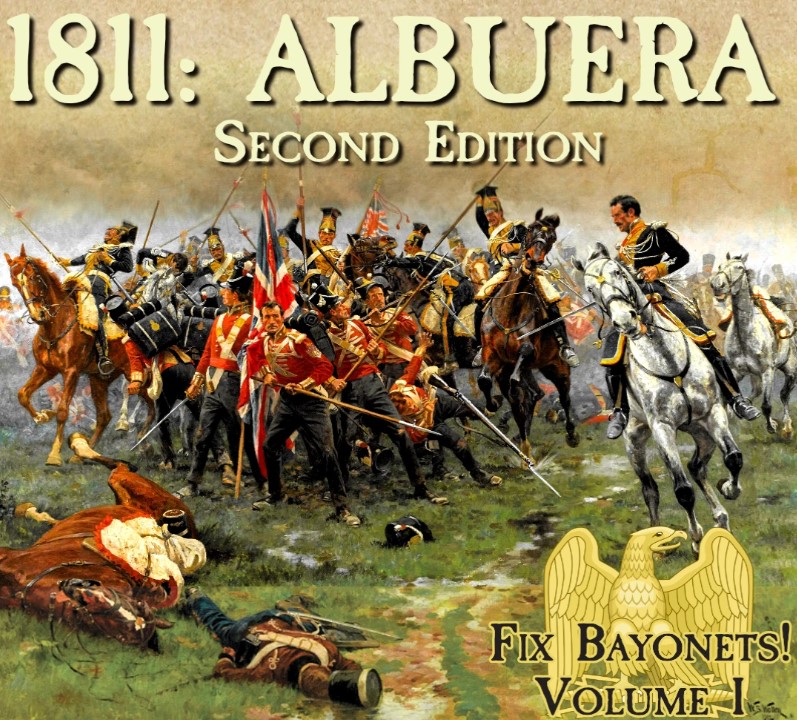
A few months ago, I caught wind of a new edition of a very interesting looking Napoleonics game getting a second edition. The game is 1811: Albuera Second Edition from Tactical Workshop, which was originally released in 2020 designed by Frederic Delstanches. I reached out to Frederic to get some more information on the design and he was more than willing to share.
If you are interested in Fix Bayonets! Volume I: 1811: Albuera Second Edition, you can back the project on the Gamefound page at the following link: https://gamefound.com/en/projects/tactical-workshop/1811-albuera-second-edition
Grant: Frederic welcome to our blog. First off please tell us a little about yourself. What are your hobbies? What’s your day job?
Frederic: Hello and thanks for having me here. I was born in Belgium but then moved to the US to learn how to fly. I am currently working as an airline pilot and living in Japan.
My primary hobby is definitely wargaming and reading/researching on related history topics. I purchased my first wargame in Brussels in 1994 and have steadily grown my collection since then.
I do also own and play non-war board games with family and local gaming groups.
Grant: What motivated you to break into game design? What have you enjoyed most about the experience thus far?
Frederic: I have always liked to create additional player aids for existing publications. As such, in 2018, I used the GameCrafter website to print and publish decks of data cards to be used with the Red Storm Series of air warfare games by GMT. To my surprise, those cards became very popular (“A must have to play the game” said one reviewer). This was probably the most enjoyable part of the adventure so far.
I also often write “house rules” for games that I enjoy but find lacking in some areas (historicity, simulation fidelity, etc.) or create new components for older wargames (counters, charts,…). I did all that for Clash of Arms’ 1987 La Bataille d’Albuera and, after just changing everything but the map and markers, I thought “Why not create a whole new game about the battle?”.
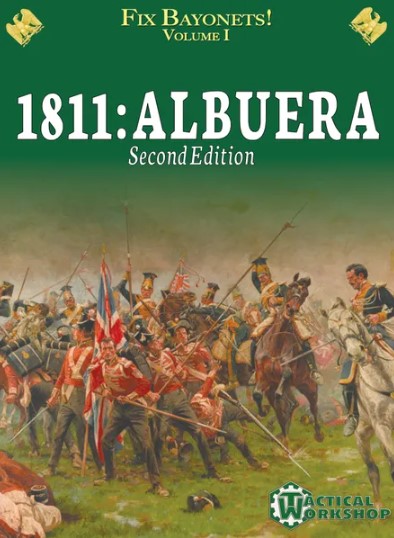
Grant: What is your new upcoming game 1811: Albuera about?
Frederic: The game is a thoroughly researched simulation of the battle that pitted Maréchal Soult’s French army against the combined British-Portuguese-Spanish forces of Marshal Beresford and General Blake in Spain in 1811.
It uses the Fix Bayonets! rule set that I designed and will work with all future entries in the series. It is a hex and counter tactical (battalion level) combat system of moderate complexity that can be played solo (but with no “automata” or bot, just by playing both sides).
Grant: What have you updated in this second edition?
Frederic: Except for the major game mechanics, pretty much everything. The first edition was a print on demand (GameCrafter) game that greatly limited me component-wise. This edition has a newly designed mounted map (44″x29″), new and better looking counters, new markers; updated, streamlined more thoroughly playtested rules, a new side board, additional historical background info and new special event cards.
Grant: What design challenges did you have to overcome with the game?
Frederic: I think the most challenging part is the constant proofing of all the components for typos and mistakes. Being the only one working on the game, I must have re-read the 52 pages “final version” of the rulebook a dozen times, finding small mistakes every time…As late as last week, I found typos on the back of 4 of the 700+ counters that had escaped me until now. Fortunately, all will be fixed before we go into full production.
Grant: What sources did you consult for the historical details? What one must read source would you recommend?
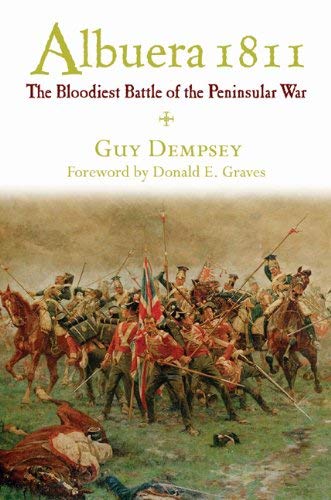
Frederic: I speak French and can read Spanish so I was fortunate to be able to use sources from all sides of the engagement. Most of my research time was spent on obtaining an accurate order of battle, getting information on how the different leaders and combat units behaved during the battle and figuring out the most likely uniform worn by the troops (which was quite a challenge for the Spanish army). A list of the 30 resources used for this battle alone can be found in the Battle booklet, however, my primary source would be Guy Demspsey’s Albuera 1811 from Frontline Books. It is the most modern and accessible to the general public book about this engagement.
Grant: What are the hallmarks of the Fix Bayonets! system?
Frederic: Having played quite a few different Napoleonic/Civil War tactical wargame systems, I tried to emulate what I liked in each of them and put it all together into a relatively easy to handle rule set.
The system itself focuses on Command and Control. The players are restricted in what they can achieve by the ability or lack thereof, of their various army and lower level leaders. A lot of wargames do not simulate this and allow players to have instantaneous god-like powers to order their units wherever and whenever they like, resulting in a not very faithful simulation.
As for the game play, my design philosophy is to limit, as much as I can, the use of markers or other game artifacts that detract from the “beauty” of only having your colorful units on the map. Effects and condition markers are unavoidable but avoiding “stacks of markers” was a priority.
Grant: What does the game model from the Napoleonic Wars era?
Frederic: The system is tactical, so it focuses primarily on how to properly maneuver your infantry battalions, cavalry regiments/squadrons and artillery batteries. It simulates the friction produced by skirmishers, the effects of massed musket fire, artillery round shot, ricochet, grape shot and howitzers, the impact of cavalry charges and infantry bayonet assaults (hence the Fix Bayonets! name) and the problems of command and order changes in the middle of a battle.
Grant: What is the scale of the game and force structure of the units?
Frederic: The game uses a hexagonal grid (to adjudicate movement and ranges) at 120 meters (~130 yards) per hexagon. Each game turn simulates about 15 minutes of real time. Each “step” of manpower is about 200 infantry men, 150 cavalry or up to 8 guns per artillery battery. Units usually have 4 steps or less (larger units might appear in future games).
Grant: Why did you feel this scale was the most appropriate for your design vision?
Frederic: I originally used the “standard” tactical Napoleonic scale of 100 meters per hex but found that the physical footprint of the maps for most battles would be too large because I wanted to use large counters (3/4″ instead of 1/2″) for aesthetic and ease of play. I thus settled for a slightly larger scale. The 200 men per step and “Stragglers” mechanic allowed me to use a system of counter flips and duplicates instead of “strength points” markers to, once again, unclutter the play area.
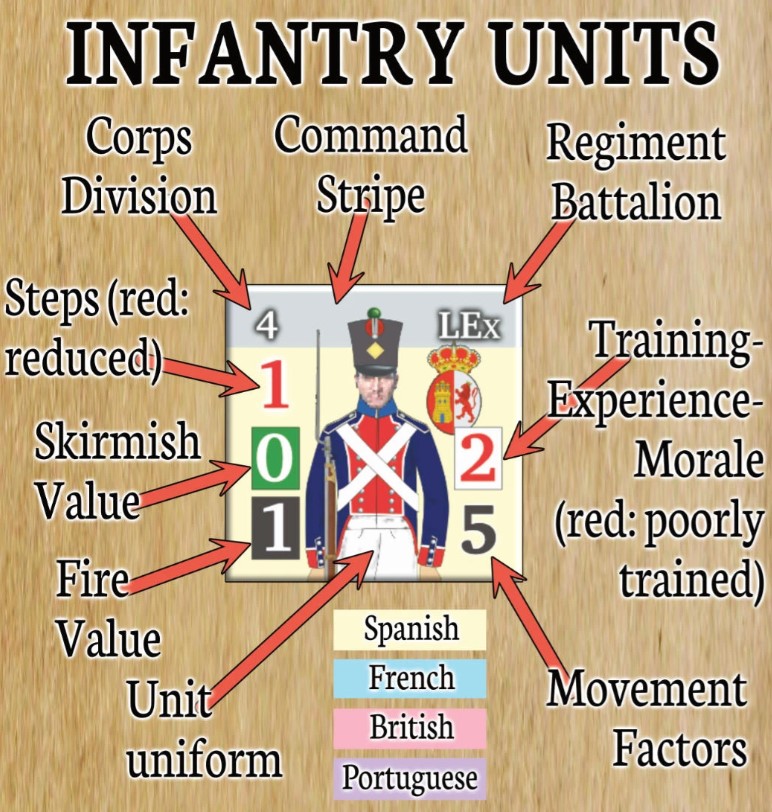
Grant: What is the layout and anatomy of the counters?
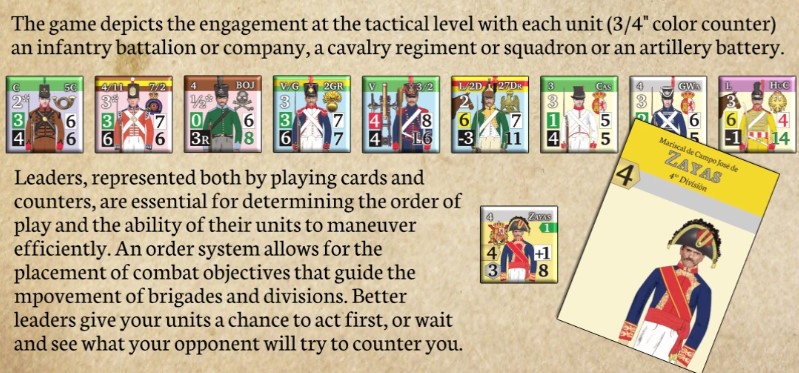
Frederic: Combat units have 5 primary values printed (some classes have less): a step number (manpower), a combat value (fire or infantry or artillery, charge for cavalry), a movement factor, a training/morale/experience value (used to take morale/skill checks) and a “special” value (skirmish for infantry, range for artillery and recall for cavalry). The unit’s official uniform features prominently in the center of the counter. A color coded identifying command stripe is at the top, along with the unit’s man and affiliation. Leaders are the same except that they have a command radius (instead of a special value) and a strategy rating (instead of a combat value).
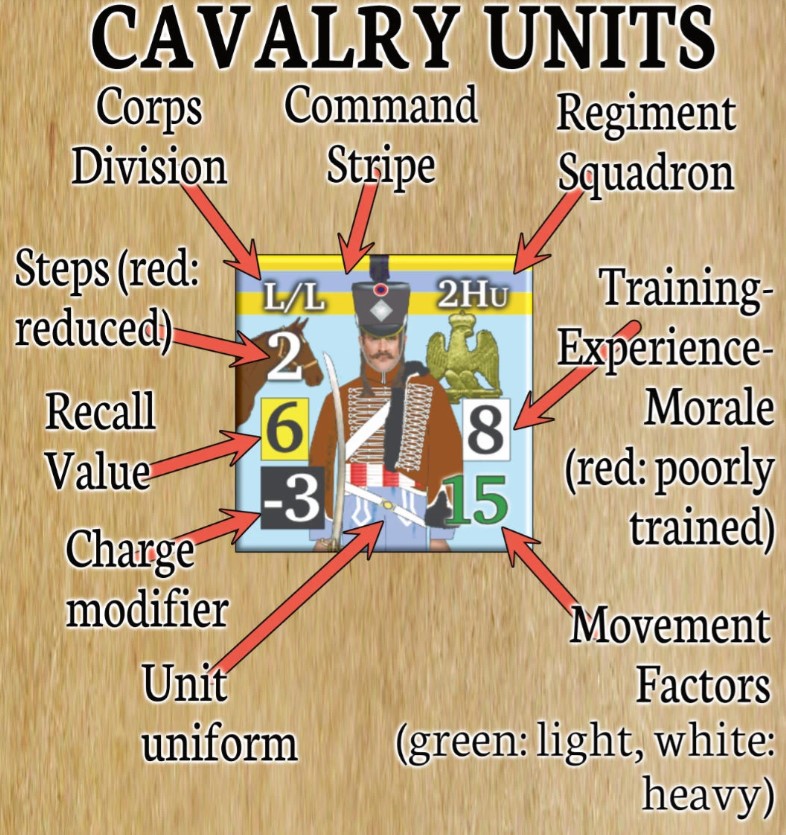
If a unit takes a full step loss, flip it or replace it with the next lower step number duplicate unit. Flipped artillery units are limbered, flipped leaders are “Passive”.
Grant: How do Leaders affect the game?
Frederic: Army Leaders issue orders to their subordinates by the use of “order” and “objective” markers. They sometimes have to send an aide de camp with the order to reach distant leaders. Lower level leaders have units under their command. In order to be effective, those units must stay “in command range” of their leader. Leaders may affect die rolls for morale checks, melee resolution or artillery fire. Finally, a leader can also suddenly become “Passive” by failing a strategy roll, which freezes him until he recovers. Lower strategy rating leaders are thus more susceptible to this.
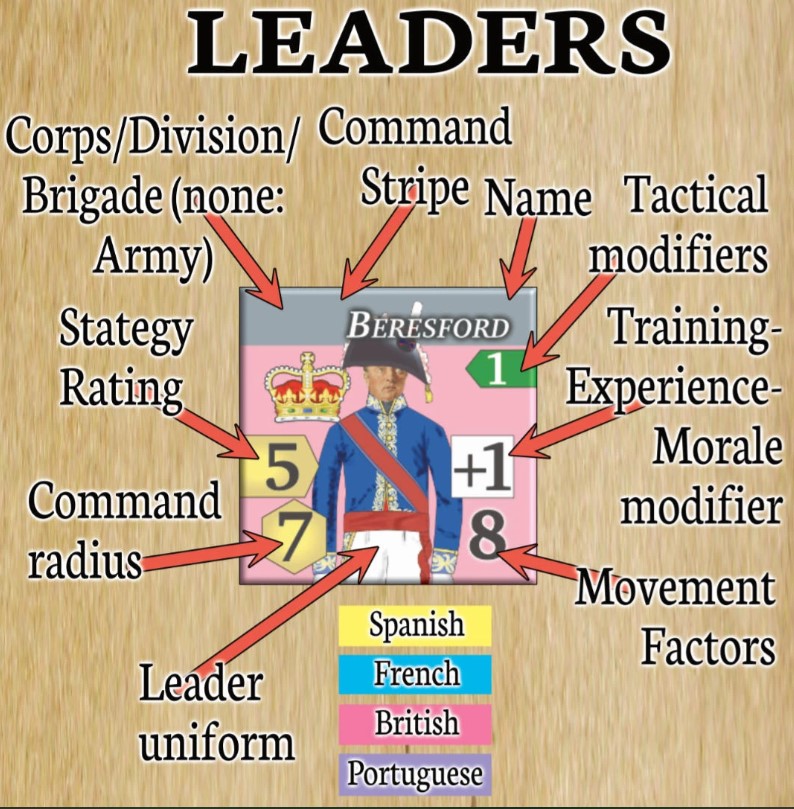
Grant: How are they represented in the game?
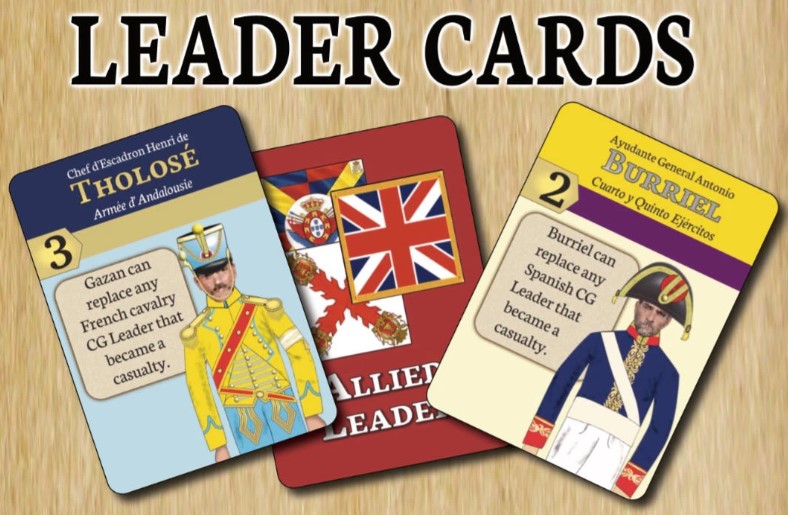
Frederic: They are represented on map by a named leader counter but also appear in each player’s hand as a Leader Card that is used to determine the order of play. Higher strategy rating Leaders have the opportunity to activate before lower ones and also can attempt to “interrupt” the activation of an enemy leader.
Grant: Can we get a look at some of the Leader Cards?
Frederic: The cards are “mini-cards”, with a generic back for each side. They show the Leaders’ full name and rank, his command stripe color, his strategy rating, his uniform and a possible text outlining special rules for that Leader.
Grant: How is Command and Control reflected in the game and what is the role of combat Objectives?
Frederic: Field Leaders are restricted in their movement by the order, if any, they have received, represented by an Objective Marker. Such a Leader cannot move much if he doesn’t have an Objective on map. His combat units are de-facto, restricted to stay within his command radius. The ability of Leaders to issue/receive orders/objectives is crucial to be able to move your troop formations efficiently in order to implement one’s desired strategy.
Grant: What is the makeup of the orders system?
Frederic: The position of the Leaders on map determine where their subordinate units are while the placement of Objective markers allows them to move (towards the marker). Also, Objectives placed in “contested areas” (close to the enemy, behind enemy lines, etc.) are not automatically implemented when received, but the Leader must pass a strategy check in order to “understand/accept” the order or become “Passive” if failed.
Grant: How does cohesion factor into the activation and combat?
Frederic: Cohesion is factored at two levels: first, at the unit level, by having a unit become disordered and then routing off map if it fails morale checks; second, at the army level, by imposing morale penalties on armies that have lost a substantial amount of units making those left on the field more prone to failing checks. Also, fatigue and general combat exhaustion is simulated at the division/brigade level and causes some troops to become less effective the longer they fight. One can remedy this by placing the brigade/division in reserve, away from the enemy, to resupply/rest.
Grant: How does combat work in the design?
Frederic: There are two types of combat: fire and melee. Fire can be initiated by infantry or artillery (the latter at longer ranges). It produces manpower losses or morale check, or both. Melee stems from infantry assaults or cavalry charges. Assaults are resolved “simultaneously” at the end of the game turn while charges happen during the activation of the units. Melees result in stalemates or change of one side’s status (disorder, rout, spent cavalry). Manpower losses in melee only occur when a unit “runs” (routs) or if locked in close quarter fighting.
Grant: What is the area of the battlefield covered by the board?
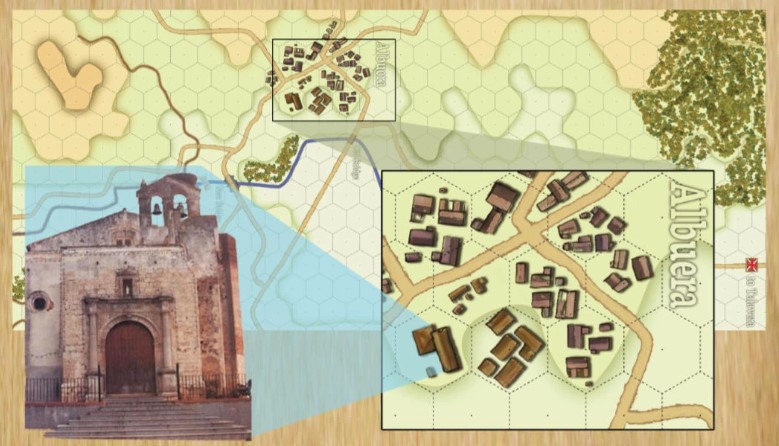
Frederic: The map covers an area slightly larger than the actual battlefield to allow players to maybe experiment with alternate flanking maneuvers.

Grant: What interesting tactical challenges does the terrain create?
Frederic: The river (Rio Albuera) on the north side pretty much prevents any major maneuvering on that flank due to the risk of disorder caused by the river crossing. The rising terrain on the south side creates maneuvering hurdles for the French that need to climb the heights. Finally, the village of Albuera itself, while mostly made of ruined houses, did see some heavy close combat fighting and is quite difficult for the French player to take over.
Grant: What roles do Event Cards play?
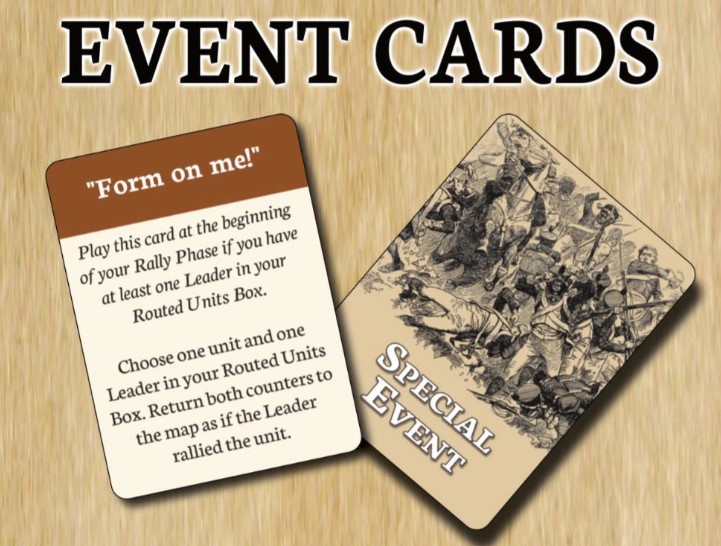
Frederic: Event Cards were introduced to add a little “fun flavor” to the game. A player that rolls badly (a natural 9) is “compensated” by being allowed to draw an Event Card that he can play now or later. These cards give a player the one-time opportunity to bend game mechanics to their advantage. Examples are: automatically passing a morale check, automatically implementing an order, achieving a better melee or fire result, etc.
Grant: What type of experience does the game create?
Frederic: While it is not a quick game to play (1-2 hours for small scenarios, 8+ hours for the full battle), once the system is understood, it flows pretty smoothly. The players have many choices to make throughout the game (“Do I risk placing an Objective there and fail to implement it?”, “Do I play this Leader now or keep it for later to counter a strong enemy Leader?”, “Do I continue this assault with fatigued troops or place them in reserve?”) and reversal of fortunes can happen following a few bad crucial die rolls. We found the game play enjoyable and the system detailed enough while not “headache inducing”.
Grant: What are you most pleased with about the design?
Frederic: The way the command and control system is kept simple by avoiding unnecessary record keeping yet works at imposing “realistic” restrictions on the players. The essence of Napoleonic battles is not the clash of swords and the musket smoke but the difficulty the officers of the time had in efficiently implementing strategies and tactics.
Also, the uniforms…that is what, as a kid, drew me to the period, since the first time I visited the Waterloo battlefield that was close to my home then. This was a primary design goal of the series: to prominently feature the uniforms of the soldiers involved on large counters. I hope I succeeded in this goal.
Grant: What has been the experience of your playtesters?
Frederic: While we made many corrections, clarifications and improvements to the rules during playtesting, we found the game quite balanced (getting an equal amount of Allied-French victories in the main battle). The randomized weather effects was also found to have major effects on the game depending on how fast the rains and squalls cleared up.
Grant: What other designs are you mulling over?
Frederic: The second volume for Fix Bayonets!, 1810: Bussaco had its first edition published in 2021, so we intend on giving it a similar face lift as Albuera. If Albuera is successful, we plan on an 1809: Talavera entry and maybe an 1809: Ocana game. We also have been working on a new tactical air-naval system for World War II for which we have a working prototype, but it is on hold at the moment.
Hope you found those answers interesting.
Thank you so much for your time in answering our questions Frederic. It was a pleasure “getting to know you” through this medium and I very much look forward to playing this game once successful with the campaign. Good luck!
If you are interested in Fix Bayonets! Volume I: 1811: Albuera Second Edition, you can back the project on the Gamefound page at the following link: https://gamefound.com/en/projects/tactical-workshop/1811-albuera-second-edition
-Grant
 The Players' Aid