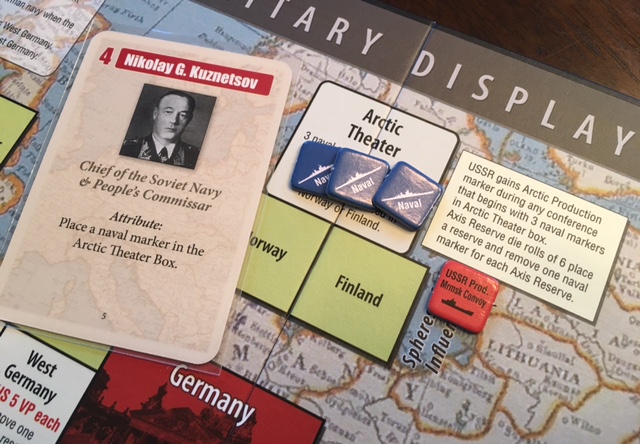
With this new My Favorite Wargame Cards Series, I hope to take a look at a specific card from the various wargames that I have played and share how it is used in the game. I am not a strategist and frankly I am not that good at games but I do understand how things should work and be used in games. With that being said, here is the next entry in this series.
#19: Nicolay G. Kuznetsov from Churchill: Big Three Struggle for Peace from GMT Games
The players in Churchill: Big Three Struggle for Peace take on the roles of Churchill, Roosevelt, or Stalin during World War II as they maneuver against each other over the course of 10 Conferences that determine who will lead the Allied forces, where those military forces will be deployed, and how the Axis will be defeated. The player whose forces collectively have greater control over the surrendered Axis powers will win the peace and the game.
Churchill is not necessarily a wargame, but more of a political conflict of cooperation and competition. Over the course of the 10 historical conferences from 1943 till the end of the war this mechanic and much of the design should not be taken literally. Before and after each conference small groups of advisors and senior officials moved between the Allied capitals making the deals that drove the post war peace. These advisors and senior officials are represented by cards with an assigned numeric value that represents an amount of influence. Each conference sees one of a group of issues nominated for inclusion in the conference for debating and discussion. The issues categories include: Theater leadership changes, directed offensives, production priorities, clandestine operations, political activity, and strategic warfare (A-bomb). Each of the historical conference cards independently puts some number of issues, such as directed offensives or production priorities, metaphorically on the table, while the players nominate an additional 7 issues.
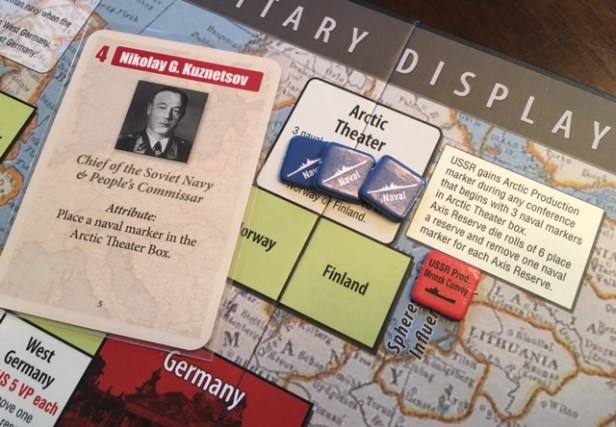
As a part of the game, various logistical and production issues are fought over between the Allied powers and it is important for each player to understand their focus and the things that they must accomplish early in order to improve their flow of men and material as well as their production. I know this might seem like a no brainer but as the Soviets you must focus on the Arctic Theater quickly in order to gain that very precious additional production marker from the Arctic Convoy. The Arctic Theater box, once it contains three Naval Markers, will provide the Soviets with the Arctic Production Marker during any conference that starts with at least 3 Naval Markers in the box. I have found that this must be taken care of prior to the 3rd conference or you will fall behind in the War in Europe. This additional production marker will add one additional Offensive Support Marker anywhere, but you will want most likely want to focus on placing it on the Eastern Front first as you will have the Eastern Horde to focus on and must make headway here to set you up for the rest of the game.
In order to accomplish this, you must spend at least 1 or 2 early Production on placing a naval marker. If you focus on it from Conference 1, it won’t seem as daunting and you will slowly make your goal by the 3rd Conference at the latest. But never fear, also to aid you in placing these naval markers is Staff Member Nikolay G. Kuznetsov, Chief of the Soviet Navy & People’s Commissar, who allows you to place a naval marker in the Arctic Theater Box when he is played. The really good news is that he has 4 power along with the marker benefit, so if you can will yourself to draw him early and often, it will be well with you.
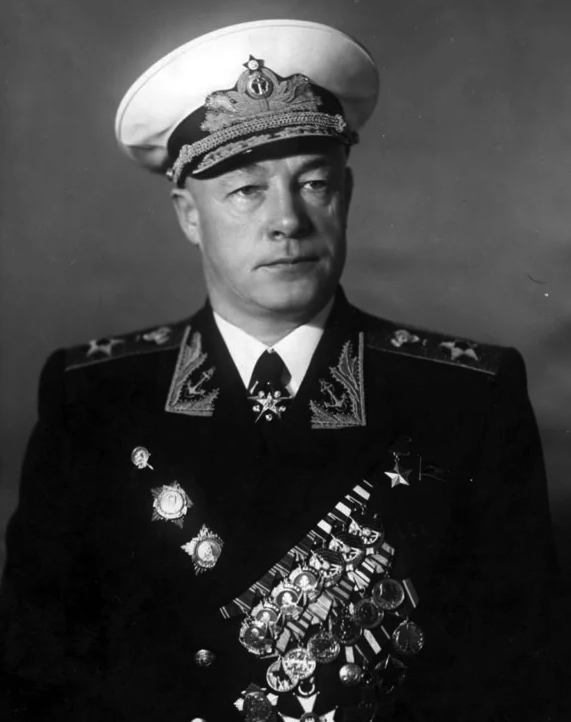
Nikolay Gerasimovich Kuznetsov was a Soviet naval officer who achieved the rank of Admiral of the Fleet of the Soviet Union and served as People’s Commissar of the Navy during the Winter War and the Second World War. The N. G. Kuznetsov Naval Academy and the Russian aircraft carrier Admiral Kuznetsov, as well as the Kuznetsov-class carrier class, are named in his honor.
Kuznetsov played a crucial role during the first hours of the war – at this pivotal moment, his resolve and blatant disregard for orders averted the destruction of the Soviet Navy. By June 21, 1941, Kuznetzov was convinced of the inevitability of war with Nazi Germany. On the same day Semyon Timoshenko and Georgy Zhukov issued a directive prohibiting Soviet commanders from responding to “German provocations”. The Navy, however, constituted a distinct ministry and thus Kuznetsov held a position which was technically outside the direct chain of command. He utilized this fact in a very bold move.
Shortly after midnight on the morning of June 22nd, Kuznetsov ordered all Soviet fleets to battle readiness. At 3:15 am that same morning, the Wehrmacht began Operation Barbarossa. The Soviet Navy was the only branch of the military in the highest state of combat readiness at the start of the initial German push.
While Stalin generally respected Nikolay Kuznetsov, particularly due to his crucial role as the Soviet Navy commander during World War II, there is evidence suggesting that Stalin did not always fully trust him and could be critical at times, especially during the Great Purge when many military leaders were targeted; however, Kuznetsov managed to navigate this period relatively unscathed due to his competence and the vital role the Navy played in the war effort.
In the next entry in this series, we will take a look at Triumph from Time of Crisis: The Age of Iron and Rust Expansion from GMT Games.
-Grant
 The Players' Aid