
With this new My Favorite Wargame Cards Series, I hope to take a look at a specific card from the various wargames that I have played and share how it is used in the game. I am not a strategist and frankly I am not that good at games but I do understand how things should work and be used in games. With that being said, here is the next entry in this series.
#18: Iroquois Alliance from Wilderness War: The French & Indian War, 1755-1760 from GMT Games
One of my fondest memories of our wargaming journey was our initial experience with the full campaign game of Wilderness War from GMT Games. We were 2 very inexperienced wargamers and we slogged through a 9-hour marathon play over a few days that ended in a 0-0 tie of all things. That’s right, the game ended in a tie, even though we both had a card in hand, but I was unable to use mine to activate Levis, which was my only potential Victory Point scoring force, and Alexander’s forces were in too tenuous a position or too wounded to risk an open battle for VP’s. You would think that this would have turned us off to the game but on the contrary it made me fall in love with asymmetric wargames and the Card Driven Game mechanic with its use of Action Points and events to wage war on the North American continent. The end score of our game really followed the tension of the game, and the blunders on the side of the British that counter balanced their various successes.
All in all, this game was excellent to play and we both highly recommend it. The two factions play extremely differently which leads to many intricate and reactive strategic decisions. The British have many powerful forces with their Highlanders and cannon while the French have access to better leaders and mobile troops and Indian allies who can run around the frontier raiding and burning settlements for VP’s. Laying siege and assaulting really feels like it should, and avoiding battle until you are ready is something that is integral to maintaining a strong presence on the board. You cannot always get into every possible fight as you will not survive the attrition of these battles. The deck plays really well, and as you don’t have to worry about the opponents events in your hand going off, the management aspect is much simpler yet very engaging as there are always reaction cards you can play or cards that you want to hold onto for that perfect moment.
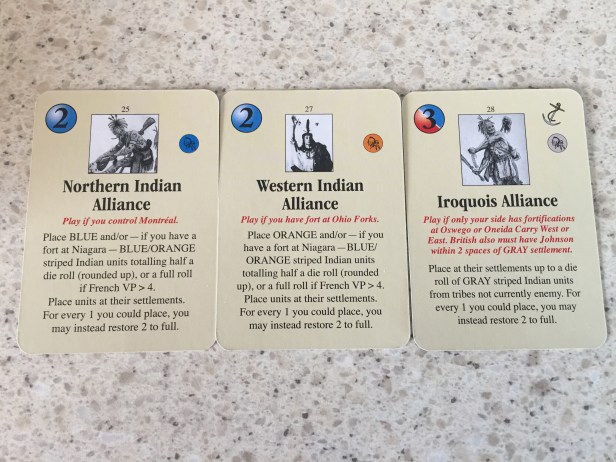
As this game game is a Card Driven Game and relies on the cards to either take movements, attack, build forts or take the printed events, I would generally say that playing the cards wisely is a required part of both British and French strategy, but for the French I feel that it is even more important for their success. The cards are so key as they give the French strategic and numeric value either by allowing the recruitment of key Indian allies or a needed host of Regulars or in allowing for defensive actions to take the momentum out of British aggression or actions. Some of the cards that I believe are so key to the French include the following: Northern Indian Alliance, Western Indian Alliance, and Iroquois Alliance. Without these cards, efforts to raid the frontier will be hampered as you are bound to take reductions due to poor rolling or attack from nearby British Light Infantry that tend to set up a defensive wall during the middle to late part of the game. The French do not have the numbers of Regulars to compete so the Indian allies and their proper use is key to a French victory.
In this post, I will focus on the Iroquois Alliance card and will talk about when to play it as sometimes it is better to be patient and play it at the correct time to gain the most utility. Most of the Alliance cards (but not so in the case of the Iroquois Alliance card) give you a bonus when you have greater than 4 VP’s so it is imperative to hold them as long as you can to make sure you get the largest benefit of the cards. If you are under 4 VP, you only receive half of your die roll of units so even a great roll of a 4 will only net you 2 Indian units. While if you played the same card when you had more than 4 VP you would have received 4 units, a net increase of 2 units. This increase of 2 units can lead to 1-2 more successful raids over the course of the game and cannot be underestimated. As you can see from my earlier discussion about the final score, 1 VP would have made the difference.

Iroquois Alliance is a card that has a special qualifier in order to be played by either the French or the British. The key here is the control of any fortifications located at Oswego or Oneida Carry West or East. To play the card, the player must have control of any fortifications in these spaces so you will have to aware of that when you are trying to play this card. If this qualification is met, the player will then roll a D6 and will place that many gray striped Indian units from the tribes in the area that are not currently allied with your enemy. The card also allows you to forego placing new Indian allies and just restoring 2 on the board who are reduced to their full status (1-6).
I really love the thematic connection here as in order to attract the Indians as your allies you must have demonstrated your strength through building and maintaining fortifications in the specified areas. Furthermore, you must have them and your enemy must not. This really is the key to how these relationships and alliances were built with the natives as they were smart and wouldn’t give their service over to an inferior power who couldn’t prove that they were dominant in the area. The existence of fortifications is also somewhat of an intimidation factor and would force the natives to side with the power that was winning the war, at least in Iroquois territory. This is one of the great things about these Card Driven Games and their use of the cards to deliver the bits and bobs of history to enlighten our understanding and to expand our knowledge of the period.

The Iroquois Confederacy historically didn’t ally with the French; instead, they primarily allied with the British, making them a key part of the British side in the conflict. The Iroquois had a long-standing relationship with the British, which was strengthened during the war, allowing them to access trade goods and support against French expansion. While most of the Iroquois sided with the British, there were instances where individual tribes or factions within the Confederacy may have shown some neutrality or even limited alliance with the French.
In the next entry in this series, we will take a look at Nicolay G. Kuznetsov from Churchill: Big Three Struggle for Peace from GMT Games.
-Grant
 The Players' Aid
Interesting article Grant. Dang, I guess I’m gonna finally have to break donw and buy the game.
LikeLiked by 1 person
It is a very interesting CDG. If you didn’t know, you can play the game on Rally the Troops online with other players.
LikeLike