
With this new My Favorite Wargame Cards Series, I hope to take a look at a specific card from the various wargames that I have played and share how it is used in the game. I am not a strategist and frankly I am not that good at games but I do understand how things should work and be used in games. With that being said, here is the next entry in this series.
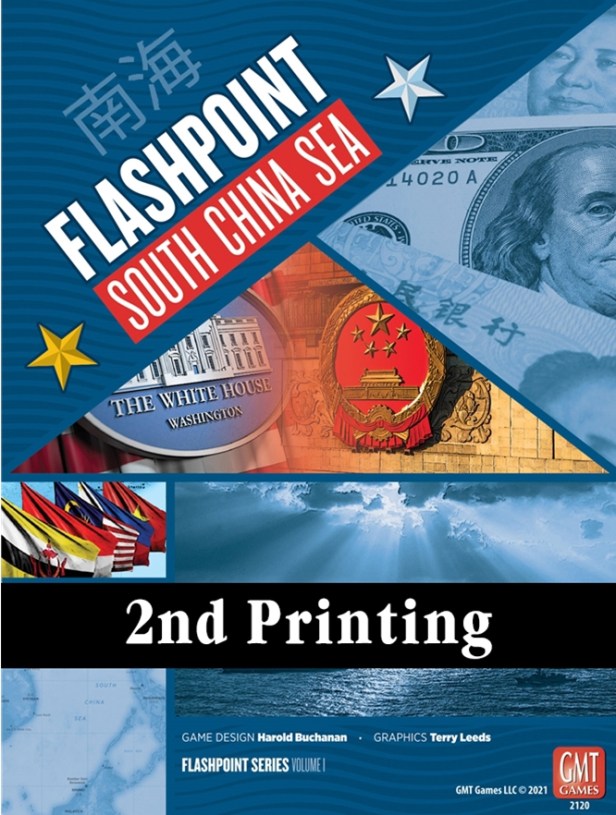
The South China Sea has been described as “a crucial link in the ‘global commons’, connecting the Pacific to the Indian Ocean, Persian Gulf and Europe. Right now, along with the East China Sea, it is the most contested piece of sea in the world and one of the main reasons for the current anxiety over China’s intentions”. It will be fought over, at least ideologically, for the next decade and will be a source of much concern for the West. You might say it is a powder keg and all it needs is a spark. With this in mind, we are going to take a look at a card from Flashpoint: South China Sea from GMT Games designed by Harold Buchanan. The game is a fast playing 2-player strategy game that simulates the complex geopolitical contest currently taking place between the United States and China in the South China Sea. The game is a Card Driven Game that uses cards to allow players to play out the struggle using events based on today’s headlines and use these cards to take actions that will provide dominance over regions and score victory points at any time during the game. We had a great time with this one and I also really enjoyed the solo mode, even though it was brutally difficult.
#17: North Korea Launches Missile from Flashpoint: South China Sea from GMT Games
One of the things that I enjoy about Card Driven Games and their use of cards is that sometimes the cards allow the player to break or ignore certain rules. This typically is a very powerful effect and is reserved for only a few cards in any game so as not to imbalance the game. In Flashpoint: South China, there are several examples of this concept. The North Korea Launches Missile Event Card is such a case where a basic concept is thrown out the window and the China player has the ability to do something that normally isn’t. This is a simple Event and allows the Chinese player to move 2 US Economic or Diplomatic Influence from anywhere on the board to the United States player’s Reserve Box. Normally, if an Influence Cube is removed from the board by the play of an Event Card, it is placed in that player’s Available Box. But in this case, the Event grants the Chinese player a special ability to move those removed Influence’ Cubes to the Reserve Box. This means that the US player now must spend their Operation Value points in the future to move a cube from the Reserve Box to the Available Box to then be able to play them back onto the board.
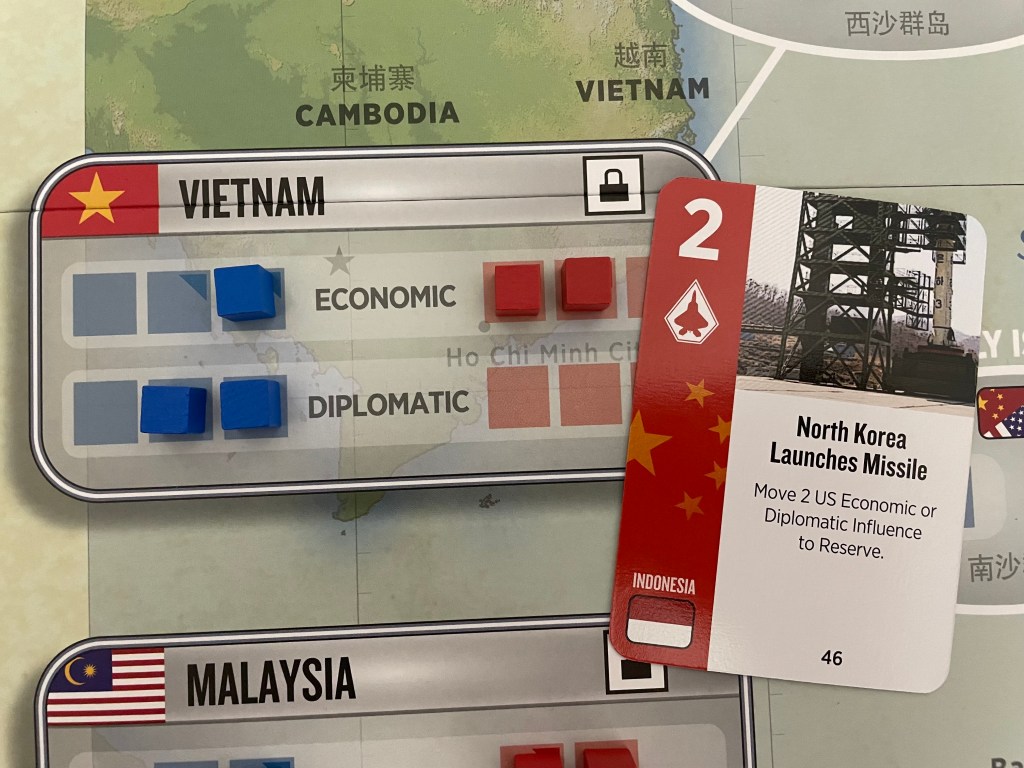
The North Korea Launches Missile Event doesn’t require that the 2 targeted Economic of Diplomatic Influence Cubes be in the same Country Box. So depending on the situation, the player may decide to take 1 from Vietnam and 1 from another Country. Or 2 from another single Country. The choices are infinite! (not really but it sounded good.) These Events are very important and you must be aware of the distinctions of how they break or change the rules to make better decisions about how and where to use them.
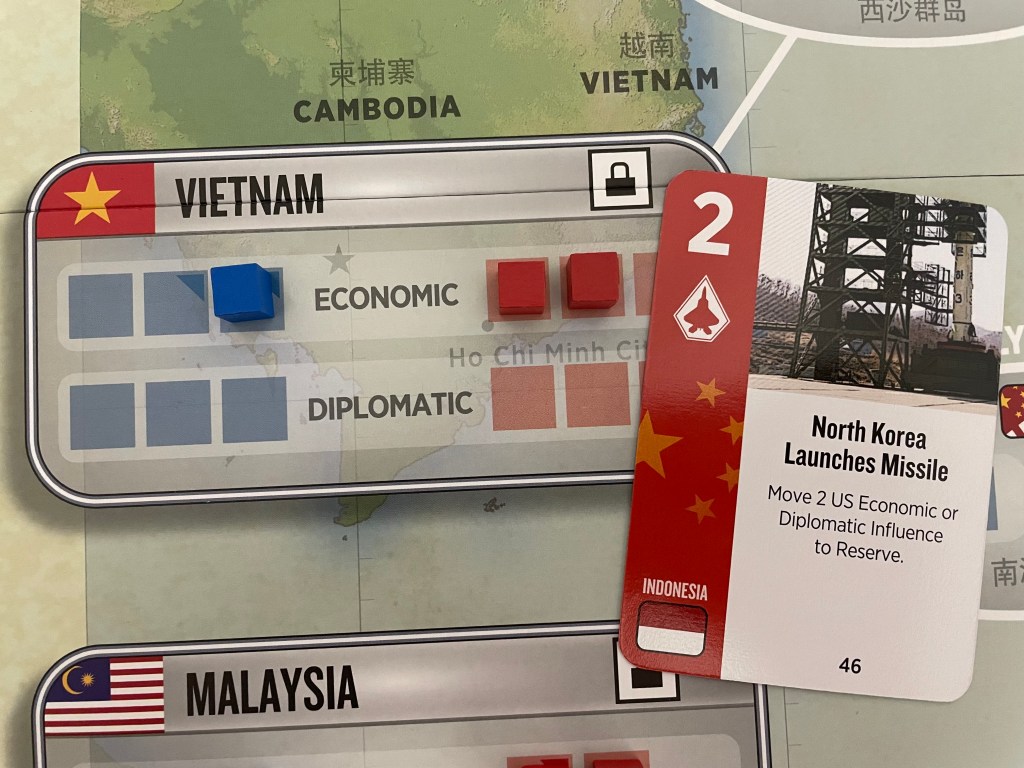
The other aspect that I really enjoy about this card and frankly the design is that the effects it has and how that translates to our modern day world. You see, in the South China Sea region, the tools of control are currently mainly limited to the economic and political, as well as militarily with a proper accounting of military assets and troops in the region as well as bases and the force that they project, but as this struggle is a Cold War there is no true fighting on the battlefield the struggle is through the power of the almighty dollar and building up of or tearing down association with allies. This card forces pressure on the United States as the exertion of force and threat from North Korea will effect the economy of the region and at home, by slowing the movement of goods and the weakening of trust in allies. I just love how those 2 aspects are the focus of the game and this card’s effects really reinforce that concept.
There are many players in the battle over control of the South China Sea. The main focus is that of the ideological struggle between the 2 Superpowers the United States and China but there are others who are also playing a major role in the struggle. North Korea has made significant progress in its nuclear and missile programs over the past 10 years and has established themselves as a direct threat to the region. There advancements have included the following:
- Intercontinental Ballistic Missiles (ICBM’s) – North Korea has tested ICBM’s multiple times, including in 2017, 2022, and 2023. In 2024, North Korea launched a “perfected” Hwasong-19 ICBM that reportedly had the longest flight time of any of its missiles at 86 minutes.
- Solid-Propellant ICBM’s – North Korea test-launched its solid-fuel ICBM, the Hwasong-18, in April, July, and December 2023.
- Satellite Capabilities – North Korea successfully launched a spy satellite in 2023. The space-launch vehicles used to place the satellite in orbit use the same ICBM motors, which gives North Korea greater intelligence and targeting abilities.
- Cruise Missiles – North Korea test-launched a new cruise missile variant, the Pulhwasal-3-31, in January 2024. It also test-launched the Padasuri-6, a surface-launched anti-ship platform, in early February 2024.
- Nuclear Warheads – As of January 2024, North Korea is estimated to have assembled 50 nuclear warheads and have the fissile material for an estimated 70-90 nuclear weapons.
North Korea’s nuclear program has expanded and they have developed all of the major infrastructure to support further development and manufacture of ICBM’s such as mines for gathering raw uranium, enrichment facilities, nuclear reactors for turning uranium and plutonium into bomb fuel, and weapons assembly plants. These advancements are allowing them to exert influence in the region and will continue to expand and create issues for the United States and its allies.

In the next entry in this series, we will take a look at Iroquois Alliance from Wilderness War: The French & Indian War, 1755-1760 from GMT Games.
-Grant
 The Players' Aid