If you know nothing about Warfighter, you simply need to because it is a really fantastic solitaire and 2 (or more) player experience that gives lots of tension and decisions about how to attack your enemy and how to traverse difficult terrain to reach your objective before the timer runs its course. Warfighter is a tactical card-based game for one to six players, where players will select and equip a squad of soldiers, and then attempt to execute the mission assigned by fighting their way to achieve the objective. This system is just FUN! It’s a type of side scrolling, pulpy, run-and-gun romp that elicits the feeling of a 1950’s style comic book. The game is very much customizable and we have a good time trying to choose our soldiers, their skills, weapons and other equipment to stay within their allotted points for the scenarios. The decisions that players have to make in this game start from the outset and you have to know what your objectives are and the type of things that you might need to take along with the team to successful.
There’s been several iterations of the system over the years in their own stand alone products, providing you with different theatres, weapons, nationalities, etc. This year, they released off of a successful Kickstarter campaign the newest addition to the series in Warfighter: Vietnam. Well, actually, the title is Warfighter: The Vietnam War Special Forces Card Game but it is colloquially referred to as Warfighter Vietnam. To date, we have played 4 scenarios together cooperatively, with each of us controlling 1 Player Soldier, and I have also played a few scenarios solitaire in the comfort of my game room. I have very much enjoyed the experience and really want to share with you what new tricks the designers have added to capture the thematic feeling and atmosphere of the Vietnam War. This is not your father’s Warfighter! It has been given a total facelift, including new graphic design, art and card backs and that is not all as they have also added new Keywords, new enemy abilities and a whole new level of requirement for a successful mission. I want to share with you what is new in this First Impressions post and take inside the jungles of Vietnam as you fight the Viet Cong and North Vietnamese Army for control of the country.

Body Count
One of the best additions to the system that really makes the game feel historically thematic and also ratchets up the difficulty is the concept of Body Count. As you may know, one of the ways that the United States tracked their progress in the Vietnam War and how they determined whether they were winning or losing the war or a single battle was counting the number of enemy dead killed by US soldiers in battle but also during various search and destroy missions. This was extremely controversial because it lead some commanders in the field to count killed civilians and unarmed non-combatants as well as enemy combatants killed as well as the inflation of these numbers reported to command. General William Westmoreland required this practice and felt that it was a good indicator of progress of operations.
The Body Count in the game is earned by Soldiers whenever they cause an EKIA (Enemy Killed in Action) on a Hostile after a hit with a weapon. This Body Count is tracked with circular markers and held in the Body Count Box on the left side of the board and when an EKIA happens, the player must decide to either Bank the Body Count to count toward the required Mission Threshold or Keep it to be spent on special abilities during the Mission after the play of Action Cards. These Action Cards will call out the use of a certain number of Body Count held by the Soldiers, not those that have already been Banked, to activate certain abilities such as access to new weapons, equipment and ammunition from the bodies of the fallen enemy to other benefits such as increasing your Defeat Cover roll, which is required to actually confirm a hit on a Hostile unit.

Over the course of the Mission, Soldiers must not only complete the requirements of the Objective chosen for the Mission but also must Bank and accumulate earned Body Count. In order to complete the Objective, the total Body Count banked must be equal to the Body Count value on listed on the Mission card. We have found that this means you have to Keep most of your Body Count earned or you will be in danger of losing the Mission by failing to meet the requirement. This Body Count concepts is coupled with the collection of Experience Points for EKIA’s as well and creates a sort of game economy as the players have to make decisions about how to use these scarce resources to get the most return.
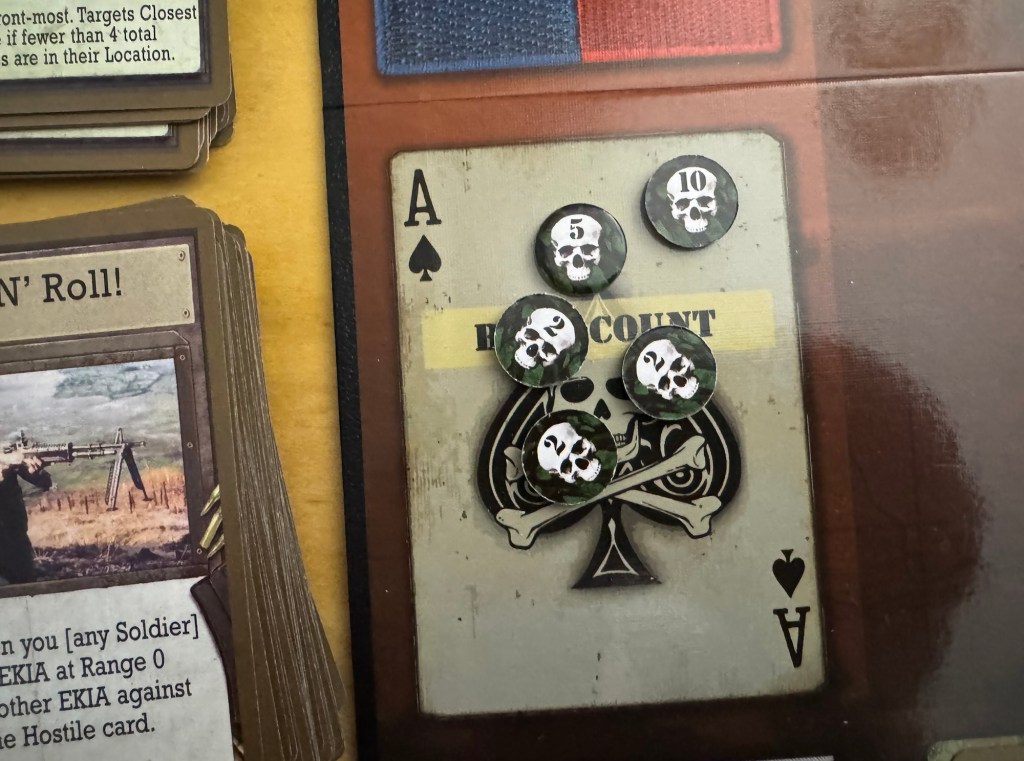
This economy also creates an added layer of tension and difficulty as in order to earn the Body Count required you really have to go hard and fast at the VC and NVA Hostiles as they appear because you never know when they are going to ultimately Fade away into the bush and evade your attacks. This addition to the game was very thematic, reflecting the direction of General Westmoreland in tracking Body Count, but also creates some added depth of interest and choice to the basic Warfighter System.
Fade
Another really great addition to the game is the inclusion of the Fade mechanic. Similar to the inclusion of Body County, this mechanic really represents the hit and run nature of the combat including ambushes and other tactics that are not necessarily a large scale stand up fire fight. During the Fade step of each of the Hostile Turns, Hostiles that have the Fade Keyword have the condition checked to see what effect it might have. If the condition listed on the Hostile Card is met, the Hostile unit will be discarded, and no additional Body Count or Experience is awarded. In fact, the player now loses the ability to continue hitting this possibly wounded and less effective enemy as they tucked tail and ran to the bush. Some of the Fade conditions have costs listed on the cards that require the player to have to pay those costs to avoid the unit from leaving the board. These costs can be paid to prevent the Hostile from Fading but is also a choice as you never seem to quite have enough of any resource, including Action Cards, Ammunition, Health, Experience Points and other things. In the example picture below, if there are no Soldiers present in the location where this Hostile is found, then it will Fade away.

While this mechanic can be quite frustrating as you see Hostile unit after Hostile unit simply run away and leave your engagement, it really is a very interesting addition to the system as it creates some additional choices that are tough but that must be considered and made by the player to have any real possibility of completing their Mission. I also would offer an alternative view of this Fade mechanic as well. Sometimes, when you are in a bad spot, have multiple wounded Soldiers, a lack of Action Cards and are being overrun by several enemy units, letting them run and leave the area is a blessing in disguise and will give you a chance to catch your breath and regroup your Soldiers to get on with the Mission and back on track. Remember, there will always be more Hostile units coming out at the next Hostile Turn and you will be right back in the hail of bullets and a target rich environment before you know it.
Engage
The final new mechanic that was added in this game was the concept of Engagement of Hostile Units. When Hostiles are placed on the board, they start as Unengaged, which means they are hiding in the shadows of the jungle and are not showing themselves fully. Because of this, the Hostiles are harder to attack and their attacks are more likely to hit the Soldiers. On the other hand, when Hostiles are successfully Engaged they are in the open and the tables turn as they are less likely to hit on an attack but their attacks can be much more dangerous. Hostiles can become Unengaged under certain conditions, hiding back in the jungle, or doing the previously discussed Fade and leaving the game entirely.
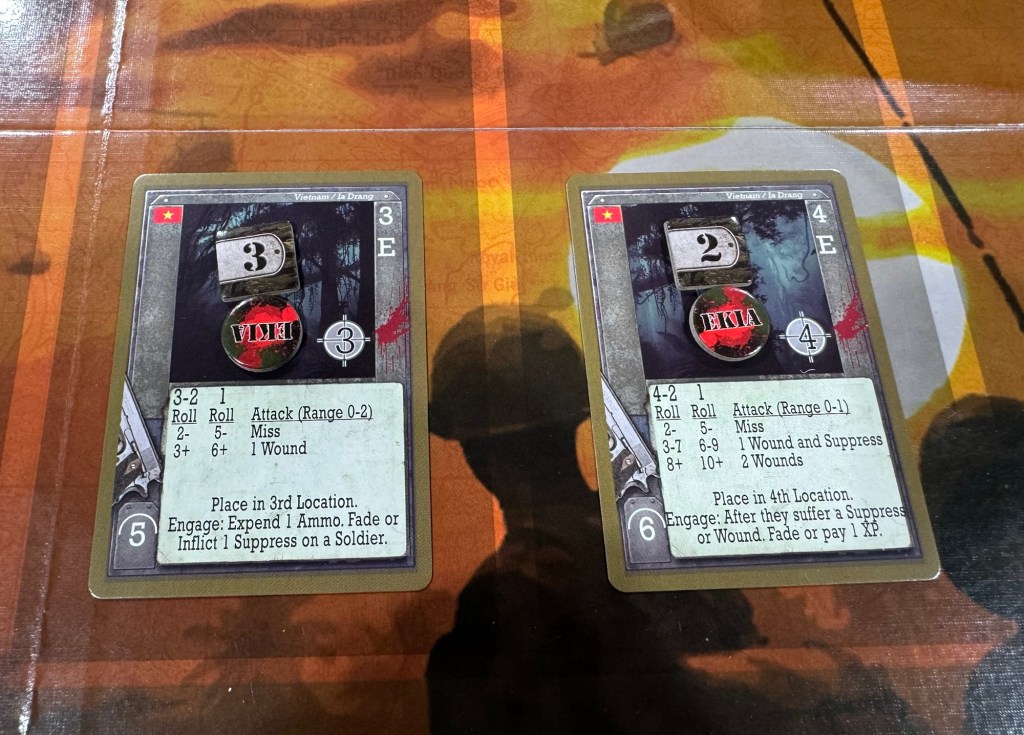
Whenever a Hostile card is drawn, it is considered Unengaged. As already mentioned, Unengaged Hostiles are more dangerous than Engaged Hostiles, but they offer but they also different rewards for being eliminated by Soldiers. Each Hostile’s Unengaged side has a specific unique condition in order to become Engaged. There are two types of these conditions including a cost that must be paid by the Soldiers to Engage them (typically something such as Engage: 2 Action Cards) or a requirement that will happen at a specific time, such as Engage: If a Soldier is in their Location. If an Engage condition lists a cost on the card, the cost may be paid at any time during the Soldier Turn by any Soldier. When this cost is paid, the player will then flip the Hostile card to its Engaged side. If an Engage condition lists a specific timing, flip the Hostile card to the Engaged side as soon as the condition has been met.
One other thing that I want you to notice is the higher Defeat Cover requirement in the bottom left hand corner of the Hostile card. In the picture above this Defeat Cover cost is a 5 and a 6 and is very tough to hit on a 6-sided die. This reflects the partially obscured and hidden nature of the Hostile unit as it is safe in the canopy and shadows of the dense jungle cover. As also mentioned earlier, their attack to hit values are pretty low as well (with a 3+ or 6+ on the unit to the left depending on how many Reticles are left after taking hits in combat and a 3+ or 6+ to deal either 1 or 2 Wounds in combat). It is in the best interest of the Player Soldiers to Engage these units to determine their true fighting and defensive abilities or they might just end you from the relative safety of the jungle.

Some Hostiles when Engaged will become Soldiers. When discovered, these Soldiers can be added to your own team by paying any costs listed on the card. If you add a Soldier to your team, they will be assigned a Targeting Counter and it will be added into the Target Cup matching those Soldier Identification Counters. These added team members will not only give you extra attacks and possible actions but will also be targeted by Hostiles and keep your other Soldiers out of the line of fire.

I loved the addition of this mechanic. It created some very interesting choices and also added in some neat little benefits, such as finding the new allies. This added depth made the game much more tactical as you had to consider the choice of whether to spend the resources needed to Engage or not.
New Graphics
The final point that I wish to discuss in this post is the increased quality of the graphics and art used in this addition to the series. Gone are the stretched and icky looking soldier images that have been used in so many of the previous games in the series. They have been replaced by historical pictures and were very well chosen to illicit the thematic feeling of the Action Cards, Hostile units or Soldiers. But the largest change was the layout and look of the board itself.
In Warfighter, the board consists of 7-8 columns that are used as the spaces to house Location Cards as they player moves their squad toward their Objective. This can be pretty easy to simply gloss over and add columns with very little to no thought about background, historical connection or even basic graphic design and layout. But I am pleased to announce that DVG really invested in the look and feeling of the board itself. They used a vintage sunset scene of Hueys gliding in over an LZ to pick up beleaguered troops. The sun is setting in the background and gives everything on the board an orange/yellow hue that brings me back to the movies. I also very much appreciated the addition of the LT and his radio operator in the foreground, positioned just above the spaces where Location Cards are placed and where your Soldiers will reside as they move down the path toward their Objective. These changes really made the game feel fresh and new and were very much needed! But the board wasn’t the only component that received a facelift!
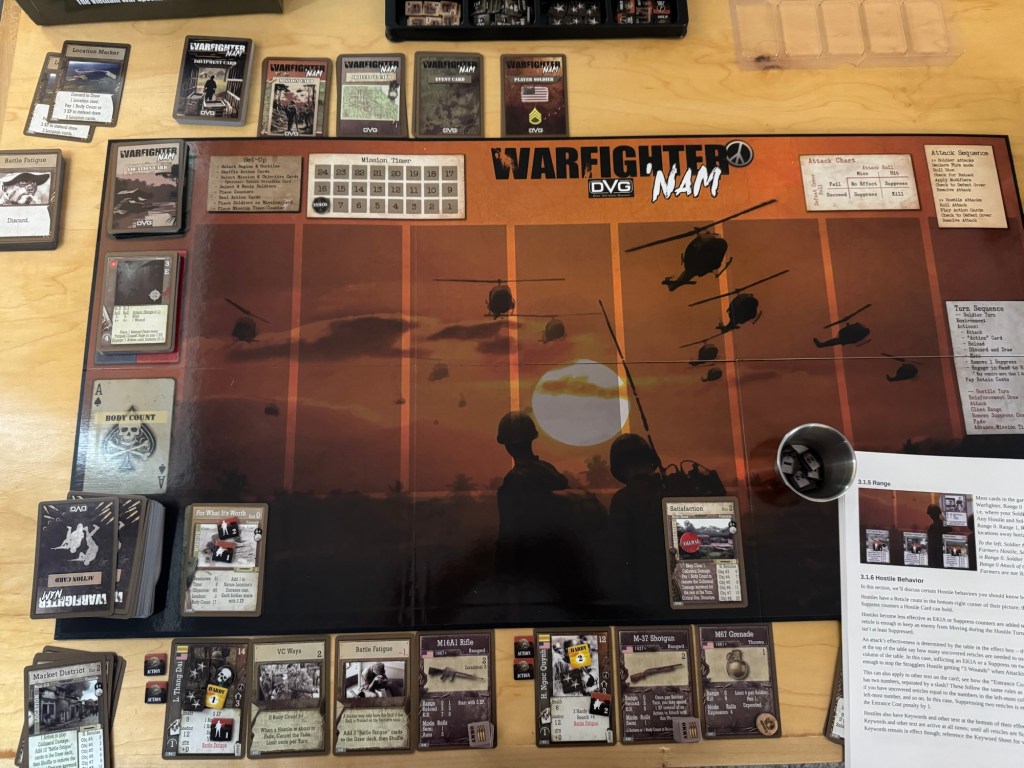
They also gave some attention to the backs of all of the different card types. In Warfighter, there are just so many different types of cards. They can be easily confused, especially when they all look the same with the exception of some different text. But they addressed this as well in the game as they created unique backs for each of the card types and also added some nifty color choices (lots of tan, orangey brown, yellow and green to give them Southeast Asian flavor and feel! They also included individual themes for each type of different cards and this was very much appreciate. The graphic work on this one was just fantastic and I truly hope that this carries over to future additions to the series.

One final thing. As is typically the case with these additions to the Warfighter Series, there are a lot of small pack expansions to add even more scenarios and cards to play with so this game is very much a lifestyle. Is this game an uber realistic historical simulation of the battles fought in these theaters? No, but that doesn’t matter. Because the game is just that much fun to play and you can really take this one out at anytime as the setup is pretty simple. The best part about the system, and the way that it works with the cards and the different enemies you will face as you move down the board are the stories that come out of the game. There are moments of heroism, bombastic exploits and exciting risk that you must take. There are also laugh out loud moments as you just can’t seem to get a card you need, or the dice hate you, but the whole experience is just plain fun. Something a lot of other wargames cannot claim.
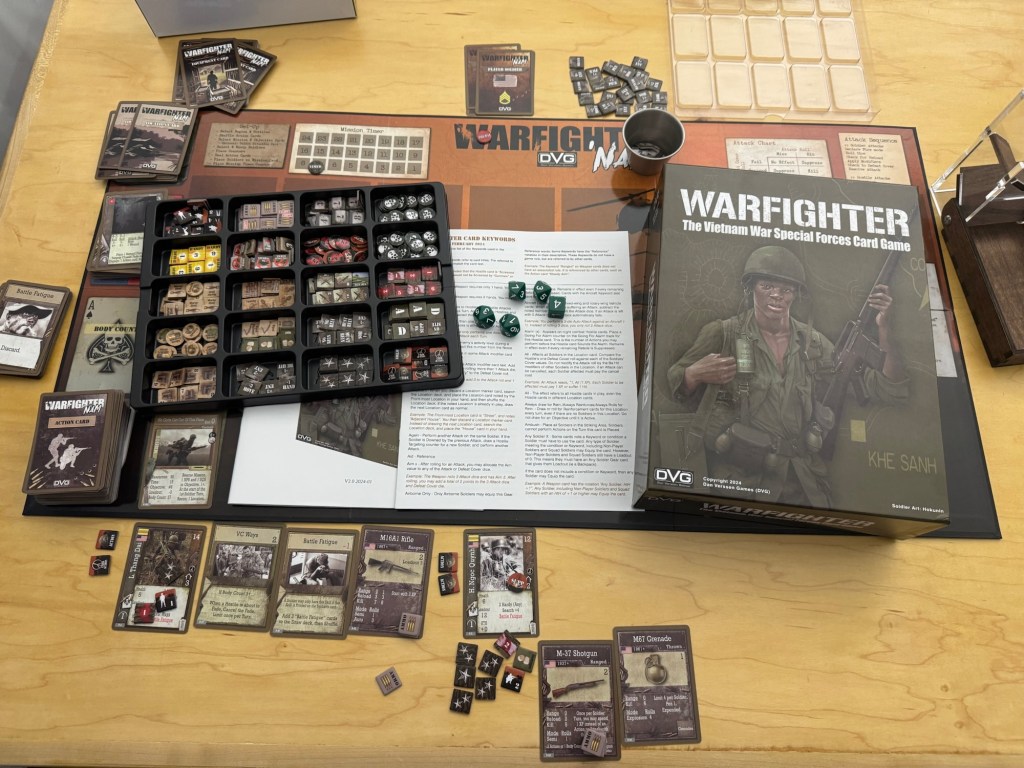
I hope that you can see the changes that were made to this entry and how DVG has stepped up their game! I have very much enjoyed my plays of this game (to date, 4 scenarios with Alexander cooperatively and then 3 solo plays) and look forward to cracking this back out as I begin to explore their numerous expansions and take the campaign out for a spin.
If you are interested in Warfighter: The Vietnam War Special Forces Card Game, you can purchase a copy for $69.99 from the DVG website at the following link: https://dvg.com/product/warfighter-vietnam/
-Grant
 The Players' Aid
Man I wish they’d include a couple or three of the critical expansions with the core game. This very much has a “nickel and dime you” feel to it, which is distasteful.
LikeLiked by 1 person
To be honest that is the way every Warfighter game is. Core game then about 10 offered expansions. I actually prefer it that way because sometimes I’m not as interested in the extras.
LikeLike
I have put DVG on my never buy again list, after trying to make sense of the Warfighter all-in-one rulebook mess. It’s good to hear that Nam has abandoned that approach, but what are the chances of DVG releasing stand-alone versions of the existing Warfighter games? I haven’t even unwrapped my North Africa Warfighter as I can’t bear the thought of that rulebook.
LikeLiked by 1 person
Cannot blame you for that stance at all. We had a horrible experience with Warfighter Fantasy and were really hesitant about Vietnam.
LikeLike
Yes, my previous experience put me off Nam.
In my previous comment I had meant to say, what were the chances of DVG releasing standalone rulebooks for the previous games?
LikeLiked by 1 person
I’m not sure.
LikeLike
+1
They really turned me of with Warfighter Fantasy mess. Lot of damage done there.
I think they need to update their business model, they are not a young start up company anymore.
LikeLiked by 1 person
It was definitely a mess. We polayed that thing 3 times and just utterly gave up because 1.) the rules were garbage, 2.) the art was so poor and 3.) it just didn’t work well together. The monsters were too many and too tough and the way they attacked just ravaged us. I don’t mind losing but I would like to have a chance at least.
LikeLike
Turned me “off” not. (I gotta learn to proof read before I hit submit) Lol
LikeLiked by 1 person