
With this new My Favorite Wargame Cards Series, I hope to take a look at a specific card from the various wargames that I have played and share how it is used in the game. I am not a strategist and frankly I am not that good at games but I do understand how things should work and be used in games. With that being said, here is the next entry in this series.
Card #15: Ambush and Local Guides from The Wars of Marcus Aurelius: Rome 170-180CE from Hollandspiele
The Wars of Marcus Aurelius: Rome 170-180CE is a solitaire only game that uses cards similarly to a CDG to simulate the strategic level struggle of the Romans led by Marcus Aurelius to stave off the invasions of Germanic tribes and Sarmatian raiders as they encroach on Roman territory across the Danube River. That’s the history. And it is really well integrated. The game play is very fun, strategic, with lots of decision points about what to do and what cards to use, and it is really challenging.
One of my favorite parts of the game is the combat. You have a standing army that you assign a leader and also place on a specific track that is attacking barbarian hordes in that region and have to go about trying to destroy them and quell their resistance to Roman rule. This combat is brutal and sometimes is very challenging if you don’t have the right leader, enough soldiers and the right cards in hand. As you drive the barbarians back toward their homeland though, their defensive abilities improve as they are more familiar with the terrain as they are fighting on their home court. When you get to the very end of their tracks at their Home space, this Terrain Value bonus will increase to +8 or higher and makes winning combats very difficult…unless of course you have the right cards in your hand! Two of my favorite cards for this situation include Ambush and Local Guides.
As you can see from the picture below, the Marcomanni Terrain Value is +6 and +8 in their last two spaces. This means that they are more often than not starting the Battle at an advantage with a +10 to +12 bonus to their Combat Roll. The highest that the Romans can get in these same spaces (without the play of an event) is a +11 but that is with a Level 2 Fort, which can be very hard to build, so more often than not they will be at only a +9 (6 Legions plus +3 for Marcus Aurelius’ Combat Value). In comes the importance of stacking up your event cards in these key battles as you look to throw the knockout punch that will force the Tribes to surrender and get out of the fight.
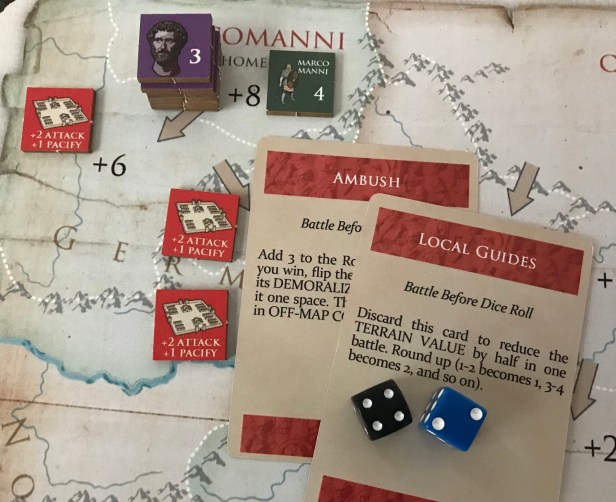
Stacking events simply means that you hold a few good cards in your hand to increase the odds of you winning a key Battle. I don’t know about you but the dice are generally unkind to me and if I am looking to roll well each Battle to win then I will be losing more often than not. I like to stack the odds in my favor by getting a few good cards and playing them together. In the above picture you will see that my situation is not dire but I want to win this fight to force the Marcomanni Tribe to surrender. We are battling in their Home space and their base Attack Value is currently a mighty +12 to which they will add a d6 for a possible range of a 13-18 Attack Value. My Roman stack is only a +9 at this point and I will also add a d6 for a possible range of a 10-15 Attack Value. This just isn’t good enough and means that I would have to roll a 5+ to the Barbarians roll of a 1 to win. So, here is where event cards become important.
I decide to play my Ambush card, which will add a +3 to my roll thereby increasing my range of possible Attack Value to a 13-18, which is much better but just not quite good enough. I then add to that my Local Guides card which will halve the Terrain Value of the Home space, reducing it by 4 from an 8 to a 4. This decreases the possible range of the Barbarian Attack Value to a 9-14. This is very possible for me to win now as I just have to roll a 2 or higher to overcome the Barbarians. I roll the dice and get a 4 to their 2 resulting in a final Roman Attack Value of 16 compared to the Barbarian Attack Value of a 10. Do you see the importance of holding onto good cards until you can stack them to assure victory? These type of combat cards are very important in the game and you will have to prepare to use them properly and most effectively when the time is right.
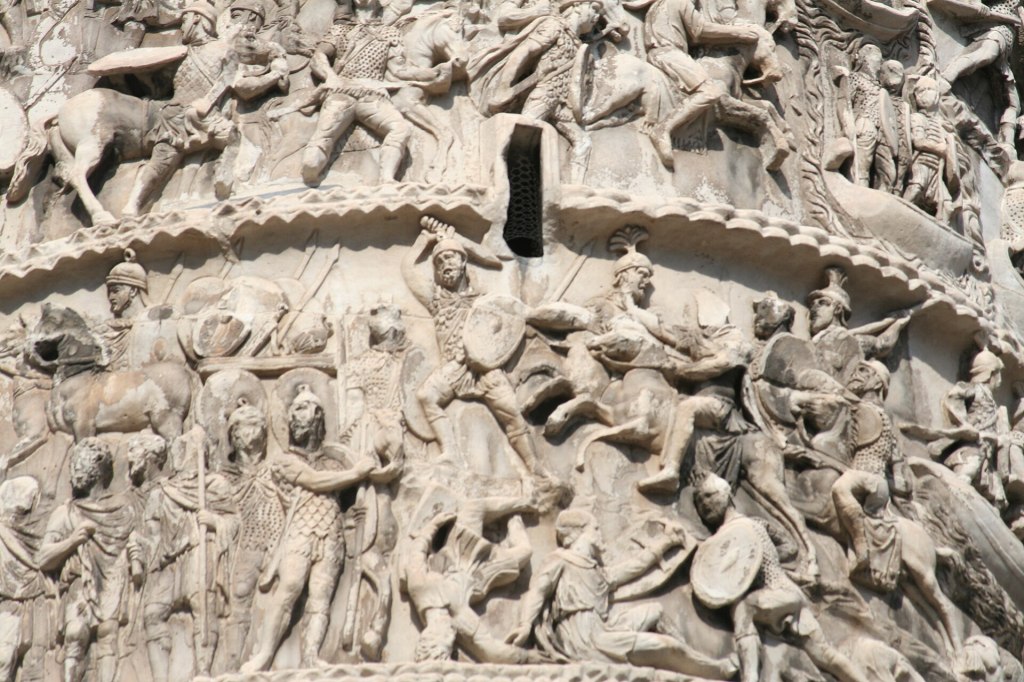
The Marcomannic Wars were a series of wars lasting from about AD 166 until 180. These wars pitted the Roman Empire against principally the Germanic Marcomanni and Quadi tribes and the Sarmatian Iazyges. There were related conflicts with several other Germanic, Sarmatian, and Gothic peoples along both sides of the whole length of the Roman Empire’s northeastern European border, the river Danube.
The struggle against the Germans and Sarmatians occupied the major part of the reign of Roman emperor Marcus Aurelius, and it was during his campaigns against them that he started writing his philosophical work Meditations.
I shot a playthrough video for the game and you can watch that at the following link:
I also followed that up with a full video review sharing my thoughts:
In the next entry in this series, we will take a look at NEST (Nuclear Emergency Support Team) from Labyrinth: The War on Terror, 2001-? from GMT Games.
-Grant

