
New Cold War is a game about geopolitics that takes place from 1989 to 2019. It begins with the disintegration of the Soviet Union and ends with the arrival of the COVID-19 pandemic. Players (from 1 to 4) take the role of the great powers fighting for the new world order: Russia, China (forming the Red Bloc), the United States and the European Union (Blue Bloc). The allied powers will have to cooperate with each other (exchange of cards, media marker…), but victory will be individual. There are two victory conditions: a power must declare two of the hidden objectives on its agenda during the game or lead the victory point score at the end of the last turn of the game. The game consists of nine turns divided into three decades with a game duration of 150-180 minutes.
New Cold War is a Card Driven Game (CDG) featuring the 135 most important events of the 30 year period covered by the game. Your power’s cards can be played as an event or as operations, while opponents’ cards and your own negative cards are played as OPS and the event is executed for or against the power to which it belongs. OPS can be played in six different ways: 1) placing or removing influence on countries on the map (based on their stability, geopolitical value and initial alignment), 2) by staging a coup d’état, 3) stabilizing or destabilizing countries to protect or favor access to them, 4) advancing on the prestige marker, 5) advancing on the media marker, either alone or in cooperation with your ally (it is a track that is contested by blocks) or 6) creating a reserve of OPS to play in later rounds or game turns.
In this series of Event Card Spoilers, we will cover several different types of cards included in the game and from the different Decade Decks and give their details so that you can understand how the game works and how it incorporates the historical narrative of the new Cold War struggle between super powers from the end of the first Cold War through 2019.


Card #25: 3rd Decade Deck – Xi Jinping
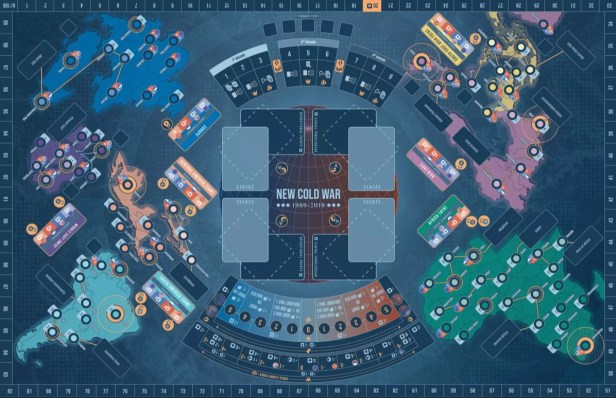
Xi Jinping is one of the five 4 Operation Point Events contained in the game, along with Maastricht Treaty, Putin, Obama and Arab Spring. They are the highest value cards and their effects cannot be avoided through the veto mechanism. Thanks to this card the Chinese player gains access to the South American region, as well as increasing their influence in Southeast Asia and Africa. This event tries to show the axis of Chinese foreign policy, which has been based on a considerable increase of its economic, diplomatic and military capabilities. Both China and the European Union will have to use this type of event to gain access to certain regions (marked on the map with a padlock token), since at the start of the game they can only influence Asia, Southeast Asia, Europe and Africa respectively. Russia and the United States, on the other hand, have access to the entire map from the beginning of the game. This asymmetric factor is of vital importance to the game play in New Cold War.
The next card up in the series will be Card #61: 1st Decade Deck – UNSC Presidency.
You can catch up on the series to date by following these links:
Card #7: 1st Decade Deck – The Tibetan Conflict
Card #105: 3rd Decade Deck – Annexation of Crimea
Card #82: 1st Decade Deck – Warsaw Pact Dissolved
Card #134: 3rd Decade Deck – Rise of the Far Right
Card #41: 2nd Decade Deck – Afghanistan and Iraq Wars
Also, if you are interested in learning more about New Cold War, you can visit the Board Game Geek game page at the following link: https://boardgamegeek.com/boardgame/405994/new-cold-war
The game is not yet ready for pre-order but should be sometime in the next several months.
-Grant
 The Players' Aid