While attending the San Diego Historical Games Convention (SDHistCon) in November 2023, we had the privilege of meeting Matthias Cramer and playing a few of his upcoming games including The Promised Land and Lenin’s Legacy, which at that time was referred to as Lenin’s Death. Lenin’s Legacy has since been picked up by GMT Games and added to their P500 pre-order system. Recently, we reached out to Matthias to see if he could share some additional insight into the design of the game and he was more than willing to accommodate our request.
*Please keep in mind that the artwork and layout of the various components shown in this interview are not yet finalized and are only for playtest purposes at this point. Also, as this game is still in development, rules and scenario details may still change prior to publication.
Grant: What is the focus of your upcoming game Lenin’s Legacy?
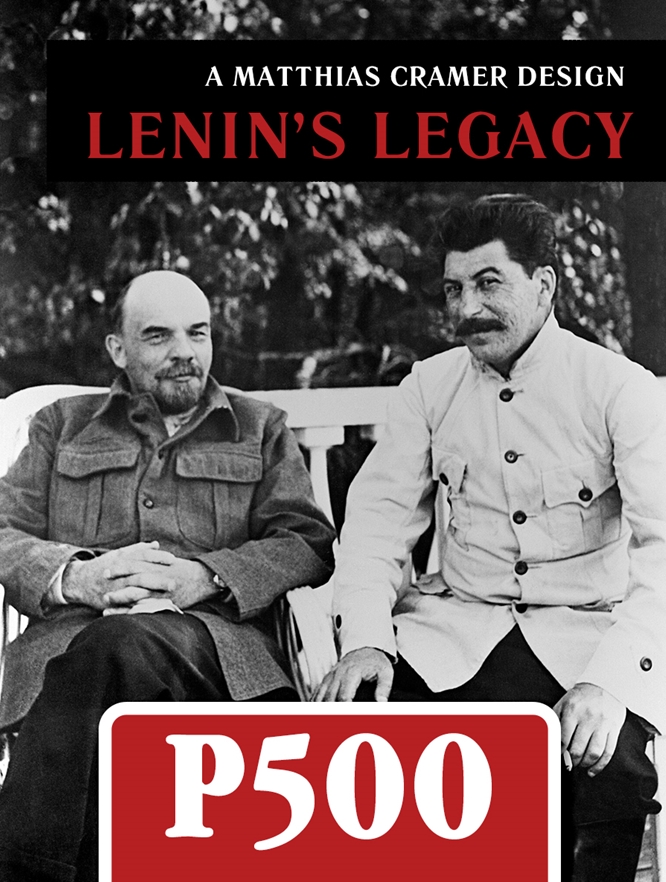
Matthias: Lenin’s Legacy is a game representing the power struggle between Stalin and Trotsky during the last two years of Lenin’s life. While Lenin’s health visibly deteriorated, the rivalry between both potential successors turned into a direct confrontation. The game has three victory conditions: control of the Army, control of the Party, or securing a place in the future history books.
Grant: Why was this a subject you wanted to make into a game?
Matthias: The early history of the USSR and the people connected to that are often idealized. In contrast, I wanted to depict the power struggle between two kleptocrats, which makes the events of the 1930’s, especially the Great Purge, easier to understand.
Grant: What is your overall design goal with the game?
Matthias: I wanted to create a game which is even more brutal than Watergate can ever be. Lenin’s Legacy is a game about threat management. You are trying to overwhelm your opponent and force them to react as you want. This creates a very interesting contest between the players and provides many opportunities for smart card play and bluffing.
Grant: How does the game use cards?
Matthias: On a first look, Lenin’s Legacy uses cards in a classical CDG approach: for either the Op Value or the printed Event. The big difference from most other CDG’s is that players draft cards from a common deck. One card is kept hidden from each player, but can still be played blind. In addition, the game has an important deck construction aspect since both players try to add their controlled regions and followers to the deck strengthening it for their benefit.
Grant: What is the concept of the common display and what do you want it to represent from history?
Matthias: The base deck covers the important events of the end of the civil war and the founding of the USSR. During that period, the Bolsheviks separated into two factions while Lenin’s influence on the party was decreasing. Around half of these cards will disappear during the game while Stalin and Trotsky are adding their own cards to modify the deck.
Grant: Why is one of those cards hidden? What type of challenge and opportunity for players does this create?
Matthias: In a late stage of the prototype, all cards were open. This sometimes led to a situation where players spent a lot of time calculating how the issues could be moved by the remaining cards. I didn’t like that, so I added some uncertainty to the design. Only 1 of 7 cards is hidden to each player, but this turned out to be sufficient enough of a change to introduce some added tension to the game and stop any calculations and analysis-paralysis.
Grant: What are the different issues that players are struggling over? Why did you choose these?
Matthias: Politburo and Region are the two issues that influence the deck composition by trying to bring your followers and controlled regions to the table. The NKVD (the predecessor of the KGB) allows you the last issue manipulation of a game round and helps to control the Army. The initiative is as important as in Watergate for having the first pick of cards, and playing one additional card each round. Lenin helps to take control of the Party and provides a veto for the following round. Together with the three powers (Army, Party and Fame), these were the key factors in the power struggle between Trotsky and Stalin.
Grant: What are Timeline Cards?
Matthias: Timeline Cards are the regular card type that the deck begins with, each consisting of an event and one or two numerical values for moving specific issues.
Grant: How do Scoring Cards function?
Matthias: Scoring possibilities are quite rare in Lenin’s Legacy and are mostly found on Region Cards. So, bringing some Scoring Cards into the deck is a huge advantage, but often comes at the cost of neglecting the issues.
Grant: What roll do the Region and Politician Cards play in the game?
Matthias: There are two versions of each Region Card. Winning the Region issue allows a player to select a Region, putting their own card from that Region into play and removing the opponent’s version from the game.
Politicians provide unique features only available for one player, for example locking an issue for the current round. Also, Stalin tries to complete his triumvirate with Kamenev and Zinoviev since it allows him to play a very powerful event.
Grant: Can you show us a few examples of these cards and explain how they work?
Matthias: You can see three example cards here. The first is a regular Timeline Card that starts in the deck, and can be used either to move the Politburo Issue two spaces (grey circle) and any other issue two spaces (white circle), or for an event that is only playable by Stalin, and only if Kamenev and Zinoviev have both been added to the deck. This event allows Stalin to move both the Party and Army control tokens one space, which is a very powerful effect as this influences two of the three victory conditions.
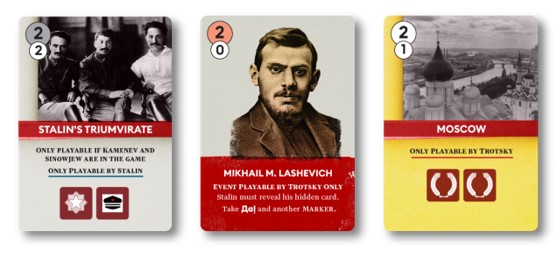
The second is a Personality, Mikhail M. Lashevich, that the Trotsky player can choose to add to the deck. The event option on this card is only playable by Trotsky, forcing the Stalin player to reveal their Hidden Card and taking the Da! Marker and another marker. Alternatively, either player may use this card to move the NKVD issue two spaces (red circle), which Stalin might choose in order to prevent Trotsky from using the event.
The final card is Trotsky’s version of the Moscow Region. If Trotsky adds this to the deck then Stalin’s version of Moscow will become unavailable (unless all other Regions have been added). It can be used to move any issue two spaces and any other issue one space, or Trotsky can use the event to move the Fame Marker two spaces. Fame determines victory at the end of the game if no other victory condition has been met, so this can be a very powerful card under the right circumstances.
Grant: What is the layout of the game board?

Matthias: You can see the prototype game board above (not final art). It consists of two tracks, one for issues and one for powers, along with a summary of the issue and power effects.
Grant: How do players move their markers up the tracks?
Matthias: Players typically move the Issue Markers by using the circled numbers of cards, or sometimes by event effects. The three power victory markers (Party, Army, Fame) are moved by some event effects and also by controlling specific issues at the end of each round.
Grant: How are the tracks scored? What effects do the various tracks provide the player who controls it?
Matthias: The Issues are scored at the end of each round, in the order they are listed on the board. The player controlling each issue gains the following bonus, in this order:
- NKVD: Move one other issue one space, then move the Army power one space.
- Politburo: Place one Politician Card on top of the deck.
- Region: Place one Region Card on top of the deck (and remove the opponent’s version of the that Region from their pool).
- Initiative: Take the Initiative pawn. If this issue is tied then the pawn is transferred to the player who does not currently have it.
- Lenin: Move the Party power one space and take the Nyet! Token.
Grant: How do players obtain the bonus markers? What benefits do these bonus markers offer?
Matthias: There are four markers in the game, which can be very powerful. For example, one marker adds 1 to the value of each card you play while another can once double the card values. Each marker can be obtained by multiple cards, so you might control the marker just for a few impulses.
Grant: How is victory achieved?
Matthias: Stalin and Trotsky can gain medals by controlling the Army while fighting a battle. Having three medals wins the game instantly. Also having the full control over the Party, which means the Party power is at 5 on your side, is the second sudden death condition. Stalin has one card allowing him to win with a Party control of 4. If both conditions do not take place, Lenin will die after some time and the player with the most Fame will be his successor.

Grant: How does the solitaire system work?
Matthias: The solitaire system uses a unique mini-deck for each solitaire opponent (Trotsky or Stalin). The opponent draws one card from this deck each turn, which will indicate what issues they move and then which regular card they discard from the display. This offers a quick and streamlined way of simulating the opponent’s card play in an unpredictable manner, without having to consider the possible effect of every available card.
Grant: Who is developing the solitaire system?
Matthias: Jason Carr, the head of GMT One (GMT’s solitaire gaming division) is developing the solitaire system. Jason has a lot of experience and passion for designing solitaire systems and will do a great job!
Grant: What play experience will the solo system create?
Matthias: The solitaire system aims to simulate the experience of playing a human opponent, without necessarily using all of the same rules. So even though the solitaire opponent plays in a different way to a human, you feel the same tension and excitement as you would in a regular game.
Grant: How long do games typically last?
Matthias: Most games take around 45 minutes, but there is a wide spread in playtime by design. Especially after Lenin’s second stroke, there is a threat that the game could end at any moment.
Grant: What kind of experience does the game create?
Matthias: I want to create a confrontation that doesn’t consist of two players hitting each other directly, but on the gradual build-up of threats over the course of the game. The players have to react to this growing menace, even if it is by building up a threat of their own.
Grant: What are you most pleased about with the design?
Matthias: I think that my favorite part of the game is the surprise in player’s faces, especially if both are thinking that they know the game well but things turn out a bit differently than they thought.
Grant: What other games are you currently designing?
Matthias: Currently, I have a finished game named The Promised Land, which covers the Israeli-Egyptian conflict between 1950 and 1978. This is a CDG covering mainly the political level of that conflict, but a single player can switch the game into a war mode to achieve objectives militarily. Towards the end of the game, one player can force their opponent to the negotiation table in Camp David. The Promised Land is a 2-player game lasting for around 3 hours.
I am also working with Maurice Suckling on a game covering Camp David, which are the most interesting peace negotiations and deserve a game on their own. This will be a 3-player game with a lunchbreak playtime.
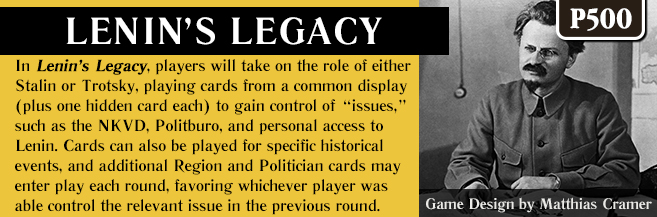
If you are interested in Lenin’s Legacy, you an pre-order a copy for $37.00 from the GMT Games website at the following link: https://www.gmtgames.com/p-1101-lenins-legacy.aspx
-Grant
 The Players' Aid