
A good solitaire game is always very much welcome on my table. I usually start these type of posts about solitaire gaming by saying I am not a solitaire gamer. Well, after playing the Leader Series from DVG for the first time about 7 years ago, that statement no longer applies. I used to really only play solitaire games when I had no other choice or available opponents. But, when I put these games on the table, my whole opinion has changed. The Leader Series is a solitaire gaming system, originally published by GMT but later republished by the designer’s own company Dan Verssen Games. The game recreates modern combat, including ground combat, air warfare and even submarine warfare and sees the player creating, managing and outfitting a group over the course of a variable length campaign. Some of the games offer individual combat systems that are included in the overall game and each handles their theater with specific rules and equipment used historically. Originally, all of the games were designed by Dan Verssen but more recently other designers have been taking up the reigns of the series.
In this entry in the Best 3 Games with… Series, I want to share my love of the series but also highlight the games that I have very much enjoyed. Now many of you have played this series, and everyone has their favorites, so just understand what appeals to you may not be as appealing to me.
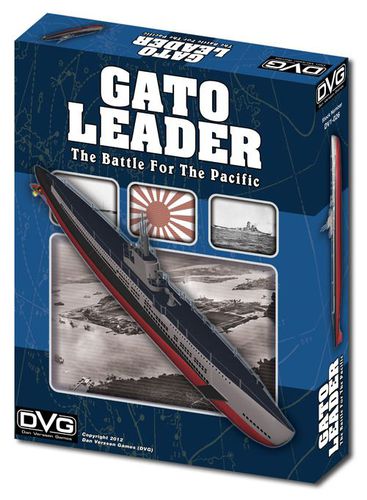
3. Gato Leader: The Battle for the Pacific from Dan Verssen Games
Gato Leader: The Battle for the Pacific is a solitaire only game in the Leader Series from DVG Games. The game focuses on the American Submarine campaign in the Pacific during World War II from 1942, shortly after the dastardly sneak attack by the Empire of Japan on Pearl Harbor, through the end of the war in 1945. Players will be placed in command of a squadron of Submarines to control over the course of a Campaign. The primary goal of each squadron commander is to sink enemy merchant ships and warships in order to meet their Victory Point goal for each chosen Campaign.
The game plays with two different maps. The first map is the Campaign Map or strategic Map as it shows the relative position of your Submarines and various Map Areas and Ports as well as transit areas and special mission boxes. The 2nd map is the Tactical Display which is drawn in the shape of a radar array that shows the location of the convoy that a Submarine has made contact with and the relative position of the Submarine and the various merchant, escort and naval ships assigned to that convoy.
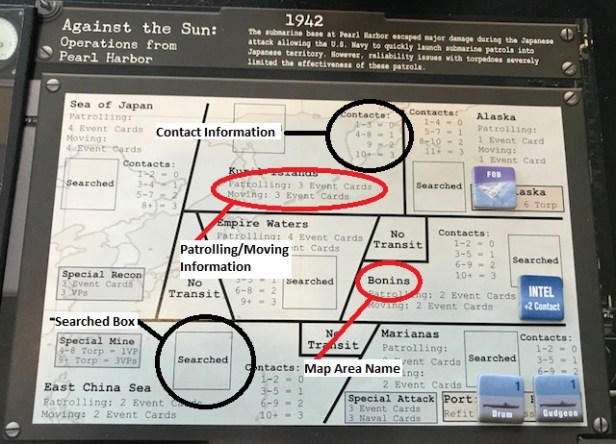
As you can see in the picture above, the Map Areas are named and contain lots of key information for game play, including the number of events that are drawn when a Submarine is moving into, through, or patrolling that Map Area, and various special mission boxes, such as Mining, Special Attack missions, Rescue and Recon missions.
The Contact information is used to determine what ships the Submarine will find while searching in the area. Contact rolls are a major part of the game and if you don’t roll well, you will not be able to find the number of ships required to meet your VP objectives. Contact is a good thing! The Contact role happens at the beginning of the Tactical Segment and is a roll of a d10 that is modified by various elements. A Submarine has to be fit for duty to make a Contact roll so if they have taken a load of Stress from the random events that are encountered while moving into a Map Space or patrolling they will be unable to make a Contact roll and will be moved to the Searched Box, effectively ending their turn. The player simply rolls a ten sided die and modifies the roll with various Contact Determination Modifiers. These Modifiers include both positive and negative numbers so you have to pay attention.
Gato Leader includes the following U.S. Navy submarine types: S Class, Narwhal Class, Permit Class, Salmon Class, Tambor/Gar Class and Gato/Balao/Tench Class. Each of these class of ships are available based on their historical years of service. So, when a player selects a Campaign, they must take out of consideration any Submarines that are not in service during that time frame.

The player then consults the Campaign Sheet to choose the length of their campaign to identify the number of Special Option (SO) Points that they will have to spend over the course of the campaign as well as what Special Options they will have to purchase before and during the Campaign. In this example, I will use the Against the Sun 1942 Short Campaign. I consult the above picture table for the Short Campaign and see that I will have to complete 1 Patrol per Submarine and I will have 32 SOs to spend during the campaign.
I first have to choose my Submarines and then outfit them with various upgrades. The first boat that I choose is the Drum commanded by Lieutenant Commander Bernard McMahon, which is a Gato Class Submarine that was in service from April 1942 through August 1945. The Campaign I chose is during 1942 so this boat qualifies. In looking over the various options of skill for the card, I choose the Veteran version which costs 12 SO Points. I then choose to upgrade the boat by adding Radar and a Torpedo Modification. The Radar will give me +1 on Contact rolls and the Torpedo Mod is very important as it will mean my torpedoes are considered to be one year later on the Torpedo Dud Table and will malfunction less. I spend a total of 15 SOs on the Drum and she will end up being my workhorse over the life of my first Campaign.

There is a lot more to this game than the simple elements I have shared with you. There is a fairly involved system of escort detection of Submarines, random movement of those escorts, as well as attacks from escorts and even merchant ships that you will have to learn to play this game. I also really like the damage system for the Submarines when they are hit by enemy ships. Each ship will be given a damage number and when that ship attacks, there are no rolls for their attack as they generally hit unless you have taken actions to avoid them such as Deep Diving or Crash Diving. When hit, you will draw a random counter from a cup and refer to either the Light Damage or Heavy Damage sides. The Light Damage is not lasting while the Heavy is and can only be removed while in Port or from certain Events. Each of these damage counters will count toward your Hull value and if you meet that value the Submarine is considered to be sunk. Evasion can be used by Submarines to reduce those counters from Heavy to Light but you still have to worry about those hits accumulating and sinking your boat.
Gato Leader: The Battle for the Pacific is a very fun and interactive game that I have played several times and still am not tired of. In fact, I am able to try different strategies each game, such as Wolfpacks, Crash Diving when I am attacked to avoid damage, and Silent Running to sneak up on those pesky escorts.
Here is a look at my video review which you can view at the following link:

2. Corsair Leader: The WWII Pacific Theater Solitaire Game from Dan Verssen Games
In case you didn’t know, I have always been fascinated with the Pacific Theater of World War II and particularly love the air naval aspect of the fighting in this theater. Corsair Leader: The WWII Pacific Theater Solitaire Game from Dan Verssen Games is a Leader Series game that focuses on the air operations of the US Navy and Marines in the Pacific Theater. As is the case with these game, the best part of the system is the deciding about which pilots and types of aircraft that you will load out for each mission involved in multiple campaigns.
One of the things that I have very much enjoyed about Corsair Leader is that there are added detailed rules for aerial Dogfighting (which is based on the Down in Flames System) and rules that allow players to also work from land based air strips or from carriers. The addition of this dogfighting aspect was truly a stroke of genius and has really added some great depth to the system and created a very new and interesting experience for veterans of the series. The dogfighting does add some time to the game but it is truly worth it as you have to make even tougher decisions about the construction of your air groups and take into account the dangers of battling the Zeroes on your way to the targets.
Also, the aircraft under your command center on the workhorse Corsair, but you also get to decide if you want to include Dauntlesses, B-25s, and B-17s as part of your group. Each aircraft has its own advantages and disadvantages and as with the other games in the series the construction of your groups is always such a fun and engaging part of the process.
The same as with the other games in the series, your chosen pilots have a range of strengths and weaknesses and choosing them is one of the most important aspects of the game. Some are fantastic dog fighters but aren’t effective at air to ground combat. Others are great all around, but are easily shaken and become less effective as your campaign grinds on. The SBD does double damage against naval targets, while the B-17 can take more damage and really shines against large targets. As you put your squadron together, you’ll have a lot to think about when picking your team. You’ll need escorts, but how many? How many SBD’s? How many level bombers? It is a balancing act and there are some tough choices to make.
Once you’ve chosen your campaign and your pilots, you will play a series of missions that vary from fighter sweeps to bombing raids deep in enemy territory. As your campaign progresses, your planes will be destroyed, your pilots will succumb to the stress of combat and your ordinance resources will dwindle, leaving you with some great challenges to overcome: For instance, your best fighter pilot might be on the verge of a nervous break down on the eve of a big fighter sweep… do you give him a day off and risk your less experienced pilots? Or perhaps you’ll find yourself confronted with a high VP bombing target… how much of your limited ordinance resources will you expend trying to destroy it with several days left to go in your campaign? These are just a few of the things you will agonize over.

The game also goes more in-depth on the tactical options you have while over target. Each turn, each aircraft can become “Offensive” which gives it an attack bonus, but also makes it easier to be attacked when it gets shot at. Likewise, aircraft can be “Defensive” which penalizes their own attacks and makes them harder to hit. “Slow” pilots can “Rush” their attack at a penalty and attack during the Fast pilot step, and “Fast” pilots can Wait and get a bonus if they attack during the Slow pilot step.
A very good entry in the series that has now spawned several other air to air combat games including Zero Leader, Stuka Leader and the upcoming Flying Tigers Leader. I think that what Chuck Seegert has tried to do here is really novel and I am glad to see that he has continued to innovated and attempt to create new experience with this system.

1. Sherman Leader: The World War II Ground Combat Solitaire Strategy Game from Dan Verssen Games
Finally, we have come to the game that I consider to be the class of the series in Sherman Leader. Sherman Leader is a solitaire only game based on ground operations during World War II that includes mixed arms including tanks, infantry and various support weapons like artillery. The player takes control of an American group of tanks, armored cars, trucks, half-tracks, anti-tank guns and infantry and is involved in various length campaigns, measured by weeks, against either the Germans in Europe or the Japanese in the Pacific. The various campaigns include North Africa 1942, Saipan in 1944, all the way through the Fall of Berlin in May 1945.
As a game that is designed as a solitaire experience, the game involves well developed AI charts and tables that decide the enemy movements and attacks, via a die roll that can be modified based on various conditions, and provide very well defined explanations of these actions. The AI is pretty simple and sometimes takes actions that make you scratch your head but it works. As someone that doesn’t play a lot of solitaire games, this one is great because it is pretty “dummy proof”. The game can be played at your own pace with each campaign involving a certain amount of weeks that play out. The setup isn’t difficult and can be done in 15-20 minutes. Weeks of the campaign can take upwards of 45-60 minutes to complete, depending on the number of enemy units you must destroy to obtain victory.
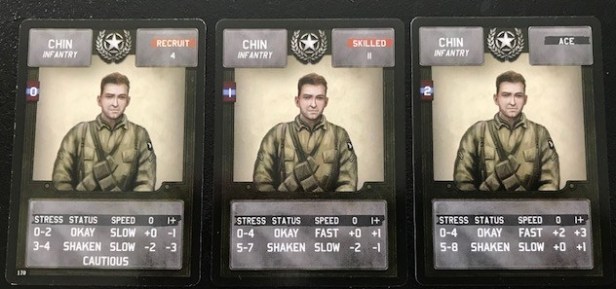
One of the really neat parts of the design is the Commander Skills. At Recruit level when the commander is new and green, he might have a skill (or several) that is negative. For example, being Cautious. This means that he cannot have his troops Move and Attack in the same round. This can be very difficult as getting in range without being able to fire upon your enemy, but opening yourself up to receive fire, is a recipe for disaster. But, with a Cautious Commander, if you don’t Move and get into range, you will never be able to make a difference. There are other skills that are very helpful and need to be developed as your Commanders level. An example is US Mechanic. This ability lets the Commander remove up to 2 Damage counters from vehicles at the end of battle. Usually, these Damage counters can only be removed with the expenditure of SO Points. So this ability is very important as it allows you to use those SO Points to repair other units, buy new units or purchase needed support chits like Scout Cars (that provide you with an additional round of combat in battle) and Trucks (which decrease the cost for you to attack enemy units on certain areas of the Operational Movement board). Sherman Leader is fun and really takes you beyond just a simple tactical wargame. It gets you into the area of building teams, outfitting those teams and managing battle effects such as Stress. Overall, a very unique take on a wargame as you are managing your forces in more areas than just combat.

The combat system is also very similar to the other Leader Series games but each does feel slightly different. One of the very best parts of the system is how damage is assessed. When a German unit is hit by an American Attack and fails it’s Defense roll, it is destroyed. When an American unit is hit by a German Attack and fails the Defense roll, the unit is not automatically destroyed but must draw a chit from the prepared wound token cup. One chit is pulled for each hit and the tokens are double sided, one side is used for hits to vehicles (denoted by a gray background) while the other side (denoted by a camo colored background) is used for Infantry hits. There are 56 of these chits and some are wounds, some are damage counters that can accumulate until a unit is unfit for combat, some have no effect and some are automatic kills, such as the dreaded Explosion for vehicles and the Mowed Down for Infantry. When these ominous chits are pulled, the unit and its Commander are KIA.
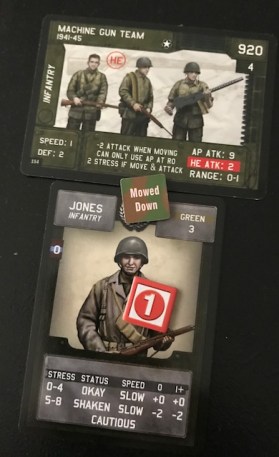
These chits are really well designed and I will cover the statistics of them when I get to my full written review later. I really like that when a chit is pulled, and it has a lasting damage effect, that it is placed on the unit or Commander card and is removed from the cup. This chit being removed then makes it more likely that you will pull one of the bad chits as the number of possible draws has been reduced. Some of these damage counters give you negative effects, such as a hit to the Gun (cannot attack at Range 2+), take out your Suspension meaning that unit cannot move in the battle or Wound your Commanders or inflict a Casualty to an Infantry unit. If they accumulate two such Wound or Casualty counters, they are eliminated from play. You can also spend SO Points at the end of weeks to repair and or replace damage or destroyed units. Great little system that can be really challenging to manage as you will find that your units will be pretty badly beaten up after a long and sustained battle against some of the German tanks, including the mighty Tiger and King Tiger.

I have played this game several times now, using both short and long campaigns, and really enjoy its systems, the structure of the AI and the management of your units and Commanders. Really engaging and enjoyable experience of ground combat in World War II. Another great entry in the Leader Series.
Here is a link to my video review for the game that you can view at the following link:
I have really enjoyed all of the games that I have played in the Leader Series from DVG. I have played B-17 Leader, Stuka Leader, Zero Leader and a little bit of both Spruance Leader and Phantom Leader, but have really been drawn to these 3 games that I shared here. I hope that you have enjoyed my look at the games in the series and if you have not yet played please find one on the subject you are interested in and give it a go. You will not be disappointed!
What are your 3 favorite Leader Series games?
-Grant
 The Players' Aid
I had both Sherman Leader and Tiger Leader.
I must say that you really need the second edition of Tiger Leader as the first one was badly designed.
I sold the Sherman version because only the Germans had Kampfgrupen (battle groups) which this game is all about.
A pity they made a few hic ups on the game maps of Tiger Leader 2nd edition too!, but that is rather trivial.
The other Leader series are not my cup of tea. I tried a few, but nothing for me I guess.
LikeLiked by 1 person
Several of the others I have not enjoyed. I am definitely a topic specific Leader Series fan focused on the different ones.
LikeLike
i have Hornet Leader, Thunderbolt Leader, and Warfighter from DVG.
the Hornet Leader and Thunderbolt leader follow a similar system. Warfighter is a card driven game.
There’s really not much player agency in any of them. Your decisions are primarily with respect to managing your resources and equipping your forces for the mission.
if you like that sort of thing these are each fine additions to your collection. But if you’ve tried similar games and been underwhelmed, you’ll find nothing new here.
LikeLike
Basically my experience with Thunderbolt Leader, which lead me to ignore the rest of the games. Just not my type of solo experience. I’d much rather play a lot of other solo games
LikeLiked by 1 person
Thunderbolt Apache Leader by far. Amazing planning and tactical experience.
I bought Gato leader as Grant has praised it before, but have yet to play it. Looks good though.
LikeLiked by 1 person
The best one? Well the one that doesn’t need to be expanded with additional expansion which cost at the end twice (or more!) the original base game. TAL is the best choice for me. I love it!
LikeLiked by 1 person
If you like the “game before the game”, great. I don’t. The original Hornet Leader and Thunderbolt/Apache Leader aren’t too bad. I got U-Boot Leader and didn’t really enjoy it. I gave away Tiger Leader.
I’d rather have limited input into my starting resources, and concentrate more on making the most of whatever I do have. I don’t want to spend time fretting over whether I’ve bought enough X, and whether that means I won’t have enough Y later.
LikeLiked by 1 person