A few years ago, we became acquainted with Andrew Rourke through his Coalitions design from PHALANX that went on to a successful crowdfunding campaign. He has since been a busy guy with starting his own publishing company called Form Square Games and also starting the first design in a new series called Limits of Glory that will take a look at the campaigns of Napoleon. In Campaign I, which is called Bonaparte’s Eastern Empire, the game is focused on the campaign of the French in Egypt between 1798 and 1801. It covers everything from the invasion fleets leaving France trying to avoid Nelson and the British Navy, to the final surrender of the remnants of the French Army to an Anglo-Ottoman force in 1801. The game is very interesting and uses some new ideas to focus on the luck and skill of commanders through a mechanic called the Glory Rating. This Glory Rating can be used as a type of currency by commanders to do several things such as reroll dice for movement or in battle. This becomes a sort of push your luck and resource management aspect and the players who more wisely use this scarce resource will find themselves victorious.
In Action Point 1, we looked at the area movement Map Board and got an understanding of the various features and also how armies navigate the hostile terrain of Egypt. In Action Point 2, we examined the Event Clock and discussed how it effects the game. In this Action Point, we will discuss the use of the Glory Rating for commanders and what it represents.
Glory Rating
In the Limits of Glory Series, each named commander, whether they are military or naval, has a Glory Rating. This Glory Rating is a concept that the designer Andrew Rourke based this system on and it involves a look at history and the abilities and victories of commanders as a combination of skill, training and forces but also including the luck factor into the equation. You know the old saying “Better to be lucky than good”. This Glory Rating is a key focus of the game and is used as a resource by the players to effect the outcome of battles through a manipulation of the die rolls.

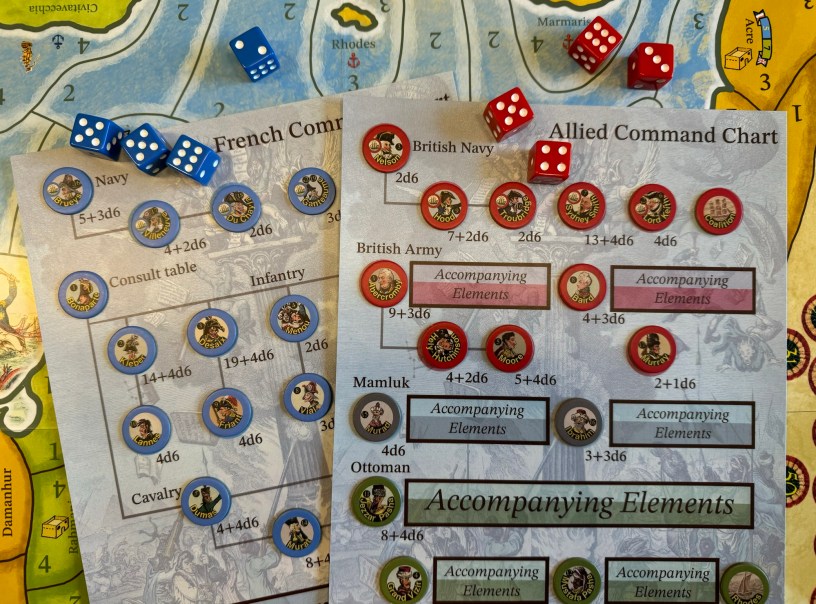
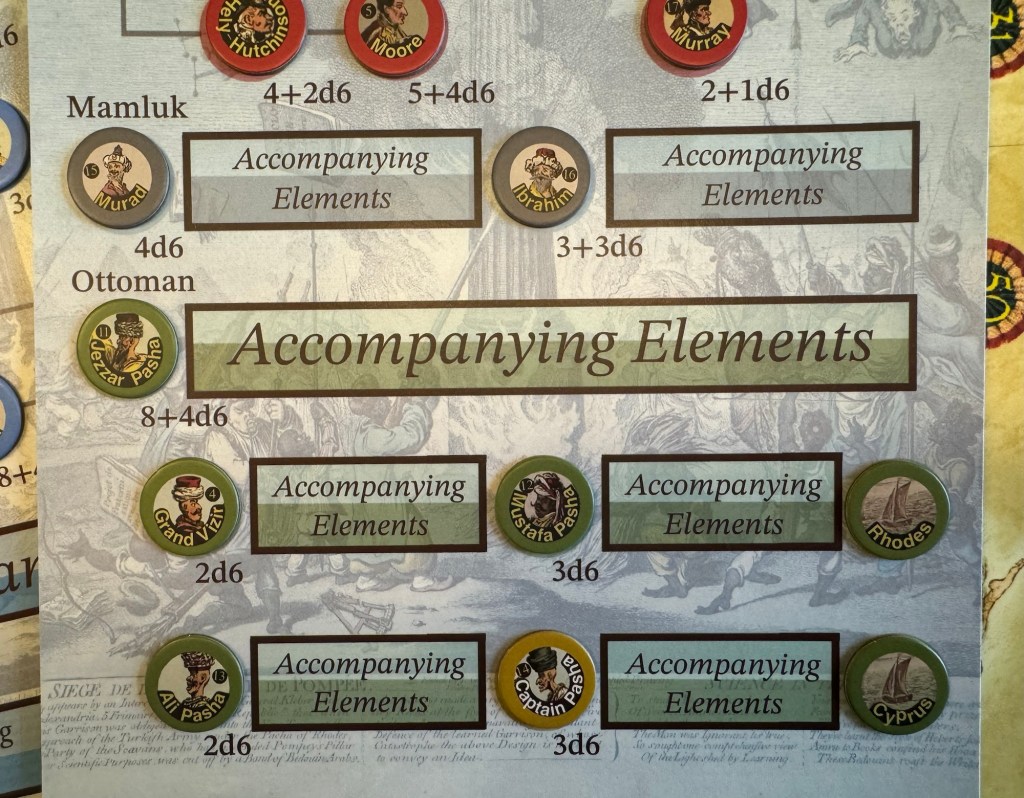
Each commander in the game has their Glory Rating established when they enter the game and after the appropriate circular Position Marker is placed out on the Map Board. The Glory Rating is expressed typically as a numeric value, which is considered the base Glory Rating, followed by a specified number of +d6 that will be rolled and then added to the base Glory Rating to calculate the commander’s Glory Rating for the entirety of the game. As you can see in the above picture, each commander is shown on their side’s Command Chart and below their name where their Position Marker is located is shown this Glory Rating formula.

The number of dice shown for the commander are then rolled and totaled and the indicated base fixed number is added together. The players then place the appropriate commander’s individual Glory Marker on the numbered track to show the result. Let’s take a look at a quick example. We will look at the Navy Commander Hood who has a base Glory Rating of 7 and then has +2d6 rolled and added to the total. The dice are rolled and result in a 3 and a 5 for a total of 8 which is then added to the base fixed Glory Rating of 7 to come up with the final Glory Rating of 14 (7 base Glory Rating +7 from 2d6 = 14). The marker is then placed on the 14 space on the numbered track.
So what is Glory used for in the game? It is a great resource to use to re-roll dice. Keep in mind that using Glory in this way represents a combination of a commander’s historical skill and how lucky they appear to have been in the campaign. As Glory is used up, a commander’s marker is moved down the number track to indicate their reduced rating. A commander’s Glory is reduced to re-roll dice during the game at the rate of one glory point per single re-roll. Any number of dice can be re-rolled once by the owning player and any successful combat dice of an opponent can be required to be re-rolled once. This was one of the parts of the design that was so very interesting. It made the process of combat very difficult for the Allied Command as they Mamluk and Ottoman commander’s Glory Ratings were very low as compared to the French and even the British values are not as goo das the French. And this isn’t necessarily surprising but once concern I had was that the rolls needed to hit for the Allies typically are much harder to come by than for the French. And I know that historically this is accurate based upon the fighting prowess and abilities of the commanders on that side but it did make for a very difficult prospect for the defense of Egypt.

I think that it is important to remember though that this Glory is a limited resource and once it is used up, there will be no more re-roll abilities remaining so it must be used wisely. Once a commander’s Glory marker reaches zero on the number track, they have used up all their available Glory and they are considered to be exhausted. The next most senior commander with any remaining Glory present in the same space will then take command and supersede the exhausted commander at the start of the next activation. If a commander becomes exhausted during an ongoing combat or siege, the next senior commander cannot use their Glory in this way to allow re-rolls in the same combat. Exhausted commanders will remain on the Map Board and may still be used to claim control of Built Up Areas (BUA’s) and allow elements to count as commanded on the combat table but no longer allow dice re-rolls.
Glory is a very interesting concept in the game and truly makes this game a very interesting experience. Being able to re-roll your own dice, but also being able to force your opponent to re-roll their dice creates some very interesting challenges to manage for both sides as this campaign for the control of Egypt and Syria unfolds. The fact that Glory is finite is a very good thing and truly makes this game a different experience from any other game on the subject I have ever played. While it was not my favorite part of the design, because I was playing as the Allies and having a great deal of trouble rolling hits anyways, when I was forced to re-roll it just about broke my spirit! But I can admit that this innovation and system is supremely interesting and somewhat gamey…but I do like it!
In Action Point 4, we will cover a few examples of movement, combat and sieges and show how they work.
-Grant
 The Players' Aid
Thanks for the really clear explanation. Really appreciate your support
LikeLiked by 1 person
No problem. Doing these is always fun as I get to relive and think about these games more as I write.
LikeLike