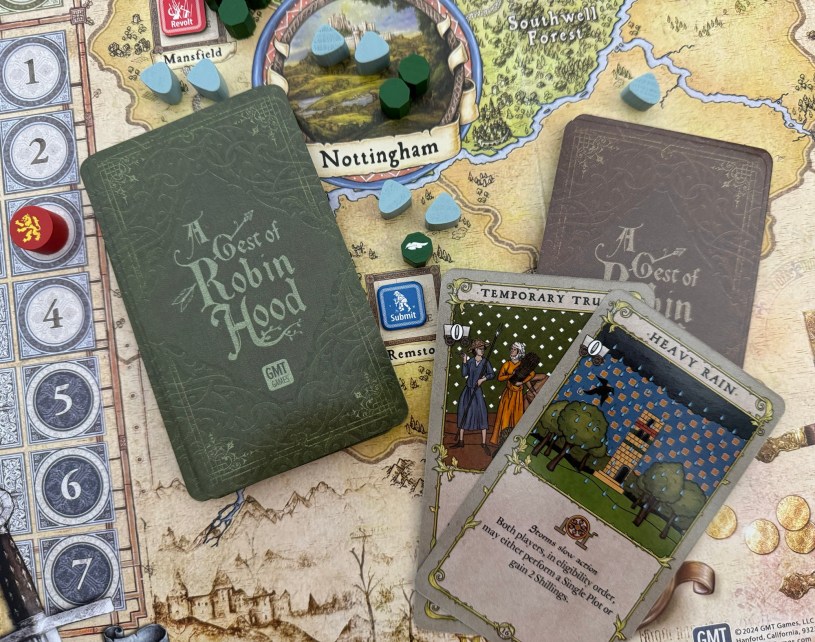
As you know, I love the COIN Series and anything associated with it. This new Irregular Conflicts Series is considered COIN adjacent and shares some of the same elements. The 2nd volume called A Gest of Robin Hood is a 2-player game that is set in the world of literature but based on actual events of the time as it covers the bandit known as Robin Hood as he patrolled the Sherwood Forest around Nottingham and attempted to relieve the evil Prince John of the money that he stole from the peasants and give it back to them. The game is very much asymmetric as each of the sides has different goals and objectives but also have different actions, called Plots & Deeds, that can be used to great effect to change the landscape of Nottinghamshire and plant the seeds of insurrection or pacify the locals and keep them paying those juicy taxes. We have played the game a few times now and have really enjoyed what is it that we are seeing and experiencing. The game is a great entry point into the world of asymmetric gaming and also teaches some of the basic principles of the COIN Series mainly focusing on the Sequence of Play, card assisted framework and diverging player sides with vastly different focus. The game is very approachable but also has a lot of meat to it and is really an interesting experience.
In Action Point 1, we took a look at the Game Board, which is absolutely stunningly beautiful yet very functional, and discussed the different areas including Prison, the Justice/Order Track and various other spaces. In Action Point 2, we investigated the 2-player Initiative (Sequence of Play) Box to understand what makes this process unique. In Action Point 3, we looked at the menu of Plots & Deeds for the Sheriff. In Action Point 4, we looked at the menu of Plots & Deeds for Robin Hood and his Merry Men and did a bit of compare and contrast. In this Action Point, we will check out the different types of cards in the game including Event Cards, Fortune Event Cards, Traveller Cards and Royal Inspection Cards.
Event Cards
In all COIN Series games, the Event Deck is essential to adding the historical flavor of the conflict and to the overall structure of the game as these card usually assist in playing the game by establishing turn order and providing 2 different events, one that favors the established government forces and one that benefits the insurgents. But with A Gest of Robin Hood, the designer has used the form of the Event Cards and the various different decks to take the system into a bit of a tangential direction. In the interview we did with Fred Serval several years ago, he said that this “was important as the mediaeval form of telling those stories was primarily oral, in the form of chanson de geste (a medieval narrative or type of epic poem that appears at the dawn of French literature), and having a very structured tempo seemed at the same time very thematic and gave players a better sense of the action economy of the game. This is why, contrary to many COIN games, a lot of the time taking the event is a good move in this game”.
So the Event Cards in A Gest of Robin Hood are more important to the game and truly make for a different experience from your typical COIN Series game. As it is 2-player, taking an event is less impactful as it doesn’t make you ineligible for the next upcoming round but simply means that you will lose the initiative and have to choose second.

The Event Cards are drawn at the start of each new round and revealed. Each turn both players will have the chance to act in eligibility order, after which the order for the next turn will be set and a new card will be drawn. Within the Event Deck there are several different types of cards that will temporarily interrupt play when they are drawn. These are the Fortune Event or Royal Inspection Cards and we will discuss each of these a bit in the rest of the post. Finally, when the King Richard’s Return card is drawn from the Event Card Deck, a final Unrest Phase will be conducted and then the game will come to an end. In the game, a set of 6 regular Event Cards and 1 Fortune Event Card as well as the end in a Royal Inspection Card is referred to as a Ballad.
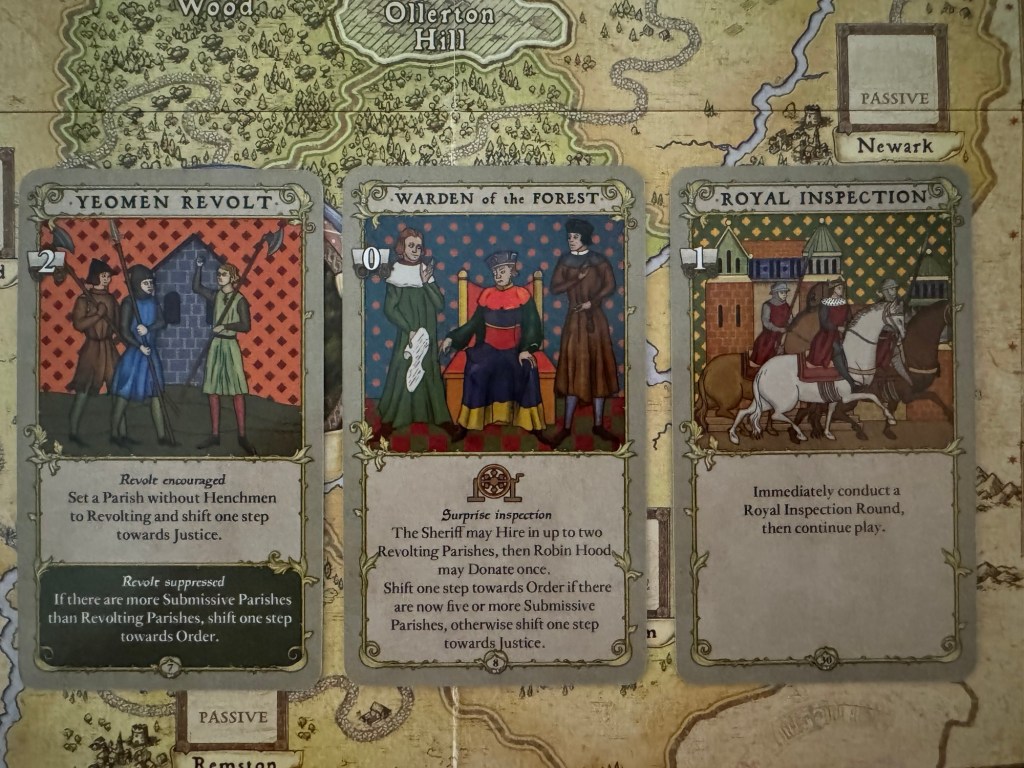
Let’s take a look at each of these types of cards.
Fortune Event Cards
Once per Ballad, which is defined as a set of 6 Regular Event Cards, 1 Fortune Event Card and a Royal Inspection Card, a Fortune Event Card will be drawn. These Fortune Events are marked with a “wheel of fortune” symbol under the illustration on the card. I guess they played bingo in the Middle Ages as that literally looks like a cranking machine I have seen used at nursing homes and community centers! At the time a Fortune Event Card is drawn, the players will execute the text of the card without changing the initiative order. Consider this a free event that just happens and gives both players some choices. Once the card has been fully executed, the next card is drawn and play will proceed. One of the key differences with Fortune Event Cards and Regular Event Cards is that there will be no Carriages moved on most of the Fortune Events. This is indicated on the cards with the 0 in the small Carriage symbol in the upper left hand corner of the cards. The exception is with the Day of Market Fortune Event, which will allow the movement of 2 Carriages when it is drawn.
There are a total of 5 Fortune Events Cards.
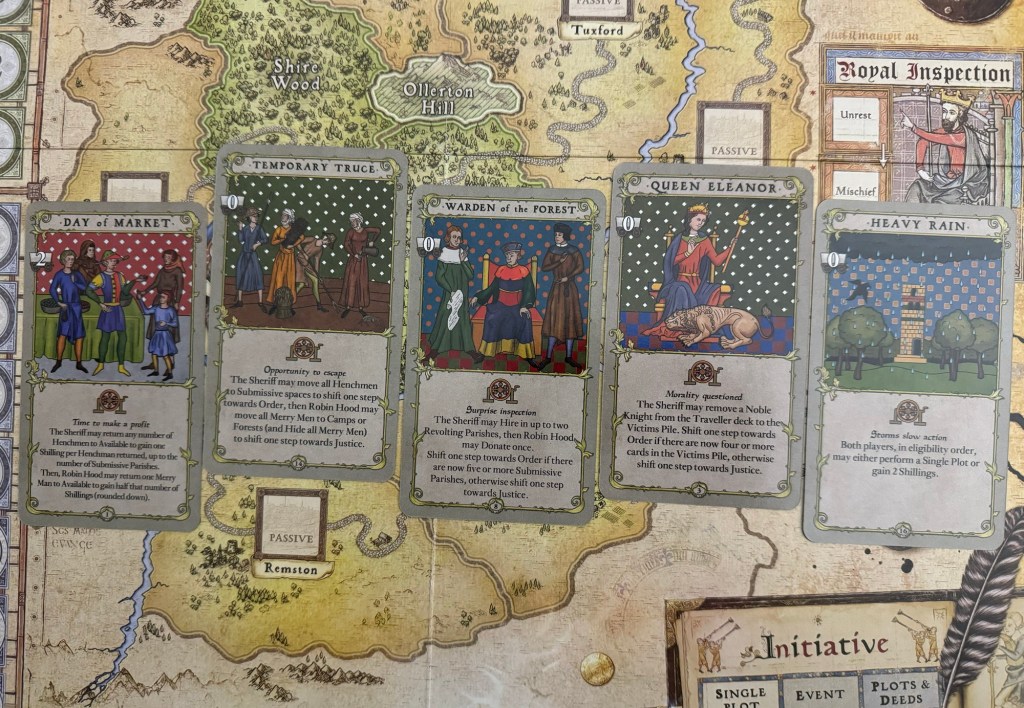
These Fortune Event Cards are typically cards that can benefit both players with a simple, yet impactful event. And the player has the choice whether they want to take the event as they typically state “may”. For example, consider Temporary Truce pictured below. The text of the card reads “The Sheriff may move all Henchmen to Submissive spaces to shift one step towards Order, then Robin Hood may move all Merry Men to Camps or Forests (and Hide all Merry Men) to shift one step towards Justice”. This card is giving players an incentive to basically vacate the spaces that their pieces are currently in, either wreaking havoc or cracking skulls, and gather in Parishes that are friendly to their efforts. The carrot here is that if this is done, the player gets a shift on the Justice/Order Track in their favor but it can be immediately undone if the opposing player takes the event. I really like this part of the game as it is a nice decision that has to be made and can make a big difference.

The other type benefit on these cards is being able to take Deeds or Plots with a twist of then being able to move the Justice/Order Track based on some sort of new state on the board, including such things as more or less Submissive vs. Revolting Parishes (see Warden of the Forest above), more than or less than a number of cards found in the Victims pile (see Queen Eleanor above), etc. I really like the variety of these Fortune Events and also enjoy that they drive home the thematic and story elements of the tale of Robin Hood.
Traveller Cards
The Travellers Deck consists of 12 cards, 10 in the base deck and 2 that can be added via Event Cards. When the Robin Hood player decides to do a Rob Plot, they can either decide to target a carriage, if one is present in the space, or a traveler from the Travellers Deck. In the latter case they will reveal the card at the top of the Travelers Deck and that will be the target of their attempt. Remember, Robin Hood was famous for robbing from the rich to give to the poor and I very much enjoyed this addition to the game as it captures this element perfectly. 2 different options of cards are available to the Merrymen; 1 which is a nice one where they rob someone who can afford to be robbed, and another one that is not as nice as these are more innocents caught in the crossfire. Once the card is drawn the process is the same as the regular Rob Plot where a die is rolled and strengths are compared. If the dice roll plus the number of revealed Merry Men is higher than the strength of the traveler plus the number of Henchmen present, then the Rob will be successful. The same as in the case of a Rob Plot, there are 2 different dice depending on if the Rob occurs in a favorable space consisting of a forest or revolting parishes or not meaning in submissive parishes or Nottingham.
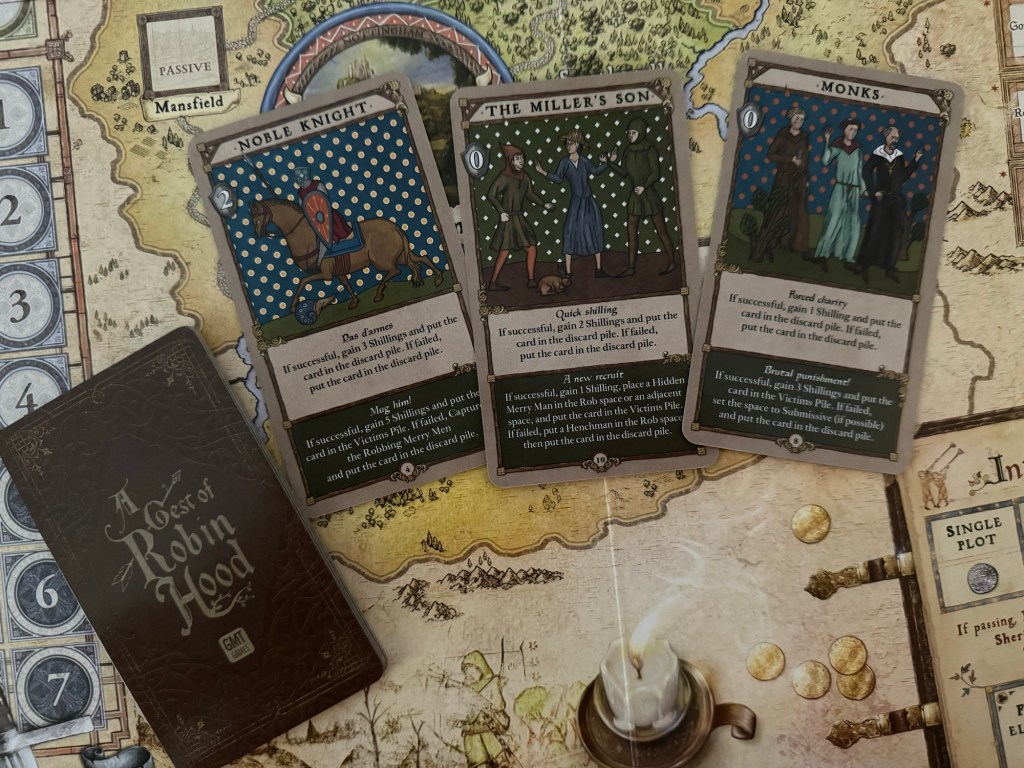
As you can see, there is a Defense Value found in the upper left hand side of the card inside a shield. This is the base value that must be overcome. If there are Henchmen there as well in the space their number will be added to the Defense Value. The Traveller Cards are a great way to earn money when there are no carriages about as they each give 2-5 Shillings and there are always 2 options as mentioned before. Sometimes the victims will be discarded but sometimes these cards will be placed in a Victims Pile and there are other Event Cards that will play off of them.
There are a total of 12 Traveller Cards with several of the cards that repeat including 2 copies of Rich Merchant, 3 copies of Monks and 2 copies of Noble Knight.
Royal Inspection Cards
The Royal Inspection Cards act as the mechanism that will bring an end to a Ballad. When a Royal Inspection card is drawn, or King Richard’s Return at the end of the final Ballad, the players will move one Carriage as indicated by the Carriage symbol on the card and then will move to conduct
a Royal Inspection Round. These cards are very similar to the COUP Cards in COIN Series games and have no other benefit or purpose in the game. I will say that the art on these is pretty nice and I love the accent colors and symbols in the background. But that is about all that I can say about these Inspection Cards.
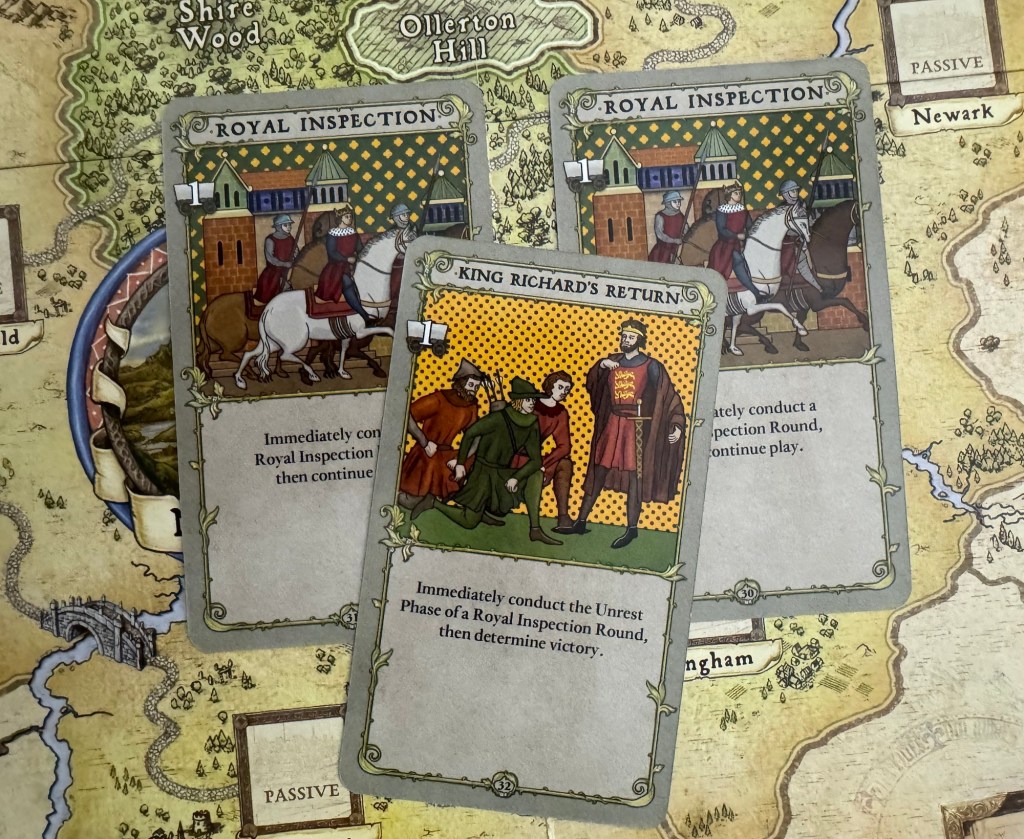
There are a total of 2 regular Royal Inspection Cards and 1 King Richard’s Return.
Regular Event Cards
We have already covered the basic rules and mechanics of the Regular Event Cards so I will show you a few examples so you can know what to expect from them.
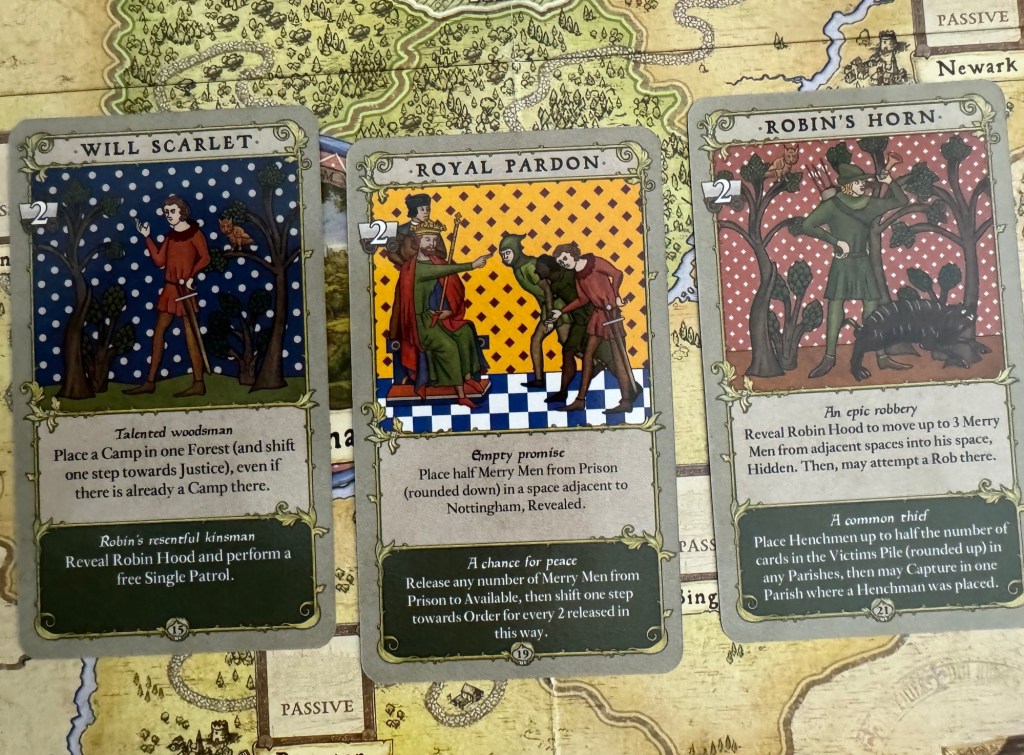
In the picture below, we see Will Scarlet, Royal Pardon and Robin’s Horn, which are 3 unique Event Cards. Will Scarlet allows the Merry Men to place a Camp in a Forest and also shift one level towards Justice. The real power in this event for Robin Hood is that this card allows 2 Camps to exist in the same space, which is normally not allowed. The bottom half of the event allows the Sheriff to reveal Robin Hood and then perform a free Patrol Plot. Free is always good for both sides!
Royal Pardon is also interesting as it allows Robin Hood to get some of his arrested Merry Men from Prison and place them in a space next to Nottingham revealed. They will be vulnerable to arrest if they do not move and hide before the Sheriff can muster his Henchmen to send them back to the dungeon. The bottom half of the event is a bit of a mind twister as it allows the Sheriff to release Merry Men from prison but grants the benefit of shifting the Order/Justice marker by 1 space for every 2 Merry Men released. This is seen as a magnanimous act by the people and they are more willing to bow under the heel of Prince John.
Ambush is a very powerful card for both factions as the top event allows Robin to move any number of Merry me to a space (notice it doesn’t say it has to be adjacent) and then they Rob that Carriage. While the bottom half of the event allows the Sheriff to reveal all Merry Men in Forests and then gain an advantage on the Order/Justice track in his favor.
You will notice that many of the events give very powerful effects, partly because they can be done out of order, or with ignoring certain limitations, and also give benefits in the tug of war over Order/Justice. Also, remember that events do not make you ineligible but will typically force a change in the initiative and who will go first on the next card.

There are 24 Regular Event Cards. I wanted to also give you a break down of the number of Carriages which can be moved by each as follows:
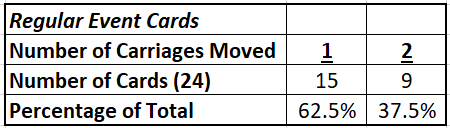
It is important to understand the makeup of the various Event Cards, including their possible effects, how they effect the Carriages in the game (more important for the Sheriff) and also which events give the best bonuses. Remember, that in COIN Series games and in Irregular Conflicts Series games, the Events can be somewhat fool’s gold. What I mean by this is that you cannot simply take every single event and hope to do well but have to analyze the situation and board state, playing the Initiative game and understanding what you are trying to do and more importantly how you are trying to do that, and then make a decision when each card is pulled based on what you are trying to accomplish that Ballad. The events are key to the design but how best to use them is up to you!
In Action Point 6, which is the conclusion to this series, we will take a look at some points of strategy that will help you get into the game and give you some guidance on how you should attack your opponent.
If you are interested, you can read our interview with designer Fred Serval at the following link: https://theplayersaid.com/2022/11/21/interview-with-fred-serval-designer-of-a-gest-of-robin-hood-insurrection-in-nottinghamshire-from-gmt-games/
-Grant
 The Players' Aid