Who doesn’t love a good challenge? A game that causes you to struggle and feel the difficulty of the task before you. And also offers a bit of insight into the historical event. One of the things that I love most about Cooperative Games is that, more often than not, they are designed as a really challenging experience. In fact, we often say in our group, a good Cooperative Game must be difficult and if it is too easy then it is not a good one. You see if you win too easily or even on the very first play, the mystique of the game is shattered and you don’t necessarily fear or respect the game as much as you did. Also, its kind of like winning the Super Bowl. Once you have climbed that mountain, the desire and urgency to do it again lessens and your effort and desire suffers. But I also like the element of teamwork in these Cooperative Games. Thinking through the best course of action, providing support to other players, helping them out to help out the group and discussions of strategy and tactics. Always great fun and creates an atmosphere of cooperation.
This past weekend, we had the pleasure of playing a new historical cooperative game called War Story: Occupied France from Osprey Games. We didn’t only play it but we had the chance to play it with one of the designers David Thompson. He partnered with Dave Neale on this game and it mixes a lot of great elements into a very smooth playing and interesting experience. War Story: Occupied France is a cooperative narrative game for 1-6 players set in World War II occupied France. The game is a scenario based endeavor where the players take on the roles of covert operatives from the Special Operations Executive (SOE), which is a British organization formed in 1940 to conduct espionage, sabotage, and reconnaissance in German-occupied Europe, to aid local resistance movements during World War II. The game merges narrative driven decisions that the players will have to make along with the management of resources and equipment all against the backdrop of a mission that has limited time to be completed before it grows too late to gain the objectives identified. The game was a fantastic experience and we really had a great time playing. In this post, I want to share my first impression thoughts after playing the 1st scenario through to conclusion. *Beware as there are mild spoilers contained in this post.

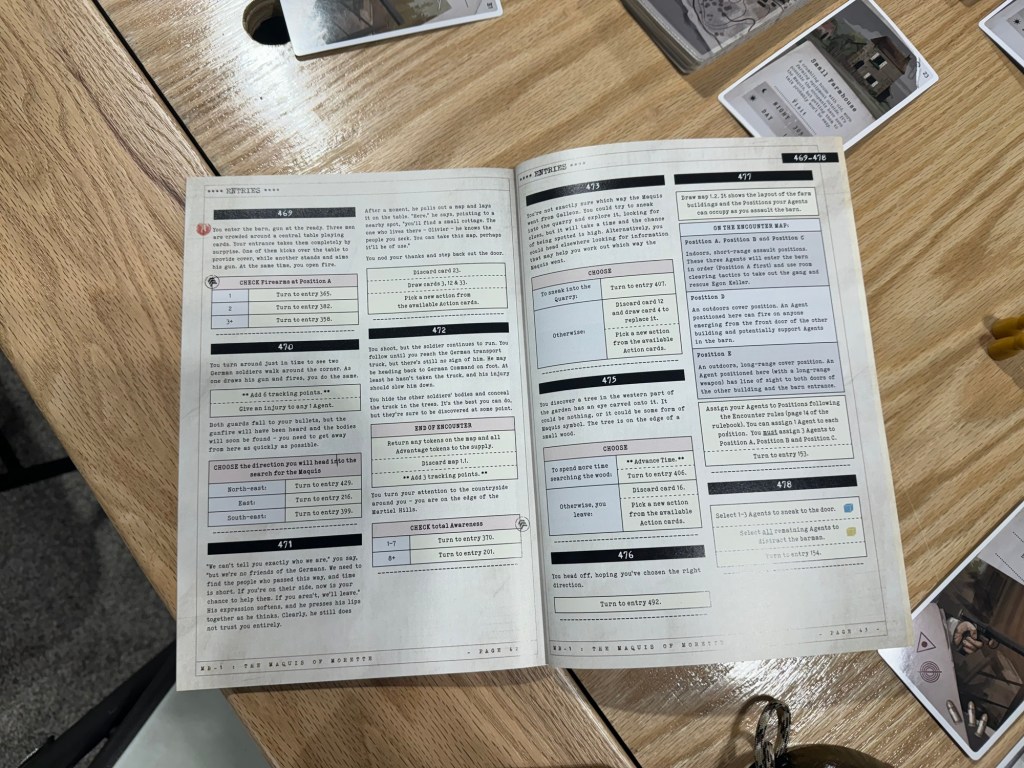
The game has no board and relies on smaller components such as maps, dossiers, orders and cards to draw out the narrative of each of the 3 scenarios included in the box. Each scenario has a fully fleshed out narrative that is driven by the players and their choices and uses a narrative booklet with well over 500 written encounters for each scenario. Players will simply make a choice, read a paragraph from the booklet, sometimes being asked to pass a test using their character’s skills and then being directed to another entry in the book where they will find out what happens and how it effects their ongoing mission. The simplicity of the system is that there are no dice to roll and you simply use the Attribute number shown on the character’s card to determine what entry you then move onto. The Attributes shown on each character card include Awareness, Influence, Stealth and Technical and they also have a Firearms Skill shown at the top of the Attributes. These Attributes range from 1-3, with 1 being basic and a 3 being considered advanced.

For example, a test might ask you to add up the total values of all character’s Influence Attributes and then compare that number to the 2 or 3 ranges of results listed to determine what paragraph to go to. The ranges might be 2 or less, 3-5 or 6+ and each of these will point the character to a paragraph to find and then read to find out what happens. We found that the low band of results is typically not great, as you either are spotted, don’t observe enemy movements, or upset those you are interacting with, while the middle band is a mixed bag with some good and some bad but the high end is almost always good. If your Attributes just aren’t great because of the Agents you chose, you can use your limited amount of Skill Tokens, Firearms Tokens or Advantage Tokens to increase your Attribute total to potentially achieve a higher band of results. But you only have a few of these and you will have somewhere between 30-40 different encounters and Checks throughout a game so you have to use them judiciously for those Checks that really matter. Now, after saying that I would say that every test matters but some seem to matter more as you are looking for a key piece of information or need to win over a contact to help you with something. And knowing when those are the key moments is a part of the mystery of the game but we found that after playing for a while we could feel something’s import. The management of these resources and the way these Checks come are just really well done and feel genuine historically as well as very thematic and interesting.
I will try to give a simple example of what I am trying to talk about. Early on in our scenario, we came to an area where there was a grouping of a few important buildings, including a few farmhouses and a suspected German listening post. As we were reading the paragraph, they described each of the buildings and I immediately caught onto something that seemed to be very important about the upkeep and look of the 2 farmhouses. I went with my hunch and we decided to approach the poorer maintained and less fancy of the 2 as we thought that maybe the farmer that was doing better, at least outwardly, was probably not going to be friendly and possibly even was a collaborator. This paid off and we had a key discovery at that time that lead us to the next step in our search for the hidden Maquis base. But, later on we returned to the uppity farmhouse only to find that they had left and the place looked like it had been ransacked. Maybe by the Maquis as retribution or by the neighbor who was emboldened by our visit and support of the Maquis. That leads me to another very interesting concept about this game…that of timing and how the passage of time will change the outcome of certain encounters.

The game is about trying to accomplish the most that you can toward finding out the hidden parts of the scenario you are playing. The world building and ecology here in this game is fantastic and very well done as an early encounter at the same location will be totally different if you visit that later on in the game. How did they accomplish this? Well, that is where Dave Neale and his writing talents came into play (now I know that David also had a lot to do with this as well). When they laid out the scenarios, they used a decision platform to literally plan out how the various parts and pieces of each of the encounters would work together and even separately. This took hundreds and hundreds of hours of copy editing, critical reading and thorough review to ensure that each part of the over 500 entries in these scenarios made sense and worked together in real time. I will refer to my DM experience here as when I put a dungeon or session together for my players in D&D, Pathfinder or any other number of roleplaying games, I always try to envision and consider how the occupants of the dungeon, castle, outpost or city will interact with the characters and also how they will react to stimulus created by the actions and decisions of the party that I am guiding through the dungeon. When they kill the inhabitants of a room and then they move on, who might wander in to discover the grisly scene and how will this knowledge of intruders change the actions that the other denizens of the dungeon will take? Will they prepare themselves for the marauding invaders by building defenses, setting traps, or even leaving an area of the dungeon to recruit other defenders? The same thing has been focused on in these scenarios and it really creates a very interesting and living interaction with this fictional situation in an historical setting and really is one of the best parts of the game. One other point about the Action Cards that used in relation to the passing of time. Each of the cards has two choices of where to go in the scenario booklet when the players interact with the location based on whether it is day time or night time. Time is tracked in the game and will progress as the players go through the different locations and search for these clues and contacts.
The game has a very limited number of components and really can be played almost anywhere with a very small footprint required. The Action Cards are drawn to determine locations and are each given a number that will be referred to specifically in the scenarios. This means that some of the locations contained in the Action Card Deck will not appear in every scenario but the deck of cards is used in all 3 of the scenarios and there will be some overlap but the setup and encounter with each will be tweaked and modified to fit the scenario.

Another interesting part of the game and how it works together is the concept of Tracking Points. Tracking Points represent the extent that the players actions and encounters alert or give information to the German Command about your team’s presence in the area. The higher that your Tracking Points get, the more German resources that will be mobilized in the area to respond to your presence. These Tracking Points will be recorded on the Team Sheet in the relevant box, and will start out at 0 but will increase with each encounter. We found that things like firing guns raised this alert level, riling up contacts would lead to this level increasing, etc. As a rough guide, 5 points
means that the enemy are aware of your activities and 10 points means that they are dedicating considerable resources to hunting you down. This effects the game at certain points during a scenario as players will be instructed to do specific things based on the number of Tracking Points that have been accumulated.
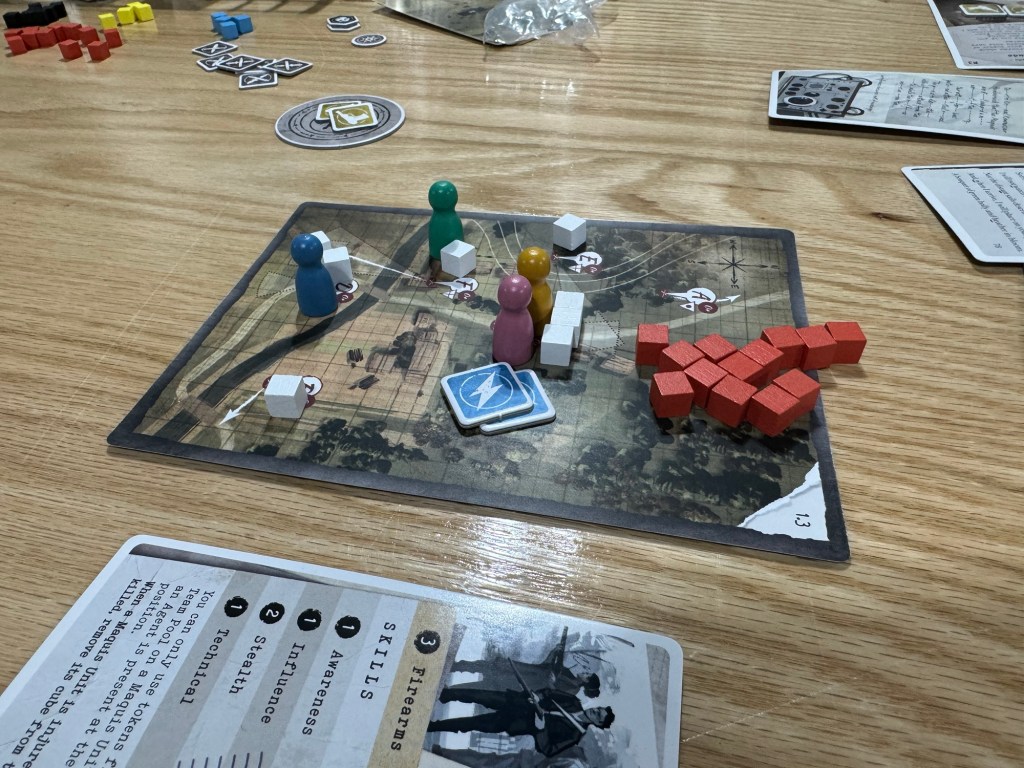
Combat is involved in the game at certain points and typically you will find yourself in strategic positions with few allies and resources and a host of German soldiers (represented by orange wooden cubes) bearing down on you with vehicles, MG’s and other heavy weapons and you will have to make the correct decisions about where to place your limited forces and with which Agents. The combat is a very simple process and typically revolves around the amount of Firearms totals the players can accumulate at a given point. Players will normally have the rifle and concussion grenade, but may acquire more Equipment during a mission that can aid in combat or any other tasks. All Agents have a Welrod pistol, which is a Silenced Short-Ranged weapon. An Agent always has the option of using their Welrod, whether or not they have been allocated other Equipment. Checks during Encounters may ask you to check Long-Range Firearms and in this case, an Agent cannot contribute their Firearms value to the Check unless they are equipped with a Long-Range weapon like a rifle. Combat is adjudicated by adding up all of the Firearms values of all Agents and Maquis as well as any used Tokens and then a scale is used to determine the number of hits. For example, a combat might say for every 5 Firearms value remove 1 enemy unit (cube). Players might be able to get to 10-15 fairly easily but will have to work hard to get to a total of 20 or more. You will never really be able to kill all of the German units arrayed against you as they are trained and battleworn soldiers and you are simply covert agents with limited weapons and training and are not there to fight it out. But, sometimes all you have to do is survive and hold the enemy off while an element of a larger plan is unleashed or you can lead them into a minefield or traps you have laid with Teller mines or into the field of fire for snipers, etc. There are always choices with combat and you will have to be cagey and smart to survive these encounters.

The best part of the game though is the thematic immersion provided by the fantastic components. There are 3 different scenarios in the game and you have 3 different sealed envelopes that you will be directed to open at the start of a mission. This envelope will include a short description and setting for the mission in the form of a letter from your commander, your goals and objectives laid out, a list of any assets you have access to including weapons, transport, communications, contacts, etc. and sometimes (we didn’t experience this in our play) special cards representing new contacts, new Agents, new equipment, etc. The look and feel of all the components is just so well done to create some fantastic backdrop for the game and really helps the players to get into the game from the outset.
We had a blast with our play of Scenario 1. We succeeded but barely as we almost got overwhelmed and failed out mission. We wasted too much time on branches that weren’t important and ultimately delayed our arrival at the point where we would move the story ahead. This delay hurt us as we didn’t have enough time to do as much preparation as we would have liked as we could have done 3 specific things to prepare and only had time to do 1. This one preparation was impactful and saved our bacon but we could have done so much better. But that is another great thing about the design. While you may have defeated or even lost the scenario, you can actually go back and play it again but make different choices. An example of this is shown in the below picture of a map of the area that you are conducting your operation in. You have a choice at the outset to insert your Agents via either a boat or by paradrop and each of these will have its own advantages and challenges but will change how the game works. We chose the paradrop insertion and as such missed all of the 4 different locations with encounters located in the village. We could go back and play it again and take the scenic route to the mission and see how that changes things. There is replayabilty here and you will be able to play each of the scenarios 4 or even 5 times without having to encounter the same things.

We really had a great time with War Story: Occupied France and cannot wait to get back at it in the near future with Scenario 2. I hope that this volume does well because that will most likely determine if there will be future volumes. So, good luck and God speed as you get this game and take it out for a spin. I hope that you enjoy the beauty of the design and have a great experience.
-Grant
 The Players' Aid