
A few months ago, MMP announced a new game on pre-order called Reluctant Friends, Bitter Enemies: The Battle for Sicily, 1943 designed by Ken Dunn. The game is being marketed as a 2-3 player game as different players can control one of the two Allied factions; either the Americans or the Commonwealth Forces. I was immediately interested as I love these type of multi-player wargames and reached out to the designer Ken Dunn to see if he could answer some of our questions. He was interested and I appreciate his efforts.
If you are interested in Reluctant Friends, Bitter Enemies: The Battle for Sicily, 1943, you can pre-order a copy for $75.00 from the Multi-Man Publishing website at the following link: https://mmpgamers.com/reluctant-friends-bitter-enemies-the-battle-for-sicily-1943-p-399
*Keep in mind that the design is still undergoing playtesting and development and that any details or component pictures shared in this interview may change prior to final publication as they enter the art department. No graphic shared is considered final art yet.
Grant: First off Ken please tell us a little about yourself. What are your hobbies? What’s your day job?
Ken: Pretty standard stuff really. Born in Tulsa but grew up in Fairfax County, Virginia outside of Washington, DC. My father worked for the federal government. I started college at a small school in Virginia (all male) called Hampden-Sydney but it wasn’t a good fit so I transferred to Oklahoma State University where I finished college. Got a job back in the DC area working for a civil engineering company and have been there ever since. Got married to a wonderful woman from Chile and we have 3 adult sons and now have 3.95 grandchildren (one is very close to joining us on planet Earth). Been playing games since I was about 12. The first game I received was a Christmas present. It was Panzer Leader. The back cover just drew me in and I was hooked. I‘ve been working with the guys at MMP for about 20+ years now just having fun mostly designing and playtesting lots of Advanced Squad Leader based products.
Grant: What motivated you to break into game design? What have you enjoyed most about the experience thus far?
Ken: I play a lot of Advanced Squad Leader. While playing ASL, I got involved with the crew at MMP and began through that relationship to see and understand the design process and naturally applied that to ASL. I have quite a few ASL or ASLSK (Starter Kit) products released into the wild as a result. Certainly, this game is not ASL I have not been nearly as prolific in other systems as with my ASL efforts. I don’t consider myself a designer really though, mostly I just tinker with existing design engines and tweak them to fit my chosen subject matter.
Grant: Where did your start to design come? How has your design process evolved over the years from your start?
Ken: It first came with ASL scenario design. I managed to get a few scenarios published as part of a larger ASL product and then it grew to doing standalone products to the entire currently existing ASLSK effort. Oddly, my process has not really evolved. Its a grind sometimes but its pretty comfortable to me so I don’t feel the need to evolve. Its starts with a decision about the game engine, then what motif or historical event. I draw the map (my civil engineering background helps there), then deign the OB and rules set and then test and test and test, then revise and test again. Then get others to test. Lots of testing and revising! Pretty simple formula really.

Grant: What is your upcoming game Reluctant Friends, Bitter Enemies about?
Ken: It is about the Battle for Sicily in 1943 during World War II between the Axis and the Allies. At the time, and this was around 2009, I was playing a lot of Card Driven Games, which are a lot fun. A good friend of mine Gary Phillips made an off hand remark about how the Americans and the Commonwealth forces disliked each other about as much as they did the Axis troops at that point, just mostly due to the personalities involved. I thought I could use that to do something unique by pitting the Allies against each other just as much as they are against the Axis. Not with outright combat obviously, but there were plenty of sly things done to advance one side or the other that I thought translated well into a passive-aggressive approach for two of the players (the Americans and the Commonwealth players) while they also try to outgun the Germans and Italian troops. The Axis player also has to struggle to decide against who he needs to defend because he can’t defend everywhere. The Axis player has to hope that the Allies get caught up messing with each other enough so that he can pull out a victory.
Grant: What was your intention with the game title?
Ken: It’s an attempt to reference the definitely bitter fighting on the island between the Axis and Allied troops, there was also an air of distrust or perhaps jealousy between the Commonwealth and Americans. Plus, the title I was originally going to use, Danger Forward, was really suited towards the intent of the game and worked better with one of the late Dean Essig’s upcoming titles.
Grant: Why was this a subject that drew your interest?
Ken: I’ve always thought the Battle of Sicily was really interesting. Its got a lot of punch inside a 30-40 day battle. That and the dynamics between the Allies that I have already mentioned truly create an interesting situation that will make for a good game.
Grant: What is your design goal with the game?
Ken: My only real goal was to design a game that was entertaining and taught a bit of the history of the campaign. The cards as I’ve designed them have historical tidbits I found interesting included and the players will learn as they play out the game.
I will also admit that I would be thrilled if people liked the game to play it more than once or twice.

Grant: What sources did you consult to get the historical details correct?
Ken: Lots of them, but just to name a few, common ones like the US Army green books Sicily and the Surrender of Italy and Osprey’s Sicily 1943 (which I absolutely love) to perhaps more esoteric ones (at least to an American audience) such as The Battle of Sicily by von Stauffanberg and (the creatively titled) Sicily by Hugh Pond. Also, an Italian language book on the Battle of Gela which I cannot find at the moment! Anyway the point is I tried to use resources written by all sides to get a broader view and perspective on the battle to improve my understanding of the situation and the constraints on both sides.
Grant: What elements from the Sicily and the Italian Campaign of WWII did you need to model in the design?
Ken: Well certainly the low-key animosity of the overall Allied command towards each other. I wouldn’t call it active dislike but certainly everyone was trying to advance their own career and defending against real or inferred slights from the other towards himself. I also tried to capture the perceived fighting qualities. One of the reasons I think I find the Battle of Sicily and in particular the Battle of Gela so fascinating is that the standard trope of the “Italians are bad, the Germans are awesome, and the Allies are mediocre” is so ingrained in us that when it doesn’t go that way we find ourselves in disbelief. That did happen often in Sicily and can happen in this game. Its easy in this game for the German player to turn in a bad performance, the Italian to defend resolutely, or the American and British troops doing both.
Grant: I see where the game is advertised as a 2-3 player game. How does this work with the playable sides being divided up?
Ken: In the 3-player game, the players take either the Americans, the Commonwealth or the Axis (playing both Italian and German). In the 2-player game its much more ‘standard” with one side as the Allies and one side as the Axis.
Grant: What is the scale of the game? Force structure of the units?
Ken: It’s a point to point game so the scale is generally immaterial for distance. The units are termed Large Combat units (typically regiments) or Small Combat units (typically battalions)
Grant: What is the general Sequence of Play?
Ken: Draw Card Phase, Action Phase, Attrition, Victory, Replacement, End Turn.
So draw the cards which are then available to be used to create actions including combat, checking of supply and to see if a win has occurred.
Grant: What is the Invasion Turn and how is it different than other phases?
Ken: The Invasion Turn is meant to simulate the first few hours of the invasion and abstracts a bit the landings themselves. The Allies were ashore rather quickly. The normal game turns last a few days and so this shorter turn allows the Allies to get ashore without expending a normal scale turn.
Grant: Why is there a bid at the start of the Action Phase? What does this represent from history?
Ken: The bid simulates the lack of communication between the two Allied nations and the underlying competition that I have already referenced. This type of situation really undermined the joint efforts and caused many issues with coordinating, supply and continued momentum in the battle. The bid also throws a bit of gaminess into the situation with allowing the Axis player to disrupt plans with a preemptive attack.
Grant: How does the player activate their units?
Ken: The active player has a variable number of Ops Points represented on the card played. They may spend that many Ops points to activate Areas on the board and therefore the units located within them for either Move or Attack.
Grant: How are strategy cards used in the design. What different type of cards are there?
Ken: Strategy cards are used in multiple ways and the decision on how to use them is in the hands of the player. The cards may be used to provide Ops Points (points used to activate spaces as mentioned previously), as an Event, or for Reinforcement Points to bring on and move reinforcements to the front. They are also used as a bid number to determine who moves first each turn.
Grant: Can you share a few examples with us and explain their use?
Ken: Any of the cards can be used multiple ways but looking at one example titled “Left Fork, Right Fork”. Historically, Montgomery landed and was driving up a road when a Messerschmidt almost gunned him down. He escaped when his driver managed to take a fork in the road that lead to safety. This card has 4 Ops Points, which is a valuable card allowing the Axis player to activate 4 different spaces, and considering he has to fight both the Americans and the Commonwealth it’s a card that allows a great deal of operational flexibility. If he plays it for the Ops he gets to place the card in the discard pile but he gets to keep a 4 Point card which might show up again in a later card draw. The card is also worth 3 Replacement Points, given the nature of the casualties the Axis player is likely to take and the cost of replacement units, 3 is a good number. However, the event allows the Axis player to roll a single die. On a 1-3 the Commonwealth player loses a Victory Point while on a 1, the Commonwealth player also suffers a -1 to every combat die roll he makes for the rest of the game. But the card is then removed form the game if he chooses to use the printed Event.
Grant: What different type of events are included on the strategy cards?
Ken: The Events on the cards are all based on historical occurrences. Obviously, what happens due to the events is my interpretation of how the event impacted the campaign. There are Reinforcement Cards which bring in new units, there are Combat Cards which influence individual battles by giving positive or negative DRM’s, there are “other” events which have some impact on the game and there are Victory Point Events which simply grant one side or the other Victory Points. Some cards trigger other events for other sides so the player needs to realize that if he plays an event now, he could be paid back in spades later on.
Grant: What is the layout of the board?

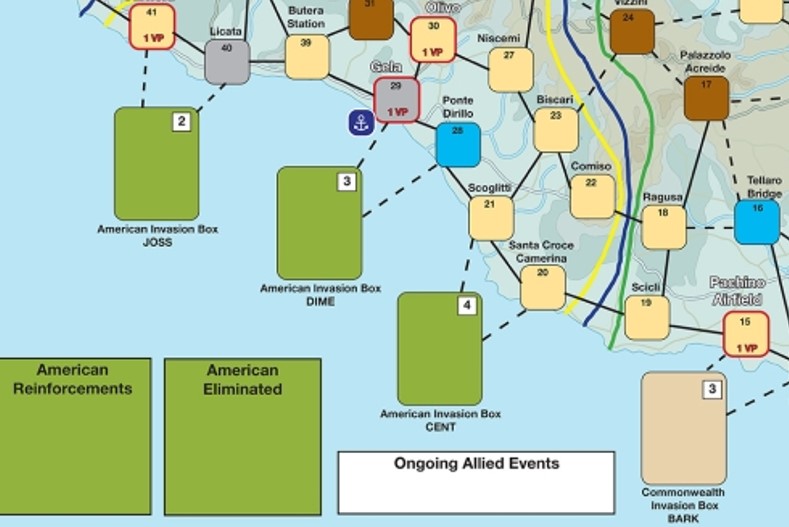
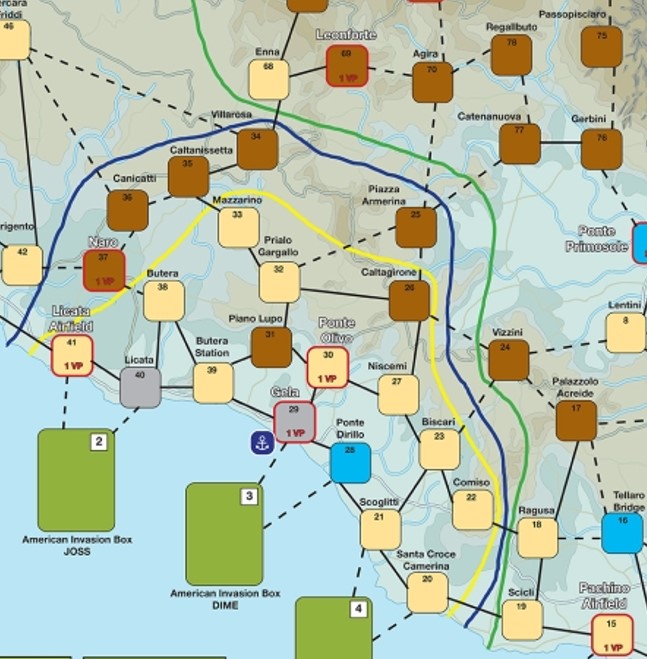
Ken: It is the island of Sicily including the “landing ships” which are unavailable spaces to the Axis troops and a bit of the “toe” of Italy for the Axis to escape to and which is an unavailable space for the Allied troops.
Grant: What is the purpose of the yellow, blue and green lines found on the board?
Ken: The yellow and blue lines were historical limiters for the American forces and the green line divided the island into two parts and denoted Commonwealth vs. American responsibility. In game terms the lines provide limits to each of the Allied forces. Manipulation of those limiters is part of the interaction between the Commonwealth and American forces.
Grant: How does combat work in the design?
Ken: Its pretty simple really…each side adds up the combat value of the units attacking or defending the spaces and finds the appropriate column on the Combat charts (there are two combat charts, one for Small combat units and one for Large combat units), apply any game based or card based modifiers to either the column or the die roll and then roll the die. The resultant cross referenced chart number is the Loss value each side must apply to their forces. The side with the larger number is the winner. Losing may force the defender to retreat although that can be prevented by terrain or other actions. If the defender retreats, then the attacker can advance. If the attacker loses, then the impulse is done.
Grant: What is a Flank Attack and how does it work within the attack?
Ken: It’s a subset of the combat rules that allows a more mobile set of units the opportunity to “outflank” a more static defender. Under certain circumstances based on unit type and terrain type, the attacker can attempt a Flank Attack and if successful based on a die roll, he can attack first forcing the defender to take casualties before responding with his own roll. It suspends the simultaneous nature of combat in the game. It can be quite powerful if the attacker can pull it off.
Grant: What is the makeup of the different types of Combat Tables?
Ken: There are two types of Combat Tables, one for Small Combat Units (battalions) and one for Large Combat units (Regiments). A mix of Small and Large units rolls on the Large Unit Combat Table. The second element to the combat tables are the columns which are based on the amount of attack factors being used in the combat. Cross referencing the correct table, column and modified die roll results in the Combat losses which are applied to the combat units.
Grant: Where do units draw supply from?
Ken: The Allies draw supply from ports or from the landing boxes (the off shore fleet) while the Germans draw supply from Messina or ports. Some cards can also provide supply.
Grant: How is victory achieved?
Ken: Its based on Victory Points, whichever side has the most VP’s wins the game. VP’s are gained a number of ways but mostly by the capture of certain important Spaces. The Axis also gain VP’s by evacuating enough units to Italy. There are some automatic victory allowances in the game as well, but these should be rare.
Grant: What are you most pleased about with the outcome of the design?
Ken: I really enjoy the idea of the two Allied players having to “fight” each other for victory as much as they have to fight the Axis. Again, obviously there is no direct combat but there is plenty of “passive-aggressive” options for each. The question is, is it in their best interest to waste time hindering their “ally” or is it better if they simply focus on the Axis?
Grant: What has been the feedback of your playtesters?
Ken: There has been a lot of constructive criticism of the design. But most of it was limited to details, such as card wording and individual game mechanisms. There really wasn’t any high level comments which I believe helps validate the idea. I think a lot of people initially wondered how the Allies would fight each other but as they saw how the game played and learned a bit about the personalities involved in the campaign they began to understand and enjoyed the game. All the comments I received were very positive.
Grant: What other designs are you currently working on?
Ken: A lot of Advanced Squad Leader and Advanced Squad Leader Starter Kit designs which is my wheelhouse. I have some ambitions on a few other games systems as well but my time is so limited due to work and other commitments that I sometimes wonder if I’ll ever have the opportunity to get to them. The design process is lengthy and fraught with a lot of “failure”. It takes a long time to go from initial idea to printed product and within that timeframe there is a lot of opportunity to derail a design effort.

Thanks so much for your time in answering our questions Ken. I am very much looking forward to this design and love the concept of the inter-rivalry between the Allies. As we all know, those egos got in the way of a lot of things (Patton vs. Montgomery) and it will be interesting to see how that plays out in the context of the greater battle versus the Axis forces.
If you are interested in Reluctant Friends, Bitter Enemies: The Battle for Sicily, 1943, you can pre-order a copy for $75.00 from the Multi-Man Publishing website at the following link: https://mmpgamers.com/reluctant-friends-bitter-enemies-the-battle-for-sicily-1943-p-399
-Grant
 The Players' Aid