
A few years ago, we became acquainted with Andrew Rourke through his Coalitions design from PHALANX that went on to a successful crowdfunding campaign. He has since been a busy guy with starting his own publishing company called Form Square Games and also starting the first design in a new series called Limits of Glory that will take a look at the campaigns of Napoleon. In Campaign I, which is called Bonaparte’s Eastern Empire, the game is focused on the campaign of the French in Egypt between 1798 and 1801. It covers everything from the invasion fleets leaving France trying to avoid Nelson and the British Navy, to the final surrender of the remnants of the French Army to an Anglo-Ottoman force in 1801. The game is very interesting and uses some new ideas to focus on the luck and skill of commanders through a mechanic called the Glory Rating. This Glory Rating can be used as a type of currency by commanders to do several things such as reroll dice for movement or in battle. This becomes a sort of push your luck and resource management aspect and the players who more wisely use this scarce resource will find themselves victorious.
In Action Point 1, we looked at the area movement Map Board and got an understanding of the various features and also how armies navigate the hostile terrain of Egypt. In this Action Point, we will examine the Event Clock and discuss how it effects the game.
Event Clock
One of the most unique and interesting parts of the design was the Event Clock. This Event Clock is the mechanic that drives the game and keeps things moving along. The design of the Limits of Glory Series doesn’t use things like traditional Event Cards and instead the Event Clock is the means to introduce various events that create some semblance of chaos and the unknown. But, this mechanic is not just about chaos as it will also provide both sides with things such as reinforcements, bring in the British to the struggle, add new previously unavailable leaders that can change the game and other effects. First, let’s take a look at the makeup of the Event Clock.

The Event Clock is a separate thick cardboard board that has 24 numbered flags, which each have a different unique event written in the space. The flags are tied to the nations that are involved in the conflict including the French, British, Ottoman and Mamluks and the flag in the space represents which of the nations will benefit from the event. You will notice that there are Event dice markers found along the left edge of each of the rows. The first event of the game is always determined by rolling a single D6 and consulting the Event Clock. Once the first event is determined by this die roll, the players will have to place the one (1) dice marker over the space for it on the left edge of the Event Clock. The number of dice to be used and totaled to decide the event changes from 1 die to up to 4 dice as the game progresses. The two (2), three (3) and four (4) dice markers are placed on their spaces as reminders when the number of dice to be used for the determination changes. This process and the number of dice that are to be rolled can determine what events can be played this game and will eliminate the occurrence of some events. At first, I didn’t really like how this worked but after playing, and then discussing and thinking about the mechanic, it really makes for a very uncertain outcome and can drastically change the fortunes of players. This keeps the game a bit chaotic and also changes the possible outcomes and improves replayability.
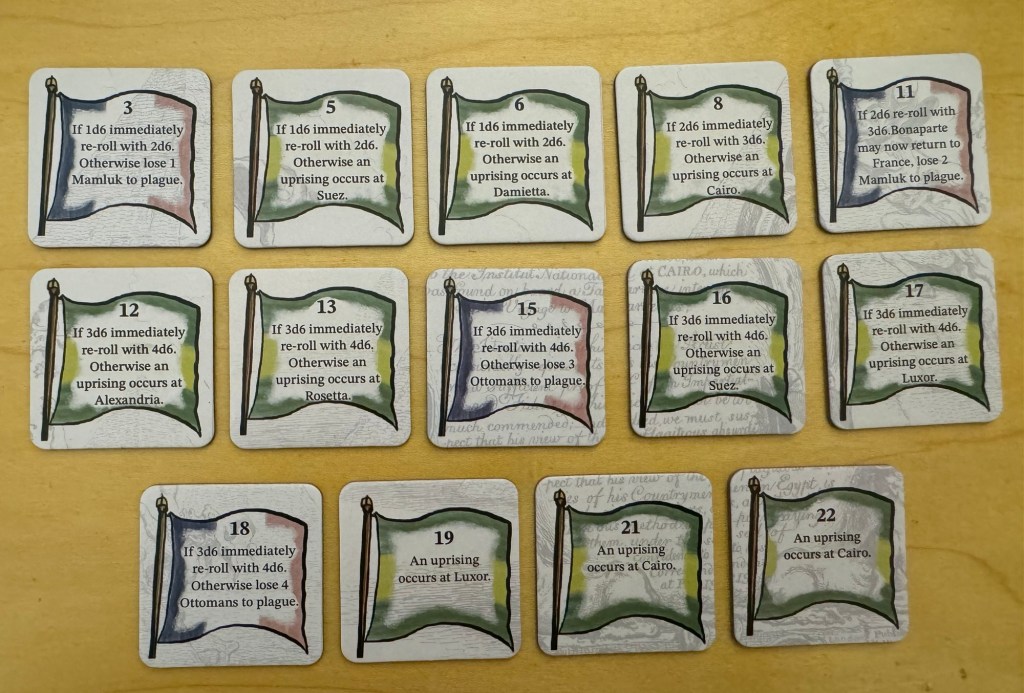
So how does the process work? At the start of each turn during the Conquest Phase, an event is rolled for, initially by rolling 1d6 as mentioned previously. The number rolled corresponds to the event that is to occur immediately, once the event has occurred the flag is covered by a second event tile unless the event is repeatable, in which case it is never covered. Some events indicate that another dice must be added to the event roll for the rest of the game, so in this way players start by rolling 1d6 for an event, they progress to 2d6, then 3d6 and finally 4d6. This means that as the game progresses more and more events become possible but the probability of particular events happening changes as the number of event dice to be rolled changes. Players need to allow for this in the decision making process during game play. Some events may never happen and others may occur multiple times. And I think that this is the best part of the inclusion of the Event Clock. While it may make the game a bit more gamey, allowing players to bet on the come with certain events or even not having to worry about ones that are past, it really keeps players engaged in this process and gives it some weight during the game and doesn’t boil it down to just a random die roll.
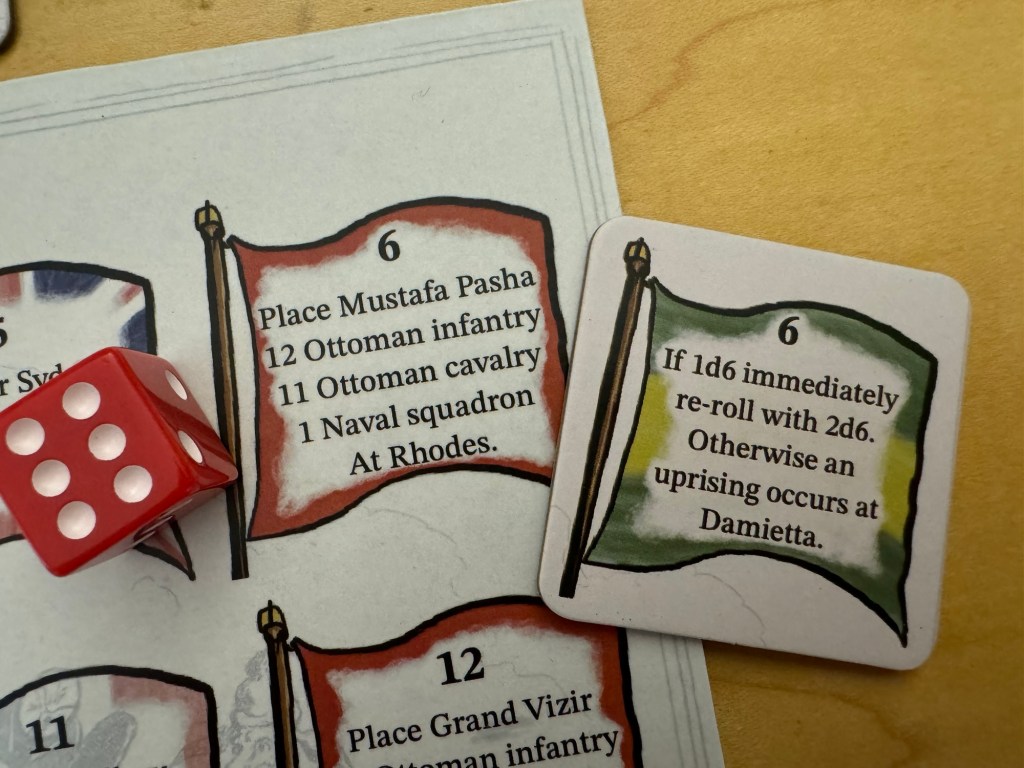
These Second Event Tiles that are placed over some of the event spaces once the event has been
carried out bringing new possible events that may occur based on the roll of the dice. This new event is different then the previous event that it has now covered and really creates a lot of the variability and undetermined nature of the game. A Second Event Tile will never cover Repeatable Events, which are marked with ‘R’, as that event can happen any number of times.
One other thing that will be determined by the roll of the dice and the number of dice to be rolled is the end condition. Once 4d6 are rolled for an event, if a score of 14 is realized then the game will come to an end. According to the designer, this represents “the fact that talks for European peace were progressing at the time, in Amiens, in France and no one in Egypt knew when a boat might arrive from Europe saying that a peace treaty had been signed, meaning fighting had to stop”. I think that this variable end condition really was a nice historically significant addition to the game and really can be frustrating for the player who is behind but is always ever-present as an outcome and something that you need to think about and consider as the game progresses.
Different Events
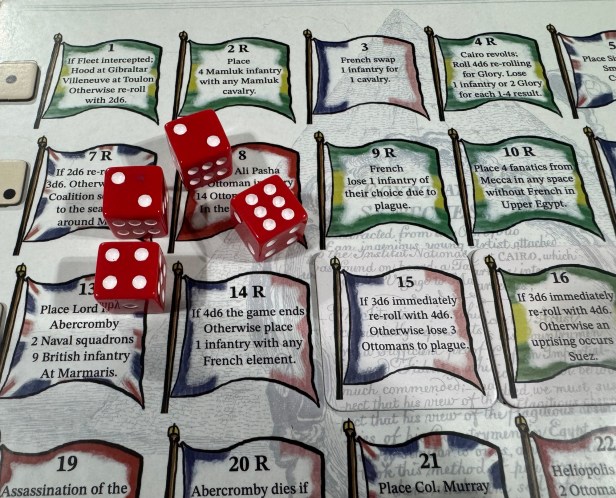
Now that you understand how the Event Clock works, let’s take a look at a few of the events that can happen when the dice are rolled. One thing to keep in mind. In general, the effects of the lower numbered events are much less impactful than those of the higher numbered events. If you look at the below picture, you can see the differences between the first row of the Event Clock (pictured are spaces 2R, 3 and 4R as compared to spaces 8, 9R and 10R) and the second higher numbered events. Typically, it has to do with the number of infantry that are either gained or lost from the events that are higher as the event number increases. But I want to point out that there are a total of 24 different base events with 6 benefiting the Mamluks, 7 for the French, 5 for the British and 6 for the Ottomans. So you can see that are far more events that benefit the Coalition of the British, Ottomans and Mamluks than the French. But, there are some very key events that if rolled can really change the game!

For example, if a 15 is rolled, Bonaparte may now be allowed to return to France. This is an entire process that sees Napoleon leave the battlefield and attempt to get across the Mediterranean to return to France and deal with challenges at home. This event opens up the opportunity for the French to gain 9 Victory Points which can truly put the game out of reach of the Coalition.
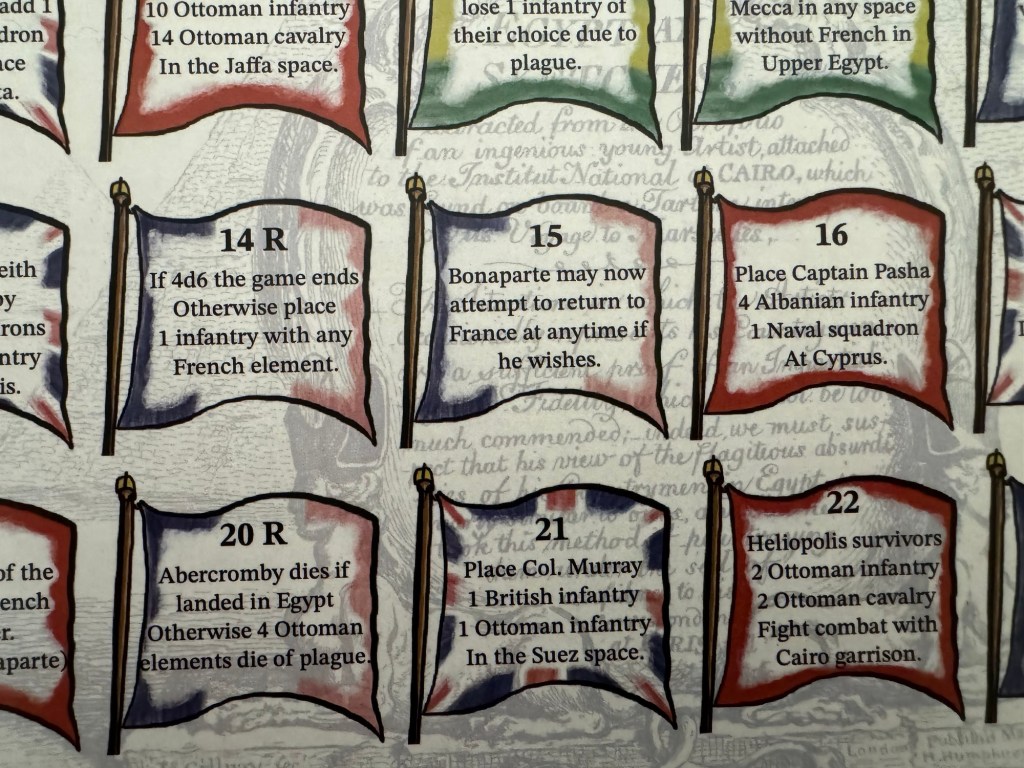
As already mentioned, a 14 result after 4D6 are rolled will end the game and this is one that you may or may not be ok with depending on your progress in the game. One other that I really liked was the treachery of the Mamluks. If a 24 is rolled, which is generally pretty rare, the Mamluks will change sides spurning the Coalition for the embrace of the French.

The Event Clock is a really nice element of the game and creates some very interesting outcomes as the events either happen or do not happen and the players are then forced to adjust. I very much enjoy a bit of chaos in a wargame and there are many ways to introduce it into a system. But this typically focuses on the use of cards or random event tables to increase tension and change the conditions of the game. I thought the addition of the Event Clock changed things in a unique and interesting way but also kept things uncertain. Will the British ever get involved? Will the Emperor be called back home? Will the Mamluks perpetrate treachery? All of these “what ifs” keep the game exactly that…a game and I very much enjoyed that aspect.
In Action Point 3, we will discuss the use of the Glory Rating for commanders and what it represents.
-Grant
 The Players' Aid