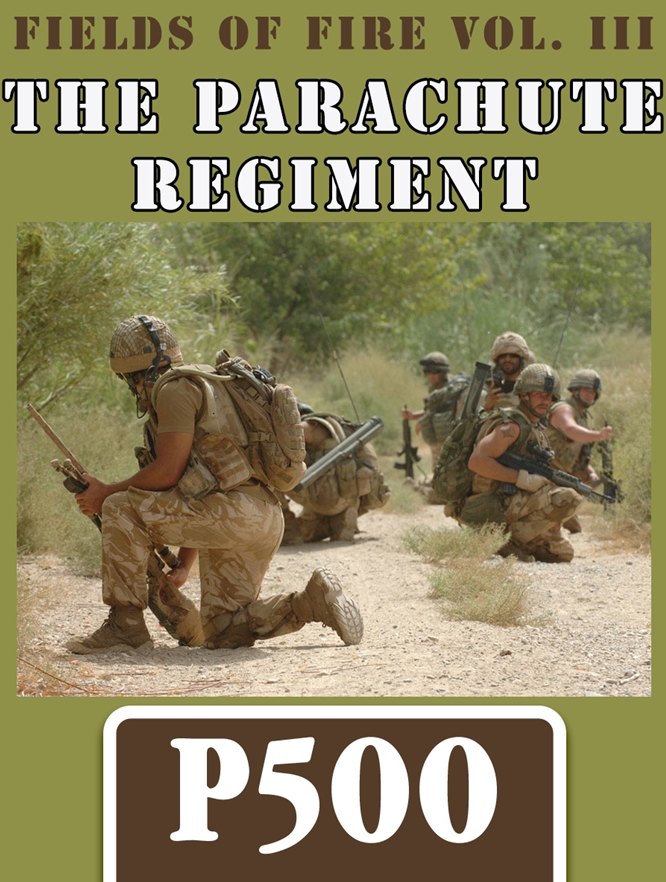
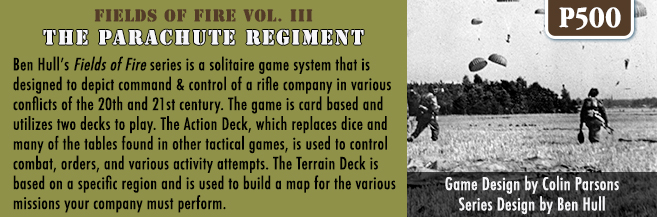
Fields of Fire is a solitaire game system that gives players the challenge of commanding a rifle company between World War II and Present Day. The game is different from many other tactical games in that it is diceless and card based and uses two decks to play. The Terrain Deck is based on a specific region and is used to build a map for the various missions your company must perform while the Action Deck serves many purposes in controlling combat, command and control and various activity attempts.
Alexander loves this game and even has gone as far as getting designer Ben Hull’s autograph on his copies of the rulebooks. He gushes when he talks about it and really does enjoy playing the game. In 2023, a new volume was announced on the P500 called Fields of Fire Volume III: The Parachute Regiment. What’s more the new volume has a new designer named Colin Parsons. I reached out to Colin and he was very willing to share about the design progress.
*Keep in mind that the design is still undergoing playtesting and development and that any details or component pictures shared in this interview may change prior to final publication as they enter the art department.
Grant: Colin, welcome to our blog. First off please tell us a little about yourself. What are your hobbies? What’s your day job?
Colin: Thank you very much, and thanks for inviting me! Exciting stuff!
So, about me; I’m a 54 year old Welsh man and I live in Gloucestershire in the United Kingdom. I’ve been a wargamer pretty much all my life – starting with hundreds of Airfix HO/OO scale plastic figures when I was young – I was very into Napoleonics. Alongside my miniatures gaming I then proceeded to get into boardgames and I still own a fair few titles from the 80’s/90’s from publishers such as Avalon Hill and Victory Games, etc.
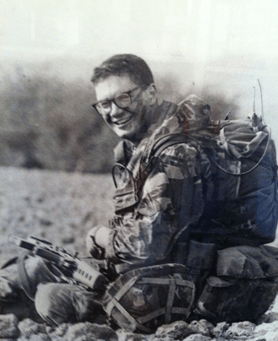
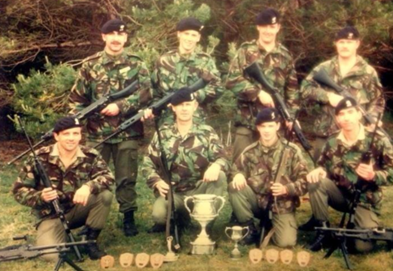
I served in the British Army for 18 years from the late eighties through to the mid-noughties . I was in an infantry battalion and worked through the ranks; I joined as a private soldier, was a section machine gunner, then a sniper, a Section Commander and then a Platoon Sergeant. After a few years doing that I got my commission and became an officer, so I was a Platoon Commander and then finally a Captain and Second in Command of a rifle company when I left. So I’ve actually been quite a lot of the counters found in Fields of Fire Volume III!
I have pretty eclectic gaming tastes; because of my background I mainly prefer ground warfare games, but also enjoy air and, to a lesser extent, naval gaming. My preferred scale is at the tactical end rather than strategic or operational – I much prefer individual units, vehicles or squads – I can’t really get excited over counters that represent whole regiments or divisions, etc. Most of my gaming is solitaire – either through playing purely solitaire games, or just playing multiplayer games two-handed – but I do occasionally play games against my son – usually either Up Front or Undaunted: Stalingrad at the moment.
I do a lot of my gaming on my laptop these days – I’m a big fan of Vassal, as it allows me to take my time and not worry about tying a table up for days (the desk in my office is pretty small, and I’m not sure my wife would put up with me taking the dining table!). If I do ever play hex and counter games these days, it is invariably on a PC, where there is some automation to help me remember things!
In terms of hobbies, I am a scuba diver, so I do enjoy doing that, especially when I can dive wrecks; even better if they were sunk through hostile action, etc. as I find them fascinating. There are some great wrecks around the British coast from both wars (and earlier), and I’ve also dived the Thistlegorm in the Red Sea – a cargo ship that was sunk by German bombers and her holds are still loaded with a huge variety of cargo. I’m also a keen genealogist and have a large family tree on the go (about 5,000 people at the moment) – again, I’m always very interested in any military ancestors I find. We also have a dog – a young Labrador – so he keeps us busy and out in the fresh air a lot. We live in the Cotswolds, so there is lots of beautiful countryside round here.
Work-wise, I’m in communications though, to be honest, with my advancing years I’m eyeing retirement already! Maybe huge success in boardgame design will make me rich enough to retire soon, hey? Er….! 😉 [Editor’s Advice: Don’t quit your day job!]
Grant: What motivated you to break into game design? What have you enjoyed most about the experience thus far?
Colin: Over the years I have created various games and rules from scratch for my own use. Back in the 80’s, because I couldn’t afford to buy the Traveller System when I was young, I made my own Sci-Fi RPG ruleset (rather cringingly called ‘Lasers and Lightyears’, if I remember correctly!). I also made a skirmish scale set of Modern rules that worked pretty well, that I used with 10mm figures and vehicles.
When I was about 11 years old, in our ‘Careers’ lesson at school, I remember really wanting to be a game designer – back then my dream job would have been doing Dungeons and Dragons stuff with TSR. I’ve had to wait a bit, but I can now tell my young self that I finally managed it!
I guess I like the challenge of making things that work and, more importantly, are fun. Before ‘officially’ working on Fields of Fire, I made a campaign based on the Australians at Long Tan in Vietnam that I put on BoardGameGeek. I’d learned about that battle a long time ago and thought it was a good fit for Fields of Fire – I think it works quite well, and I got some nice feedback on it, but I’ve learned a lot more about design since, so maybe I’ll re-do it someday and improve on it!
Working on Fields of Fire with GMT Games has been fun too – the Developers are a good bunch, with a similar sense of humour to my own.
Grant: What is your upcoming game Fields of Fire Volume III about?
Colin: Fields of Fire Volume III, as per the first two volumes of the game, is a solitaire wargame that focuses on the actions of a single regiment across a variety of eras – in this case The British Parachute Regiment, in the late Second World War at Arnhem (1944), the Falklands Conflict (1982) and Afghanistan (2008).
Grant: What does the subtitle “The Parachute Regiment” tell us about the game and what the player can expect?
Colin: Well, for the first time in the series we obviously have non-US troops as the focus of the game. This will introduce the player to new weapon systems, doctrine and theatres of war (and words like ‘Armour’ and ‘Paralysed’ being spelt in the correct way! 😉 ).
The Parachute Regiment are one of the elite units in the British Forces, and often operate mostly independently of any heavy support, and at company level, so I felt they would fit into the Fields of Fire System very well. Next was selecting the campaigns; initially it was Tunisia 1942, Goose Green 1982 and Afghanistan 2008. I didn’t pick Arnhem because I thought it may be too hard to do, but then I thought “well you can’t have the Paras without Arnhem”, so dropped Oudna in Tunisia (though I may come back to that) and also expanded the Falklands campaign to include the battle of Wireless Ridge too.
Grant: Why was this a subject that drew your interest?
Colin: I served in the British Army for 18 years, so although I loved volumes 1 and 2 of Fields of Fire, I really wanted to get the British into the game. I joined not that long after the Falklands, and it was still fresh in the minds of everybody – some of the instructors on my Section Commanders’ Battle Course at the School of Infantry in Brecon were Falklands veterans. I then served through to the mid-noughties, including a tour in Iraq, but not Afghanistan, so I felt I had some good experience to bring to the series.
Grant: Why do you believe the Field of Fire Series is so popular?
Colin: Having operated in many of the roles covered in Fields of Fire, I genuinely believe that Fields of Fire gives the most accurate portrayal of what it is like to command troops. The whole system of Commands (and never having enough to do exactly what you want) and the fact your units do their own thing to some extent and don’t perform all your orders perfectly when in contact, definitely rings true to my experiences of command. I used to love hex and counter games, but after playing Fields of Fire incessantly for the last 4 or so years, having large stacks of counters doing exactly what you tell them to do doesn’t feel quite right!
Also, with the work Andrew Stead and I have been putting into buffing the Deluxe version, I think the system is now becoming much more accessible than it ever was. Let’s face it, it’s a relatively complex system, but the new Series Rules have lots more examples throughout; the new Mission Books are much clearer; and the new Field Manuals, with their detailed explanations and walkthroughs, will get new players’ “boots on the ground” much easier than previous editions. We’ve also run a few ‘multiplayer’ missions on Facebook, guiding often complete newcomers through the system – hopefully this has inspired more people to play the game – it is worth it!
Grant: Why did we need another volume?
Colin: All of us (Ben Hull, Andrew and myself) are keen that Fields of Fire is both interesting and educational. We don’t want to just add more counters but have the gameplay feel the same. Ben did that well with Volumes I and II, where commanding a USMC company feels very different to commanding a US Army one, and Volume III will add to that – playtesters have reported that commanding the British feels very different again to previous volumes.
And there’s a lot of potential out there, right? I think the fact the Korean War features in Volumes I and II is great – that conflict does tend to be lightly covered elsewhere – and I believe that the campaigns in Volume III will also help educate people on topics they might not be too familiar with. The Falklands War is pretty well known in the UK (at least for people of a certain age – I was 12 when it happened and had an uncle on one of the Destroyers), but probably less so elsewhere. We have lots of other potential campaigns on our list too, in various stages of development. As above, each of those bring something new to the system, be that unique terrain, or units, weapons or tactics, that will all give the players new challenges, and not just more of the same but with new counters.
Grant: What can we expect that this volume will add to the series?
Colin: I guess that alongside a whole new nation, the main thing that this volume brings to the series is the advance in time. Previous volumes brought the player up to 1968 in Vietnam, but the Falklands War was 24 years after that (actually the same amount of time between the Normandy campaign and Vietnam!), and Afghanistan another 26 years again beyond that. A lot happened in the military in those 50 years! So in Volume III you will find there is more night fighting, as night vision devices became more common and then eventually ubiquitous by Afghanistan, and personal communications down to section or even individual level will also change how you command; in Afghanistan and to some extent the Falklands you can now order units forward, and then give them further orders by radio without having to rely on them using the General Initiative draw.
Grant: What is your design goal with the game?
Colin: As above – I mainly want to create something that is a fun experience for players (even Arnhem is ‘fun’, even though you are basically up against overwhelming odds and it’s never going to end well). And I also want it to be educational and feel different to what players have experienced before.
Grant: What sources did you consult about the details of the history? What one must read source would you recommend?
Colin: For the Falklands campaign I’ve actually been lucky enough to be able to speak to Chris Keeble (who was a Major and second in command of 2 Para in the Falklands; he took command of the battalion when the Commanding Officer, Colonel ‘H’ Jones was killed in action at Goose Green) and ‘Chip’ Chapman (now a Major-General, but was a 2 Para Platoon Commander in 1982). I’ve got some great insights from them, especially around the details of the logistics. I’ve also spoken to a Parachute Regiment company commander who served in Afghanistan, who has similarly been very generous answering my questions to help craft that campaign.
I’ve also used my own military knowledge – I’m well-acquainted with all the weapon systems and tactics used in the Falklands and Afghanistan, but I can’t say I have any firsthand knowledge of Arnhem! I did fire Lee Enfield No.4 rifles and Bren LMG’s when I was an Army Cadet though – both very nice weapons. No PIAT’s though, unfortunately!
As part of our education drive I hope to include Reading Lists in each campaign book (space pending). But for each era, if I could only pick one book, I would recommend the following to get people in the mood for the campaigns:
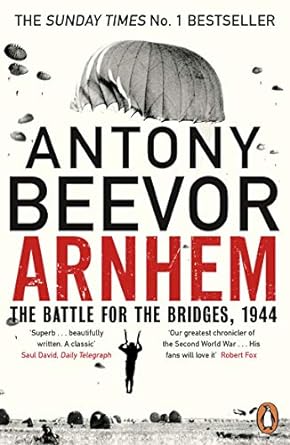
Arnhem: Arnhem, The Battle for the Bridges, 1944 by Antony Beevor. A good book that covers both Operations (Market and Garden), so not specifically all related to the fighting in the town that Volume 3 focuses on, but it does cover it well.
Falklands: Goose Green by Nigel Ely. This is an excellent account of the first battle in the Falklands Campaign, told through eye-witness accounts from many soldiers of 2 PARA. The author was a Corporal in 2 PARA during the battle.
Afghanistan: Company Commander by Major Russell Lewis. Russell was the Company Commander of B Company 2 Para at Forward Operating Base Inkerman in 2008. This is the period that the campaign recreates, so this is basically the primary source text for the campaign’s missions.
Grant: When the radios fail, what new options does the player have?
Colin: The efficiency of the radios, or rather the lack of, in Arnhem is well documented. Once they got into the dense built up area of the town they had extreme difficulty communicating back to battalion and brigade HQ’s. Therefore, in many of the missions the player will find Company HQ having to operate on Initiative draws, or they will occasionally be lucky enough to receive orders from a battalion runner. This will also have an effect on how Company HQ can activate the Platoon HQ’s – your runners will be very busy!

However, the company commander of A Company, Major Digby Tatham-Warter, had a trick up his sleeve. Before joining the Paras he had served in the Light Infantry. Since Napoleonic times British Light Infantry regiments have used bugles to pass orders (and they still do, actually for ceremonial purposes). Major Tatham-Warter had predicted the communications issues he would face and trained his troops to understand bugle commands. This is represented in the game by a Bugle Asset counter and a set of Arnhem-specific additional Actions that are available to the Company HQ.
Grant: What unique weapons and tactics are introduced into the system with this volume?
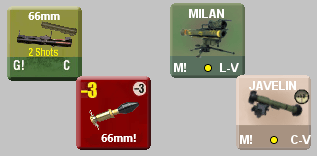
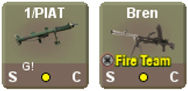
Colin: Weapons-wise, at Arnhem we have the “Projector, Infantry, Anti-Tank” or PIAT, which was basically a bomb and a big spring, that hurled the warhead towards its target. I admittedly do them a disservice there – they were actually better than they sound! The Launchers were centrally held in the Company and pushed out to where they were needed most, so in the game there is a mechanism similar to Runners, where Company HQ holds the teams like an Asset, and can then generate a PIAT Team and attach it to a Platoon HQ to go off and hunt tanks. By the Falklands and Afghanistan Anti-Tank weaponry had improved rather a lot, so your sections will be carrying 66mm Light Anti-Tank Weapons, that function a bit like Rifle Grenades really, and also Guided Missiles – MILAN in the Falklands and JAVELIN in Afghanistan. Guided Missiles don’t exist in previous volumes so I’ve designed the rules for these for Volume 3, including a new M! VOF for missiles.
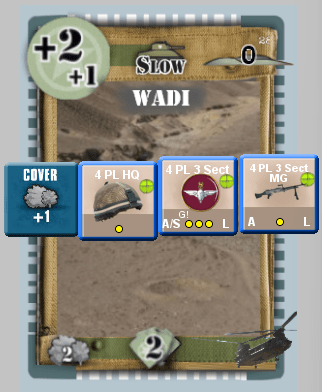
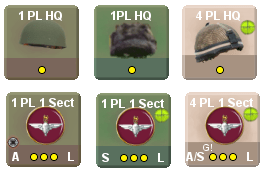
With regard to Tactics, the commander will have a few new Actions available to use over and above those in rule 4.2. British sections are made up of a Rifle Group and a Gun Group – in the Falklands and Afghanistan these are represented by two counters, which gives you a little more flexibility in how they operate; there is a new command to order them to move, or seek cover, etc. as one unit. You also have vastly improved communications as you come into more modern times, giving you much better command and control. It will be possible to send a Section ahead, and then radio them to seek cover or carry out spotting, etc., due to their Advanced Handheld Radios, which have been in the rules since the start of the series but not appeared in either of the previous volumes.
Grant: How did you go about identifying their relative values?
Colin: A lot of the time a rifle-armed British section is pretty much the same as a rifle-armed US squad, whatever the era, but yes, there are new things. I was mostly able to find the closest match to them in the previous volumes and go with those, but I have run a few things past Ben to check as I’ve gone (the PIAT anti-tank weapon for example).
I have also come up with some other rules to cover other British-specific weapons. For example, the Para sections in Arnhem were very well armed; they generally had a Bren Light Machine Gun, a sniper rifle and a light mortar, in addition to all the rifles and submachine guns. To represent this they project an A VOF when at full strength, but only an S VOF when reduced to 2-steps. Also, the Bren LMG was notoriously accurate (a version of it was actually still in use in the Falklands!), so whilst they are operational the units get an additional card draw when concentrating fire, similar to the USMC’s massed Browning Automatic Rifles in Volume 2.
Grant: What new experience do Urban Defensive missions create? How will these missions challenge the players?
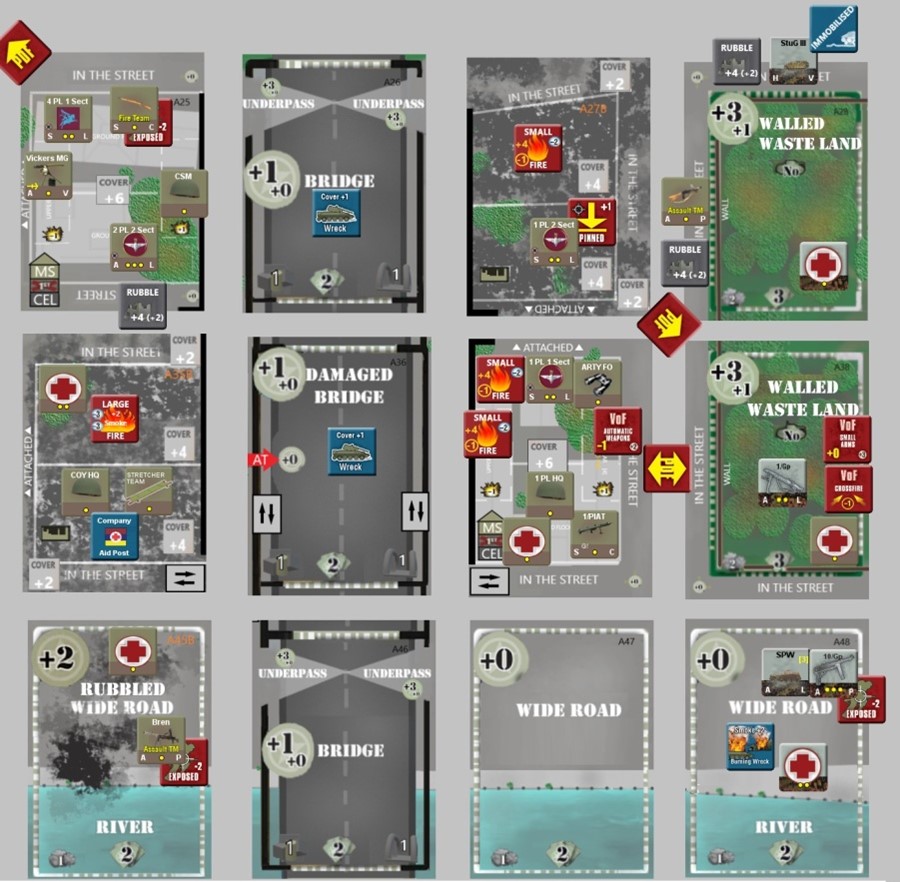
Colin: Well, urban combat is as complex as it gets in Fields of Fire, but is also great fun! There will be a specific Field Manual in the box covering urban warfare, with lots of examples and walkthroughs, so players will be able to get up to speed easily. For the first time in the series (apart from the odd foxhole) players will come across deformable terrain – four of the urban missions are played on the same map, over a few days. Buildings that collapse will carry over to the next mission – by the last mission it is not uncommon for not much of the town to be left standing!
Grant: What is the new urban offensive enemy hierarchy chart? How does it function differently?
Colin: Previous volumes only had enemy in a defensive posture in urban terrain while you attacked them (Volume II’s Hue campaign). In Arnhem, you are defending against oncoming (and ultimately overwhelming) German forces. The advancing troops need to behave realistically – do they enter the buildings and work their way towards you, use the street to bypass your positions, leaving follow on forces to mop you up, or do they sit back and concentrate fire onto your building, or just set fire to it to flush you out? So to achieve this, there is a new ‘Enemy Urban Assault’ chart, with two columns covering whether the Germans are advancing cautiously or going all out to overrun you.
Grant: How have you modeled the effects that groups of people and incoming vehicles on the battlefield create? How can these encounters turn wrong?
Colin: In Arnhem, the vehicle priority tables will make vehicles advance cautiously through the streets – in real life urban terrain is lethal for vehicles if they are not supported by infantry to flush out enemy anti-tank teams. The activity tables for the German squads will encourage them to try to advance with the armour, but if you can strip the infantry away you may be able to ambush the Panzers.
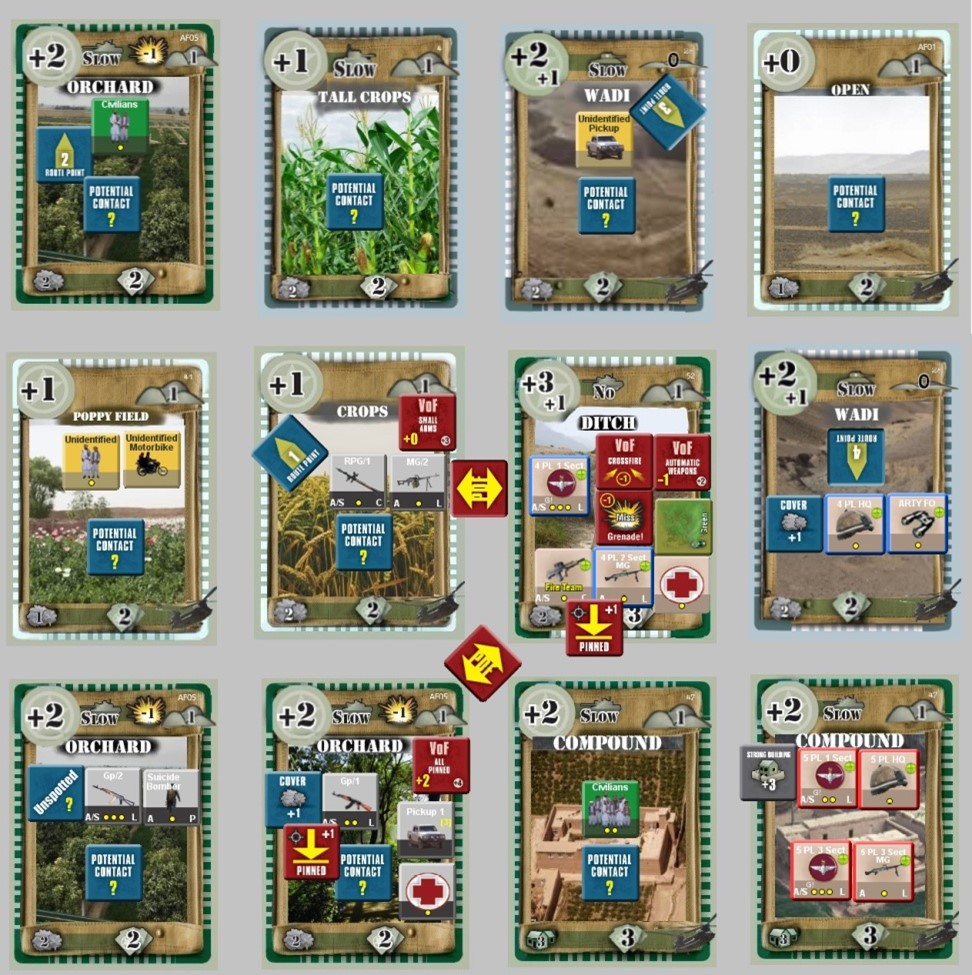
Afghanistan is different again; civilians (or at least what you assume are civilians, they can turn out to be Taliban fighters) start on the map. In most scenarios, the majority of ‘Contacts’ from PC Marker checks do not generate enemy units, but place unidentified groups and vehicles, that then move randomly around the map. You need to positively ID these groups and vehicles to check them out as being either civilian or Taliban. Occasionally what you thought were civilians will turn out to be Taliban groups, that can surprise you! Civilians also affect how you conduct your battle – strict Rules of Engagement are in place and your troops will not open fire on cards containing civilians, even if Taliban are present – the risk of collateral damage is too high. Often therefore you will find yourself manoeuvering into better positions to engage, whilst the civilians will probably scatter when Taliban are present, knowing what’s coming.

Grant: What new terrain has been added?
Colin: The terrain in the first two missions of the Arnhem campaign, as you’re making your way from the drop zones to the town, is fairly similar to Normandy (but without the bocage!). The Arnhem Urban terrain cards are based on the actual layout of the town, using contemporary maps, aerial photographs and sketches, so players should be able to recognise the town as they try to defend their perimeter.
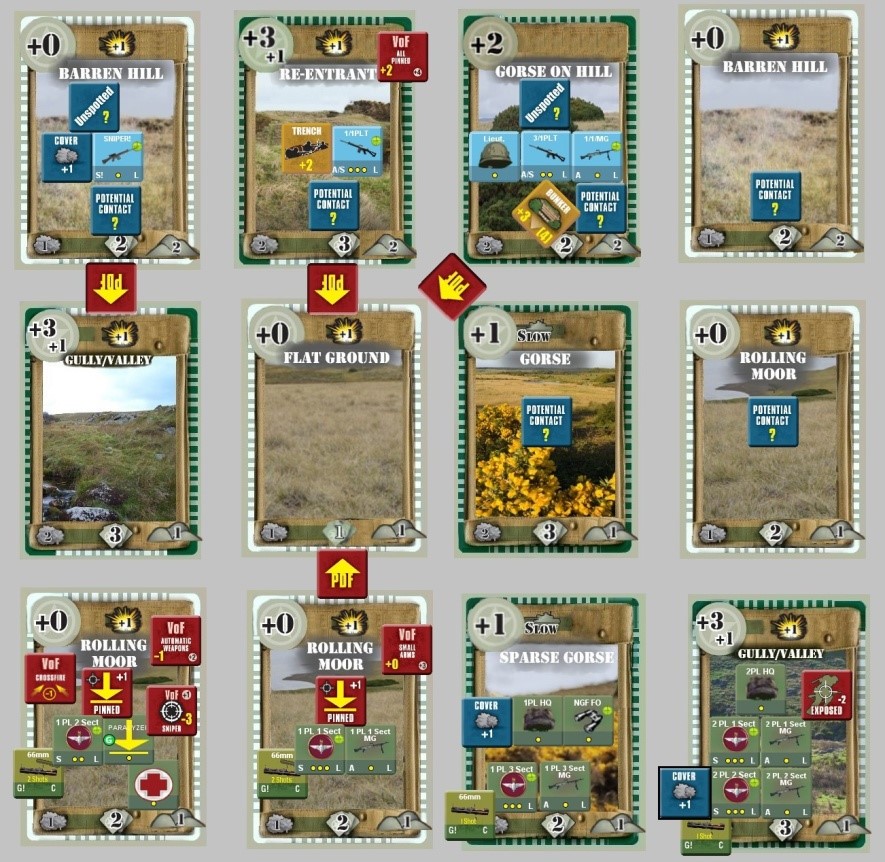
The two Falklands decks are quite distinct; Goose Green comprises a few gullies and gorse bushes, and a lot of flat open land! The peat soil helps to deaden artillery fire, but you will often find yourself terribly exposed. In comparison, Wireless Ridge is very craggy which, in conjunction with the nighttime conditions in which you assault, offers a lot more protection but to both you and the defenders.
Afghanistan terrain is also varied. The dense Green Zone comprises orchards, ditches and head-high crops that cut the Line of Sight drastically. Desert terrain is barren, but with the odd hill or wadi to provide strategic points.
Grant: What type of challenge do collapsing and burning buildings create for the player?
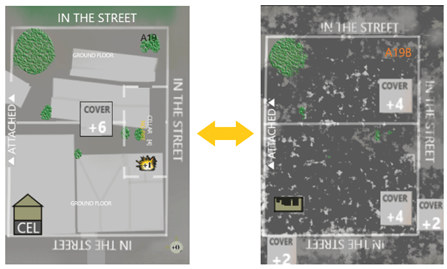
Colin: I’ve had to come up with rules to cover fires, collapsing buildings, and various other aspects of urban warfare. Troops can stay in areas that are on fire if they want, or need to, though they will suffer a combat modifier. They may also be ordered to attempt to tackle fires, but it will take them out of the fight for a period. There is a new mechanism that makes fires shrink, grow or spread; if you leave them unattended for too long, you are generally asking for trouble! Once fires get out of hand the buildings become impossible to occupy, and will eventually collapse. Buildings may also collapse when hit by artillery, tank fire, or demolition charges.
Collapsed buildings leave your perimeter vulnerable – you can still defend them, but the difference between defending a Barricaded Building with +6 cover and a Rubbled one with just +2 cover, that the enemy can freely enter, is stark.
The Building Terrain Cards will be double-sided, and are flipped when the building collapses
Grant: What different campaigns are included in this volume? How many and what different types of scenarios are included?
Colin: There are three campaigns in this volume, all covering the 2nd Battalion of the Parachute Regiment.
First up (chronologically at least; though it is probably the most complex campaign due to the urban combat) is Arnhem in 1944 (8 missions) – the ill-fated ‘Bridge too far’ of operation Market Garden.
Next, and probably the most ‘simple’ for new players, is the Falklands in 1982. This campaign is made up of 9 missions across two battles – the Battle of Goose Green (6 missions), that was the first land battle of the Falklands war, and was characterised by very little fire support and brutally flat ground, and then the Battle of Wireless Ridge (3 missions), which was the last battle of the campaign, and has been viewed as a ‘perfect’ all-arms attack, having learned the lessons of Goose Green.
And finally, we have 8 missions in Afghanistan in 2008, where 2 PARA are in the Sangin Valley area of Helmand Province. With often short range ambushes, and complicated by the presence of civilians on the battlefield, this will have a different feel than previous campaigns that are made up of large set piece assaults, etc.
Grant: How does the volume investigate and teach the various changes to the 2 Para over the years and various wars?
Colin: Well, there’s a long time between 1944 and 2008! If you were to go back the same amount of time (64 years) from Arnhem, the British Army were fighting the First Boer War in South Africa in 1880; I’m sure you’d note the differences between that and Arnhem too, if we ever make ‘Fields of Fire, the Victorian years’.
But in Volume III terms, you will see the progress from troops who were literally on their own after being dropped behind enemy lines, though what was effectively ‘just’ an elite infantry battalion in the 1980’s, fighting across barren terrain that required extreme resolve and grit to win the day, and then on another quarter of a century to Afghanistan, where modern communications will make command and control easier, but the close country, combined with confusion around civilians on the battlefield hands some of that edge back to the Taliban.
But ultimately all three campaigns are classic “infantryman’s wars”; very little support outside of your company, platoon and section; just you and the enemy fighting for survival and control of the ground.
Grant: What are you most pleased about with the outcome of the design?
Colin: I really like the fact that each campaign ‘feels right’. It would be very easy to make the British overpowered (I obviously have huge amount of pride for the British Army!) but they are definitely vulnerable when misused. Using ‘real’ tactics in the game pays dividends – the Falklands sections have a semi-independent gun group that can (and should) be used to help suppress the enemy positions whilst the rifle group closes and attacks with fixed bayonets, for example.
Playtesters have also pretty unanimously reported that the missions are interesting and provide them with new challenges. I’ll take that!
Grant: What has been the feedback of your playtesters?
Colin: I’ve been really pleased with the feedback from the playtesters. A huge majority of them have really enjoyed the two campaigns we’ve done so far (Arnhem and Falklands), noting how different they have felt to previous volumes. I owe all the playtesters a real debt too – they’ve all been really positive and some of them have been absolutely fantastic in terms of the amount of time they have spent testing for us and providing detailed constructive feedback. When I launched the playtest versions I thought they were pretty much good to go, but between them they’ve pointed out loads of ambiguous bits that needed fixing, or highlighted areas that could be improved – they’ve been great!
Grant: What other designs are you currently working on?
Colin: Nothing really formal, and I’m certainly not planning to bring Lasers and Lightyears back! I have been doing a bit of playtesting on other future GMT games too to help out other designers and developers – there are some more really nice ones coming that I’m quite excited about!
Most of my time over the last couple of years(!) has been taken up with getting the Deluxe version ready. We naively thought it would be a lot quicker to get ready, but it’s going to the printer very soon, so we’re nearly there. We’re all REALLY pleased with the result.
I’d quite like to revisit Fields of Fire: Long Tan at some point and bring that up to ‘Deluxe standard’ with everything I’ve learned in the time since I made it. Whether that becomes an ‘official’ expansion, or a ‘fan-made’ free release on Vassal, we’ll have to see. But first I’ll be working on developing Ben’s next campaigns, Tarawa and Saipan, and also Andrew’s potential Volume IV box (but I’ll let him tell you about that!).
As well as those, there are lots of other things on the go in the Fields of Fire Series – I’ve brought us forward in 25 year leaps with Volume III, and Ben is going the other way with his First World War campaign. He has some other theatres too (French in Indochina, and a more modern one from the 1990’s which should be good) and I have the Tunisia campaign for 2 PARA in 1942 too (Battle of Oudna). If Volume III gets a good reception, that might be a nice campaign to work up as an expansion, like Bulge?
But the future looks good!
Thank you so much for your time in answering our many questions Colin! I really appreciate your insider view of this volume and appreciate your military service as well.
If you are interested in Fields of Fire Volume III: The Parachute Regiment, you can pre-order a copy for $87.00 on the P500 game page at the following link: https://www.gmtgames.com/p-1051-fields-of-fire-volume-iii-the-parachute-regiment.aspx
-Grant
 The Players' Aid