
I love a good tactical wargame! And when that tactical wargame is a solitaire game mores the better. And this new design called Solitaire TacOps: Ortona really looks interesting as it has a campaign system where you can play across 12 different scenarios and also uses a very interesting looking dice combat resolution system. I am also very intrigued by the phrase “where operational decisions meet tactical realities” and want to see how that works and what it looks like. I reached out to the designer Non-Breaking Space to see if they wanted to chat about the design and they were more than interested in sharing. If you didn’t know, NBS has already designed another great looking game called Cross Bronx Expressway and we also did an interview for that design and you can read that at the following link: https://theplayersaid.com/2022/01/17/interview-with-non-breaking-space-designer-of-cross-bronx-expressway-from-gmt-games/
*Keep in mind that the design is nearing completion but that any details or component pictures shared in this interview will change prior to final publication as they enter the art department.
Grant: Welcome back NBS. What is your progress on Cross Bronx Expressway?
NBS: As I type this, Cross Bronx Expressway is in the middle of getting the rules laid out for print. We’ve wrapped up design and development so all efforts are towards finalizing the product so we can get it off to the printer as soon as possible.
Grant: How has that design changed since we last talked?
NBS: The core of the design hasn’t changed much but the presentation has been given a complete facelift from the physical artwork, to the rules and learning materials. The thing I’m perhaps most excited about is how much history as an experience we’re packing into the box. I think everyone is going to be pleasantly surprised when they open it up and dig into it all.

Grant: What is your new design Solitaire TacOps: Ortana about?
NBS: Solitaire TacOps is a system that I originally designed as more of a sandbox to explore urban combat. It was tactical but scaled high at 15-30 minutes per turn and multiple effectives represented on single counters. The goal was to really explore the tactical approach to taking and controlling objectives. A lot of the friction that comes at that scale is abstracted away higher up, and often not contextualized lower down.
The system is called TacOps because a key element is the way those tactical objectives work toward the operational goal. The system puts players into a campaign where they have to organize and choose tactical engagements. The resources are fixed, so the core challenge is maintaining the combat effectiveness needed to achieve the operational goal.
As the system became more refined I planned to test it on the Battle of Ortona. This WWII campaign from December 1943 is almost a textbook study on modern urban warfare, including the leadup to it. The First Canadian Division had to sustain combat effectiveness from the Moro River all the way up to Ortona against the 90th Panzergrenadier Division and the 1st Fallschirmjäger Division.
Grant: Why was this a topic you felt needed to have a design about it?
NBS: There really are not enough urban warfare designs. There are some good ones, but it is a topic that could be explored a lot more. Stalingrad is often considered the standard but that is often presented from an even higher scale specifically because Stalingrad is geographically bigger. Outside of the games like Red Barricades, Stalingrad is mostly explored at the operational scale.
I wanted to start with Ortona specifically because in many ways it is urban combat basic training. The Canadians had not been properly trained for urban combat, they had to learn by doing. Modern urban combat only started showing up in military training manuals in earnest after WWII and Ortona was an early reference, including for the US Army.
Ortona was an urbanized town. The streets were really narrow, the buildings not that tall. There was enough advance notice of the coming battle that a good portion of the population had left (though a considerable number did stay and indeed there were relatively high civilian casualties). The Germans actively used the environment as a defense, destroying buildings to create rubble piles up and down the streets. The defensive advantage of shapable urban terrain is on full display in Ortona. Some of the tools and resources have changed over the years making urban combat today much different than what was seen in Ortona. Yet so much of the core urban tactics that were learned over the course of the campaign are still valid today.
Grant: What does the following phrase mean for the game: …”where operational decisions meet tactical realities”. What should be expected by the player?
NBS: The game will come with multiple scenarios that standalone but are intended to be played as either a historical or more open campaign. The campaign is at the operational level, while each scenario is tactical. A player will make a decision to engage the Germans near San Leonardo with the hopes of moving their headquarters there. The Germans however will have a say in the matter as first the player will have to take the town, choosing a formation to give the objective. The tactical realities are the number of casualties the Germans might inflict before relinquishing control.
Grant: What is the makeup of the forces available to the player?
NBS: The player controls the First Canadian Infantry Division. This is comprised of three Infantry and one Armored Brigade, plus other support including Engineers, Artillery and Medical units. Other than some replacements, that is the extent of the forces available to the player, making a big part of the challenge sustaining the Division as a fighting force.
Grant: How are these units best used in the operational space to improve the odds of mission outcomes?
NBS: For any scenario the player will only deploy elements from one or two regiments. Over the campaign, casualties are cumulative, so choosing which formations to send where has an impact on their overall effectiveness not just for the scenario but for the campaign. For example, an important decision early in the game is securing Moro River crossings so the armored units can advance. If Germans are allowed to harass those crossings it could decrease the firepower available by the time the player gets to Ortona.

Grant: What is the anatomy of these unit counters?
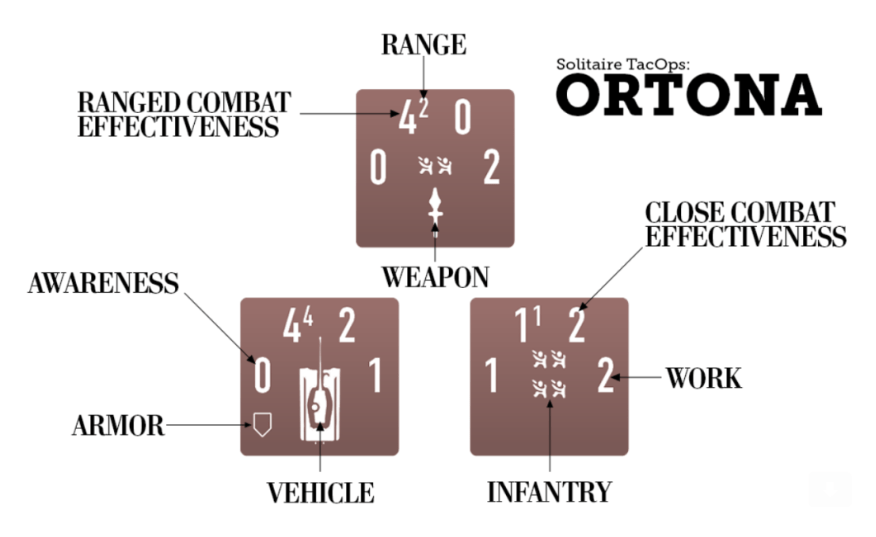
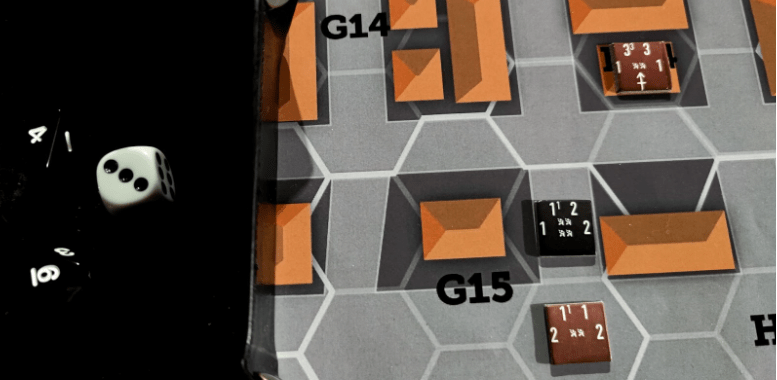
NBS: The art on the counters is still subject to change but the organization is likely to be similar. Iconography is used for the effective value of units, with soldier and weapons silhouettes. Then there are four primary stats on the counters. On the left side there is the Awareness Value which is used both for maneuver actions and as a defensive awareness when under attack. On the right side is the Work Value which is used when units perform more stationary tasks like searching an area, building a bridge, calling HQ, or rallying pinned units. On the top of the counter are Combat Effectiveness stats. The left one is for ranged combat with the range shown as a superscript. The right stat is for close combat conducted against adjacent enemy units.
Grant: What is the dice system that is used to make both player and opposition actions?
NBS: The dice system is quite unique for wargames but was inspired by the Ironsworn/Starforged RPG System. All actions are resolved by rolling 1d6 for the player against 2d8 for the opposition. The player’s roll is modified by the player and opposition stats tied to the action. All the dice are rolled. If the player’s modified roll is equal to or greater than both of the opposition dice then it is considered a success. If only equal or greater than one of the opposition dice then it is considered mixed. If less than both opposition dice it failed. Each action has instructions for how to resolve the roll as a success, mixed or failed result.
Grant: What is the Megahex Activation System? How does it function?
NBS: Megahexes is a callback to a big inspiration for the game which is the old SPI game Cityfight by Stephen Donaldson and Joseph Balkoski. The high level idea is that zones of control are on the map more than they are with the unit. Controlling territory is about controlling megahexes which is accomplished by having every hex in a megahex adjacent to one of your units. Territorial gains are measured in megahex control, which is what the Germans most actively contest.
Grant: What are the priorities of the opposition? What decisions will be required by the player to control the opposition?
NBS: The general pattern for the Germans throughout the boot portion of the Italian campaign was to hold positions at prepared defenses for long enough to inflict significant casualties and then pull back to another prepared position. It was almost purely attritional with the intent to delay the Allied forces while degrading their combat effectiveness.
In individual scenarios, the Germans will cycle through a series of postures that reflect this strategy. They patrol from their prepared defenses, with some recon to determine the allied location so that fire support can be prepared. Once contact is made they fight hard to inflict casualties. Then, due to either causing enough Allied casualties or taking too many of their own the Germans will retreat back to a defensive position for the next scenario.
Grant: What type of experience does the opposition create?
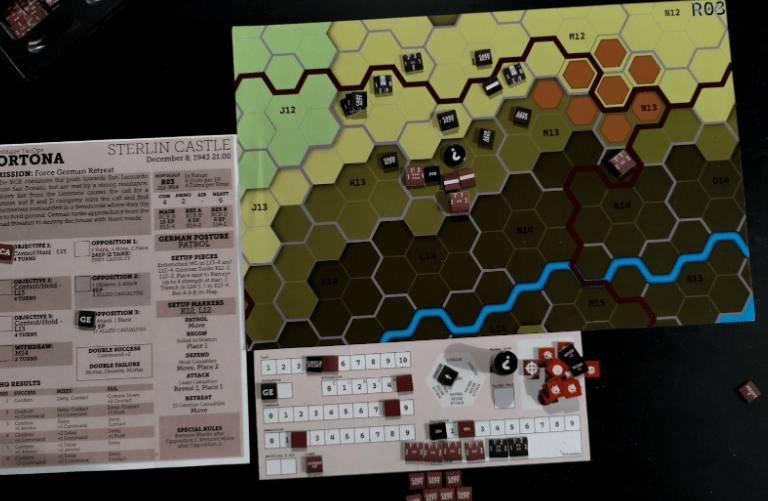
NBS: While at a high level the Germans follow this pattern, each engagement is quite unique even for the same scenario. The player never knows where all of the Germans are, as a strong fog of war is maintained. They also don’t always know what type of support the Germans have. The distribution of units and effects change with each play. The game enforces the need for using tactics that can account for any type of German behavior.
Grant: How does combat work in the design?
NBS: There are three types of combat – ranged, close and melee. Ranged combat is performed by weapons at a distance. The ranged effectiveness of the weapon is evaluated against the awareness of the target to provide a modifier before the resolve roll is made. Close combat can occur when units are adjacent and happens just like ranged combat but using the close combat effectiveness stat. Additionally, if the result of close combat is high enough the attacker has the opportunity to move into melee in the same hex. Melee combat is resolved the same as the other combats but the modifier only uses the soldier silhouettes as the effectiveness values for both sides.
Grant: How important is support for these combats? What choices does a player have about the use of their assets?
NBS: There are no assets in the game, but there is air and artillery support as well as weapons attachments which come as additional units in formations. Choosing which weapons to bring for a specific scenario is often critical to success. Additionally the tactical use of that weapon to maximize effectiveness is important. For example, if a scenario sees the Germans in entrenched positions but the player has no artillery support, they may want to include mortars with the formation to be able to break those entrenched positions.
Grant: How do players go about trying to minimize casualties?
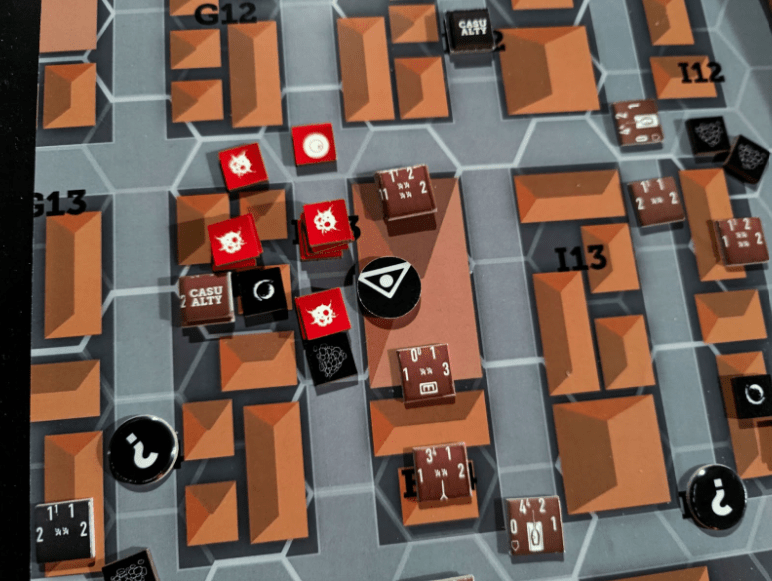
NBS: Casualties are an important part of a design as they are critical for measuring effectiveness. Historically both sides took heavy casualties and that is reflected in the game. Players will do what they can to minimize them but the real question is what they do after the casualties have been taken. Physical casualty markers are placed with units that take losses, and if those markers are not returned to the rally point before the end of a scenario they could be lost.
Units will often carry casualties. Even though this makes them less effective in the near term, losing those casualties will make them less effective in the long term. The same is true for the Germans though they can be a little more cavalier with their casualties.
Grant: How do the scenarios work together and play off of each other?
NBS: There are two modes of campaign play. The historical campaign involves just following the historical path of the First Canadian Infantry Division up the coast to Ortona, scenario by scenario. In the more open campaign the player starts on the far bank of the Moro River and can decide where they want to send their units and when. They have to determine the German composition and plan their missions accordingly, charting their own path to and through the streets of Ortona.
Grant: How many different scenarios are included? How do they differ to create a challenge for the players?
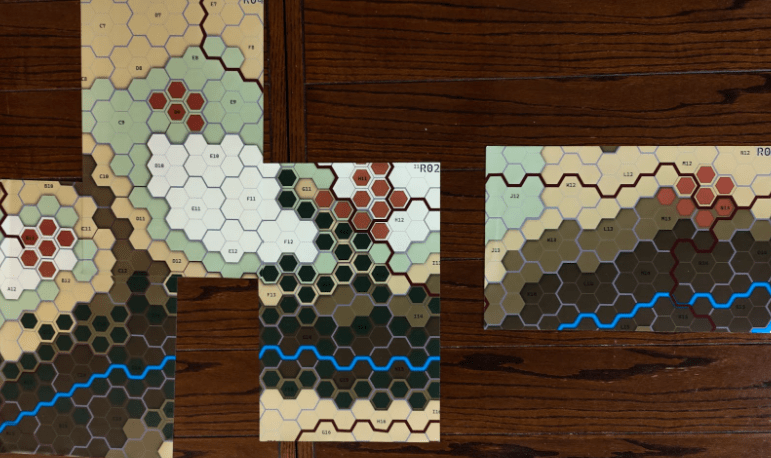
NBS: The final count on scenarios is still being determined. There will be sixteen maps, 8 regional and 8 urban so at the very minimum there will be sixteen scenarios. Each scenario is designed around historic engagements with the terrain playing a huge role in the variability between them. From the gullies of the regional maps to the rubble piles on the urban maps, the player will be challenged to choose and use the right formations to approach each scenario for maximum effectiveness.
Grant: What do the scenario maps look like?
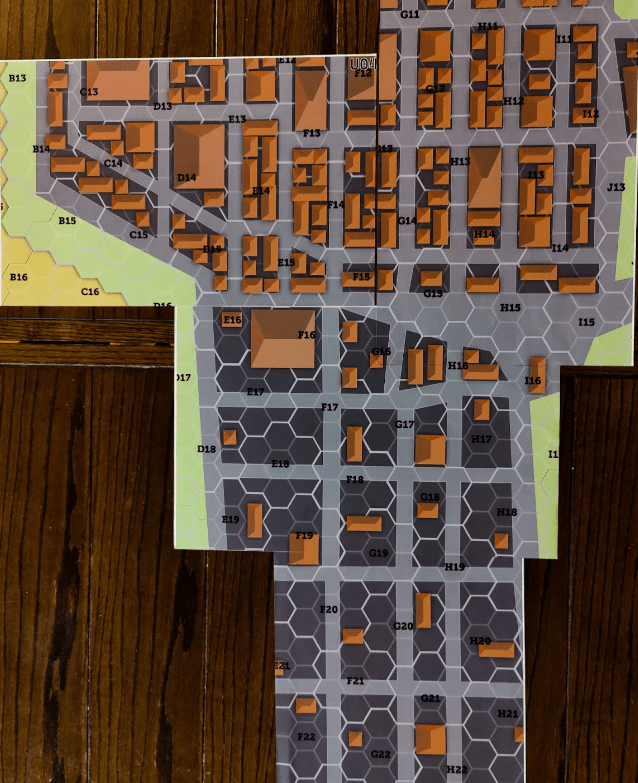
NBS: First four urban playtest maps show Ortona proper. The scenarios connect through gameplay as players push their forces up through the streets of the town.
Grant: How do the scenarios lead to the final engagement in the streets of Ortona?
NBS: The first half of the campaign is on the regional maps. Because of the timeframe the Canadians had to chart their path to Ortona contending with destroyed roads and bridges, weather and other challenges to getting their full fighting force into the town. The main objective of the regional maps is to push up the coast and reach Ortona with a fighting force strong enough to take the town from the Germans.
Grant: How does the German resistance in the urban setting differ?
NBS: The urban maps are at a much lower hex scale to reflect the tactical urban situation. The Germans have the defensive advantage here, having had the time to turn buildings to rubble, set traps, and take strong positions around key areas hoping to force the Canadians into fire lanes where they can use their advantages.
Inside the town the layout of the streets plays a huge role as each block becomes somewhat isolated. German familiarity with the area means they have lots of places to hide making it important for the Canadians to clear every inch of ground they take.
Grant: How does the player have to deal with destroyed buildings, rubble piles, mines, snipers, and other traps?
NBS: The non-combat unit stats really show their value once players get to the urban maps. Awareness is critical to avoiding the traps and traversing the obstacles the Germans have laid. Doing the work to search the buildings and clear the rubble can be slow going but protects your units. You will want to have protected your engineers on the regional maps so that they are still available to clear mines and repair tanks. When the enemy is spotted, falling back on tactics like suppressing fire, leapfrog movement and the effective use of weapons is essential to pushing the Germans back and avoiding losses.
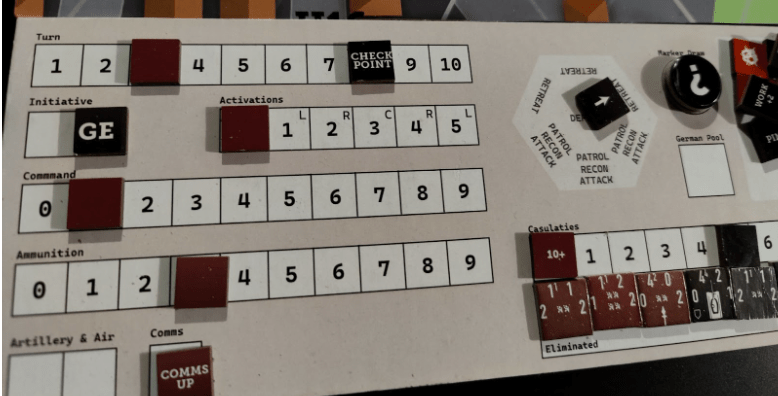
Grant: What information is continued on the Dashboard Display?
NBS: The Dashboard Display is an at a glance look at the current status for a scenario. It lets you know turn and initiative, with player activations, as well as the command value and ammo levels for the scenario. Additionally there is a display for the German posture which informs their movement from turn to turn.
Grant: How does the player use the Campaign Tracking Pad? What important information is recorded on this tool?
NBS: When playing the open campaign you keep a record of your forces by formation. As you go into each scenario you are consulting the campaign sheets to determine what formations are available and at what strength. There are times where you may want a regiment to sit a scenario out so they can recuperate, while other times you won’t have a choice but to send a formation at diminished effectiveness. You may want to send your full strength regiment into the heat of the action, but it may take a full day to get them there. Like historical war diaries, the tracking for the open campaign will tell your on the ground story of the full campaign.

Grant: What type of experience does the game create for players?
NBS: Just playing a scenario stand alone can be a pretty intense and engaging experience. They are all designed to give players a good challenge on their own, which, because of the way the Germans behave, is sure to be replayable multiple times, always yielding a new experience. Once a player has some experience with managing the tactical situations they can challenge their operational acumen by trying the campaign to see if they can repeat the successes of the First Canadian Infantry Division in taking the town of Ortona.
Grant: What are you most pleased about with the design?
NBS: The thing I’m most pleased with about this design is the variability. Each time you set up a scenario you are bound to get a different play experience. It is not random but carefully tuned for variability that adheres to the historical setup. This means you cannot predict what will happen from turn to turn and thus must really reinforce your own tactics to prepare for anything and be ready to pivot as needed.
Grant: What has been the feedback of your playtesters?
NBS: Most of the playtesters have been pleasantly surprised by how the game plays. There’s a unique flow to it. For example there is no opportunity fire, which when you look at it may make it seem that you can chain actions together to walk right down the middle of the street in front of an entrenched machine gun no problem. Yet you quickly learn that even without that immediate opportunity fire to stop your movement, the game is able to account for the risk you would take by doing so and make you pay for it dearly.
Grant: What elements still need testing and refinement?
NBS: Right now we are really just refining the campaign rules to make sure all of the historical scenarios are strong, and that the more open campaign is as fluid as single scenario plays. Things are pretty close so hopefully we’ll be design complete soon and can start thinking about the broader presentation of the game. I make the playtest art with some fidelity to get a good sense of the experience through design and development, but it will all change when we get a proper artist attached to the project. If it works out for Ortona the way I think it might I think everyone will be quite pleased with the final art.
Grant: What other designs are you currently working on?
NBS: I have plenty of games in the works. In this vein I’ve got a co-design with David Thompson about the integrated Fifth Platoons of the American Army in WWII. It is a cooperative game focused on the action around Honningen, Germany in 1945. I also have Overthrow, a 2-player design that uses a modular map to simulate 24 hours of a coup attempt. Then there is my WWI system Tactics to Doctrine, which is a 2-player campaign system focused on the battle of Verdun. There’s actually a secret cabal of WWI designers right now that are going to make wargamers really excited about the period. Every one of them provides new insights into the realities of the great war. Me and Volko have been comparing notes for a while now, and there’s a game by another designer I’m not at liberty to discuss yet, but let me tell you, if you are a fan of WWI or even if you are a skeptic that thinks that gaming WWI is the boring slog of trench warfare, get ready to be wow’d over the next few years.
Thanks for your time in answering our questions Non-Breaking Space. I am very excited to bring this new and interesting looking game to our readers while also learning about it myself. I am really interested in your approach to this tactical level game and also am very much interested in the solitaire aspect and how it works. I cannot wait to get this one to the table in the near future!
If you are interested in Solitaire TacOps: Ortona, you can pre-order a copy for $46.00 on the P500 game page at the following link: https://www.gmtgames.com/p-1072-solitaire-tacops-ortona.aspx
-Grant
 The Players' Aid
Looking forward to this and Cross-Bronx very much.
Will also be nice to add another game to the short list of games about the coup d’etat!
LikeLiked by 1 person
Cross Bronx Expressway will definitely be interesting. I look forward to what else NBS comes up with. Thanks Brian!
BTY played a game of 4-player A Distant Plain last weekend with friends in Pittsburgh and had a great time. That game is soooo very good and each time I play it I realize how good it is. I think that was my 7 play and I am always looking forward to the next opportunity!
LikeLike