
With this new My Favorite Wargame Cards Series, I hope to take a look at a specific card from the various wargames that I have played and share how it is used in the game. I am not a strategist and frankly I am not that good at games but I do understand how things should work and be used in games. With that being said, here is the next entry in this series.
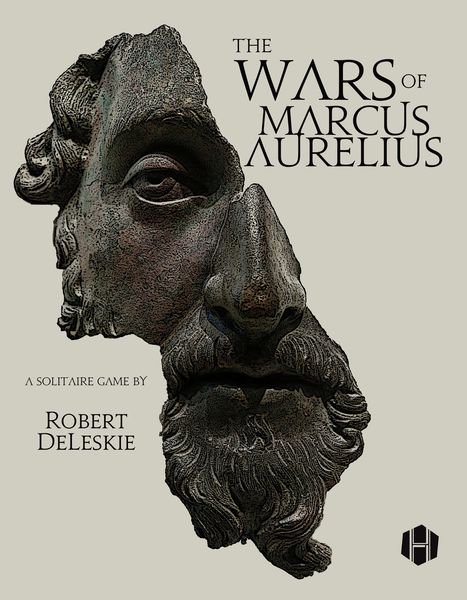
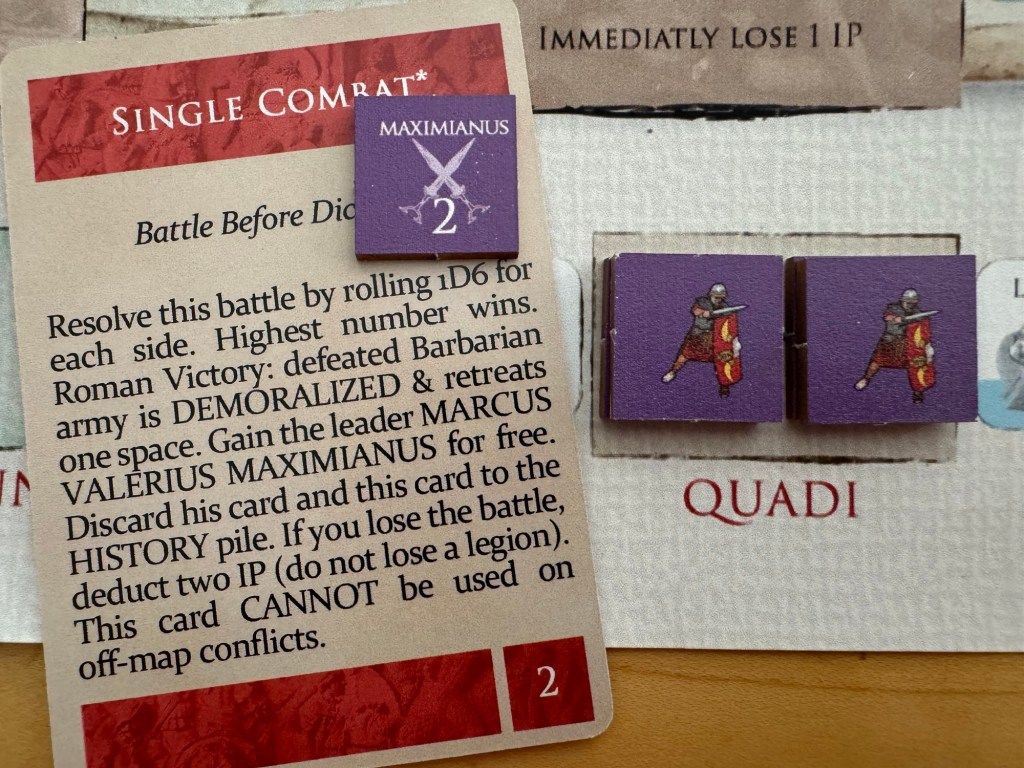
Card #11: Single Combat from Wars of Marcus Aurelius
The Wars of Marcus Aurelius: Rome 170-180CE is a solitaire only game that uses cards similarly to a CDG to simulate the strategic level struggle of the Romans led by Marcus Aurelius to stave off the invasions of Germanic tribes and Sarmatian raiders as they encroach on Roman territory across the Danube River. That’s the history. And it is really well integrated. The game play is very fun, strategic, with lots of decision points about what to do and what cards to use, and it is really challenging.
One of my favorite parts of the game is the combat. You have a standing army that you assign a leader and also place on a specific track that is attacking barbarian hordes in that region and have to go about trying to destroy them and quell their resistance to Roman rule. This combat is brutal and sometimes is very challenging if you don’t have the right leader, enough soldiers and the right cards in hand. One of my favorite cards in the game is Single Combat because it throws all of the battle rules out the window and a combat comes down to the leader versus the leader in a die roll off!
The use of this card for the printed event is a bit of a risk as in the case of a loss you will lose 2 Imperium Points, which draws you closer to being usurped by your internal enemies. But when the cards are stacked against you and you have little other hope for a victory this card can be a lifesaver. Especially when you are shorthanded or your leader is demoralized (as shown in the picture below as Marcus Aurelius is mourning the death of one of him family members). This card is the great equalizer and can be played to even the odds in a fight. First, you must discard another card in your hand to initiate a battle. As you can see, the card says “resolve this battle” and denotes that you must actually be participating in a battle which requires the discard. After you have discarded your card to initiate the battle you play this card and the normal rules for a battle are thrown out the window. This card is very powerful in the instance where you are simply outgunned. For example in the picture below, the Roman player has several things going against them. One, Marcus Aurelius is demoralized and will only contribute +1 to the battle whereas normally he contributes a total of +3. You will also notice that he only has 4 Legions in his army out of the maximum of 6. This means that he will only add +4 for troops to the roll rather than the total possible of +6 as he had lost a few battles prior to this combat and some of his Legions were removed. His enemy the Marcomanni are also being led by a fully bold leader and they are receiving a huge +8 modifier from the terrain in the home space. The chances of the Roman winning this battle following the conventional battle rules are pretty slim. Playing the event Single Combat takes all of those modifiers away and simply forces the battle to be determined by an even roll off of a d6.

Now I know that the battle comes down to a die roll off with the highest roll winning but really this is a better choice than a normal combat and I really like the option here. But (and there always seems to be a but in this game), while this card has a great ability that will make a difficult battle winnable by the Romans, there is a catch. If the battle is lost the Roman player will lose 2 IP (Imperium Points) and will get closer to an automatic loss by being usurped. You must tread lightly with this event and remember that fortune favors the bold.
The player will also gain a great leader if they win the battle in Maximianus. His value is a 2, which is the 2nd best value amongst the leaders the player has access to. So winning the battle is nice but also gaining this guy to lead is a real bonus. Marcus Valerius Maximianus was a very important Roman general of the period of the Marcomannic Wars during the reign of Marcus Aurelius. He was born in the Roman colony of Poetovio (modern Ptuj in Slovenia), where his father, also called Marcus Valerius Maximianus, was a local censor and priest. He was decorated for services in the Parthian War of Lucius Verus and was appointed by Marcus Aurelius to ensure the armies in Pannonia were supplied by boats on the Danube. It is also known that Marcus Valerius Maximianus knocked the Naristae Tribe out of the war after he defeated their chief in single combat in 171CE.
I shot a playthrough video for the game and you can watch that at the following link:
I also followed that up with a full video review sharing my thoughts:
In the next entry in this series, we will take a look at the English Home Card Six Wives of Henry VIII from Here I Stand: Wars of the Reformation 1517-1555 from GMT Games.
-Grant
 The Players' Aid