
Our friend Gregory M. Smith is a solitaire genius and has done many of these solo, narrative driven wargames that we have all enjoyed for hours on end while we have been unable to find an opponent or just because we want to play a game on our timeline. We have interviewed him many times for his games such as Zeppelin Raider, Interceptor Ace, The Hunted, Western Front Ace, Amerika Bomber, Defending America, American Tank Ace and most recently British Tank Ace. Greg always has something cooking in his game design kitchen and recently I saw mention of an upcoming game that will be appearing in Paper Wars Magazine from Compass Games called Sinking Yamato: The Final Cruise of the Super-Battleship: April 7, 1945. I reached out to Greg and he was more than willing to talk with me about this new game.
*Keep in mind that the design is still undergoing playtesting and that any details or component pictures shared in this interview (with the exception of the near final cover) will change prior to final publication as they enter the art department.

Grant: What is your new upcoming game Sinking Yamato about?
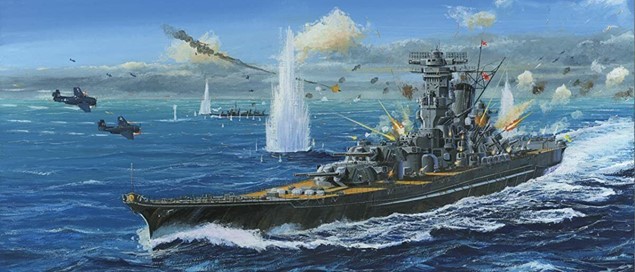
Greg: Sinking Yamato is a solitaire game covering the final voyage of IJN Yamato, Japan’s super-battleship, on April 7th, 1945. The game focuses on the fact that the last mission given the ship was a suicide mission and the player has to attempt to last as long as possible against an inordinate amount of US air power arrayed against it and continually attacking.
Grant: What inspired you to make this game?
Greg: I actually recently got a Japanese movie DVD called simply Yamato, which was made in 2005. Although I had to watch it with the subtitles on, it was extremely interesting and very grim. I couldn’t remember anyone having done a game on this final voyage, so I thought I should in order to expose gamers to this amazing story.
Grant: What sources did you consult to get the details correct?

Greg: The “bible” for this project was the book Battleships Yamato and Musashi by Janusz Skulski and Stefan Draminski. Although an Osprey title, it is not some flimsy small book. At over 300 pages and containing hundreds of drawings and photos, tables and schematics, it was invaluable to my design efforts.
Grant: As a magazine game, how did this change your usual approach to the design?
Greg: Well, if you remember from last year, I didn’t think I’d ever do another magazine game (as they are a bit too restrictive on what you can do and include). I didn’t lie, the truth simply changed! Ty Bomba had a slot come open unexpectedly, and the game I had come up with actually perfectly fit the magazine format (one map, with tables on the map, not a lot of counters, etc.). So it wasn’t so much I changed the design for this one, rather, the design itself fit the format offered from the beginning.
Grant: What is the player’s goal in the game? How realistic is it to earn a victory?
Greg: The goal is to simply survive as long as you possibly can. There is no real “victory” possible in this game – compare it to a game about Custer and the 7th Cavalry. You won’t survive since there are hundreds of American dive bombers and torpedo bombers attacking you, wave after wave. Hundreds. You can earn a “game victory” however. I would say it is realistic in the sense that in the real battle, the Yamato lasted two hours. The game gives realistic results in that sense.
Grant: What does a victory look like in the game?
Greg: You have to stay alive as long as possible. If you get sunk early, it’s a loss. If you can last until the last wave of American planes, it’s a win.
Grant: What is the general Sequence of Play?
Greg: You roll for wave arrival. Assuming your radar hasn’t been knocked out, you know in advance if that’s port or starboard so you can train your big batteries in that direction. The attacking planes in each wave arrive randomly (bow, stern, or midships) and you have to allocate your AA fire. Then, any surviving aircraft attack. You then allocate your damage control teams, possibly replace eliminated gun crews, put out fires, and counterflood if needed (to keep the ship from capsizing).
Grant: How many waves of American aircraft are there? How does each of these waves differ?
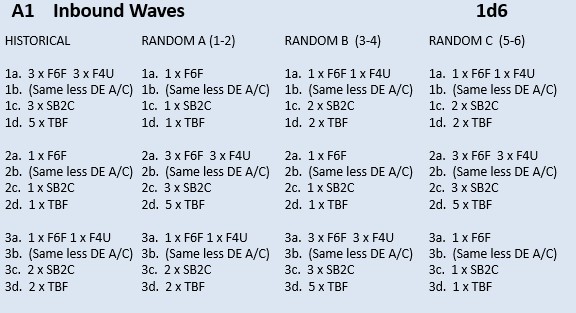
Greg: If playing historically, there are three large waves (each consisting of four sub-waves) for a total of 12 attacks inbound. These waves differ in aircraft composition not only numbers, but types. Most waves have a mixture of fighters, dive bombers, and torpedo bombers in various amounts.
Grant: What starting preparation decisions does the player have to make?
Greg: To add to the player’s decision making I have allowed players to make choices of where to focus his training (gun crews, or damage control) and what spare resources to request before sailing. The choices will either give the player a slightly better defensive situation, from a damage control standpoint, or a better offensive situation from an AA standpoint. Or he can opt for a little of both.
Grant: How do these decisions ultimately affect the outcome?
Greg: The “Battle Preparation and Training Focus” part of the game really doesn’t truly give the player a huge advantage in survival, but they do give options for how you want to approach survival and will definitely effect the game outcome.
Grant: How are the damage control teams used? What abilities do they have to repair?
Greg: Damage control teams have multiple uses. They can fight fires with a die roll, and prevent flooding. A Veteran Damage Control Team automatically stops fires and flooding, but you can only have one such team maximum. The problem is the teams tend to get killed due to the continual wave of attacking planes, especially by bombing. Placement of the teams is important as well
(port or starboard, bow or stern.)
Grant: How do players have to counter-flood the boat to prevent capsizing?
Greg: Counterflooding decisions come at the end of each sub-wave (each turn, basically) and you have to flood the opposite sides of the ship (and opposite ends at times) as you don’t want to nose down, or roll over. The problem is it can get you very close to just flat out sinking, and it slows you down considerably making you more of a sitting target. Counterflood carefully – sometimes it might be better to be listing a bit (which hurts your AA ability) in order to save a box of flooding.
Grant: What is the layout of the board?
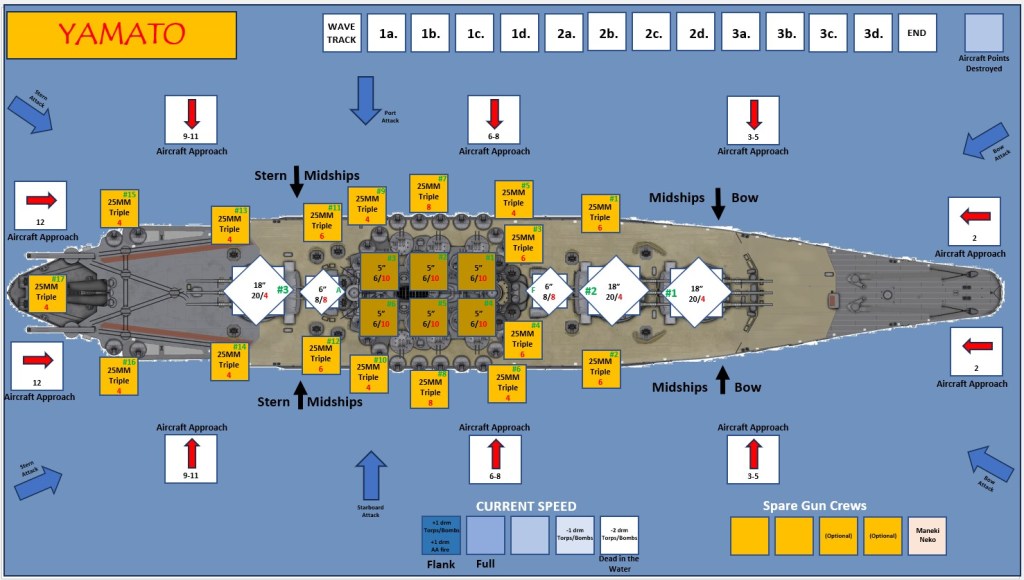
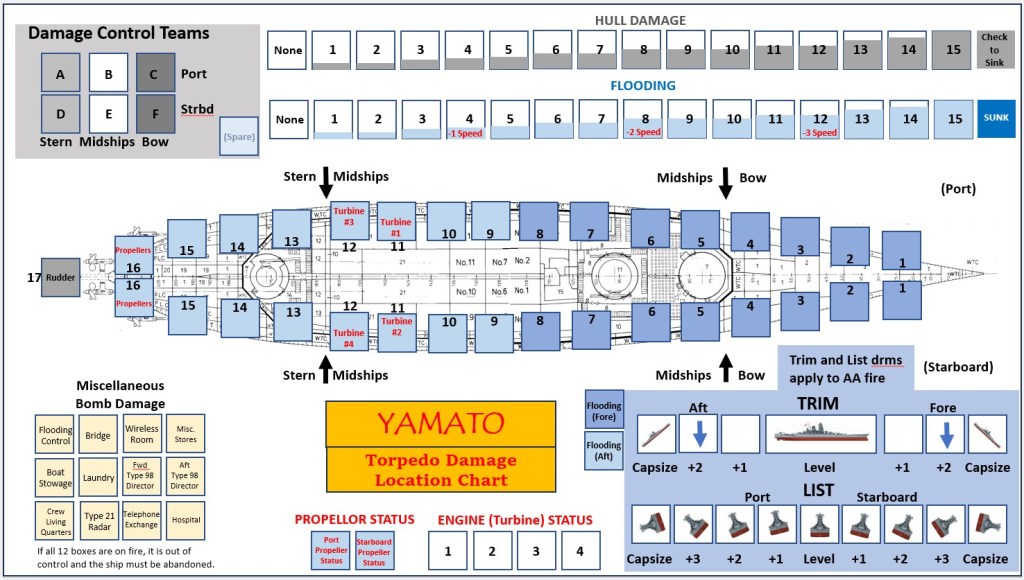
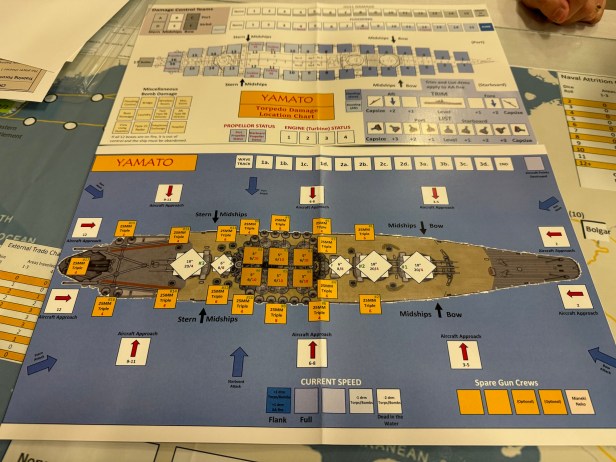
Greg: The board has a top down view of Yamato, with the guns up top and a second view of the below decks (to show the location of torpedo hits and flooding).
Grant: What different combat charts are included?
Greg: The combat charts are reasonably simple: there’s a chart to fire AA, there’s a chart for the US planes to strafe your gun crews, a chart for dive bombing, and a chart for torpedo bombing. Other charts give you the locations of the hits.
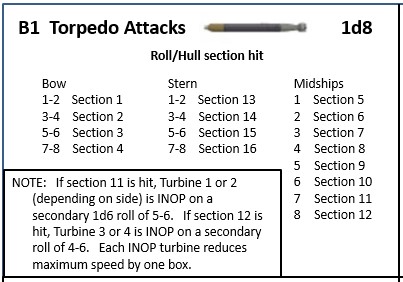
Grant: What are the purposes of the different dice as players will be asked to provide one twenty-sided, one eight-sided and two six-sided dice?
Greg: Curiously enough this is my first design to require eight-sided dice. Torpedo damage occurs by section of the ship, and this turned out to be four, eight, and four sections per side. Therefore eight-sided dice were perfect for that. The twenty-sided die is used to determine what portion of the AA guns the American Strafing Attacks will target. The other attacks and damage worked out better with standard six-sided dice, so those need to be used as well.
Grant: What is the anatomy of the different attack aircraft counters?
Greg: A certain amount of abstraction had to occur, so each aircraft counter represents roughly 20 attacking aircraft. This was needed as almost 400 U.S. aircraft came on the 7th of April, 1945.
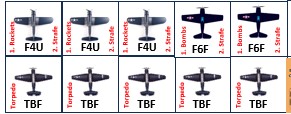
Grant: What different special attacks does each aircraft type possess?
Greg: The fighters actually bomb and fire rockets, depending on the type, but all of them strafe. The Japanese player will find many of his gun crews wiped out accordingly (these are the 25mm triple mount crews, which were exposed on the deck with only a small gun shield at best for protection.) The dive bombers drop armor piercing bombs, of course, and the torpedo bombers launch torpedoes.
Grant: What different defenses does the Yamato possess?
Greg: The Yamato went through several armament upgrades throughout the war, but the final 1945 configuration included an astonishing 150+ 25mm AA guns in triple mounts. Sadly the 25mm triple mounts proved to be not very effective. There were also six six-inch guns in two triple mounts, one fore and one aft. Probably the best AA defenses were the twelve 5″ guns in twin high-angle mounts, three per side. The nine 18″ main guns, in three triple batteries, were of very limited use but actually had a “beehive” incendiary round that was used for AA purposes. The game amalgamates a lot of the 25mm triple mounts into groupings, in order to keep things playable.
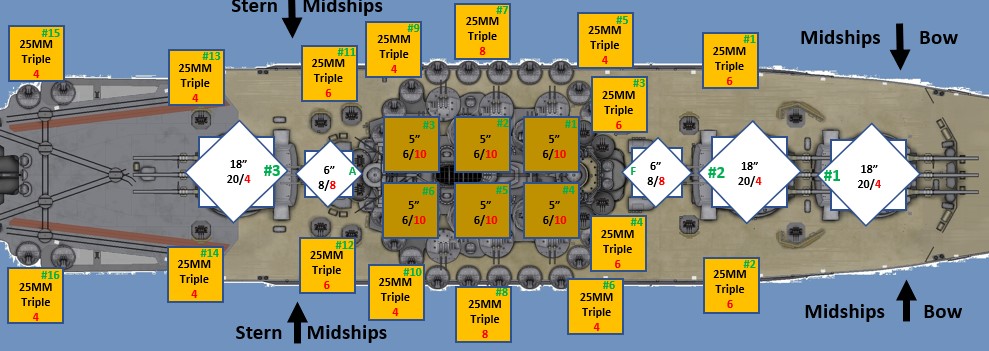
Grant: How are firing decisions made by the player?
Greg: After determining where the aircraft are arriving from, the player assigns all his AA fire then executes it. Not all mounts can hit all targets, of course, and the player has to decide which guns fire at what available targets.
Grant: What optional rules are available?

Greg: There are a few optional rules, such as allowing the player a good luck charm (re-roll) and also a multiplayer game (the game is primarily designed as a solitaire game, however). The main optional rule allows for the arrival of the USS Hancock’s 53 plane strike, which historically got lost and never arrived for the battle. Fortunately, they were not needed, but this optional rule serves to make things a bit tougher for the Japanese player.
Grant: What type of experience does the game create for players?
Greg: Mainly, I think the players will get a sense of the futility of what the Japanese were asked to do in Operation Ten-ichi-go. There are some decisions to be made, but at its heart it is a lost cause as you fight to keep the battleship afloat. The Japanese officers knew that without air cover, they were doomed, but they went anyway. I think the game gives you that sense of relentless attacks. It’s actually somewhat amazing that the “low end” estimates are ten torpedo and seven bomb hits, while the Osprey book lists as many as 35 torpedo and 19 bomb hits. The actual number will probably never be known.
Grant: What are you most pleased about with the design?
Greg: It is just a fun, interesting and clean little game that plays fast, but I think what I liked most about the design is you get a feeling you are playing with a miniature of the ship due to the map essentially being the deck of the ship with all the gun emplacements. It feels like a “miniatures” experience more than just a straight wargame.
Grant: What has been the feedback of your playtesters?
Greg: The testers had some great feedback at the last convention, mainly “tweaks” here and there. The main takeaway was they enjoyed it. It’s not a monster game, or a battle of maneuver. It’s literally just recreating a specific situation where the world’s largest battleship was sunk. It is small, and fast playing, and that’s why I was happy to have it as a magazine game.
Grant: When can we expect to see the game released?
Greg: I am not sure when Paper Wars Issue #112 is due out, but that’s the issue it will be in.
Grant: What other designs are you currently working on?
Greg: I’ve got a few irons in the fire. Insurgent Tide (Iraq counterinsurgency 2003-2008), Carrier Ace (Pacific war from the decks of US aircraft carriers) and Panzer Ace and British Tank Ace (the follow on games to American Tank Ace). Rebel Tide and Sensuikan are both almost complete, and I also just started on a Vikings game that will resemble Strategy & Tactic’s Conquistador from back in the
1970’s, at least to a degree. So, I am still keeping busy 🙂 Thanks as always and let me know if you have questions.
If you are interested in Sinking Yamato: The Final Cruise of the Super-Battleship April 7, 1945, you can pre-order Paper Wars Magazine Issue #112 from the Compass Games website at the following link: https://www.compassgames.com/product/subscription-issues-109-to-112-with-game-us-domestic-shipping/
-Grant
 The Players' Aid