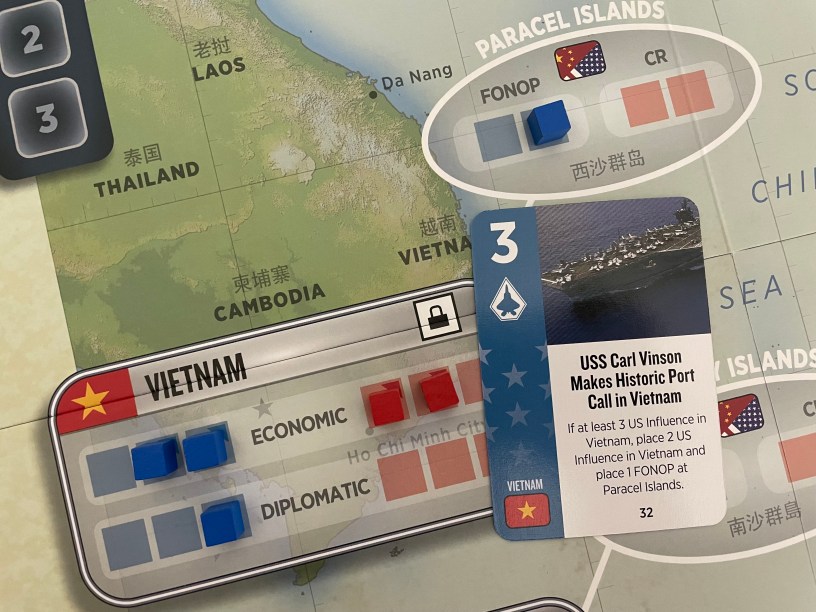
With this new My Favorite Wargame Cards Series, I hope to take a look at a specific card from the various wargames that I have played and share how it is used in the game. I am not a strategist and frankly I am not that good at games but I do understand how things should work and be used in games. With that being said, here is the next entry in this series.

The South China Sea has been described as “a crucial link in the ‘global commons’, connecting the Pacific to the Indian Ocean, Persian Gulf and Europe. Right now, along with the East China Sea, it is the most contested piece of sea in the world and one of the main reasons for the current anxiety over China’s intentions”. It will be fought over, at least ideologically, for the next decade and will be a source of much concern for the West. You might say it is a powder keg and all it needs is a spark. With this in mind, we are going to take a look at a card from Flashpoint: South China Sea from GMT Games designed by Harold Buchanan. The game is a fast playing 2-player strategy game that simulates the complex geopolitical contest currently taking place between the United States and China in the South China Sea. The game is a Card Driven Game that uses cards to allow players to play out the struggle using events based on today’s headlines and use these cards to take actions that will provide dominance over regions and score victory points at any time during the game. We had a great time with this one and I also really enjoyed the solo mode, even though it was brutally difficult.
Card #9: USS Carl Vinson Makes Historic Port Call in Vietnam from Flashpoint: South China Sea from GMT Games
One of my most favorite aspects about the Card Driven Game genre is that of managing the negative effects or capitalizing on the effects of a card by paying attention to the current board state and whether or not various pre-requisites for a card’s event are met in order to go off. This can be a real source of tension as you look at a card and realize either it can or won’t hurt you now but if you wait it might become suited for it to be able to be executed. The USS Carl Vinson Makes Historic Port Call in Vietnam is a good example of such an Event that has a prerequisite to play. The card also provides the player with the opportunity to place both Influence Cubes and a FONOP (Freedom of Navigation Operation) on one of the disputed islands in the South China Sea. This is a very powerful dual effect that players must be ready to take advantage of.
The card is a 3 Operation Value Event Card aligned with the United States with the following text:
If at least 3 US Influence in Vietnam, place 2 US Influence in Vietnam and place 1 FONOP at Paracel Islands.
This Event Card has a prerequisite that at least 3 US Influence must be already placed in Vietnam. This can be of either type, Economic or Diplomatic. If this is the case, and in the picture below it is, the US player can then take the action as written on the Event by placing 2 US Influence in Vietnam and also being provided the added benefit of placing 1 FONOP at the Paracel Islands.
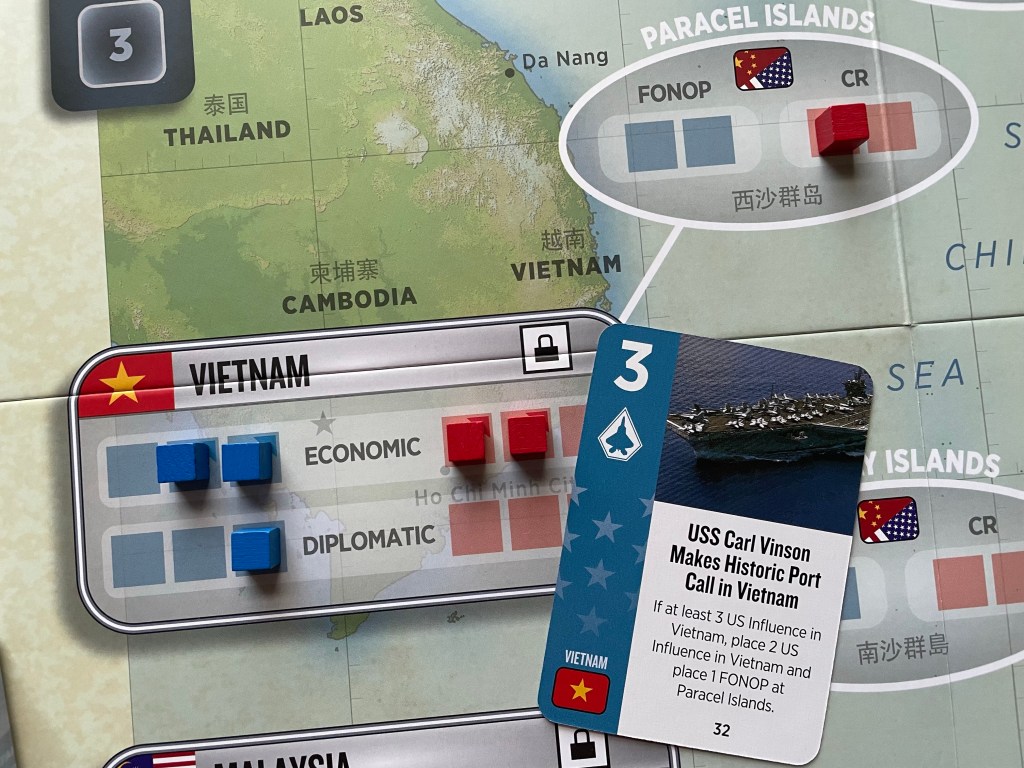
The important point I wish to show here is that Event Cards and their text are very powerful. They typically provide multiple benefits that are way more efficient than doing the same thing by using the Operation Value on the card to take the same actions. For instance, in the case of the USS Carl Vinson Event, the actions granted, namely placing 2 Influence Cubes and 1 FONOP, would have cost a total of 3 Operation Value. So the same. But the difference here is that the Event ignores any restrictions from the Tension Level. See, if the Tension Track was in the High Space, the FONOP would have been unable to be placed. With the Event text though, the player could have ignored that prohibition and placed the FONOP. There is power in the use of Events as they break or circumvent the rules.
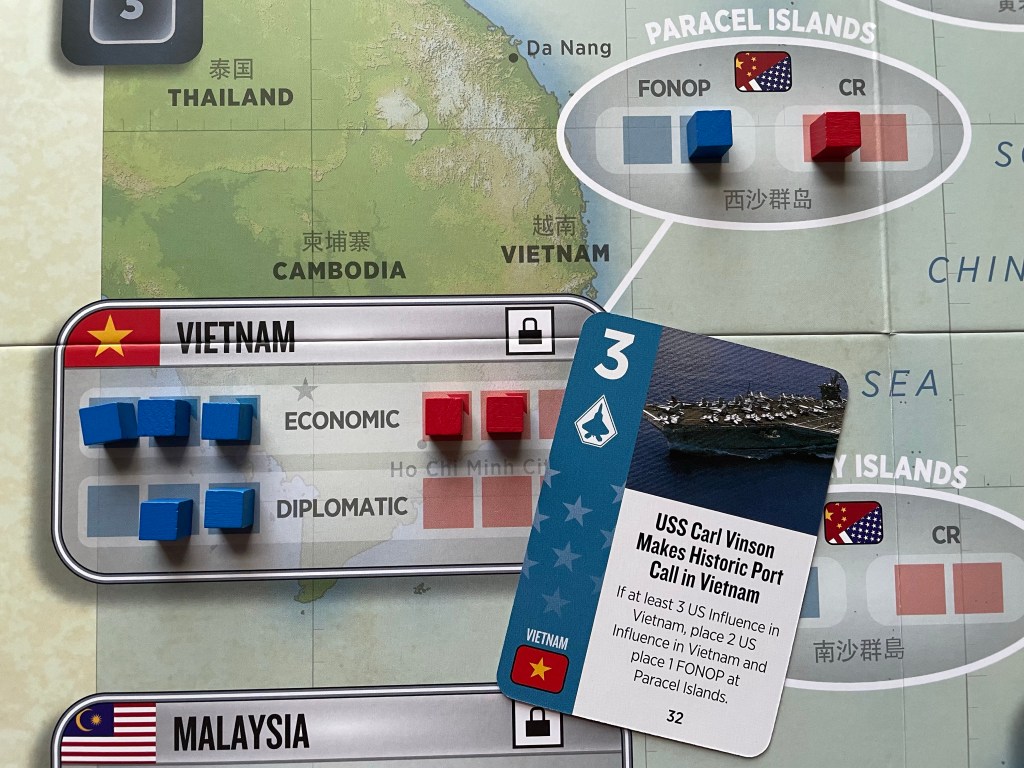
The other key element with this card is that it is a bitter fight to control the various Islands on the board with the FONOP markers. China seems to have a bit of an easier time in accomplishing the placement of FONOP and they also don’t lose them the way the US player will at the end of a turn. This card is a great example of a powerful dual benefit event that players must be on the lookout for in the game.
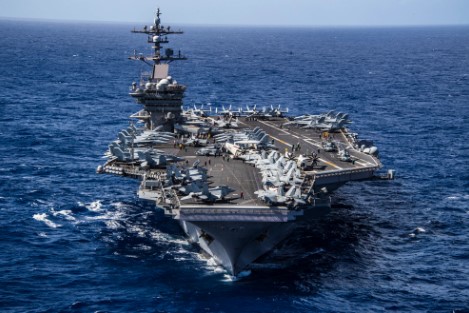
The USS Carl Vinson, which is homeported in San Diego, California, is the third Nimitz-class nuclear-powered aircraft carrier and one of only 11 operational aircraft carriers in the United States Navy today. Approximately 3,000 men and women make up the ship’s company, and they keep all parts of the aircraft carrier running. They do everything from preparing meals to handling weaponry and maintaining the nuclear reactors. Another 2,000 sailors comprise the air wing, the people who fly and maintain the aircraft aboard the ship. These aircraft carriers are vitally important to the efforts of the US Navy to keep the sea lanes open in the South China Sea and to maintain a presence so that no one is allowed to take aggressive actions unchallenged.
In the next entry in this series, we will take a look at Outwit Your Foes from Stilicho: Last of the Romans from Hollandspiele.
-Grant
 The Players' Aid