In July 2019, in the “Before Times”, I had the pleasure of meeting Keith Tracton at the World Boardgaming Championships in Pennsylvania. He was showing off his new game at the time World At War 85: Storming the Gap and it was a thing of beauty! Since that time, we have seen Keith design a follow up effort to World at War 85 in the Blood and Fury Expansion and recently I caught wind that he was working on a Sci-Fi wargame with Blue Panther called Raider Drop Zone. I reached out to Keith and he was more than willing to share about the design.
If you are interested in Raider Drop Zone, you can learn more about the design on the game page on the Blue Panther website at the following link: https://www.bluepantherllc.com/products/raiderdropzone
Grant: What is your upcoming game Raider Drop Zone about?
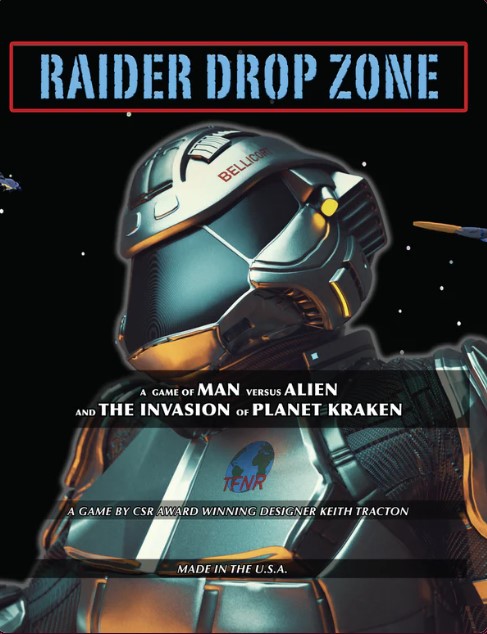
Keith: Raider Drop Zone is an operational level, company-scale Sci-Fi ground combat game. It simulates the invasion of the home world of a subterranean alien species known as the Kraken. The game features three maps: a Surface Map, a Tunnel Map, and a Near Space Superiority Map. The game simulates the interaction between these maps and the effect of Near Space Superiority on the battle. It takes place in my Firepower Pass science fiction universe.
Grant: What was your inspiration for the design?
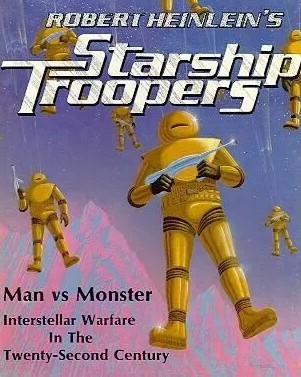
Keith: The original 1977 Avalon Hill game Starship Troopers designed by Robert Heinlein! In the back of the rules for that game is a photo/art montage and one of the items was a Mobile Infantry drop grid governing a much larger combat drop of Mobile infantry than the game portrayed. I decided I wanted to make a game based on that grid and scale.
Grant: What is the setting for the game? How much have you fleshed out the backstory?
Keith: The story takes place in my Firepower Pass science-fiction universe during an epic war between the Star Nations of the Orion and Perseus spiral arms of our Milky Way galaxy. It is a space-opera genre setting of a war between the space-nations occupying adjacent spiral arms of our Milky Way galaxy. The universe has been around since the 1980’s when a friend created it around an alien species he created but needed an opponent: he asked me to develop what has become in Raider Drop Zone the Terran Corporate Consolidation – us humans but called the Terrans – based here on earth and in our Sol star system. I also invented some new space-nations as new opponents. I will be exploring the War Between the Spiral Arms in my future games.
Grant: What is your design goal with the game?
Keith: I wanted a game that fit the scale of companies for Terran troops and the feel of SWARMS of Kraken coming at them. There would be moments of terror for both sides: Raiders can be overwhelmed despite their firepower, but Kraken can fail despite their numbers. I wanted players to command in this game: each Attack they would maneuver to deploy their best combination of troops available in a location, deploy them depending on their opposition, and then hope for the best (the dice rolls!).
I wanted a game that was replayable many times, where a scenario would be similar enough that the stories from it would be fun to recall, yet varied enough that it never played exactly the same way twice. Scenario design is very important to me.
And (this may sound weird), building on scenario design, I wanted a game where both sides are having fun, but yet might feel like they are losing – until the very end!
Grant: What is the scale of the design? Force structure of the units?
Keith: The Raider units represent companies of exoskeleton-armored troopers (say 150-300) or armor units, and their various support troops; while the Kraken represent large swarms of their Dragoon-style soldiers (but numbering in the thousands) and mega-swarms of their Drone workers, including engineers (though fewer engineers, numbering in the tens of thousands).
The ground scale of the planetary surface square spaces that are 75 miles on a side (165 km). On the Tunnel Map the squares are also multiple miles deep, as the Kraken are a subterranean species and their drones and engineers combine to build and maintain underground habitats for them, small and large, and tunnels to connect them underground.
To coin a phrase, I like to think of it as an Epic Operational scale.
Grant: What different armies and formations make up the forces in the game?
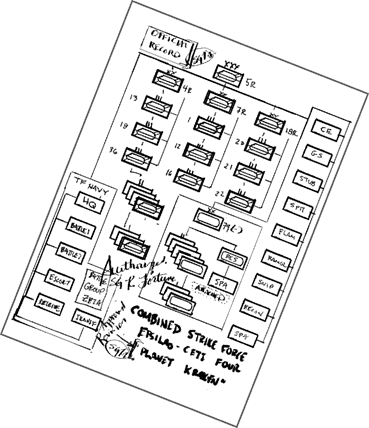
Keith: The Terran Fleet sends their last strategic reserve in the Midpoint Station sector: the 5th Raider Corps. Comprising 3 full Raider exoskeleton-infantry divisions – the 4th, the 7th, and the 18th – and reinforced with a portion of the Terran Interstellar Army’s 79th Armor Division. This is the Kraken home planet so there are tens of millions of Kraken swarming under the surface, a portion of which are fighters – “Dragoons” – and many more of which are drones that perform various combat-related functions. The Kraken also have anti-gravity propelled combat vehicles, their equivalent of Terran armor (hey, they have spaceships, so, yes, tanks too…).
Grant: What different units are included on each side?
Keith: The Terrans consist of Raiders and supporting special weapons teams. Combat engineers, and Ground Sonar sections are also provided to locate and force them to the surface. And of course the massive Ypres anti-gravity propelled tanks for the 79th Armored Division are available, with a small portion of supporting self-propelled cluster artillery.
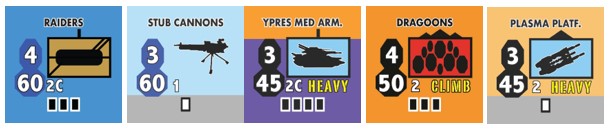
Grant: What is the anatomy of the various unit counters?
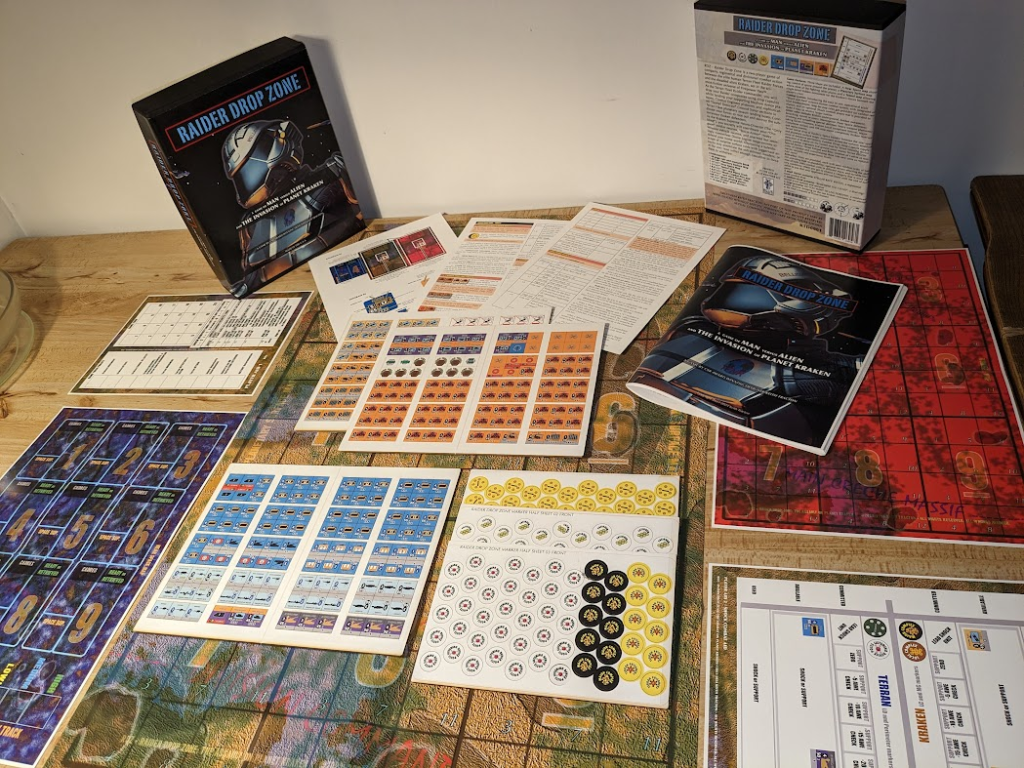
Keith: The counters show the unit type using a symbol or vehicle silhouette; the Shock and Awe values of each unit, used for combat and other game functions; their current strength in steps; their current size shown with a number of pips; a gray Support unit identifier if the unit is not a Shock unit; and the name of the unit.
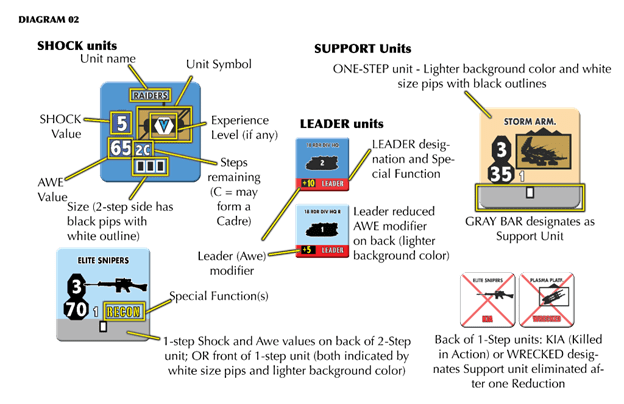
Grant: What are the concepts of Shock Value and Awe Values of units?
Keith: Shock Value wraps a number of concepts into one number. It is at its heart the strength of the unit: its base Shock combat result. But also the number of modifier dice the unit will roll in attack or defense. The higher the Shock Value the better trained/experienced/armed the unit. The modifier dice it rolls modify that base value. Comparing an attacking and defending unit’s modified Shock Value determines the result of any Shock combat between the two units.
The Awe Value is closer to a morale value (so there is some crossover with Shock Value) but is used mostly to determine if a unit maintains its cohesion before, during, or after combat.
Grant: Why is size important?
Keith: If two opposing units are the same size (in number of size pips; they could have completely different Shock Values), then after each rolls modifier dice to resolve the combat if it turns out that their modified values are the same, the larger unit will win. If they are the same size, the defender will win. What this speaks to is if the result of the combat is close then numbers will prevail, otherwise as a design concept if the two sides are the same size, tie goes to the defender.
Grant: How important is Experience Level for the units?
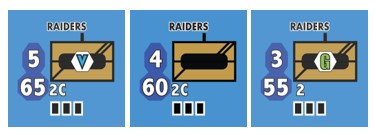
Keith: Experience Levels influence the Shock Values of most units both Terran and Kraken, but are slightly redundant of the increase in Shock Value that is built into the pieces. However, the more experienced Terran units (Regular and Veteran units) have the ability to partially reform after being eliminated. The least experienced Terran units (Green) do not have this capability. The Kraken have something similar for their higher strength units.
Grant: How are units activated? What role do HQ units serve in this process?
Keith: There is no unit activation per se, it’s a U-Go/I-Go turn sequence. It works well to portray the operational differences between the two sides: the Kraken move and fight first as they have the advantage of total intelligence of the Terran deployment. The Terrans move second as they are reactive to any Kraken offensive actions or they otherwise try to seize the offensive momentum and force the Krakens to defend their local and major complexes (“towns” and “cities”). Its an old school sequence of play but it works well with the concept of the game.
HQ’s are a subtle influence, more subtle than most games. The Kraken are more centrally controlled via their tunnel communications; the Terrans are made up of troops, especially the Raiders themselves that are experienced (for the most part) and so self-directed in many ways. But HQ’s do provide Awe check bonuses to friendly units in the same or an adjacent space.
Grant: How does combat work?
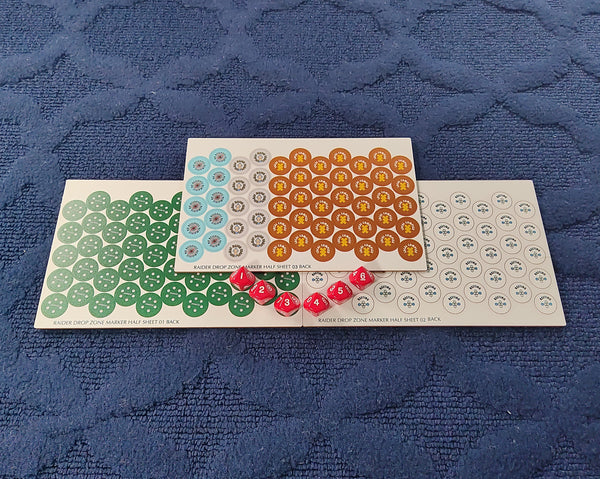
Keith: If a space on the Planetary Surface Map has units from both sides, an Attack may occur. The Terran may opt to attack during their attack phase; the Kraken MUST attack during theirs. The Attack (combat) is executed as a series of Shock combats between pairs of opposing Shock units, possibly supported by up to five Support units per side. Once the Shock combat between sets of units is resolved, the next set of Shock v. Shock units are set up and the next Shock combat is resolved, or the Attack in that space is concluded. Awe checks can be forced on either side before resolving the Shock combat itself if enemy Supporting units are involved in a Shock combat, and failure of an Awe check reduces or eliminates the unit failing. An eliminated Shock unit may need to be replaced; if none remain for your side you may need to use a Support unit instead. Once the pre-shock combat Awe checks are complete, each side rolls a number of d10 equal to their Shock Value. Each die may modify their Shock Value. Comparing modified Shock Values, the higher value wins; or the larger unit wins, if tied; or if the same size, the defender wins the Shock combat. In any case the loser will likely suffer a slightly worse result than the winner.
Grant: What is the purpose of designations such as lead units, support units, etc.?
Keith: Lead units are typically Shock units, meaning the main combat units like Terran Raiders, Medium Tanks, or Kraken Dragoon (warrior) units. These are required to be designated as Lead units if available. Support units, though with powerful weapons are much smaller in size and would not be designated to be the primary unit to “hold the perimeter.” Support units therefore are only used as Lead units if no Shock units remain unused (or available) for your side in an Attack. Also Support units can be used to Support any lead unit by inducing a pre-combat Awe check on the enemy Lead unit. The interplay between Lead and Support units is a big part of the operational tactics reflected in the combat system.
Grant: What are the various possible combat results?
Keith: Results include more Awe checks; modified Awe checks, adding or subtracting a value depending on the result; reduction of a unit; or elimination of a unit.
Grant: Why did you settle on the use of 10-sided dice? What advantage does this give the design?
Keith: The metrics I was using to evaluate the combat strength of the units ended up being divisible by ten, so it was a natural fit. I use percentile dice (rolling two d10 rolled with one being the tens digit and one being the ones digit) for the Awe checks as the metrics for those are more granular. In future games to which I adapt the Shock and Awe System this will give me more flexibility in my Awe Values, allowing me to distinguish more finely between the Awe capabilities of more unit types.
Grant: What is the Shock Combat Aid? How does it help the players through the process?
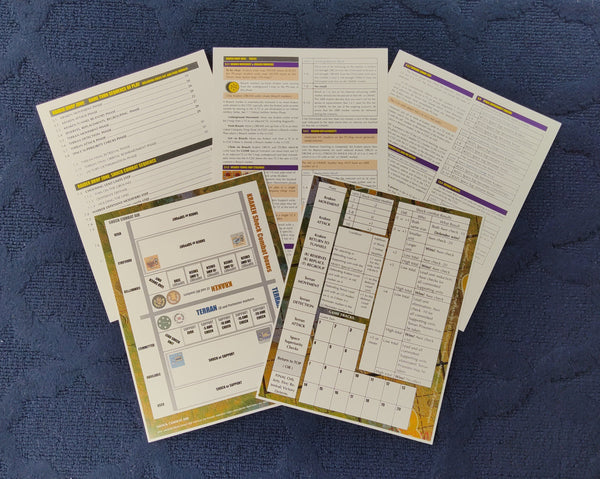
Keith: I developed the Shock Combat Aid to streamline the status of what can be a large number of unit counters in a single Attack (a single space on the Planetary Surface Map). There are holding boxes for units not yet used in a Shock combat in the Attack; artificial terrain or other advantages (like Listening Device Posts that detect Kraken early); the units involved in the current Shock combat, and for units already used during that attack. Units move between the status boxes as the Shock combats of the Attack proceed.
Grant: What are the purposes of Local Complex and Listening Device markers?
Keith: Local Complexes are Kraken “towns”. The scenarios all assign Victory Points to the Terrans for a discrete group of Local Complexes eliminated, say 2 Victory points for every set of 5 Local Complexes eliminated. If the Kraken defend a Local Complex they get a slight defensive bonus. The Terrans can generate and monitor Listening Device posts which gives the Terrans a similar defensive bonus in a space.
Grant: What is the take prisoners step of combat? What happens to prisoners?

Keith: If the Kraken succeed in a Shock combat with a severe enough result against the Terran, a Terran prisoner is taken, indicated by a Prisoner marker. Prisoner markers are moved to the closest Kraken Major Complex and held there for the rest of the game unless the Major Complex is destroyed (then they are freed). Prisoner markers generate victory points for the Kraken at the end of the game.
Grant: What are the uses for the 3 different maps including the Near-Space Map, Planetary Surface Map and the Tunnel Map?
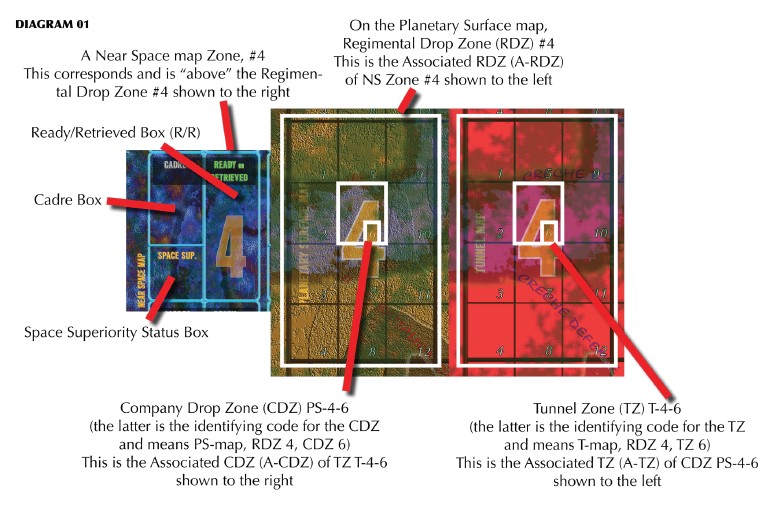
Keith: The Near Space Map is used by the Terran to show activities going on in near-orbital space above each Regimental Drop Zone on the Planetary Surface Map, including which side’s space navy has control of the space above each Regimental Drop Zone. Terrans can move to and from the Planetary Surface Map subject to interception. The Space Superiority Level governs how dangerous it is for the Terran to move to or from the Near-Space Map and the Planetary Surface Map.
The Planetary Surface Map is where the majority of the action takes place, all attacks and Terran movement.
The Tunnel Map is where the Kraken move under the surface. Kraken map is hidden from the Terran! To attack they breach the planet’s surface and move through the breaches to the Planetary surface map.
Grant: What is the general Sequence of Play?
Keith: This is actually an I-Go, You-Go sequence. The Kraken have the benefit of 100% intelligence of what is on the surface. Though they are defending they are an aggressive species and so go first in the Sequence of Play, moving then attacking then retreating back under the planet’s crust to their Tunnel Map. The Terrans then proceed to move, detect the Krakens under the surface on the Tunnel Map, and then attack them. After that the Space Superiority Levels are adjusted for the turn and the sequence begins anew for the next turn.
Grant: What optional rules are available to the players?
Keith: Two optional rules are provided: a rule which increases the damage done when a Kraken Major Complex (city) is destroyed; and another for assigning alternate terrain types in Regimental Drop Zones, and their effects.
Grant: How is victory achieved?
Keith: Depending on the scenario, sudden death victory conditions may be provided, but mainly one side wins if they score more victory points than the other. Victory points can be scored for the destruction of Local and Major Complexes, or enemy combat units; or for clearing the Terrans off the surface; or for the Terrans successfully retrieving their forces from the surface; or for performing other tasks. If multiple categories of Victory points are available, some scenarios provide for the player secretly doubling the points to be awarded for one category, only revealed to the other player at the end of the game.
Grant: How many different scenarios are included?
Keith: I included three scenarios, a small (one Raider Regiment), a medium (Two Raider Regiments plus some supporting armor), and a large (a reinforced Raider Division with Supporting armor) depending on how much time you have to play. For good replayability, each features either a semi-variable order of battle; and/or secretly selecting your doubled victory point category; or both. The large scenario uses every combat unit on both sides, it’s a real bug hunt!
Grant: What are you most pleased about with the outcome of the design?
Keith: I wanted a ground game where the ground commanders (the players) need to be conscious of the naval aspects on the Near-Space Map even though they have little control over them (it is not a space naval game!), but not have it be a space naval game. It’s definitely a ground game but I am most pleased that even though there are no space naval pieces in the game, you must be conscious of the both sides’ navy’s influence through the simple orbital artillery, space superiority, and interception rules.
Grant: What type of experience does the game create for players?
Keith: This is not your usual maneuver game of mobile maneuver across the plains: it is a vertical maneuvering game. The Terrans, on the Near Space Map have the ability to drop to the surface, engage, retrieve, then quickly transfer to an entirely different section of the map if needed, then drop again much faster than the Kraken can traverse the Tunnel Map. But because many times the Near Space Map is contested, that has its hazards. For the Kraken, they have the best defense imaginable: the planet’s crust is between them and most Terran units. They can pick and choose when and where to attack (or counterattack). Playtesters found the collision of the two combat styles to be very dramatic, more like an operational knife fight, with an even spread among ambushes by either side (one side FAR outnumbers the other) and attritional slugfests, attack sizes ranged from very small to very large in each scenario. And both sides felt like they were losing until the victory points were added up!
Grant: What has been the feedback of your playtesters?
Keith: A couple things stood out to them: built-in orbital artillery strikes – if you win and clean up the enemy, but the enemy has partial or full space superiority, orbital artillery strikes may hit you. The price of winning! Then, in a couple of scenarios each side can secretly select a victory point category to double their own points awarded for, which makes the victory conditions variable. Lots of good feelings especially about those two items but overall positive feedback for simplicity of individual rules (easier to remember!) and game flow.
Grant: What other designs are you currently working on?
Keith: I have a series of games related to the Firepower Pass universe in which Raider Drop Zone is based, and using a modified version of the Shock and Awe combat system found in RDZ (every system needs adjustments due to game scale, I have found). I have a working title covering four games comprising a giant sci-fi siege: Firepower Strike, The Siege of Midpoint Station. The Battle is between the besieged Terran Corporate Consolidation forces (including the remainder of the 79th Armor division from RDZ here) and the major antagonists, the Procyonese Concordat, an alien race invading the Orion spiral arm from the Perseus spiral arm. Each game covers a quadrant of the encircled station. In the end all four can be combined into one monster map of the Siege of Midpoint station
On the back burner I have in development the main game of the Firepower Pass universe, Firepower Pass itself, a board game 3D Squadron level starship combat in the War Between the Spiral Arms. I had self-published a miniatures rules version of the game back in 2006 but it is being thoroughly streamlined and some new art will be added (though a lot of the old art is still fine.) Still a lot of work to do on this though.
For the World At War 85 Series from Lock ‘n Load publishing I am designing a squadron level operational air game covering NATO and Soviet Air Forces during the WaW85 WWIII opening campaign over the US V Corps, VII Corps, and a portion of the North German plain, set in 1985, of course. I will be handing that off for development to Nicolas Michon and the rest of the team for final development.
And finally, piggybacking on the air combat work I’ll have done for the World at War 85 Air game, I’m in the beginning stages of development for a lift off of style World War II European campaigns Squadron level game. Keeping busy!
As always Keith, thank you for your time in answering our many questions about Raider Drop Zone. This one looks pretty interesting and I am always a fan of your systems and design approach.
If you are interested in Raider Drop Zone: A Game of MAN versus ALIEN and THE INVASION of PLANET KRAKEN, you can order a copy for $90.00 from the Blue Panther website at the following link: https://www.bluepantherllc.com/products/raiderdropzone
-Grant
 The Players' Aid