In case you missed it, we just posted another interview with Dan Fournie covering one of the other 2 games included in this Kickstarter offering from Worthington Publishing called Drop Zone: Southern France. You can read that interview at the following link: https://theplayersaid.com/2024/08/19/interview-with-dan-fournie-designer-of-drop-zone-southern-france-from-worthington-publishing-currently-on-kickstarter/
In this interview, we asked Dan some questions about the solitaire travel-sized strategic level game called Operation Dragoon 1944 that is being offered in this same Kickstarter project.
Grant: What is your upcoming game Operation Dragoon 1944 about?
Dan: Operation Dragoon 1944 is a travel-sized solitaire strategic level game covering the Allies’ campaign in Southern France in 1944. It is a corps and division-level game covering the campaign’s big picture. You play the Allies as they must gain key ports quickly while stopping the Germans from escaping from Southern France to fight another day.
Grant: What is a travel sized game? What are its dimensions?
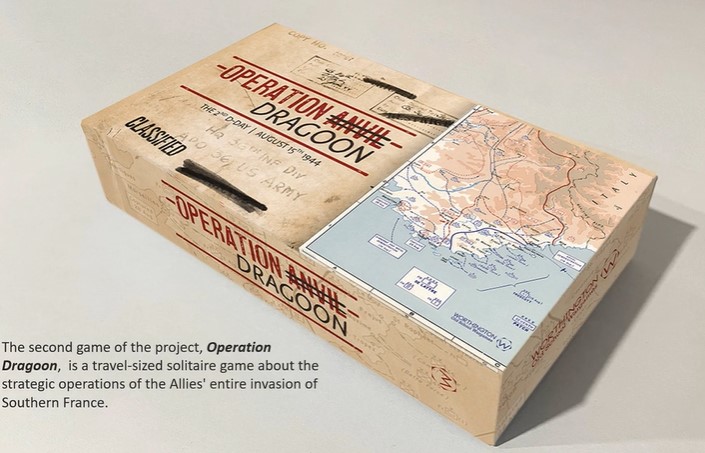
Dan: Worthington has published 2 earlier solitaire travel games, including War of 1812 and Pacific War 1942. These games are designed to be very portable—the box is 7 x 4 x 1.5” and the mounted map is 14 x 7”. It also includes about 20 large counters, two player aid cards, short rules, a die and a tray. It’s small enough to play on an airplane tray table and very easy to transport.
Grant: What is your design goal with the game?
Dan: My aim was to produce a quick-playing solitaire game of the entire campaign in southern France which followed the lesser-known 2nd D-Day that occurred on August 15, 1944. Most of the German forces conducted a fighting withdrawal, so solitaire is the ideal way to play this operation.
Grant: What is the scale of the game?
Dan: The map covers an area of Southern France 300 km (180 miles) by 200 km (120 miles). The units are Corps (minus) and Division level in size. There are 15 daily turns, from D-Day (15 August 1944) to D+14 (29 August).
Grant: What is the layout of the board?
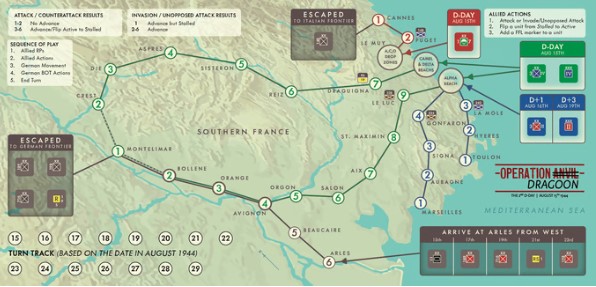
Dan: The board has a north-south long axis. The map is oriented with north to the left. The right (south) side is the Mediterranean Sea and the invasion beaches, drop zones and ports along the French Riviera. The left (north) side reaches as far as Grenoble. The top (east) edge is near the border with Italy, while the bottom (west) edge is the Rhone River valley.
Grant: What key areas are shown on the board?
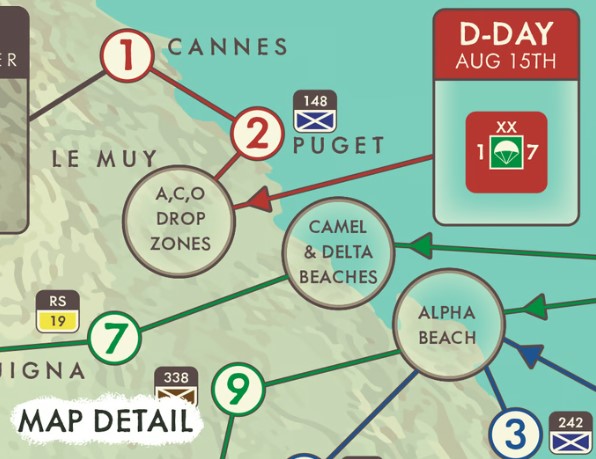
Dan: 2 landing beach areas and one drop zone are the starting locations for the Allied forces. There are over 25 objective cities/towns, including the two fortress ports of Marseilles and Toulon. The main axes of advance for the five major Allied units are portrayed by color-coded lines. There is one withdrawal route for the Germans indicated on the map as well. There are also boxes for German units that escape destruction, a turn track and tables.
Grant: What different Allied forces are included in the game?
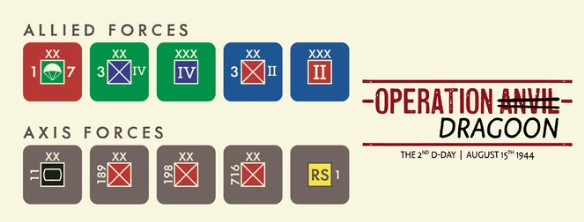
Dan: This was primarily a joint Franco-American force, the nucleus of what would later become 6th Army Group but controlled by General Patch’s Seventh Army in this initial campaign. The American forces include VI Corps, and the separate 3rd Infantry Division (3rd ID) detached from VI corps. The French forces include II Corps, and the separate 3rd Algerian Infantry Division (3rd AID) detached from II corps. The fifth unit is the small division sized allied 1st Airborne Task Force (1st ABTF), composed of American, British and Canadian airborne troopers and commandos.
Grant: How do the Allies work together with the French Forces of the Interior (FFI)?
Dan: FFI support units are added to an Allied unit by an action costing 1 RP. The FFI provide a re-roll of a die on an attack (as attacker or defender) for the unit being supported. This represents the major role played by the large FFI forces in this campaign. Examples of FFI contributions include ambushes, screening, scouting and intelligence and providing guides and auxiliary combat forces. In Marseilles, the FFI convinced a German Ost Legion Armenian battalion to defect from the Germans to the Allies.
Grant: What is the goal of the game for the Allies?
Dan: The Allies have three main goals: (1) capture the key port fortresses of Marseilles and Toulon, to open a new logistics base for the drive on Germany; (2) destroy as many of the retreating German forces of the Nineteenth Army as possible, preventing their withdrawal to re-group and continue fighting on the German frontier; and (3) drive the Germans out of France and into the Italian Alps, to prevent any incursion by the German Army Group C in Italy against the newly won logistics bases in the south of France.
Grant: What actions can the Allies player take?
Dan: The Allied player has three main actions to choose from. Each action costs 1 Resource Point (RP): (1) Attack: the player chooses one Allied unit to attack an adjacent German unit on one of his five advance routes. There are also variations of attack, including invasions and unopposed attacks against a vacant location.
(2) Refresh one “stalled” Allied unit to “active” status.
(3) Add one FFI support unit to an Allied unit.
Grant: How are the number of actions per turn determined?
Dan: Each turn the Allied player rolls a die and consults the Resource Point (RP) Table to see how many RP’s he receives. From 2 to 4 RP’s can be received each turn. The RP table is more generous for turns 16-22 (D+1 to D+7). In the second half of the game, turns 23-29 (D+8 to D+15), RP’s are more constrained, as Allied logistics were stretched thin by the rapid advance.
Grant: What is the makeup of the German forces arrayed to stop the Allies advance?
Dan: The Allies were opposed by the thinly stretched divisions of German General Weise’s Nineteenth Army. The 148th and 242nd ID’s of LXII Corps defended the beaches from the Italian border to Toulon while the 244th and 338th ID’s of LXXXV Corps were located from Marseilles to the Rhone River. The IV Luftwaffe Corps’ 189th, 198th and 716th ID’s begins off the game board further west, along the Mediterranean coast to the Spanish border. Rear security and support elements of both the German Nineteenth Army and the First Army, retreating from the Spanish border and Atlantic coast, were pressed into service. The only German mechanized unit is the powerful 11th Panzer Ghost Division (11th PzD). The three infantry divisions of IV Luftwaffe Corps, the 564th Unit composed of First Army’s support and rear security elements and the 11th Panzer Division form an escape column that moves up the Rhone River valley every turn in a race to escape before being trapped and eliminated by the US VI Corps and 3rd ID.
Grant: How are the actions of the Germans determined? What are their actions?
Dan: German actions occur in two distinct phases.
German Movement Phase: the 5 units of the escape column enter the board and move steadily north towards escape.
German BOT Action Phase: To determine the German BOT actions each turn, the player rolls one die and uses the result on the German action chart following its instructions. There are usually 2 German BOT actions each turn. Some actions appear on the table only on odd or even turns, while others occur on all turns that match the die result rolled. The two main German actions are Counterattack and Desperate Defense. Other actions include Anti-Partisan Operations, Allied Fuel Shortages and Bad Weather (which grounds Allied Air support).
Grant: How are attacks resolved?
Dan: Allied attacks and German counterattacks are resolved by rolling a die, adding or subtracting die roll modifiers (DRM) and finding the result on the Attack/Counterattack Results Table. DRM’s are provided by Allied Air Support, German Desperate Defense and Fortress Ports. If an Allied attack is successful, the Allied unit advances one location and the German unit must retreat. If retreat is not possible, the German unit is eliminated. If a German counterattack is successful, the targeted Allied unit is flipped from “active” to “stalled” status. If the Allied unit is already “stalled” it must retreat and the German unit advances. Allied attacks on invasion beaches, drop zones and unopposed vacant locations always result in an advance but if a “1” is rolled the advancing Allied unit becomes “stalled.”
Grant: How is the air support market used?
Dan: The Allied player may use the Air marker to support one (1) attack per turn unless bad weather was the German BOT result on the previous turn. The player places the Air marker beside the attacking unit and it provides a +1 DRM for an attack.
Grant: What is the German Desperate Defense?
Dan: This represents a German unit temporarily halting its withdrawal to mount a determined defense, or a unit that has reached the end of its possible withdrawal. German units may acquire the Desperate Defense modifier in the following ways: the 11th PzD, 148th, 242nd, 244th and 338th ID’s and 19th Army Rear Security units upon entering Montélimar, Cannes, Toulon, Marseilles, Orgon and Crest, respectively and through several of the German BOT actions. Desperate status is put in play by flipping a German unit to its -1 or -2 DRM side. When the German unit is attacked, apply a -1 or -2 DRM to the Allied attack die roll. If the Allied unit wins the attack and advances, then retreat the German unit back a location and flip the marker to the non-Desperate Defense side. The German Desperate Defense DRM has no effect on German counterattacks.
Grant: How is victory earned?
Dan: The game ends at the end of the 29 August turn. If neither the fortress port of Marseilles nor Toulon is controlled by the Allies, it is an automatic German Victory. If either or both fortress ports are controlled by the Allies, proceed to calculate Victory Points (VP’s) and consult the VP table to determine if the game is lost, drawn or won. Eliminating a German unit is worth 1 VP each; Marseilles is worth 2 VP; Toulon and Cannes are worth 1 VP each.
Grant: What type of experience does the game create?
Dan: Dragoon is a quick-playing, tense game that requires taking risks to win. These gambles can sometimes pay off, but other times may prove disastrous. The German BOT actions will at times be exactly what you did not want. You will always begin a game hoping to win big, but sometimes by the end you will be desperately struggling just to avoid defeat and manage a draw.
Grant: How long is the play time?
Dan: You can complete a game in just under an hour.
Grant: What other topics might you consider covering with this system?
Dan: As mentioned, the earlier games in the series cover the War of 1812 and Pacific War 1942. Other campaigns that might be good candidates for this solitaire treatment could be Poland 1939, France 1940, Barbarossa 1941, the initial phase of the Battle of the Bulge 1944, Korea 1950, Desert Storm 1991, and Iraqi Freedom, 2003.
Thank you so much for the information on this very interesting looking game. I have played the other 2 travel-sized solitaire games and have really enjoyed them. They are simple to set-up, with easy to grock rules and create some really tense die rolls and decisions. I am hoping for more to the system with this entry.
If you are interested in Operation Dragoon 1944, you can check out the Kickstarter page at the following link: https://www.kickstarter.com/projects/1040417273/drop-zone-southern-france-and-operation-dragoon-1944?ref=discovery_category_newest&total_hits=90622&category_id=34
-Grant
 The Players' Aid