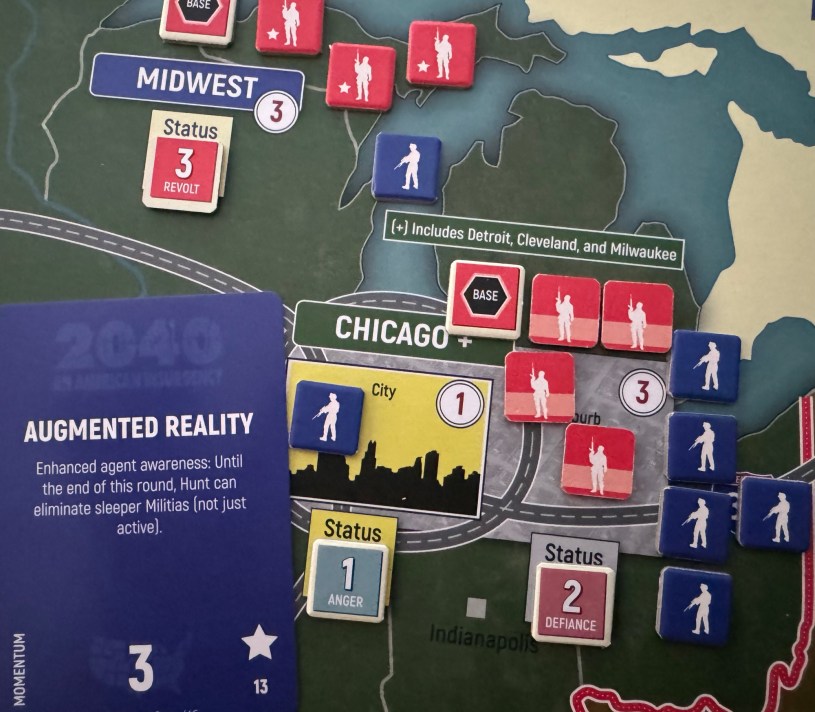
With this new My Favorite Wargame Cards Series, I hope to take a look at a specific card from the various wargames that I have played and share how it is used in the game. I am not a strategist and frankly I am not that good at games but I do understand how things should work and be used in games. With that being said, here is the next entry in this series.
Card #7: Augmented Reality from 2040: An American Insurgency from Compass Games
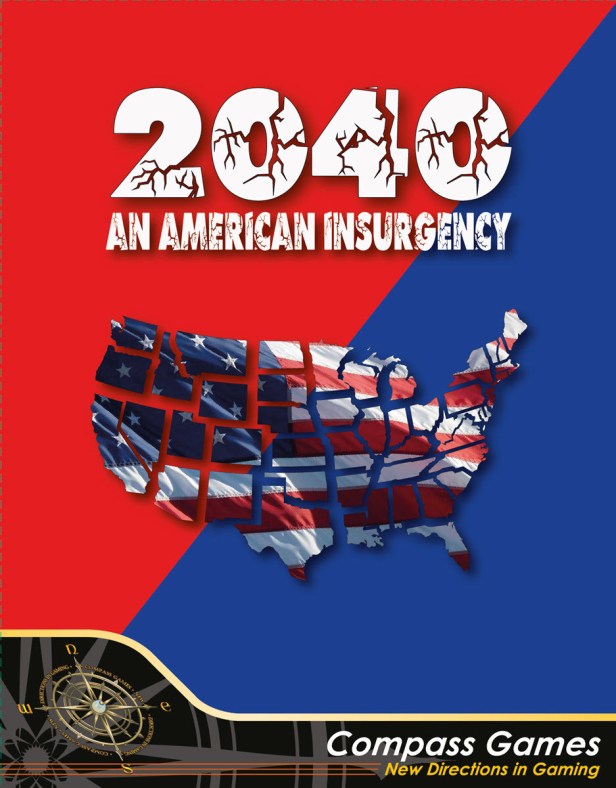
2040: An American Insurgency is a card driven game that attempts to simulate a near future US civil war in the 21st century. In this 2-player game that plays in less than 3 hours, the blue team is the Federals representing agents of the government in Washington. The red team are the Rebels including militia groups trying to seize control of states, highways, and cities. The conflict spreads across the entire continental US, from Miami to Seattle and from Los Angeles to New York.
This game is not perfect and it has some issues and the graphics are not that great frankly. As I played the game, I actually felt like it was a pretty decent game, with some very interesting mechanics covering an interesting topic. I know it isn’t perfect and in some ways the designer was so careful not to offend anyone in the game that he really didn’t get to say anything about the situation and its causes, and the game somewhat suffers from that. But it was interesting and I believe that we are about the only ones who played the game.
In this post, I want to focus on the Augmented Reality card which is a Federal aligned event.
In 2040: An American Insurgency, one of the main missions of the Federal player is to hunt down, uncover and eliminate Rebel “sleeper” units who are gathering in various areas. These Rebels will build Bases that allow them to recruit more units that will come into play as “sleepers” hidden from detection as they go about their lives undercover or on their underground side (with the white stripe along the bottom of the unit counter) and be used to devastating effect to swing the control and Status of these areas. Just like in several other counter insurgency focused games, eliminating these hidden “sleeper” units is typically a 2-step process that requires the Federal player to take the Hunt Operation to first uncover these “sleeper” units, which flips them to their active side. When Rebel “sleeper” units are active they are vulnerable to being removed. This can be accomplished by uncovering 1 militia unit per each Federal agent (or 1 per 2 if in mountainous terrain) in the space where the Operation is taken. But when they are hidden, this will only uncover or make them active. The Federal player will have to await their next turn to be able to use the Hunt Operation again to then remove them.
This allows the Rebel player to take their Recruit Operation to add “sleeper” units to the space which protects the active units. Keep in mind that this Recruit doesn’t cause the units to go back underground but simply will add more units to the space and units and bases cannot be removed until all “sleeper” units are revealed. This is quite the quandary and can create a back and forth affair where units are being placed and revealed over and over again.
In comes the very good card called Augmented Reality. Augmented Reality allows the Federal player to use the card to provide enhanced Agent awareness to eliminate “sleeper” units without having to first uncover or activate them. In my opinion, I really love cards like this that allow the player to break or ignore a certain game rule or effect. This card doesn’t create a situation where this enhanced awareness lingers and carries over into the next round but can be used to really make headway in a specific area.
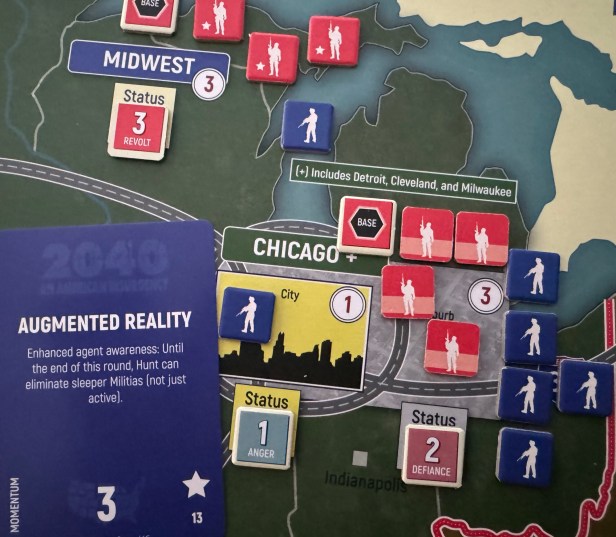
Keep in mind that 2040 has some very interesting movement and mobility rules included. For example, a noteworthy feature, which is a situation that is somewhat unique to the United States, is that the suburbs and central cities of an urban area can be at diametrically opposite poles of the revolution and have very different Status (Anger, Defiance or Revolt). This creates a difficult strategic problem for the players, in that Operations that pass between two urban cores must necessarily go through the suburbs of both cities along the way. If those suburbs are enemy-controlled, meaning they have more enemy units than the units coming into the space, the transit may be blocked. Forces inside cities can effectively be trapped by hostile suburban forces without a way to get out or to really be much use for anything. I really like this design choice as the real suburban/urban political conflict in the US has important implications for operational effectiveness in the game. And this card Augmented Reality really creates some interesting opportunities for the Federal player to rescue these besieged units or to crack open a particularly stubborn area to their pacification efforts.
Augmented Reality (AR) is an interactive experience that combines the real physical world and various computer-generated 3D content. This computer content can include multiple sensory aspects, such as visual, auditory, haptic, somatosensory and even olfactory. AR can be defined as a system that incorporates three basic features to create an enhanced experience including the combination of real and virtual worlds, real-time interaction with the environment, and accurate 3D registration of virtual and real objects. The hallmark of AR is that the experience generated is seamlessly interwoven with the physical world and adds in a perception and focus that will enhance the experience of the real environment. In this way, augmented reality alters one’s ongoing perception of a real-world environment, whereas virtual reality completely replaces the user’s real-world environment with a simulated one. 2040 makes a good attempt to integrate a lot of emerging technologies into the game giving the players greater capabilities and assets to fight this war.
Here is a link to our full unboxing video showing the components:
Here also is a link to our full video review:
I also posted an interview with the designer Edward Castronova on the blog and you can read that at the following link: https://theplayersaid.com/2023/04/04/interview-with-edward-castronova-designer-of-2040-an-american-insurgency-from-compass-games-currently-on-kickstarter/
In the next entry in this series, we will take a look at Famine from Twilight Struggle: Red Sea – Conflict in the Horn of Africa from GMT Games.
-Grant
 The Players' Aid