
The Valiant Defense Series designed by David Thompson has been one of my favorite solitaire wargame series of the past nearly 8 years. Each of the volumes in the game address very specific situations and always have a very interesting take with fun mechanics, great art and fantastic production. The torch for the series though appears to be passing to a new designer in Vince Cooper. He has been working on Guadalcanal: The Battle for Henderson Field, Oct 23-26 1942 for the past few years and it is finally ready to go do crowdfunding on July 30th. I reached out to Vincent and he was more than willing to share.
If you are interested in Valiant Defense Series Volume V: Guadalcanal: The Battle for Henderson Field, Oct 23-26, 1942, you can check out the Kickstarter preview page at the following link: https://www.kickstarter.com/projects/danverssengames/dvg-valiant-defense-guadalcanal
*Keep in mind that the design is still undergoing playtesting and that any details or component pictures shared in this interview could change prior to final publication as they through the final art design process.

Grant: What is the status of your design Field Commander: Robert E. Lee from Dan Verssen Games?
Vince: The game is complete at my end 😊 and is currently with Dan and the team at DVG waiting in turn to be sent to the printer. I want to apologize to everyone for the delay. To give a full explanation for anyone unaware: The Kickstarter FAR exceeded any expectations we might have had. Certainly, in the last few years, there is no other ACW game that has generated more money from the initial KS. As a result of that, a great deal of extra content was added in the form of Battle Packs. The number of scenarios – light, ‘lunch time’ games – grew from 20 to 25, to 30 and then 35. This necessitated a great deal of extra time to be able to complete everything, but completed it was! For the last few months, I have been out of the loop so to speak, so I don’t know precisely at what stage of the print process the game is at, but the files are being prepared. The final page count is something in the region of 250 pages, so there is a lot of work to be done to get it to print. Not bad for my first design! 😉 😉 😊
The first expansion for Field Commander: Robert E. Lee is in the early stages of first person play testing at the moment, but more on that later in this interview.
We posted an interview with Vince last year covering Field Commander: Robert E. Lee as a part of the Kickstarter and you can read that at the following link: https://theplayersaid.com/2023/07/03/interview-with-vince-cooper-designer-of-field-commander-robert-e-lee-a-civil-war-solitaire-strategy-game-from-dan-verssen-games-currently-on-kickstarter/
Grant: How have lessons learned from that design helped you with your other projects?
Vince: Enormously!! To really understand the feedback/development loop that was created I also need to mention [SECRET TITLE] Assault – Merville Battery, which will hopefully get to Kickstarter at the end of 2024. FC: Lee is heavily based on FC: Napoleon; Guadalcanal is heavily based on Pavlov’s House. Merville Battery is much more ‘my’ game (though it is also based on a well-known brand, that some have guessed…). As such, I felt a greater sense of freedom to explore new ideas and include them in the game. It was these ideas that were then fed back into FC: Lee and Guadalcanal, helping to make them more distinct from the original games that inspired them. In turn, ideas developed in relation to, say FC: Lee, were fed back into other games.
Interacting with customers/players has been great. There’s always one or two people but I’m a very positive person so that’s all water off a duck’s back. Nevertheless, this has been a very valuable experience. Deciding to concentrate on game design on a more-or-less semi-professional basis was a major decision and I recognized that to be commercially successful, I would have to ‘put myself out there’. David Thompson does so, Chuck Seegert, Ben Madison, Hermann Luttmann and others also make an effort to interact with people. I also had to confront the fact though that by putting myself out there, there would inevitably be negative comments and attitudes expressed. Finding out that I am able to stay focused, keep smiling and continue working on designs has been an enormous step forward and very encouraging.
The other main thing that I learned was the necessity of working with a talented and committed artist and how difficult it can be to convey ideas that are turned into art. It takes an extraordinarily long time to get things right, and the earlier you can start on the process, the better. 😊

Grant: What is your upcoming Guadalcanal: The Battle for Henderson Field about?
Vince: As Midway is widely regarded as the turning point in the war at sea in the Pacific Theater, the Battle for Henderson Field is similarly seen as the pivotal point in the land war in the Pacific. The failed attack on Henderson Field by the 17th Army marked the end of strategic offensive operations for Imperial Japan. Thereafter policy shifted to a defensive strategy designed to make America bleed island by island, with the hope for either a climactic Naval battle after US forces had been whittled down and/or a negotiated peace settlement that would allow Japan to keep control of at least some possessions. The game focuses specifically on the four days of the Battle for Henderson Field on October 23-26, 1942.
Grant: As a part of the Valiant Defense Series, why was this battle a good candidate for the series?
Vince: The basic concept of all Valiant Defense Series games is that the player is commanding forces that are defending a fixed position. Pavlov’s House – my favorite solitaire game – takes this a step further by adding an Operational command element in which, if the reader is unfamiliar, the player also has to make certain critical decisions from a wider perspective, in particular, the supply of Pavlov’s House via the Volga River. This is my favorite element of the game, and it is very popular with a lot of players too.
The Battle for Henderson Field on Guadalcanal was a good choice for this model as, first of all, the basic requisite is met: Forces defending a fixed position. The 1st Marine Division – supported by the 164th Americal Regiment (AMERIcan/CALedonian) – are fighting off the 17th Imperial Japanese Army that is trying to cross the Matanikau River, more of a diversion than anything else, while the main force launches what is supposed to be a decisive attack against the Lunga Perimeter to the south.
Of equal interest and importance is the Cactus Air Force, operating out of Henderson Field. While the IJA are making night attacks, during the day, as had been going on for several months, Japanese aircraft flying from Rabaul are trying to bomb and/or dogfight the Marine pilots into submission. While all this is going on Vice Admiral Nagumo is moving undetected ever closer to Guadalcanal with a carrier force intent on seeking revenge for Midway and destroying the US carrier fleet in the Pacific. Another Naval operation is also underway: The light cruiser Yura is also moving into position to bombard Henderson Field from the sea. Finally, Task Force 62 is trying to keep the Marines supplied. So, all the elements were there for an Operational command aspect to the game as well, similar to that found in Pavlov’s House. 😊
In effect, the player is commanding the USMC firing line beating back waves of Japanese attacks while also making critical decisions as, simultaneously, the commander of the 1st Marine Division (General Archie Vandegrift), the commander of Task Force 62 (Rear Admiral Turner) and the commander of the Cactus Air Force (Brigadier General Roy Geiger).

Grant: What is the story that led you to this design?
Vince: The story starts with Undaunted: Normandy. After playing the game and being very, very impressed, I tried to find out more about the designers, Trevor Benjamin and David Thompson. Trevor is very quiet on social media, while David is the complete opposite. I came across an interview you guys at The Player’s Aid did with David and you were talking about Pavlov’s House. I asked around and one of my friends had it so we arranged a co-op game with myself, Jay and Juan (the designer of the COIN Series game A Fading Star: Insurgency and Piracy in Somalia). Jay and Juan had been playing Caesar: Rome vs. Gaul and I had a slow whisky while they finished up playing, then we moved onto Pavlov’s House.
By now I was VERY relaxed and having a drink makes me very creative, so we started playing. First time for all of us, so the first 5-10 mins was spent just figuring out the basics…but after no more than 10 mins, once I understood the basics, my brain went into overdrive, from which in the last 4 years it hasn’t slowed down!!! I was stunned with how good the game was, and spent the rest of the evening not so much playing but analyzing it. By the time we finished, I had two very clear ideas formed for adaptations of the system. Neither was WWII and neither portrayed individual combatants.
I contacted DVG to see what the status of the game was, but was told it was purely a David Thompson thing, but I was encouraged to contact him. I did so, not really expecting a response, but he was kind enough to indulge me. There was a brief discussion of the ideas, some hesitancy on his part (totally understandable) but – and I will forever be grateful – I didn’t get an outright ‘no’. Some discussion with Dan at DVG led to the acceptance of all parties that a game on Guadalcanal, and specifically the Battle of Henderson Field, would be preferable. This was not in fact one of the original ideas, which are stored away for the future. 😊
Grant: What new additions can we expect to see intrusive to the series through this volume?
Vince: The biggest one is one that I hope players won’t really notice! That is, the scale of the game has changed completely from the individual defenders portrayed in past Valiant Defense Series games to a battle involving thousands of soldiers on either side. There were hints of this in previous VD games with the composition of an attacking counter not really being described and there are no objections to this that I am aware of, so that is being extended further to the composition of the defending counters also not really being stipulated, though the scale is platoon(ish).
This is a big risk and again I would like to thank David for trusting me that I would look after his baby so to speak! If Guadalcanal is popular, then the breadth of topics that can be covered in future games expands enormously.
The other notable new additions are the Difficulty Levels and the Variant play options. If you like the game in its basic form, you will have hours and hours of different, challenging options to work through. 😊
Grant: Why was this a subject that drew your interest?
Vince: I have lived in Japan now for more than half my life and the Pacific Theater of Operations – along with Japanese history in general – has long fascinated me. Guadalcanal holds a deep interest for me because it was where the land-based fight back against Japanese expansion really started, and the defense of Henderson Field was the critical battle. The battle fit perfectly for a Valiant Defense Series game, and those two factors made the decision easy.
Grant: What research did you do to get the details correct? What one must read source would you recommend?

Vince: I have been reading about Guadalcanal on and off for years. By far the best resource is Richard Frank’s Guadalcanal – The Definitive Account of the Landmark Battle. Although this was first published more than 30 years ago, its extensive use of Japanese sources has yet to be matched.
There are two superb books by Robert Leckie (‘Peaches’ in the HBO Series ‘The Pacific’): Helmet for My Pillow and Challenge for the Pacific – Guadalcanal.
Another excellent book is Guadalcanal Diary by the news reporter Richard Tregaskis, though the narrative ends in late September, 1942 when he left the island (that’s a month short of the Battle for Henderson Field).
Grant: How has the design progressed over the past few years? What have you scrapped or invented with the system?
Vince: The design process started early in 2021. As mentioned, I am the biggest fan of Pavlov’s House and my initial goal was to emulate that game. As such initially, Guadalcanal wasn’t much more than a direct copy of Pavlov’s House but with the names changed!!! The Soviet defenders simply became the USMC. The attacking Wehrmacht simply became the 17th Army. Storm Groups simply became Scout/Sniper Combat Patrols and so on. There is still a fair amount that is recognizable. The ‘Betty’ bombers flying in from Rabaul will be immediately recognizable as doubles for the Stukas!! David encouraged me to make Guadalcanal more a game about Guadalcanal and less about emulating the Pavlov’s model, which I hope I have succeeded in doing. The Banzai card was probably the first big change and again, though some points are clearly influenced by Pavlov’s House (dehydration for example), those cards begin to lend a different flavor, capturing the desperation of the Japanese attackers to overwhelm the Marine firing line with numbers rather than guile, along with the rules for pilot nutrition and the bombardment mission of the Yura.
Probably the biggest design element created are the rules for Defensive Fire and Hand-to-Hand combat. For much of the design process, the game ended as normal for a Valiant Defense Series game with an IJA counter advancing from an Attack Position into a USMC Combat Position. The rules for Defensive Fire and Hand-to-Hand combat capture that final, brave attempt by the defenders to hold their position to the last man. In fact, historically there were isolated cases of the Japanese breaking through the lines and carving out a salient, at least on the first night of fighting, and a few even managed to get to Henderson Field, so I am trying to capture that aspect and have the game really come down to the last roll of the dice!! 😊
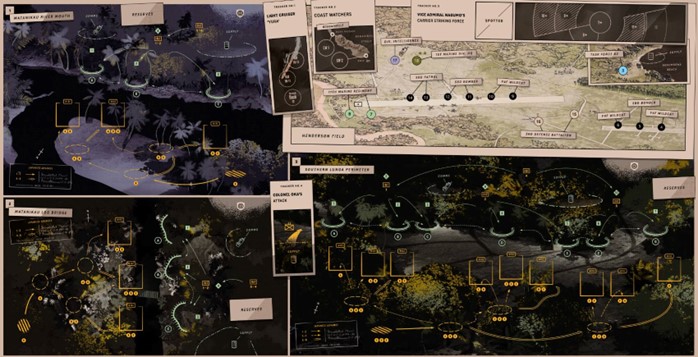
Grant: What is the layout of the game board?
Vince: The gorgeous game board was designed by Nils Johansson. Right from the first conversation he had a strong vision of how it would look, and that he would contrast the night assaults conducted by the infantry with the day time air raids against Henderson Field. The board depicts the major areas of fighting: The Matanikau River Mouth, the Matanikau River Log Bridge and the Southern Lunga Perimeter, where fighting was the heaviest. Also depicted is Henderson Field, which is affected by the Operational choices made by the player. There are also trackers for Coast Watchers on Bougainville Island, the approach of the light cruiser Yura and the success or not of Search and Patrol flights conducted to locate Nagumo’s carrier force. Finally, there is a section for Colonel Oka’s attack that took place in the early hours of October 26th. This was a bit of a non-event but I wanted to include it for the sake of completeness if nothing else, so it is highly abstracted but does affect the final Victory Point total.
Grant: What different areas must the player defend and what difficulties does the layout create?
Vince: The overall aim is to protect Henderson Field. To do this the player must first use assets located on Henderson Field itself: The Wildcat F4F’s of the Cactus Air Force and the 3rd Defense Battalion (which provided Anti-aircraft fire). Also important are the two Coast Watchers located on Bougainville Island who, if activated, are able to give an early warning to the pilots who are then assumed to be able to reach an altitude of 20,000 feet (‘Angels 20’) and destroy the incoming Betty bombers and Zero escorts quickly and easily. Similar to Pavlov’s House, if the 1st Marine Division HQ is destroyed, that ends the game. Attempting to do this, along with the bombers from Rabaul, is the light cruiser Yura and her escort. Once again, the Cactus Air Force is needed, this time utilizing SBD – Bomber aircraft to execute dive bombing missions to drive off the encroaching bombardment force.
Further to this is the firing line manned primarily by Marines, but supported by the 164th Americal Regiment. The defensive line stretches from the Matanikau River Mouth south to the Matanikau River Log Bridge and then east along the Southern Lunga Perimeter, which is where the heaviest fighting took place. To help defend the perimeter the player has access to various counters with different abilities, including heavy weapons, along with the support of the 11th Marine Regiment (Artillery) firing out of Henderson Field.
Grant: How has Nils Johansson’s abilities assisted you in creating a thematic experience?
Vince: I have always been aware of the tension between being technically qualified to do something but not necessarily experienced enough to do something. This is VERY apparent in the professions that I pursue (English communication teacher and a wedding conductor). In these professions experience outweighs anything else.
Working with Nils (and David) allowed me to basically fast track my experience. It’s not really an exaggeration to say that when I paired up with Nils we were matching the least experienced wargame designer in the world with the most accomplished wargame artist in the world! The experience of working through the project with him – not to mention creating the final game – has been immensely rewarding and of tremendous value to me.
The concept of the game board came entirely from Nils: Shifting between the assaults during the night with the daily air raids against Henderson Field. I really don’t know if this has been done before. Certainly, I have never seen anything like it before and the Combat Sectors – portrayed at night – make the game highly atmospheric.
The same can be said of the cards and counters. The first art completed were the IJA cards and I was blown away with the sense of tension in the bodies of the Japanese soldiers as they were portrayed making their way through the dense jungle towards the USMC line. There is something very subtle in their stance, a little hunch of the shoulders, a hesitancy in their step. Truly masterful!!! 😊 😊 😊
Grant: What role do Event Cards play?
Vince: Event Cards represent real life events or potential events that could have occurred in favor of the Imperial Japanese forces. Introducing these cards will make the defense of Henderson Field even more challenging!
For some Event Cards, there are three Difficulty Levels: Regular, Veteran and Elite. This determines the severity of the event stipulated, with higher Difficulty Level introducing more severe challenges for the player.
We have play tested for three Event Cards per game, though there is no reason a player cannot reduce or increase the number of Events used.
The conditions stipulated on the Event Card remain in effect for the duration of the game. The Tactics Cards (detailed below) are drawn on a turn-by-turn basis. Normally the player would draw three random Event Cards per game, but one of the play testers – Shane – came up with some thematic ideas for scenarios that focus on making one particular aspect of the game more difficult. And of course, the player can create their own scenarios. 😊
An example scenario might be ‘There are No More Reserves. Hold the Line.’ In this scenario the player pre-selects the Malaria, No Reserves and one of More Ammo, Damaged Wire or Poor Morale Event Cards. In this scenario, the number of Marines to man the front line is limited, which in turn has affected the resupply of ammunition, the preparation of defensive positions or has impacted morale in a negative manner.
Here are some example Event Cards.
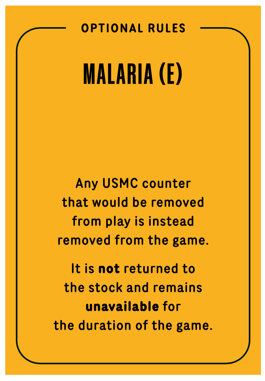
Malaria (Elite)
Malaria – amongst other health hazards – was a major issue for the Marines in Guadalcanal. As such, there are actually three different Malaria Event Cards, from Regular to Veteran to Elite Difficulty Level. This card (Elite) is the most severe.
The text reads: Any USMC counter that would be removed from play is instead removed from the game. It is not returned to stock and remains unavailable for the duration of the game.
There is a hard limit to the number of USMC counters available to the player. This Malaria card adds a further restriction because the stock is never replenished. This emulates the debilitating effects of malaria and simulates the dwindling number of combat effective troops that can be sent to the front line.
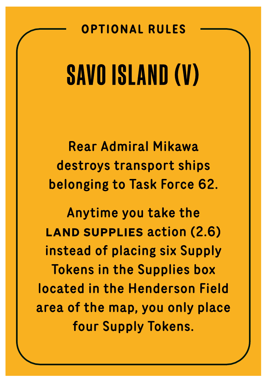
Savo Island (Veteran)
The Battle of Savo Island took place on the night of 8-9 August, that is, immediately after the 1st Marine Division landed on Guadalcanal on 7 August. Mikawa was able to surprise the US Navy in the vicinity of Guadalcanal and demonstrate the skill of the Imperial Japanese Navy during night actions. Savo Island is regarded as being perhaps the worst defeat in history of the US Navy, and is certainly regarded as being one of the worst. Fortunately for the Navy, Mikawa withdrew before sunrise, fearing a counter-attack from US carriers he assumed were in the area; in fact, they had also withdrawn, fearing a similar attack from the Japanese Navy. As a result, the supply ships of Task Force 62 were spared. Savo Island is depicted in Episode 1 of ‘The Pacific’, with the Marines looking across at the burning ships.
The text reads: Rear Admiral Mikawa destroys transport ships belonging to Task Force 62. Anytime you take the Land Supplies action (2.6) instead of placing six Supply Tokens in the Supplies box on Henderson Field, you only place four Supply Tokens.
So, this Event Card assumes Mikawa was able to inflict damage on Task Force 62 and in turn hinder the supply of the 1st Marine Division. Supply Tokens are generic (Pavlov’s House uses specific Tokens) and critical for various actions, such as readying 11th Artillery Tokens or ensuring the Wildcat F4F pilots have high quality nutrition, so limiting the supply is a major problem for the player.
Grant: What different types of units does the player have access to?
Vince: Defending the perimeter are Rifles, NCO’s, Officers, Medics and Weapon Teams utilizing heavy weapons. Counters have different abilities, and the stronger those abilities are, the higher the Deployment Cost. On Henderson Field, the player is controlling the 1st Marine Division HQ, Task Force 62 (responsible for Supplies), Division Intelligence (D-2), the 11th Marine Regiment (Artillery), the 3rd Defense Battalion (Anti-aircraft) and the Cactus Air Force, which uses Wildcat F4F, SBD – Bomber and SBD – Patrol aircraft. In addition, the Coast Watchers on Bougainville Island take a part as does COMAIRSOPAC (Commander, Air, South Pacific), though the latter is ‘off-board’. As a point of interest, in the early stages of the Guadalcanal campaign John McCain, Senior occupied the position of COMAIRSOPAC, though he had been replaced by Admiral Aubrey Fitch by the time of the Battle for Henderson Field.

Grant: What units do the Japanese attackers have?
Vince: The 17th Army is represented by Infantry, Officers, Bushi, Veterans, and Infiltrators, supported by Knee Mortarmen and a single Tank unit.
The Infantry are the most numerous and – an added twist – as the Wave number increases, so does the number of Infantry placed. So, by Wave 4 if you draw an Infantry Card during the IJA Card and Counter Phase, you will place four Infantry counters randomly on the game board.
The Officers are accompanied by an Infantry counter, and that Infantry counter must be destroyed before the Officer can be targeted.
Veterans are similar to Infantry but receive a higher Defense Value.
Bushi are inspired by Yamato Damashii (Japanese Spirit) which makes them fight to the bitter end. A Bushi gains a saving throw if it is hit, and that saving throw becomes easier as the Waves progress.
Infiltrators are something new. When an Infiltrator crosses the USMC line, the game does not end. Instead, the Infiltrator will target a USMC counter in a rear Combat Position or the Reserves box. This means there is no hiding from an attack.
The Knee Mortar and Tank counters progress along Attack Tracks as normal, but fire at the defenders with each move.

Grant: What new and unique actions can players take?
Vince: Most of the Actions will be familiar for Valiant Defense players. Rapid Advance and Rapid Fire are new (and their inspiration will become clear when Merville Battery is fully revealed…).
Grant: What role does suppression play in the game?
Vince: Suppression is a key weapon in the arsenal of the player. For anyone unfamiliar, the attacking IJA counters are placed on Attack Tracks with subsequent counters pushing forward the foremost counters, closer and closer to breaching the USMC line. When an IJA counter is first placed, the player may use any number of Suppression counters available to make an immediate attack on that IJA counter. Some counters – the Tank, the Veteran and the Officer – are Immune to Suppression and cannot be targeted.
Suppression counters are generated by heavy weapons: the 60mm and 81mm mortars generate the most, followed by the M1919 Browning Light Machine gun and the 37mm AT gun which was also capable of firing cannister shells. The Suppress action requires two matching Weapon Team counters to use two Actions (which are limited according to the Difficulty Level) and for a Supply Token to also be redeemed. Heavy weapon counters and their attendant Teams are expensive to deploy, and both Actions and Supply Tokens are in short supply, so the decision of whether to use Suppression is important. I don’t want to give too much away as I love designing games that are non-telegraphed brain teasers, so I want the player to figure things out by himself through trial and error and reflection on failure, but deciding whether to go with heavy weapons and Suppression will shape the game in very different ways to not going with heavy weapons.
Grant: What type of defense do the players have access to?
Vince: Historically all aspects of the defense of the perimeter were intertwined. Certainly, the artillery played a massive role in breaking up the attacks into small, manageable groups of advancing Japanese infantry that were more easily repelled. To avoid ‘Barrage! Barrage! Barrage!’ though the 11th Marine Regiment has been neutered. Forward Observer counters are restricted, and easy to destroy. Setting up the artillery on Henderson Field takes time and a single Betty or stray shot from the Yura can ruin everything. So, while the artillery plays a part, the player will also need to make use of heavy weapons to generate Suppression tokens and, in the case of the MG, use direct fire. But that still isn’t enough. Ultimately, it is the Rifle counters on the front line that must first lay Barbed Wire then defend it, possibly using hand-to-hand combat in the final Banzai!
Grant: How does the design use Tactics Cards?
Vince: Tactics Cards are Variant/Optional Cards that experienced players are encouraged to use. Each Tactics Card represents decisions and situations at the tactical level, with different cards impacting different areas on the game board at different phases of the game for the duration of a single turn. The number of Tactics Cards drawn in the IJA Card and Counter Phase is determined by the Difficulty Level (Boot, Regular, Veteran and Elite), with more cards being drawn at higher Difficulty Levels.
Let’s take a look at a couple of examples 😊

Air Cover (Yura)
The text reads: No SBD – Bomber Dive Bomb actions can be taken against the Yura this turn (along with the rules reference).
If the player draws this at the beginning of the IJA Card and Counter Phase, it will remain active during the following USMC Card Phase, which covers the operational aspect of the game. The player will be unable to select the SBD – Bomber Dive Bomb action on that Operational Card. The other actions (Ready SBD – Bomber and Repair) actions will be available as normal. This can really mess up the player’s plans for the current and following few turns and forces the player to initially be reactive when first using the Tactics Cards and find a solution then, as his experience grows, become more proactive as he learns what cards are potentially coming up. With the Yura approaching and about to bombard Henderson Field now, does he launch a Dive Bomb mission in the current turn with a single flight of SBD – Bombers or take a risk and hope he can ready more bombers for a larger attack in a future turn?
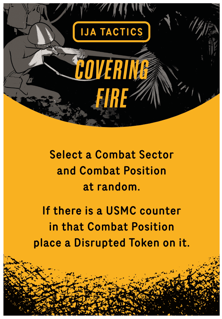
Covering Fire
The text reads: Select a Combat Sector and Combat Position at random. If there is a USMC counter in that Combat Position place a Disrupted Token on it.
This Tactics Card affects the Marines in the firing line. A Marine with a Disrupted Token must either Recover or be targeted by the Command action to remove the Disrupted Token. This means that in the upcoming USMC Counter Phase, that counter will not be able to Move or take any other Action. In addition, at different points in the game a counter that is Disrupted suffers further penalties. For example, a Disrupted counter cannot use Defensive Fire against an IJA counter that is making the final surge against Henderson Field moving from the foremost Attack Position into the defending Combat Position. A Medic that is Disrupted cannot use the First Aid action. Again, the card forces the player to react to different battlefield conditions until he ‘learns’ the deck and becomes more proactive in anticipating what may happen next and takes measures accordingly.
Grant: How do you handle levels of difficulty? How does each level change the game?
Vince: The origins of the Difficulty Levels lie in Field Commander: Robert E. Lee but really came to fruition with my upcoming Merville Battery. These were added at a later stage to Guadalcanal as Pavlov’s House doesn’t incorporate these mechanics. The initial issue was how to keep a new player involved in a game for as long as possible in order to learn what is going on rather than losing in the first 20 minutes and having to set things up again without really progressing deeply in the game. The ‘easy’ level (Boot) probably won’t be much of a challenge to a veteran Valiant Defense player but for someone new to the Valiance Defense Series or solitaire gaming in general, it’s a really good place to start.
Beyond Boot the levels get progressively more difficult (obviously… 😉). Where the game really comes into its own though is when the player starts to mix different Difficulty Levels for different aspects of the game.
Choosing the Boot level Deployment option combined with the Elite USMC Counter Phase (limiting Moves and Actions) creates a very different game than choosing the Elite Deployment option and the Boot USMC Counter Phase. All these Difficulty Levels have been extensively play tested to work seamlessly with the Variant Rules options as well.
I am also a wargame consumer and I live in Japan. Take a look at the shipping costs and the current exchange rate to understand why I totally sympathize with anyone who wants a very high-quality game that provides – really!! – hours of replayability.
Grant: What type of experience does the game create?
Vince: The game has been designed to create a tough, tight, decision-heavy 75-90 minutes of non-telegraphed gaming bliss!!! We have been able to cover ALL the major events surrounding the defense of Henderson Field and Nils has represented all those elements beautifully. Some aspects are more abstracted than others, for sure, but this keeps the game manageable and playable (twice!!!) in an evening.
Grant: What are you most pleased about with the outcome of the design?
Vince: Where to start?!?!? The magnificent art, obviously. I really can’t say enough about the quality. The more I look at the detail the more I am drawn into the game. It amazes me that another person can do something like this.
I think the game does justice to the Valiant Defense Series and to Pavlov’s House in particular (and I am sure David is happy/relieved about this as well… 😉). That was my only goal when I started this: To emulate Pavlov’s, and I think I have done that.
I think the game offers enormous scope to be played again and again and, as I mentioned, in the current economic climate I think that’s VERY important.
Finally, as I mentioned, I have succeeded in designing the kind of game that I want to play. I wanted to create a non-telegraphed, decision heavy game that had to be played, experienced and analyzed to succeed at. This is not the kind of game you can simply pull out of the box and beat the first time you play. There is no obvious ‘hack’. There are multiple paths to victory and each must be experimented with. The Variant rules prevent the player from repeating the same method again and again. The player has to become good at the game and has to be able to respond to the ever-changing situations on the board. 😊
Grant: What has been the feedback of your playtesters?
Vince: “Contender for the #1 solitaire wargame ever!!!!!!!”
No joke.
And that’s before Merville Battery. 😊
Grant: What other designs are you currently working on?
Vince: Merville Battery is in the most advanced state of readiness. Basically, we are just waiting for Guadalcanal to conclude and we will reveal the ‘Secret Title’. Some people have already guessed, but let me just say that if you’re a fan of the Valiant Defense Series, you’ll LOVE Merville. 😊 The game itself is now complete, we are just waiting for the art to catch up. 😊 Hopefully that will go to Kickstarter in late 2024.
Looking forward to 2025 two new games from DVG will appear. The first will be PT Boat Leader. This marks the first game in a new sub-series within the Leader series, this one following the crews of PT Boats in the Pacific. Expansions may look at the Med and D-Day in Europe, but we’ll see. Players select their PT Boats, their Skippers and complete Missions throughout the Pacific, managing their Squadron in down time. Combat is more tactical than an average Leader Series game with different weapon configurations with different firing arcs really impacting game play significantly. If there is demand the series will continue with the British Navy in the Med, Schnell/Enemy Boats in the Baltic and Channel, modern Fast Attack Craft and Imperial Japanese Navy destroyers in World War II.
As briefly mentioned above, the second game from DVG and the first expansion for Field Commander: Robert E. Lee is also in the early stages of play testing. This will be a stand-alone game utilizing the Advanced Battle Rules found in FC: Lee and modified for the Mule Shoe/Bloody Angle battle in the vicinity of Spotsylvania Court House in the Overland Campaign. The player will have 1-Player Confederate, 1-Player Union and 2-Player Confederate vs. Union options. Everything you need to play the game will be included in the box, so owning FC: Lee will not be required (but we hope you’ll be so impressed, you’ll want to buy that game as well!!!).
Field Commander: Caesar also has the core campaigns planned out, but I am not sure that can get to Kickstarter in 2025.
Three games that definitely will be published in 2025 though are my first attempts at self-published ‘wargame books’ as sold on Amazon and made popular in particular by Mike Lambo. There are three diverse games, one covering a very bloody clash during the American Civil War, another covering the award of a Victoria Cross in World War I and the third related to Mogadishu and Task Force Ranger and a certain Black Hawk helicopter going down. Third person play testing begins very soon on these titles. 😊
Thank you so much for your time in answering our questions Vince. We look forward to this game as well as your other designs in the near future.
If you are interested in Valiant Defense Series Volume V: Guadalcanal: The Battle for Henderson Field, Oct 23-26, 1942, you can check out the Kickstarter preview page at the following link: https://www.kickstarter.com/projects/danverssengames/dvg-valiant-defense-guadalcanal
-Grant

First look at the Companion Book, which provides a brief history of the battle and the key participants (whose actions are reflected in the Operational Cards). A free digital version of this Companion Book will be included as a Stretch Goal when the Kickstarter goes live.
 The Players' Aid
Thank you for the interview, and thank you for asking about FC Lee. I’m sure Vince has crafted a good game, and PT Boat Leader sounds very interesting. The issue is Dan Verssen and DVG.
Looking at the FC Leee KS comments Vince has made clear he’s done all he can but Dan and DVG are dropping the ball. It appears he can’t get Dan/DVG to communicate with him.
Same with Eagle Leader. Doug has been clear he can’t get a response from Dan or anyone at DVG.
DVG ignores their backers, and when a KS is finally produced their shipping is a mess.
Unfortunately this is a hard pass on KS. Supporting DVG products only allows them to continue their poor (if I’m being charitable) business practices.
LikeLiked by 1 person
I get it. I am not sure what their problems are but I am sure there is a solution out there they just need to find it.
LikeLike
There seem to be several smaller problems that have compounded to create one (much) bigger problem. BUT each smaller issue is being dealt with and resolved, one at a time, but things are heading in the right direction as far as I can tell 🙂
LikeLiked by 1 person
This is a very fair summary of the situation. Totally understand why you – and others – are hesitant about the Guadalcanal KS, but as Grant notes below, I am confident things are in hand and there will be an improvement. I hope that once ‘Canal is release you will take another look at it and consider a retail purchase!
LikeLiked by 1 person