Over the years, we have had a good time playing various volumes in the No Retreat! Series from GMT Games which are designed by Carl Paradis. This is a very popular series that does a great job of simulating some very key battles of World War II. But Carl is not just a one-trick pony and has some other systems that he has been designing and developing over the years. His newest series is called Battle Commander and the first volume in this new series is called Napoleon’s Italian Campaigns and will be coming to Gamefound in the next month. We reached out to Carl to talk about his vision for this new series.
If you are interested in Battle Commander Volume I: Napoleon’s Italian Campaigns, you can check out the project on the Gamefound page at the following link: https://gamefound.com/en/projects/sound-of-drums-gmbh/battle-commander-volume-i
Grant: Welcome back Carl. What have you been working on over the past few years?
Carl: Besides the No Retreat! Series reprints and the last of the series No Retreat! 5 The Western Front 1944-45 for GMT Games, I have been working on quite a few new and tentative game projects, including some Euros.
In no particular order:
- A Godzilla monster game, a bit like the classic SPI The Creature that Ate Sheboygan, with both co-op, 2-player and solitaire.
- A “Hard” Science-fiction game, a bit like the SPI Battle Fleet Mars game, a 2-player affair, but with a third side played by a bot system.
- An ultra-realistic WWII Submarine Solitaire game, focusing on the commander’s experience of two specific subs, the American USS Drum, and the German U-662. I have been doing research on that topic since 20 years ago, and have collected a slew of unpublished information, contacting various national archives and also stuff from relatives of the crew-members of both vessels. Some of that research was in fact shared by me to be used for a documentary about submarine warfare some years ago. Needless to say, this is a very long-term project!
- An Ancients/Dark Ages/Medieval Battle game system called A Hundred Battles, using Generic game pieces, special dice and a deck-building mechanic. LOTS of scenarios will be included, very player-friendly.
- And the biggie: My upcoming Napoleonic Battles Series, I have been mainly working on that one for the last four years, a game-player’s wargame, super-interactive.
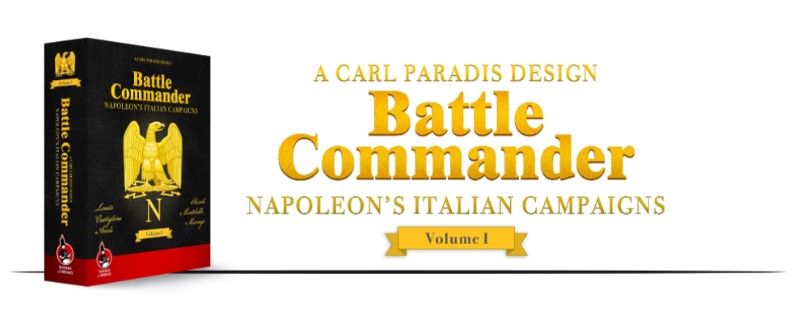
Grant: What is your latest upcoming design Battle Commander Volume I: Napoleon’s Italian Campaigns?
Carl: Oh boy, this is my real “Labor of Love” all right! I’m a Napoleonic nut, having a dedicated topic library and collection at home. I have studied the period for the last 40 years or so, and am being involved with miniature gaming since then, having painted over 10,000 miniatures. Crazy! Vive l’Empereur! 🙂
The system is at Brigade/Division scale, is very playable, with no downtime or complex computations or mechanics. I am a game component maniac, so the package will be super-deluxe, using a very large box, allowing the 2-sided mounted maps to be folded only once (think of the 70’s Avalon Hill flatboxes maps), game pieces will be painted-on wood blocks of different shapes, so no annoying stickers to apply, you’ll have a couple dozen blocks per side in a game, often less. Also, no dice, almost no markers, the emphasis is on the gameplay!
The crux of the game engine will be ( 1 ) the deck of event cards, that will also take care of all the combat results and other dice functions, and ( 2 ), the cube-pull mechanism, that will manage player unit activations, but also turn end, when combat and rally happens, and other similar game happenstances. It’s all a very granular affair. The whole package has a definite “Kriegspiel” look, with all the graphics done in a contemporary Napoleonic style, with a very different way of maneuvering units on the field of battle compared to other Napoleonic games.
Grant: What battles does the game focus on?
Carl: I plan to cover most of the interesting Battles of the period, in more-or-less chronological order. Emphasis will be on Battles that Napoleon fought in, but not exclusively. Note that if well-received, I plan to use the system to also cover other blackpowder periods, like the American Civil War and the Seven Years War.
So for Volume I, you’ll be able to play the following battles: Lonato – Castiglione – Arcole – Rivoli – Montebello – Marengo. There will also be a separate Scenario Pack with extra battles, and a crowdfunding stretch goal with yet more. Battles of the same two Italian Campaigns, like Fombio, Caldiero some pre-Rivoli skirmishes, etc. So you’ll have quite an eclectic mix of contests, some small skirmishes, some multi-day Battles, and a couple in between.
Grant: What are the hallmarks of the Battle Commander Series?
Carl: As I previously explained it’ll be a very playable system with deluxe components, extreme playability, lots of fun period chrome, no downtime, lots of action and interesting command decisions. The game system was designed to be very stable from the get-go, so the core rulebook will stay as-is for the other volumes of the series. It was all designed to be used for most “Black Powder” epochs, so expect some American Civil War and Seven-Years War volumes in the future, and possibly others. If you ask me to describe the package in one sentence: It’s a game-player focused affair, with no quality compromises.
Grant: What has been your experience working with Sound of Drums?
Carl: Oh my, it was most excellent! I could not ask for a better publisher and team of talented individuals. Uwe Walentin, the owner, understands what this hobby is all about, the Euro aspect too, as he also owns a game-distributing company in Germany. He has excellent manufacturing contacts, and is a wargame designer to boot! He’s extremely receptive, understanding and has the satisfaction of his customers as priority #1. Mark my words, this small start-up is going to shake things up. My one regret: Sounds of Drums should have been started sooner!
Grant: Why did you think they were the best publisher for this project?
Carl: Well, for the above mentioned reasons! This project started with a smallish form factor one-battle design that another editor asked me to do over four years ago. But after a while the scope of the design ballooned out of proportion and I needed a much bigger venue for what had become a large series of multi-game titles. I shopped around a lot, and almost signed contracts with a slew of publishers, but there was always some irritants and points I was not fully at ease with. So when I was approached by Sound of Drums, purely by accident, I knew I had finally found the perfect fit.
Grant: What sources did you consult to get the historical details correct? What one must read source would you recommend?
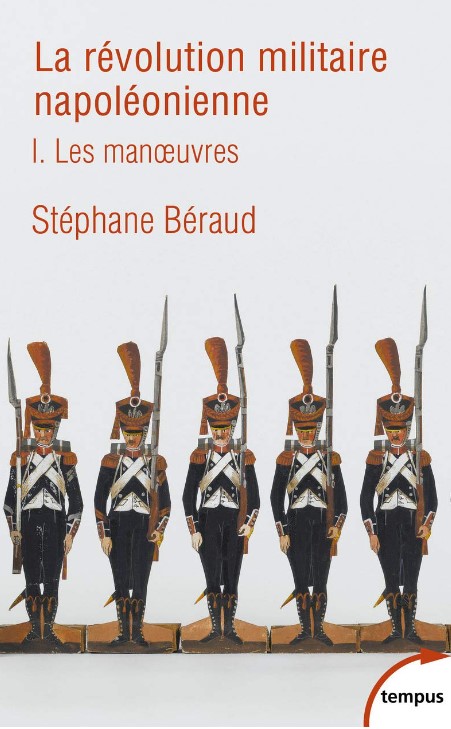
Carl: As told from the start, I’m a Napoleonic maniac and own hundreds of books on the topic, so way too many sources to list here. I also got the kind help of a number of scholars on the period, to which I am deeply indebted. My “Modus Operandi” also involves studying and comparing previous game designs of the same scale and scope; something pretty easy for me to do as I must own or have owned a majority of the notable Napoleonic systems in my 3,000+ wargame collection. One must read source? If I had just once source to recommend, it would be the new and most excellent Three book series written by Stéphane Béraud, La Révolution Militaire Napoléonienne (The Napoleonic Military Revolution). Always for msot of your readers, the series is now only published in French; albeit I’m sure it will be translated eventually, it’s that good, covers all the bases in an easy-to-read way. If you go through it all, you’ll be all set. A fourth volume is in the works. If you want an English “one-stop” look at it all, I recommend the easy-to-get Armies of the Napoleonic Wars,
an Illustrated History from Osprey Publishing. It has everything to please even a new dilettante.
Grant: What is your design goal with the game?
Carl: Let me quote here the first paragraph of the designer’s notes:
“After spending many years covering WWII Campaigns, I decided to tackle my all-time favourite military period: the Napoleonic Wars. As with my previous works, the spark was a mild disappointment with most of the designs covering this captivating epoch. So I created a new- fangled grand-tactical system to showcase my own “grognard” take of how such momentous military engagements should be represented on a gaming table, putting emphasis on dynamic gameplay and historical pageantry.”
Also, always in my mind during the design process was the goal to make this into a multi-era game series, using a common, stable and adaptable ruleset. This is why I took so darn long to come up with the first Volume of the series: I wanted to make everything as perfect as possible from the get-go.
Grant: How did you focus on command decision and maximum playability in the design? Have you succeeded?
Carl: I think I have. Heck, if not I would not be publishing this game series! Seriously, the playtester team like the game a lot, and the more they play, the more they like it. Hard to explain it all in a short and concise manner. I put in all of my 45 years of wargaming, role-playing, miniatures and Euro gaming experiences into that darn thing. And I dare to say that it’s a very realistic system, putting you in the shoes of the army’s commander, so no micro-management, only meaningful decision points.
So I built a simulation engine that depicts the correct historical battle dynamics in a way to make the gameplay as effortless as possible for the gamers. Block count was kept low, with about the same number of maneuver elements as in chess; combat resolution computations are sparse and mechanics kept simple: this allows players to focus on strategy, not wasting precious match time working as glorified accountants. Emphasis is put on the army commanders’ job of battlefield planning and maneuvering, resource management, morale and skill. YOU play the game, it does not play you!
Grant: What elements of Napoleon’s Italian Campaigns did you need to model in the design?
Carl: These two Campaigns are where Napoleon learned his trade as a master Tactician and Strategist. So the battles that showed the progressive evolution of his skills, and that of his subordinates, were chosen. Most of the large well-known ones, but also some of the smaller engagements, and those that Bonaparte lost, too; including a few nifty encounters fought by his subordinates. Note that all these battles were small by the later Napoleonic standards.
Grant: What is the scale of the game? Force structure of the units?
Carl: There are two scales in the game, of which just the smaller is used in Volume I. The “small” scale has most units at Brigade-Scale (3,000 men per block for the larger units), with 1,000 meters per map zone or less. The future ‘large” scale will use Divisional-scale blocks, with zones up to 2,000 meters. There will be some adjustments in future scenarios to cover the Larger stuff. Games are around one to two hours. As the number of game pieces is kept to a low number, I might split in parts some of the huge battles like Leipzig, which were really a series of contiguous engagements anyway, as the technology of the time did not allow for a commander’s full control of such gigantic battlefields.
Grant: I see where the description says that the player focus is on making meaningful high-level decisions. What does this mean and how does it play out in the game?
Carl: The players will manage only two levels of command, at the Army Commander level, and the step just under (Corps or Division). No monster-game minutiae here where you have to decide upon the facing and formation of every battalion or regiment, period. The system also takes care of most computations. So your “brain time” will be focused only on the fun parts, you will not be side-tracked into a multitude of needless options the main Commander had no time for. Yes there is still some chrome elements added (I love chrome) but even these can be optioned out without breaking the core game system.
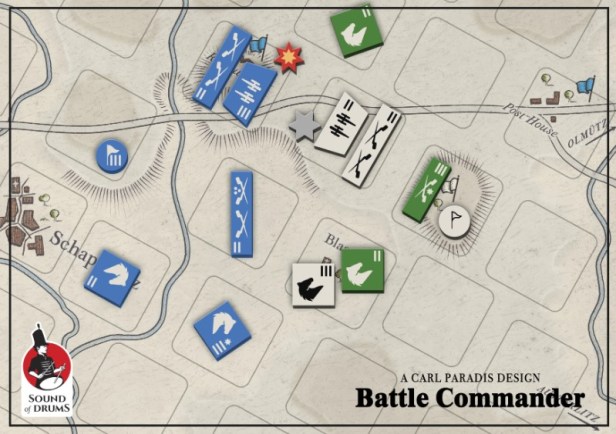
Grant: What is the general Sequence of Play?
Carl: It’s really dirt-simple:
- New Game-Turn Phase – Turn Events are checked, Order cubes & Attack tokens are prepared, new cards are drawn.
- Order Cube Draw Phase – Order cubes are pulled from a cup and acted upon.
- End of Turn Phase – Victory conditions are checked.
Ok, this is a bit disingenuous. as the order draw phase will be very intricate, that’s were all the action happens!
Grant: What is Cube-Pull Activation and how is it used to manage game phases?
Carl: This is the crux of the system. Movement, Rallies, Combat Phases, etc… In an order all decided by the Cube-Pull, BUT not fully like many other “Chit-pull” games where event the specific formation activated is randomly decided. Here, only the specific Player Phases are decided on. Let me quote the rulebook:
“Each turn starts by filling a cup with coloured “order” cubes, replenishing the attack token pools, and drawing new cards in your hand. The cubes will then be pulled one by one and acted upon, each representing a different game action. Players can also react to enemy moves by using order cubes saved in their reserve orders box. Then a Player’s side cube is pulled (French or Coalition ), they can either move a few blocks, play an event card, put the cube in reserve for use later, or do some other minor actions.
Movement is easy: the activated blocks are allowed to move to an adjacent map square (called “zones”). Blocks too far away from their headquarters will have to check for activation to perform move actions. When a yellow cube is pulled, reinforcements, rallies, and purchase of extra cubes/tokens will happen. By spending saved order cubes, players can try to rally their units so to remove shaken and disrupted statuses, or gain back army morale: A card is pulled to check if the rally is successful or not, comparing it to the skill rating of the rallying unit or army commander.
When a red cube is pulled, each player, in turn, will execute a combat using an attack token, until both pass.
When a black cube is pulled, extra card draws, voluntary retreats and turn end could happen.
There you have it. So no sure-thing in terms of activation, but more leeway than other chit-pull systems.
Grant: How does the game use cards?
Carl: Your hand of cards is your “game money”, you discard them to purchase extra cubes or tokens, or for their text events, giving you perks in combat and special actions. Card deck composition varies by scenario, with specific leader cards added-in. Speaking of cards, your Commander Card is crucial: it manages your resources (cubes, attack tokens), and how effective your army will be in battle (special abilities). The cards also replace the dice found in most games. They are pulled out to resolve all combats and morale checks.
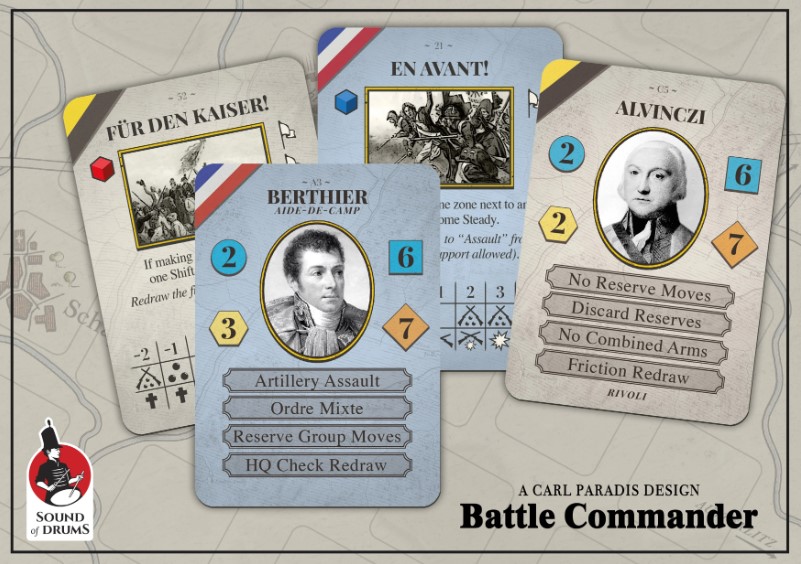
Grant: What are the different types of cards in the deck and can we see a few examples?
Carl: There are three main types. Shared (tan) cards playable for their events by anyone, French (blue) cards, playable only by the French player, and Coalition (white) cards playable by the Coalition player. Unplayable cards can still be discarded as “game money”. There are also “Play Immediately” event cards that must be acted upon when drawn.
NOTE: The pictures of these cards are from the Playtest version.
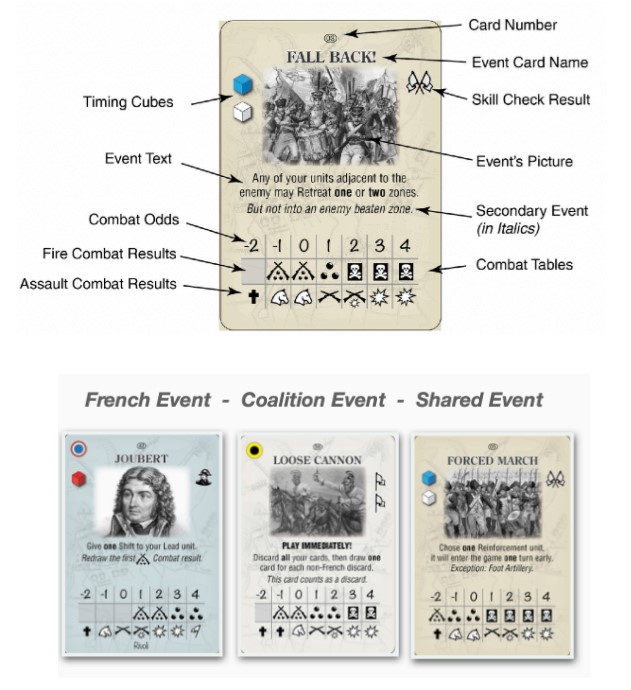
Grant: What is the function of persona cards? Can we see a few examples?
Carl: Each player has one Army Commander Card (with an Aide-de-camp on the reverse if he’s incapacitated or otherwise not present on the field of Battle). Your Commander Card is crucial: it manages your resources (cubes, attack tokens), and how effective your army will be in battle (special abilities) and the ability of your troops to follow orders.
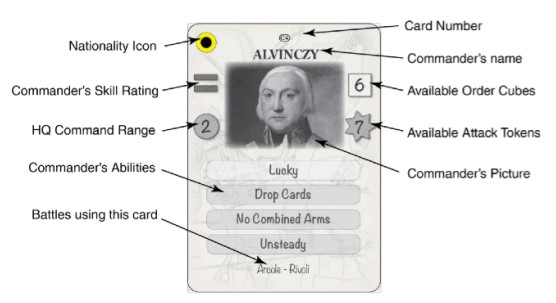
Grant: How does the combat system work?
Carl: That’s the fun part! Blocks may perform one attack per combat sequence, paying for each with an attack token. Nearby units might be allowed to give “support”, enhancing an attacker’s or defender’s fight posture. Note that cavalry units are able to move during combat.
Fight resolution is performed by comparing both sides’ strength values, drawing a card and checking one of its two printed combat tables (Fire or Assault) to determine the battle’s outcome. Before the draw, Event Cards affecting the combat can be played by both parties.
Units may become shaken or disrupted, lowering their effectiveness (shown by flipping blocks); army morale will be gained and lost (shown on the map’s morale track), retreats and advances will be made, losses will be taken. Note that the direct elimination of units happens much less often than in most similar wargames; instead, low level casualties are represented by morale losses.
Grant: How are morale and troop skill a core mechanic of the design?
Carl: These manage effortlessly both the battle degradation of the Armies’ fighting abilities, and what the troops can achieve (or not!). It demands no complex roster sheets, casualty markers, or the elimination of scores of counters. Like the real thing, most units will at first keep their cohesion, engaging reserves to keep battle lines manned, until their army’s morale starts to disintegrate; but on occasion catastrophic losses can and will happen.
Army morale also decides which side has the initiative, giving many advantages. A low morale score lowers unit effectiveness and magnify combat losses. Worse, if morale gets too low, the game might be instantly lost!
The game board will look pretty much like a Napoleonic battle map; when things go bad, you’ll literally feel the enemy pressure, your army slowly falling apart… All simulated in an easy to play format.
Grant: How is victory achieved?
Carl: The game is won by destroying/demoralizing the enemy army, owning more locations of strategic & tactical significance than the enemy, or by scenario’s special victory goals, example below:
Montebello Extra Victory Conditions
Heavy Losses: At the instant the French/Coalition Army has taken five step losses, their owner’s loses the game.
Grant: What are you most pleased about with the outcome of the design?
Carl: I have been waiting for over 20 years to finally start this Napoleonic design. I never felt I was ready and with the right ideas. Then the process happened almost by accident and it’s seeing the light of day after that many years, and with a very supportive publisher. So I guess this is what I’m the most pleased about with the design: it started “just right”, and will be THE grand-tactical “Black Powder” game I would have loved to play when I was a teen, eons ago. It was well worth the wait. 🙂
Vive l’Empereur!
Carl Paradis, Québec, Canada.
As always, thanks for your time in answering our questions Carl. The game sounds great and I really look forward to the multitude of different battles and situations to explore. I am very glad that you have found a publisher that will help you realize your true vision for the series and I hope that we, as gamers, are the ultimate beneficiaries!
If you are interested in Battle Commander Volume I: Napoleon’s Italian Campaigns, you can check out the project on the Gamefound page at the following link: https://gamefound.com/en/projects/sound-of-drums-gmbh/battle-commander-volume-i
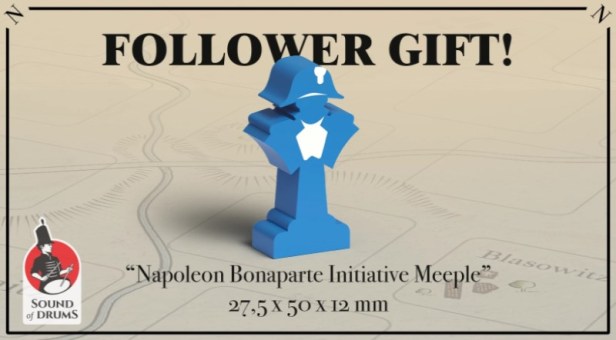
I know that if you follow the campaign early, you can get a free gift of a special Initiative piece in the shape of the Emperor himself!
-Grant
 The Players' Aid
Really looking forward to not only this game, but the follow up games in the series. Great stuff!
LikeLiked by 1 person
I am also greatly anticipating this one. I think it can really be a good little system that is crunchy yet playable and expand the offerings for Napoleonics beyond the monsters that seem to be more prevalent.
LikeLike