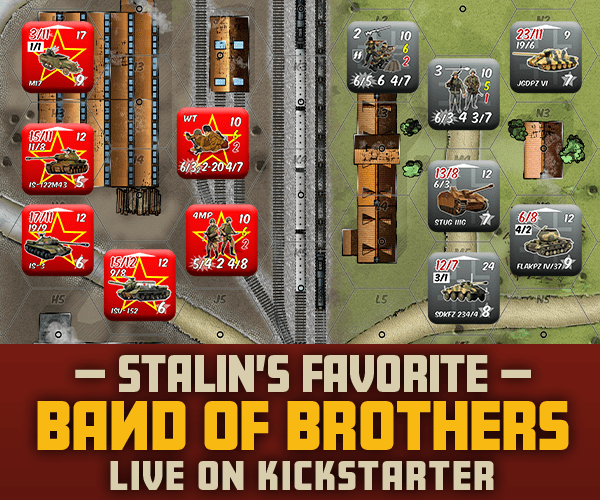
There are some series out there that people really love and enjoy playing. This love leads to the series selling well and then expanding as the market is able to continue supporting the games. Band of Brothers from Worthington Publishing is such a series. A tactical level squad based game set in World War II, the series has expanded into several different theaters and has multiple stand-alone expansions. Recently, I saw news that there would be a new volume coming to Kickstarter called Stalin’s Favorite, which is set on the East Front of WWII and includes battles from 1943-1945 and is designed by Jim Krohn. I reached out to Jim and he was more than willing to share his throughs on the design.
If you are interested in Band of Brothers: Stalin’s Favorite, you can back the project on the Kickstarter page at the following link: https://www.kickstarter.com/projects/1456271622/band-of-brothers-stalins-favorite
Grant: Jim welcome to our blog. First off please tell us a little about yourself. What’s your day job? What games are your favorites?
Jim: I started as an Electrical Engineer working in manufacturing. After progressing up that path awhile, I left the job to become a full time pastor and I have been in the ministry for over 20 years. Besides more traditional pastoral work, the switch also allows me to do other cool things like teach history, run kids camps, and start activities like family game night.
I started playing wargames with SPI’s War of the Ring in 1979 and was hooked. I have designed numerous games, including the Band of Brothers Series with Worthington Publishing, Space Empires 4X and Talon with GMT Games. All my designs have been published out of love. They are definitely different and will appeal to different people, but I enjoy playing all of them. If you will permit a tease, I think what will be my finest designs are not yet finished.
Grant: What motivated you to break into game design? What have you enjoyed most about the experience thus far?
Jim: I’ve been a gamer since I was 12 years old and I love games and game design. What I have most enjoyed is playing my designs with nice components! I would design a game, but it is not like I could replicate the component quality of a published box. It is always a good day when I get to play my games with published components.
Grant: What is your upcoming game Band of Brothers: Stalin’s Favorite about?
Jim: The end of WWII on the Eastern Front. That means the game comes with all the big baddies like the IS2 and the Tiger 2. Ghost Panzer essentially took the battles in the ETO up to Kursk. Stalin’s Favorite takes the battles from Kursk onto Berlin and the end of the war.
Grant: What does the subtitle “Stalin’s Favorite” tell us about the game and what the player can expect?
Jim: All of the games in the series focus on a specific combat unit. Ghost Panzer focused on the German 11th Panzer division, perhaps the finest division in the ETO. Stalin’s Favorite zooms in on a Soviet unit, the 2nd Guards Tank Army. “Stalin’s Favorite” was created in January 1943. In the campaign season of 1943 the unit fought in the battles at Sevsk and Kursk. This would have been hard to do 10 years ago, but I am thankful for the 2 books that have been published since then (in English!) that gave us so much information for the module.
Grant: Why was this a subject that drew your interest?
Jim: I mean….giant tanks, Jabos, Volksgrenadiers and Volkssturm, Russian engineering and submachine gun squads, Kursk, Berlin….what is not to love?
Grant: Why do you believe the Band of Brothers Series is so popular?
Jim: I would say two things:
1. “Realism” – That word is in quotes because, no, people are not shooting at you, but it is the closest representation of WWII squad tactics out there. You will deploy your troops in a spread out fashion and you will have to suppress and flank positions in order to advance. After doing the research for this series, I have a hard time playing other systems. Why am I putting all the best squads, support weapons, and leaders in the same hex? But no commander would ever do that? I can’t unsee it.
2. “Simplicity” – That word is in quotes because this is a complicated topic. However, for tactical games, it is comparatively simple and intuitive. The rules have lengthened some, but that has been driven mainly by adding terrain types and weapons. The core system is very simple. You will do all the realistic things with your troops, not because a rule requires it, but because the system rewards it. In many ways, the complexity is baked in.
Grant: Why did we need another volume?
Jim: What I love about the system is that it has proven robust. Scenarios in Screaming Eagles, Ghost Panzer, Old Breed, and Stalin’s Favorite are all of different character, for example. You have to adjust your play somewhat based on the vastly different troops, terrain, and weapons. That is how it should be and is almost a proof to me that I got some things right with the original design.
Grant: What can we expect that this volume will add to the series?
Jim: Basically, more goodness and all the end of war vehicles.
Grant: What is your design goal with the game?
Jim: Really pretty simple: To capture the flavor of the conflicts as World War II drew to a close. The fighting during this time was desperate and much more brutal, particularly on the Eastern Front. The Soviets were gaining their stride while the Germans were being defeated and pushed back. Showing the difference in unit quality and experience is also a big part of my goal.
Grant: What sources did you consult about the details of the history? What one must read source would you recommend?
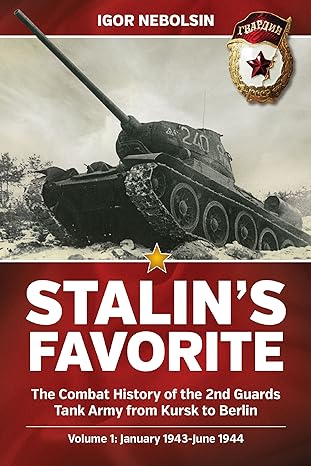
Jim: I have posted before about all the books that went into the series design. For this particular module, it was clearly Stalin’s Favorite: The Combat History of the 2nd Guards Tank Army from Kursk to Berlin: Volume 1 and 2 written by Igor Nebolsin. Frankly, this book is the definitive source on the 2nd Tank Army. Stalin’s Favorite was not an ordinary force; by 1945 it was an elite Guards formation which played a decisive role in the Soviet offensive operations of that year and whose tanks were the first to enter Berlin’s streets. The Army commander, Colonel-General Semen Bogdanov, became a Marshal of Armored Troops and was promoted to the position of Chief Commander of all armored and tank units of the USSR shortly after the war, and remained in this position until 1953. 2nd Guards Tank Army remained in Germany until 1993, a period of 48 years. It is the only Soviet Tank Army of the war that still exists today, now named 2nd Guards Army.
This study is based on the rarely available operational documents of the Army from the Central Archives of the Russian Defense Ministry and provides an analysis of every battle it fought in World War II.
Grant: What important elements from this period of WWII were important to model in the game?
Jim: Not to be repetitive, but the huge vehicles and specialized units that show up the last couple of years of the war. Including these in the game make it feel more real and representative of the time.
Grant: What is the anatomy of some of the new unit counters?
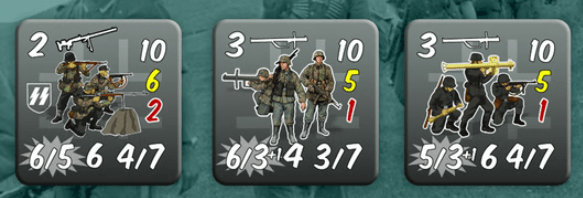
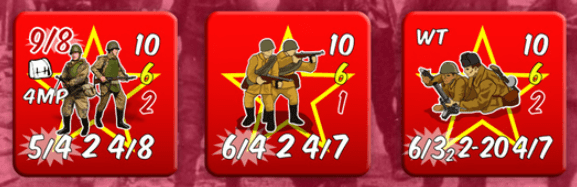
Jim: They are the same as in previous modules. Vehicles will be rated differently for Firepower against armored targets and against infantry. They will also have a Proficiency Rating which greatly impacts their effectiveness in anything but an easy shot. Infantry units have a Firepower, obviously, but have other things that represent their training, like a Casualty Rating and a lower Firepower for situations like opportunity fire and assault fire.
Grant: What type of armor units are represented?
Jim: Here is a partial list of the armor units included in the box:
StuPzIV (Brummbaer), Marder IIHetzer (JgPz38-Troublemaker), Nashorn (PzJg III/IV-Rhino), PzVIB (King Tiger), JgdPz IV, JgdPz IV/70JgdPz V (Jagdpanther), JgdPz VI (Jagdtiger), FlaKPzIV/20 (Wirbelwind), FlaKPzIV/37 (Ostwind), PSW (Sdkfz) 234/4 (Pakwagon), T34M43, SU76M, SU85, SU152, T34/85, IS-85 (JS-1), IS-122M43 (JS-2), IS-122M44 (JS-2), IS-3 (JS-3) (yes, I realize there is no definitive proof it saw combat), SU-100, ISU-122, ISU-122-2, ISU-152, SU-57 (U.S. T48 GMC) and Valentine IX (r).
Grant: For those unfamiliar with the Band of Brothers Series, how are units activated?
Jim: Each side has an operations range which allows them to activate a number of units. A typical turn has the ability to activate units pass back and forth between players many times.
Grant: How important are leaders?
Jim: They aren’t. The over emphasis of a couple of leaders per side is one of the great sins of tactical games. It is one of the things that greatly increases the tendency to clump your troops unrealistically. Small unit leadership is represented directly in each squad’s ratings. Company level leadership is represented abstractly by the use of Command Points.
Grant: How does combat work in the design?
Jim: Find, Fix, Flank, Finish. Casualties by squad fire against units in good defensive terrain are harder to come by in this game. You have to suppress the units and finish them via assaulting their positions.
Grant: How does the Suppression Mechanic work and what is this supposed to model from combat?
Jim: Each unit has different morale ratings and Suppression lowers the target’s morale temporarily. It represents that units who are taking effective fire are less likely to respond and those taking a lot of effective fire find it very difficult to respond. When the unit stops taking fire, it automatically begins to recover its morale.
Grant: How do Morale Checks work?
Jim: When you want to activate a unit, they have to take a Morale Check. Normally this is automatically successful. However, if they are currently suppressed or taking casualties their morale will be lower. You won’t know exactly how your units will respond until you try to activate them.
Grant: How does Proficiency and Casualty Ratings work in the design?
Jim: They represent training. With Vehicles, it is a little more than that. as it also represents other key things that impact performance. Does the vehicle have a 3 man turret (much better responding to threats because the commander does not have to concentrate on firing the weapon)?, does the vehicle have a radio?, etc. With Infantry, better trained units were less likely to take casualties. In some ways it represents the unit’s deployment within the hex.
Grant: How many different scenarios are included in this volume?
Jim: Stalin’s Favorite will include 16 new scenarios from 1943-1945.
Grant: What are you most pleased about with the design?
Jim: Like the modules that have preceded it, I think it captures the specific feel of the period.
Grant: What other designs are you currently working on?
Jim: With the Band of Brothers Series, I am working on a Commonwealth module! Also, I am working to finalize all of the various bits and modules for the final expansion to Space Empires 4X called All Good Things from GMT Games.
If you are interested in Band of Brothers: Stalin’s Favorite, you can back the project on the Kickstarter page at the following link: https://www.kickstarter.com/projects/1456271622/band-of-brothers-stalins-favorite
-Grant

 The Players' Aid