A few weeks ago, I came across this pretty interesting looking project from the great mind of Dana Lombardy and Lombardy Studios. This project is called Big Red One at Bloody Omaha Project and is a very interesting approach to combine a new solitaire/2-player wargame along with some great looking WWII art from a very talented artist in Keith Rocco. I reached out to Dana and he was more than willing to share with us.
If you are interested in the Big Red One at Bloody Omaha Project including 2 books, 2 posters solitaire/2-player wargame, you can back the project on the BackerKit website at the following link: https://www.backerkit.com/c/projects/lombardy-studios/bloody-omaha-big-red-one-solitaire-and-2-player-boardgame

Grant: Dana what is the focus of your company Lombardy Studios?
Dana: We mainly focus on wargames but also in several different areas including military history books, comics, posters, and magazines. You can check out our website to view our various offerings at the following link: https://lombardystudios.com/
Grant: You are quite the experienced designer. What wargames have you designed and published over the years?

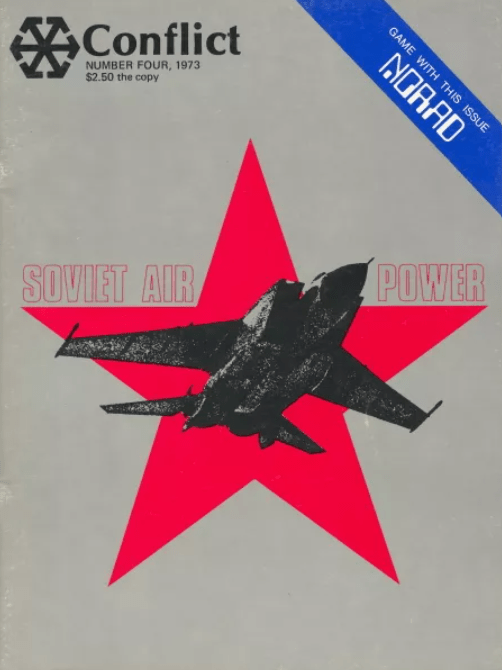
Dana: I am probably best known for the multiple award-winning Streets of Stalingrad company-level “monster” game first published in 1979 with three editions through 2002. At the other end of the spectrum is my simple, abstract nuclear war game NORAD (called “nuclear checkers” by one fan) published with Conflict Magazine #4 in 1973 – a new 3rd edition by Banzai Magazine should hopefully be out in 2024.
Khalkhin-Gol was a traditional standard size hex-and-counter wargame published in 1973 with Conflict Magazine #5 about the Soviet-Japanese conflict in 1939. I published my first professional quality design Dunkerque 1940 in 1972 and there have been about a dozen other games of my design or development published over my career. This includes four mini-games published with World War One Illustrated Magazine that I created for the nonprofit World War One Historical Association. One of those games – Russia’s Great War 1914 – won a 2019 Serious Play award in the Educational Board Game category. My latest design (2021) was a card game with Hall of Fame graphic artist Rodger MacGowan called (not surprisingly) MacGowan & Lombardy’s The Great War.

Grant: What is your new project Bloody Omaha: D-Day Amphibious Assault?
Dana: My newest wargame is a byproduct of a major art project done by the artist Keith Rocco for the Big Red One – the First Division Museum (FDM) outside of Chicago, Illinois. I published a comic, hardcover book, and poster foldout of Keith’s two murals displayed in the FDM.
Grant: Who is Keith Rocco and what art/drawings has he been known for?
Dana: Keith is a professional military artist I’ve worked with since the 1990’s. His paintings hang in many major collections including Andrew Mellon Foundation, the Pentagon, the U.S. House of Representatives, the U.S. Army War College, and Gettysburg National Park just to name a few. He specializes in American Civil War and Napoleonic Wars subjects. These two FDM murals are his first major World War II undertaking. Keith has a traveling exhibit of his art throughout this year that includes sections of Omaha Beach on D-Day with 3D miniatures (more details are available on the crowdfunding campaign page).

Grant: What is the focus of the foldout posters offered in this campaign?
Dana: Keith Rocco’s foldout shows both of his FDM D-Day murals (June 6 and June 7, 1944) back-to-back. The other poster has artwork by historian and filmmaker Michael Akkerman that shows the German defenses and soldiers at Omaha Beach (Keith’s art focuses on the Big Red One’s experience on D-Day). Michael also designed the 80th anniversary Omaha Beach decals for supporters of the crowdfunding campaign and another for playtesters who download the free print-n-play version (https://bit.ly/4bwWLHY) or printed ready-to-play game. (https://bit.ly/4aOneAz).

Grant: How are the offered books different than other books on D-Day?
Dana: The narrative throughout the books are primarily the eyewitness words of the men who were actually at D-Day. Many of these men lost their lives or were wounded in both body and spirit. Their eloquent testimonies, intermixed with Keith Rocco’s powerful illustrations, are compelling stories assembled by award-winning historical researcher and nonfiction author Gerald D. Swick. The hardcover book was a finalist for an Indie Book Award in the military category.
Grant: What is your game Bloody Omaha: D-Day Amphibious Assault?
Dana: Bloody Omaha: D-Day Amphibious Assault is a solitaire and 2-player board game that comprises multiple landing waves and drift, beach obstacles, fortified defensive positions and strongpoints, hedgerow terrain inland, large 1-inch counters representing American infantry companies (battalions in later reinforcement waves), U.S. engineers and tanks, hidden defense die-cut marker Tokens including German armored vehicles, plus playing-card-enhanced tactical opportunities and challenges. The final version will include the playtested rules and movement/engineer/combat and Random Event tables, plus a 6-sided die. (Everyone who fills out and sends in theirplaytester feedback form gets their name printed in the game credits.) An Add-on deluxe expansion has thicker die-cut counters, a larger 18-by-18-inch mounted game board map, a storage box for everything, and new illustrated battle notes with a commentary by me.
Grant: As a solitaire wargame how does the AI function to create a challenging experience?
Dana: The AI consists of placing the die-cut Hidden Defense Tokens randomly on each Strongpoint, Town, and Hedgerow square so the American player doesn’t know the strength of that square until attacking it. When the Americans move into those Strongpoints, that Token is then revealed (flipped over). Because you mix the Tokens without looking at them, every game will have a slightly different defense and therefore the game should have good replay value.
Grant: What is the makeup of the Hidden Defense Tokens? What kinds of nasty surprises do they hide?
Dana: Most of the Tokens show a numerical German defense strength for their square. The Strongpoint Tokens are usually higher numbers compared to the Encounter Tokens placed in the other squares such as Hedgerows. Other Tokens include German armored vehicles (StuG), or snipers, or mines, or Random Events requiring a die roll on the Random Events Table.
Grant: How does the game change when 2-player?
Dana: My developer, Craig Robertson, suggested a really good idea. Instead of a traditional opposing sides version (US versus German), both players are American: one activates, moves, and attacks with the 1st Infantry Division (BRO) while the other player has the 29th Infantry Division and Rangers. They compete to see who captures the most territory off the beaches.
Grant: What is the scale of the game? Force structure of the units?
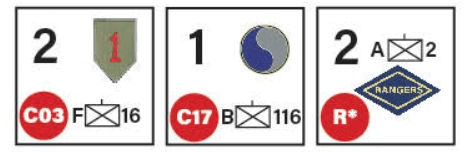
Dana: Most units are infantry companies with a few battalion-size reinforcements. US tanks are 1 or 2 strength Tokens added to the infantry.
Grant: How is the board laid out?
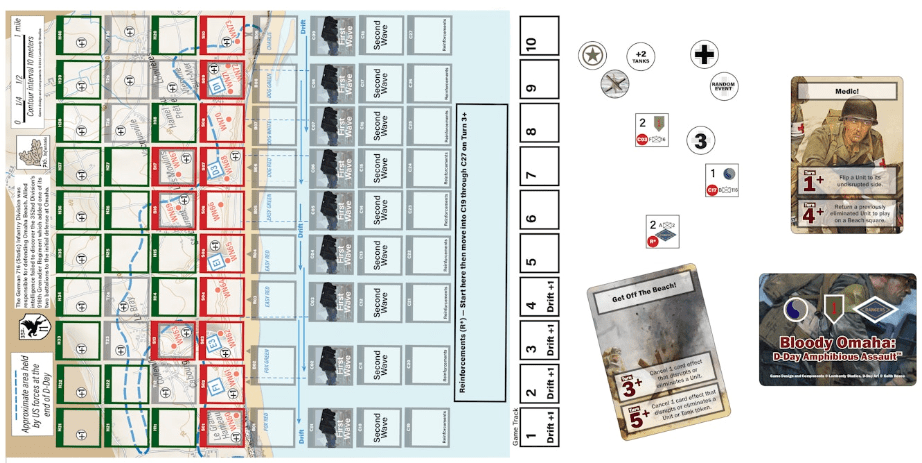
Dana: In squares (no diagonal movement). Squares fit the terrain much better than hexes which would have required distorting the terrain. Omaha Beach was straight and long and this board takes that into consideration and creates a very interesting experience as you attempt to move up the beach one space at a time.

Grant: How does the player move their units up into these boxes?
Dana: The Americans receive increasing Initiative points as the game continues. One Initiative point enables the American player to either move one of their US units, or to attack a square containing a German Strongpoint or Encounter Token, or use US Engineers to clear a beach obstacle or minefield, or flip a disrupted (reduced strength) US unit to its full-strength side, or attach a US Tank Support unit to an infantry unit, or move one Reinforcement unit to an adjacent Channel square where it may then move toward the beach squares.
Grant: How does the game use cards?
Dana: The American player first draws 3 player cards and discards one. These 2 cards are his starting hand. Each Turn thereafter the American draws one card to use that Turn or hold for a future Turn. These cards help the Americans: add initiative points; cancel a Luftwaffe air attack; remove a German defense Token that survived an attack but is still blocking a square; add a US Tank Token to a beach square; add combat points such as mortar or naval fire to an attack, etc. This is a card-enhanced game, not a card-driven design.

Grant: What different types of cards are included?
Dana: M4 Shermans, Leadership (Initiative), Medic (flip a disrupted unit to its full-strength (undisrupted) side, etc.
Grant: Can we see a few examples of these cards and have you explain their use and function?
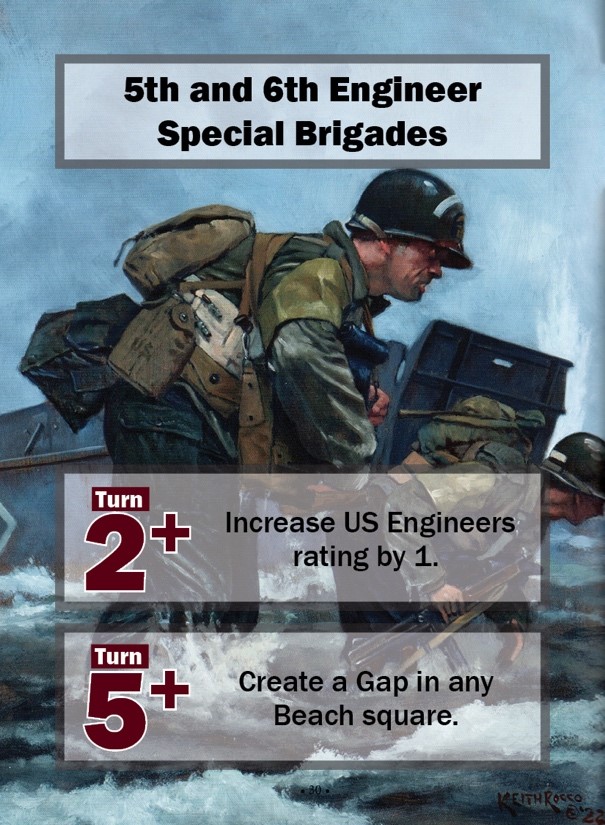
Dana: Most of the cards offer two different options depending on the current game turn, and the American player may choose one to help his assault. There are no low value cards that would simply be discarded and not used. Kudos to developer Craig Robertson for this improvement to the original cards.
Grant: What kind of experience does the game create?
Dana: The player is the American V Corps commander General Leonard T. Gerow who was responsible for the Omaha Beach landing. Unlike the other beaches that were backed by open land, Omaha had cliffs and high ground. The Germans pounded the landing area with heavy fire from mortars, field cannon, and machine guns. All of which is recreated in the game. Some sources claim that General Bradley, commander of the American 1st Army, considered calling off the attack at Omaha.

Grant: What are you most pleased about with the design?
Dana: Craig and I were able to put a lot of historical detail into the game without adding too many pages of rules (5.5 pages total of solo rules, less than 1 page of 2-player rules). The AI is very simple consisting of only the Hidden Strongpoint and Encounter Tokens but this approach works really well in creating an interesting and very challenging situation.
Playtesting will tell us if we succeeded in creating a game with 10 quick-moving Turns that plays in 60- to 90-minutes. This is the first game I have ever been able to provide a free downloadable print-n-play version. It will be interesting to see how many people take advantage of this feature (and the ready-to-play print version).
Grant: When do you feel the project will fulfill?
Dana: After the crowdfunding campaign ends on July 26th, we should be able to deliver the final playtested rules and art to the printers in late August and start shipping to backers in September.
Grant: What other games are you currently designing?
Dana: As I came up with new ideas for my old designs from the 1970’s, I added them to folders for future second (revised) editions of Khalkhin-Gol, Dunkerque 1940, and Cromwell. I am also working on a smaller format Streets of Stalingrad (regiment- and brigade-level), as well as mini games of Waterloo, Pearl Harbor, Kursk, and the Bulge.
Thanks so much for your time in answering our questions Dana and for putting such an interesting and beautiful product as this is together. I am very much looking forward to seeing more on this in the near future and definitely want to add this game to my solitaire wargame collection.
If you are interested in the Big Red One at Bloody Omaha Project including 2 books, 2 posters solitaire/2-player wargame, you can back the project on the BackerKit website at the following link: https://www.backerkit.com/c/projects/lombardy-studios/bloody-omaha-big-red-one-solitaire-and-2-player-boardgame
-Grant

 The Players' Aid