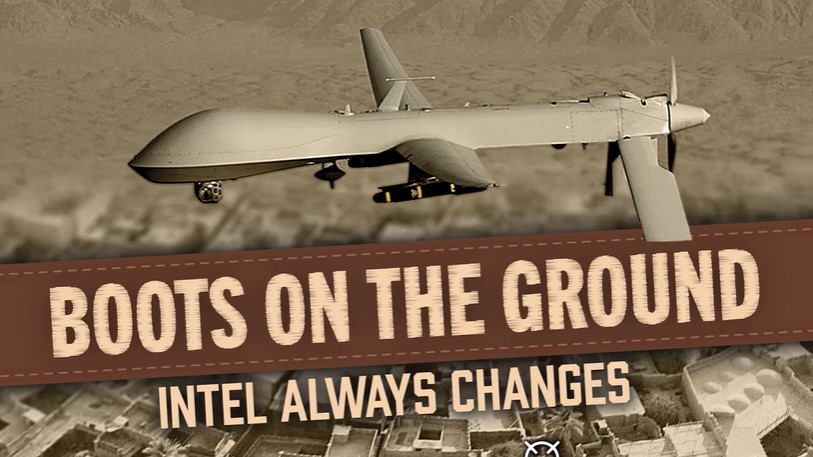
Recently, Worthington Publishing released a game on Kickstarter that is getting a Deluxe Edition treatment that looks really interesting. Originally released in 2010, Boots on the Ground Deluxe is a 1-3-player game based on modern urban warfare, which is playable in 30 to 60 minutes and has multiple scenarios to choose from. I reached out to the designer Sean Cooke, who normally does most of the graphics work on Worthington projects, and he was more than willing to give us a bit of information on the project.
If you are interested in Boots on the Ground Deluxe, you can back the project on the Kickstarter page at the following link: https://www.kickstarter.com/projects/1456271622/boots-on-the-ground-deluxe?ref=discovery_popular
Grant: First off Sean please tell us a little bit about yourself. What are your hobbies? What’s your day job?
Sean: I am a father of five with everchanging hobbies. In the past, I have taken up kayaking or woodworking. Currently, I am on a fitness kick and spend my mornings in the gym. As for my day job, I am a CRM consultant in the education and non-profit space.
Grant: What motivated you to break into game design? What have you enjoyed most about the experience thus far?
Sean: I have worked as a creative designer with Mike and Grant since the first Worthington game, Victoria Cross. Problem-solving is what attracts me to game design. My “day job” and any hobby I have taken up are about looking at what you have around you and building a solution; I see the similarities with game design. Some things are fixed, like the sides of a die or a card count. Using those fixed items to plot a course and build a fun and unique game is a great challenge.
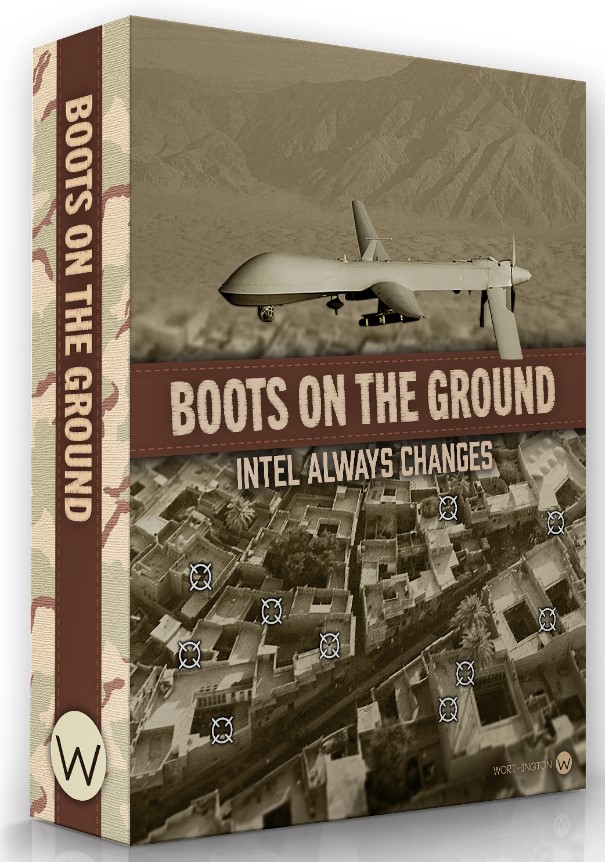
Grant: What is your upcoming game Boots on the Ground Deluxe about?
Sean: When I originally designed Boots on the Ground in 2010, the “War on Terror” was in full swing, and the news cycles constantly repeated the story of soldiers walking house to house searching for insurgents and terrorists. They stood out as apparent outsiders, and danger was always around the corner. I was intrigued by the unknown threat and how the enemy was not clearly uniformed, like Green vs. Gray. The game tries to replicate this everchanging battlefield.
Grant: What does the subtitle “Intel Always Changes” say about the game and what the player can expect?
Sean: The game sets you off on a sometimes simple mission like “go from one green zone to another” or sometimes more involved like a rescue of a wounded team member. In any scenario, the initial information you receive is where some hostiles are at that very moment in time, but with each movement, the landscape changes, and new enemies can appear in a 360° area. Many games only move linearly, as once I move through a space, I can treat that as safe and not have to worry about it. Boots on the Ground, however, puts you in constant danger until the mission is completed.
Grant: Why was this a subject that drew your interest?
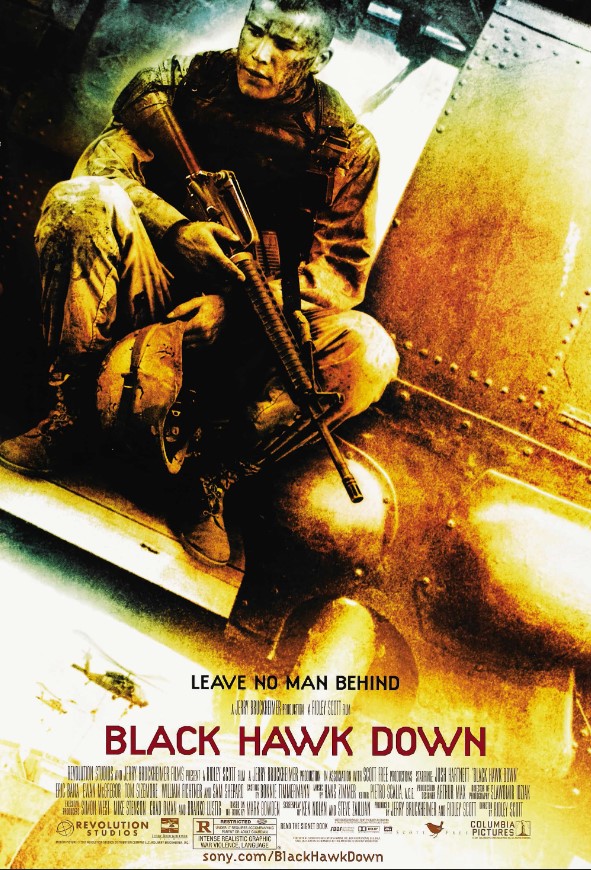
Sean: I love war movies, and Black Hawk Down from 2002 has a special place in my memories. That and the politics of the day drew me towards this game. This is a subject that truly is interesting and I was really interested in how a game co0uld simulate the changes in an environment and more mimic the real world situation.
Grant: What is your overall design goal with the game?
Sean: I wanted a quick, intense, solo or co-op game that could make your heart race and give you a sense of danger. And also give you a reason to fist-bump your buddy after you and the team return to the green zone after a successful mission.
Grant: What role does the player take in their team?
Sean: You are the team leader; you tell your units where to go and what to do. With the updated game variations, you can build your team with various combinations of team members (and even some non-specialists).
Grant: What types of soldiers does each team consist of?
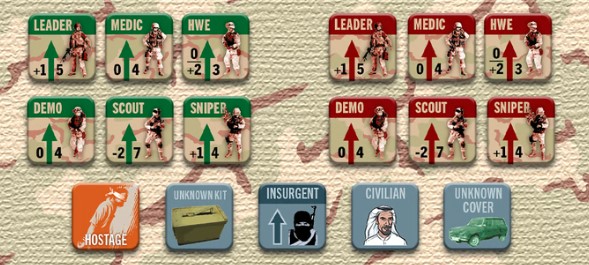
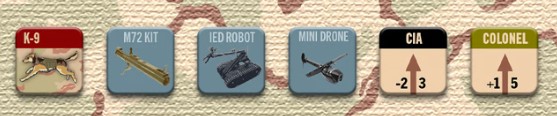
Sean: The primary team comprises a Leader, Sniper, Scout, Medic, Heavy Weapons (HWE), and Demolition Expert (Demo). The player can also choose specific special assets to assist with the mission such as trained K-9’s, drones, and a new assortment of gear.

Grant: What type of abilities, skills and benefits does each team member provide?
Sean: As a team (2 or more members moving together), they fire better and move at a constant rate. Separate, each can do something different. For example, the Demo unit can blow holes in walls and “make a door” anywhere needed. As for the Scout, that unit can move faster than any other unit and identify enemy units’ locations to give the team a firing advantage. Each of the units will bring a different ability and skill to the game and it is important for the player to know how best to use each of these assets.
Grant: What is the anatomy of the games counters?
Sean: All counters have a facing arrow for better or worse firing advantages. All combat is simultaneous, and the facing arrow combination dictates the reaction fire. For example, if an enemy engages a team member face-to-face, there is a slim chance it will work out in their favor, but if they attack that unit’s six, the team unit has less opportunity to react. As for the team units, each has a movement value and a fire DRM modifier. Plus the team members have a flipped side t denote a hit.
Grant: What type of player counts are available and how do they each present different challenges?
Sean: The three main types of play are Solo, Co-op, and competitive, each with the cards driving the insurgents. In Solo mode, you move your team, and then a card draw tells you how many insurgents move or appear. You place and move them, and then your team reacts. In the Co-op and competitive version, you place and move the insurgents against the other player’s team. My favorite way to play is Co-op and create a “hammer and anvil” scenario where our teams work together to provide security and fire superiority to control the board.
Grant: How are cards used to dictate the insurgent’s reactions?
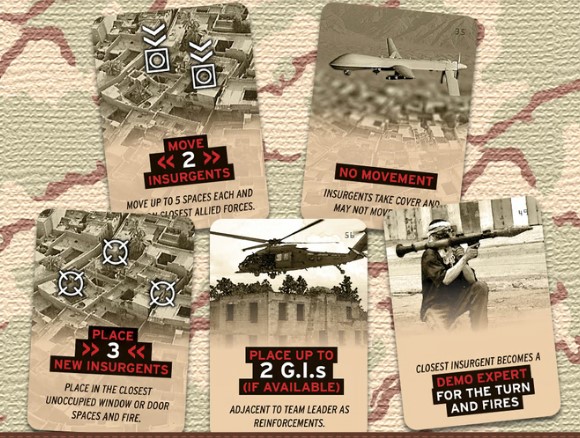
Sean: Cards typically say things like “closest 3 insurgents move 1 space” or “add 2 insurgents”. Either way, the insurgents will fire whenever a team unit is in their view. The combat is simultaneous, and the double die roll, plus the firing angle, will allow the team unit to have a responsive fire. The overriding theme with cards is “danger-close,” and the cards push the enemy to constantly engage your team.
Grant: What is the layout of the game board?
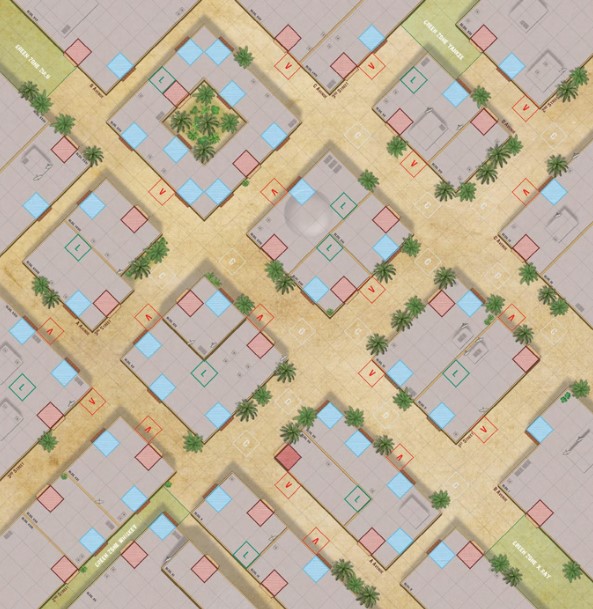
Sean: It represents a bird’s-eye view of a local town. Civilians are mixed in with the insurgents, and your team must move in the grid system to complete the mission.
Grant: What are the purpose of the different colored boxes and symbols on the board?
Sean: The boxes allow for easy vehicle setups and lockboxes (supply dumps that can be accessed by team members). It also includes the locations where insurgents start and can appear later in the game.

Grant: What new additions have been added to the game since its original release?
Sean: We adjusted the rules for all the concerns we could find. Updated the board and card’s look and style. But the cool stuff is what we added. First, as a dog person, we added tactical K-9’s, they help clear buildings. Plus, we added a game mode called “Mystery Date,” where you randomly pick a unit member to tag along with your mission. This may be a Mercenary that can help your team find scout and demo skills, or it may be a VIP like a movie star studying for a role and cannot fire and has to have a chaperone everywhere they go.
Grant: What type of different scenarios are included?
Sean: There are a total of 12 different scenarios included in the game. Between the 12 scenarios, there are A to B movement, rescue, target elimination, and hostage missions. We tried to give a good variety while covering some of the major aspects of operations on this level.

Grant: How is victory achieved?
Sean: Each mission has a set goal and a limited number of cards based on the number of players needed to complete it. The goals must be accomplished in the allotted time.
Grant: What type of an experience does the game create?
Sean: A quick, high-pressure, dynamic experience. Your heart should be pumping in some firefights as your team takes cover while hoping your demo unit can diffuse the IED.
Grant: What are you most pleased about with the outcome of the design?
Sean: I like the low die-roll-to-action ratio. The plan was not to create a chess-like experience where the battle commander can wait indefinitely to make a move or counter; it is meant to be instant and messy. This keeps the game intense and adds some pressure which mimics the real world situation. Each turn should be a new encounter as you push through the streets to complete your mission.
Grant: What other designs are you currently working on?
Sean: As a team here at Worthington, we are producing many new games, and each of us has our own projects that get worked into the lineup. As for me, I have a more family-friendly game in Wings, and I am looking into a game inspired by the Corsair Black Sheep Squadron of WWII.
Thanks for your time in answering our questions Sean. I know that once this project was announced, as I was doing my research on the game, I saw where people felt the game was a good design but had some issues. I am glad that you are addressing these concerns and also upgrading the components. This one definitely has my attention and I am very much interested in the game, especially as a solitaire game.
If you are interested in Boots on the Ground Deluxe, you can back the project on the Kickstarter page at the following link: https://www.kickstarter.com/projects/1456271622/boots-on-the-ground-deluxe?ref=discovery_popular
-Grant
 The Players' Aid