
I have really enjoyed my plays of several solitaire games designed by R. Ben Madison. He has a knack for including elements of the history into the gameplay while placing the events into the framework of his chosen system, which is usually the States of Siege Series…but not necessarily always. His newest offering is called Gift of the Nile: The Rise & Fall of Ancient Egypt from White Dog Games and is a solitaire only game that uses the States of Siege Series System and delves into Ancient Egypt and the rule of the Pharaohs covering over 30 dynasties starting with the Old Kingdom in 2600 BC to the Late Period starting in 700 BC and ending with the intervention of Rome. This is a long and involved game (ranging from 36 turns to something less based on certain conditions happening or a player loss) that really gives the player a good feel for the might and power of the Egyptians, as well as the various threats and enemies they had to deal with to survive for nearly 3,000 years.
In Action Point 1, we looked at the Game Map (board), which shows the various “Paths” used by the assaulting outside Khasti Kingdoms converging on the capital city of Men-Nefer. In Action Point 2, we investigated the purpose and makeup of the 3 different draw cups, which is where the game action starts including the Dynasty Cup, God Cup and Sepat Cup. In Action Point 3, we took a look at the Nile Phase and further discussed the economy of the game. In this Action Point, we will dive into the 4 different Eras or Kingdoms that the player must traverse through safely to come out on top and some of their unique aspects.
The 4 Eras or Kingdoms
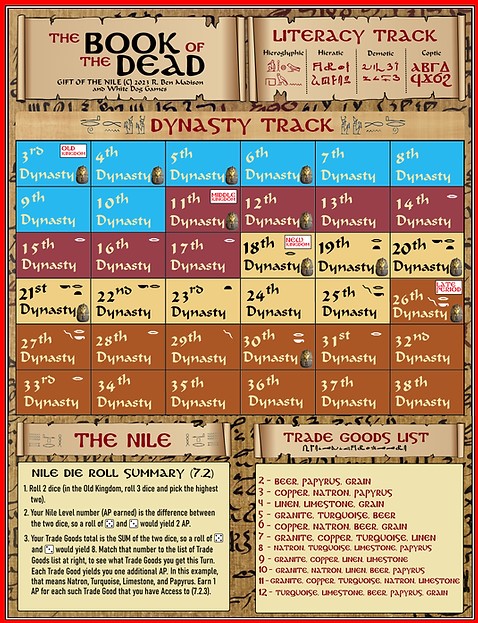
The game is divided into 4 distinct and different Eras or Kingdoms that cover the ancient history of Egypt from around 2,600 BC to approximately 330 BC. These Eras include the Old Kingdom, the Middle Kingdom, the New Kingdom and the Late Period. These 4 Eras are all shown on The Book of the Dead, which functions as the Turn Track and these Eras are further divided into Dynastic Periods covering approximately 75 years of history that represent 1 Game Turn. These start with the 3rd Dynasty in Turn 1 and end with the 38th Dynasty in Turn 36. These 4 Eras are very different, with the Old Kingdom being very different functionally, and the remaining 3 Eras having a different historical focus as new events and peoples come and go to assault Egypt. Let’s take a bit of a look into each of the Eras.
Old Kingdom
The Old Kingdom is where the game starts off and finds Egypt relegated to control of only their capital city of Men-Nefer at the center of the Game Map. The Old Kingdom covers the period of Egypt’s initial phase of growth and expansion and encompasses roughly 2680-2055 BC. The period is denoted on The Book of the Dead as the blue colored boxes representing the 3rd Dynasty through the 10th Dynasty. During this Era, the Sepats found on the Game Map are hostile toward Egypt and are independent kingdoms who will resist being incorporated under the Pharaohs. This means that the player must rally their troops, move out from Men-Nefer and conquer these independents to gain their riches and trade goods and grow the fledgling Egyptian economy and spread their influence.
One of the best parts about the Old Kingdom Era is that you can discover new Sepats as you expand out onto the Paths. At the start of the game, the player only controls Men-Nefer and their territory is adjacent to all 5 of the Paths and the first Country Boxes located on them. These include Per-Bastet, Iunu, Per-Medjed, Payom Lakes and Khem. At setup, the player will randomly draw 1 Sepat from the Sepat Cup and place them in these 5 Country Boxes with their Untempled Sides faceup. These are the known lands surrounding Men-Nefer and the player can see the Trade Goods that the specific visible Sepats provide. Once they move into and conquer these Sepats and incorporate them into their fledgling empire, the player will once again “scout” ahead on the Path and draw a random Sepat from the Sepat Cup and place it in the next adjacent Country Box. But if that Country Box is a desert, identified by the dunes picture, no Sepat will be placed. This gives the player an idea of what Trade Goods are available as they expand outward on the Paths and they can begin to plan what they need to conquer in order to increase their economy and Action Point haul during the Nile Phase.

During the Old Kingdom Era, the player will have access to special troops called Medjai Troops, which consist of mercenaries from surrounding areas all paid for by the Egyptians to exert their influence. These Medjai Troops are not free, as no self respecting mercenary is, and the player will have to spend their Action Points to acquire more of these troops and to move them out on the various tracks to conquer the Sepats. The Build Medjai Troops Action costs 1 Action Point and allows the player to place a new Medjai Troop Counter from the Counter Tray out on the Game Map in the city of Men-Nefer. The player will have to spend Action Points to purchase all 5 of the available Medjair Troops but do so when they are ready to but only 1 Medjai Troop Counter can be on any given Path at a time.
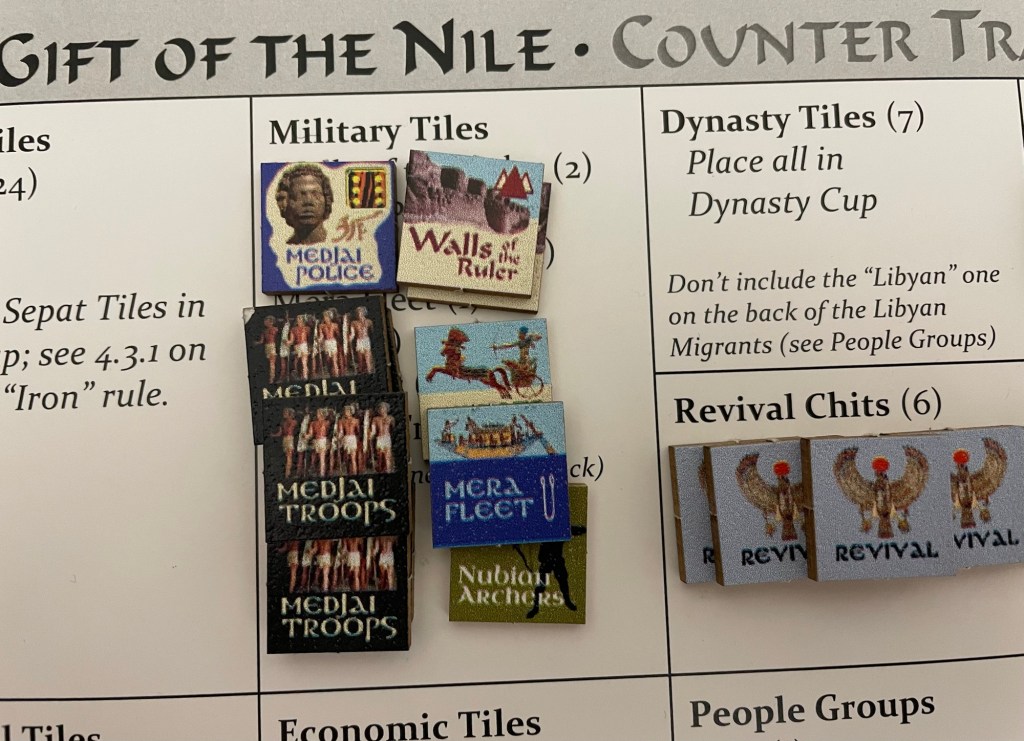
After acquiring the Medjai Troops, the player can then spend an Action Point to take the Medjai Troops Advance Action to move that Troop Counter out onto one of the 5 Paths. As they advance into a Country Box that contains a Sepat, as part of the Medjai Troops Advance Action they can attack the independent Sepat. This is done with the player rolling 2D6 and attempting to roll a number higher than the printed Value on the Sepat ranging from 1-4. This Value can be modified by events such as the Rise or Decline that was discussed from the God Phase. If the roll is greater than the modified Value on the Sepat, the player simply places that Medjai Troop on top of the Sepat to denote that it is now controlled by Egypt. If the result is less than or equal to the modified Value, the Medjai Troop will have to retreat to the Country Box that they came from and will have to spend an additional Action Point later to attempt another Advance and attack Action.

This can be a slow and plodding process as early in the Era the player will not have enough Action Points to purchase new mercenaries and also send those they have retained out to conquer Sepats. As the player gains control of new Sepats, they will gain more and more Action Points during the Nile Phase as they accumulate Trade Goods for the 2nd part of the economy as mentioned in Action Point 3. This is the time to shine for the Egyptians as they simply have to expand. Remember that during this Era, there are no Khasti Armies located on the Paths and therefore no threat to the Egyptian capital city of Men-Nefer. It is time to “make hay while the sun shines” and get out on each Path to take in as many different Sepats as you can in the span of the first Era, which lasts just 8 turns.
Middle Kingdom
The Middle Kingdom was a period where the Egyptians really focused on and developed their religious ideas. They also became much more democratic in their governance and the people finally were given hope that they could also enjoy an afterlife. The age was also characterized by a focus on literacy and learning. This is one of the more interesting parts of the game as the player can use their limited Action Points to take the Advance Literacy Action to develop literacy from the starting Hieroglyphic to Hieratic then Demotic to Coptic. Each of these levels allow the use of additional Actions such as Invading a Country or Buying Ma’at Tiles. These are two very important aspects of the game as Invading a Country allows the player to hold back the advance of the Khasti Army whose country they have invaded and forces them to deal with the internal strife first and the Ma’at Tiles can be used to undermine a Rival Dynasty, to Temple Sepats and to block Revolts. These Actions are very important and I like to think of their connection to literacy as being investment into language and literacy that has allowed the Egyptian ambassadors and spy networks to work behind the scenes in these distant lands to better learn and understand their weaknesses and how to exploit them allowing for this type of conquest and blocking of Revolts. Without the player having invested the costly 5 Action Points to increase their Literacy for each of the three steps (Hieratic, Demotic and Coptic), they would be unable to take these important Actions. What I found through the game was that I was forced to really think about my overall goal first, before even having to think about the more immediate and pressing matters such as Khasti forces on the doorstep of Men-Nefer or even protecting your cash cow in the gold fields of Nubia.

The Middle Kingdom covers the period of roughly 2055-1550 BC and the period is denoted on The Book of the Dead as the darker red or maroon colored boxes representing the 11th Dynasty through the 17th Dynasty. At this point of the game, the hostile Khasti Armies will appear on the borders of your kingdom limits and will begin to be activated by events found on the Chronicle of Manetho. The Khasti Armies will be activated and then commence attacking your claimed Sepats. If they are successful in their attack, they will move into those Country Boxes where your Sepats were located and will wrest control away from you. When a Khasti Army marker ends the turn still located in your former Sepat, or in a Country Box behind where they are located with your former controlled Sepats behind their marker, they will wreak havoc and begin the process of dismantling your work as the Sepat will be degraded. Degrading a Sepat means that if it was Templed, it will now be flipped back to its lesser Untempled side and if it is already on the Untempled side, the Sepat will be removed at the end of the turn. This process will continue throughout the remainder of the game and will be a continual struggle to keep your kingdom together.
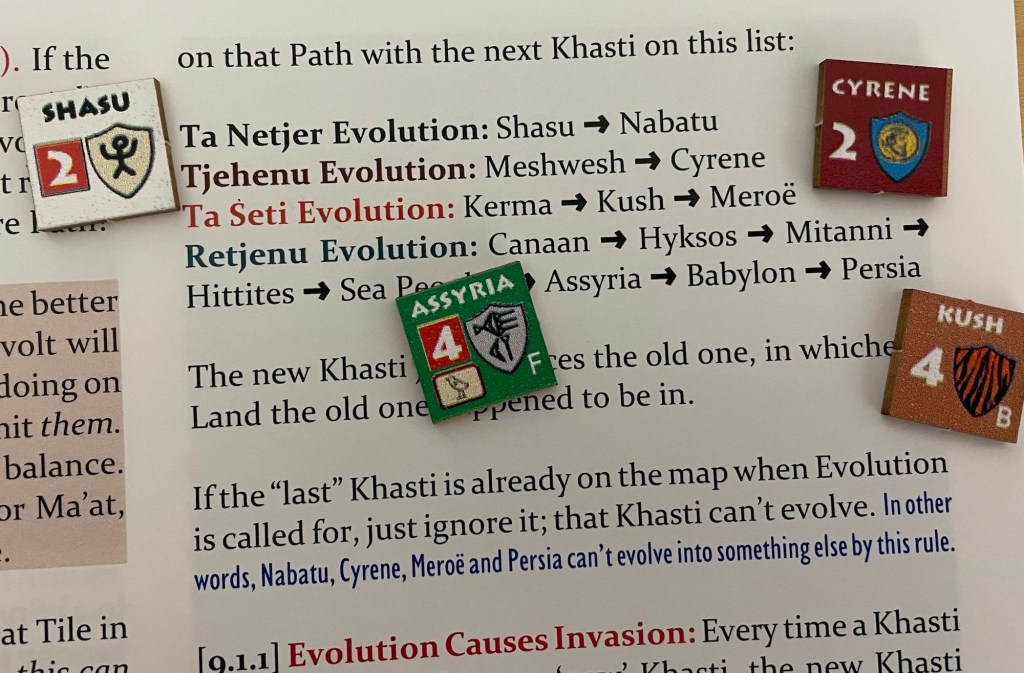
The other new part that now enters the game is the Khasti Evolution Phase. If the current Dynasty is in a Book of the Dead Dynasty Box that has a Path Symbol printed in the upper right hand corner, the player will roll a D6. One a result of 1-3, nothing will happen but if the result is a 4-6 then the Khasti Army on that Path will now Evolve into a new version or threat. This evolution has 2 steps. First off, the player will consult the the rulebook that has a handy chart that shows each of the Khasti Armies and what they will evolve into.
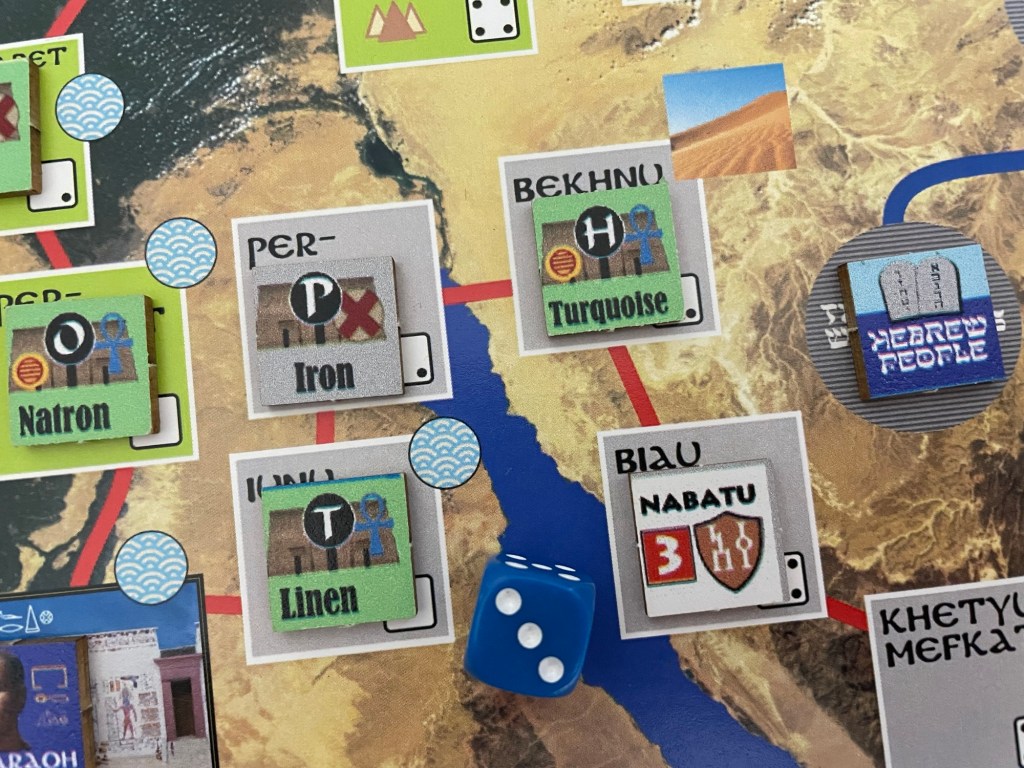
For example, if the evolution takes place on the Ta Netjer Path and the current Khasti Army is the Shasu, they will then evolve into the Nabatu. The player will find the correct marker and replace it on the board in the same space it was before. If the evolution already occurred and the Nabatu are the current Khasti Army, then there will be no evolution. Pretty simple. Sometimes this change is a good thing as the new Khasti Army might be weaker but sometimes it is also a bad thing as it may become more powerful with a higher value that will be more difficult to defeat in combat.
But this evolution also has another effect as that evolving army will now activate and move on the players kingdom. This is kind of a double whammy and the player will have to pray that the dice favor them as too many evolutions and too many subsequent attacks will spell doom. I will say this. This is a part of the game that I have pretty much played incorrectly in each of my plays. I have been hard on myself and was not even rolling to see if the Khasti Army would evolve but was thinking it was an automatic thing. Yikes! I really made the game harder on myself. But it really made it challenging and that is what I want from a solitaire game.
New Kingdom
The New Kingdom represents Egypt at is highest imperial power and covers the period from 1550-664 BC. The period is denoted on The Book of the Dead as the tan colored boxes representing the 18th Dynasty through the 25th Dynasty. The same thing continues to occur with the Khasti Evolutions and Activations found on the Turn Track but there are a few new things that the player now has access to in order to keep the wolves at bay.
The first of these new tricks available during the New Kingdom Era is the concept of royal marriages in order to shore up relationships and treaties with surrounding kingdoms. Marriage is where the player can place the Marriage Tile onto any Path and pay 2 Action Points to force a peace on the Path by marrying into the royal family of that kingdom. The Marriage Tile is placed into the Country Box of the Path, i.e. the end of the Path, and it can block future movements by that Khasti Army. If a Khasti Army on a Path that has a Marriage Tile placed in its Country Box is activated, the player can instead pay any number of Action Points and Gold to attempt to stop that advance. The player will spend these AP and Gold and then roll a D6. If the result is less than or equal to the number of AP/Gold spent for this aspect, then the Khasti move is stopped. So, if you spend 3 AP and then roll a 1-3, the movement will be stopped. This is extremely expensive but can make the difference in life or death. In my opinion, I would rather wait until the Khasti Army is threatening a really important Sepat due to what Trade Good it is providing or if they are approaching Men-Nefer to use this option. It is more efficient to simply spend Action Points to Attack the Khasti Armey during your Action Phase. But, I really appreciate the fact that this is an option for the player and attempts to incorporate this ages old practice of marriage covenants.

The next new option available to the player is to build the Mera Fleet unit. If you remember, there are a few units that the player can build that will aid in the defense of Egypt in both the Nubian Archers and the Mera Fleet. The Nubian Archers are available much earlier in the game and are very critical to a good defense. But the Mera Fleet can only be built after the 18th Dynasty, which is the start of the New Kingdom Era. The player will have to pay 4 Gold, which is very expensive, but once built then the unit can be used and once used will become available again at the start of each new Dynasty. The Mera Fleet can also be built more cost effectively if the player controls the Sharuhen Land Box on the Retjenu Path. This space is marked with a tree icon and represents the valuable timber resources present in this area to build such grand navies and is very nice to have if you plan to be able to build this unit. See at this point in the game, Gold will be scarce and you will have had to be either smart about how you spent those resources or lucky or even both.
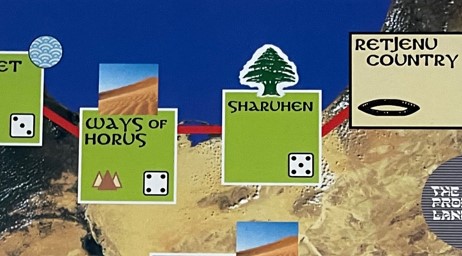
The Mera Fleet has some limitations though as it may only be placed into a Land Box that has a Nile Icon. Some of the Land Boxes have a blight blue circular icon in the upper right hand corner of the box. This is the Nile Icon and represents the Nile River and shows that this Land Box is on the banks of the river itself. This is only used in the game to denote this as a Nile River space for the use of the Mera Fleet Hero.

Late Period
Finally, we have made it to the Late Period and things really get crazy here as the game is drawing to a conclusion. The Late Period covers from 664 BC to 1 AD. The period is denoted on The Book of the Dead as the copper colored boxes representing the 26th Dynasty through the 38th Dynasty. This is the longest period with a total of 13 Dynasties but the game can end as early as the 34th Dynasty depending on the die rolls during the Chronicles of Manetho events. This is due to the continual decline and attacks on the culture and lands of the Egyptian Empires and having been subjected to rule by several other major civilizations such as the Assyrians, Babylonians, Persians and then finally the Greeks (Alexander) and Rome.
One thing that is unique is that if the player chose to use the Late Period Iron Optional Rule, if they control and have a Templed Sepat of the lone Iron Trade Good, they will gain a +1 DRM in all battles fought from the start of the Late Period. This is a god send at this stage of the game as your enemies are all around you and will literally be at your doorstep. Gaining that +1 DRM to attacks is really key and will make a huge difference but it is really hard to keep this Iron Trade Good Templed depending on where it has been placed randomly when drawn from the Sepat Cup.
Another very unique aspect that can happen now is the arrival of Alexander the Great and his Ptolemaic Dynasty. If the Alexander event is rolled during the Chronicles of Manetho Phase, the game will change for the remaining Dynasties.
The current Dynasty is taken over by the Greeks and this will start a new era where inbreeding causes difficulty in ruling and containing infighting. The Alexandria Tile will be placed in the A Box on the north end of the map. This represents that the trading city of Alexandria has been built and that the player will now always receive a bonus of 1 Action Point. But this is somewhat counteracted as the player will have to identify amount of Land Boxes they control on any of the Paths. This number will be where the player will now place the Inbreeding Tile and this is now the maximum amount of Action Points the player can earn in the Nile Phase. The bonus previously mentioned for the Alexandria Tile will not be gained if it would make the AP’s higher than the space where the Inbreeding Tile is placed. This is a very important consideration that the player must keep in mind and should prepare for this inevitability by making sure they have between 3-4 Controlled Land Boxes on each Path. Easier said than done I can assure you but it must be a focus.

Don’t worry though. If you are running low on Action Points you have some options to rectify that. Not good options but options nonetheless. You can start looting your Megaprojects which will give you a D6 roll worth of Action Points (1-6) but will reduce their Survival Point value at the end of the game from 5SP to just 2SP. You can also use the Greek Mercenaries Tile and plunder them. You have to spend an Action Point and roll a D6. On a roll of 1-2 nothing will happen but you can gain 3-6AP based on the rolls of 3-6. Good luck!

Finally you can borrow from Rome itself as they have a great interest in Egypt and getting their foot in the door. You can take as many AP from Rome as you wish but at the end of the game Rome will come to be paid back and they will attack you as many times as you have outstanding debt. If zero they will not attack but it can be as high as 7-9 and you will have to withstand that many attacks to survive. Yeah right! It’s not going to happen.
One of the strengths of this game is how it all works together historically to tell a story similar to the actual outcome. You have lots of options at your fingertips and can really do quite well by managing all of the different aspects. Planning in this game is vital but also knowing what options you have and also how those options can help or harm you is important. I hope you have a better idea now of the structure of the different Eras and how the game changes over time.
In Action Point 5, we will take a look at the various Actions that players can take during the Actions Phase and why they are important.
-Grant
 The Players' Aid
Thank you for another great AP. I am fairly new to the world of wargaming (Got those games last year for solo gaming: D-Day at Tarawa, Fields of Fire, Skies above Britain and most recently Atlantic Chase).
This ggame absolutely peaked my interest as it has both a great theme and a tense gameplay. I am looking forward to AP 5 and maybe I will get my hands on it soon.
Keep up your awesome work, I follow your reports on a regular basis and already found some great and interesting games (Comancheria is my number 1 on my “want to have” – list but nearly impossible to get here in Germany. Hoping for the reprint to be available anytime in the future.
LikeLiked by 1 person